Thank you for visiting SNEWPapers!
Sign up free
Story
January 29, 1802
The Kentucky Gazette
Lexington, Fayette County, Kentucky
What is this article about?
On January 8, 1802, in the US Senate, Mr. Breckenridge argues for repealing the Judiciary Act establishing additional federal courts and judges, citing decreasing caseloads, unnecessary expense, and Congress's constitutional power to abolish them. Others speak for and against.
Clipping
OCR Quality
98%
Excellent
Full Text
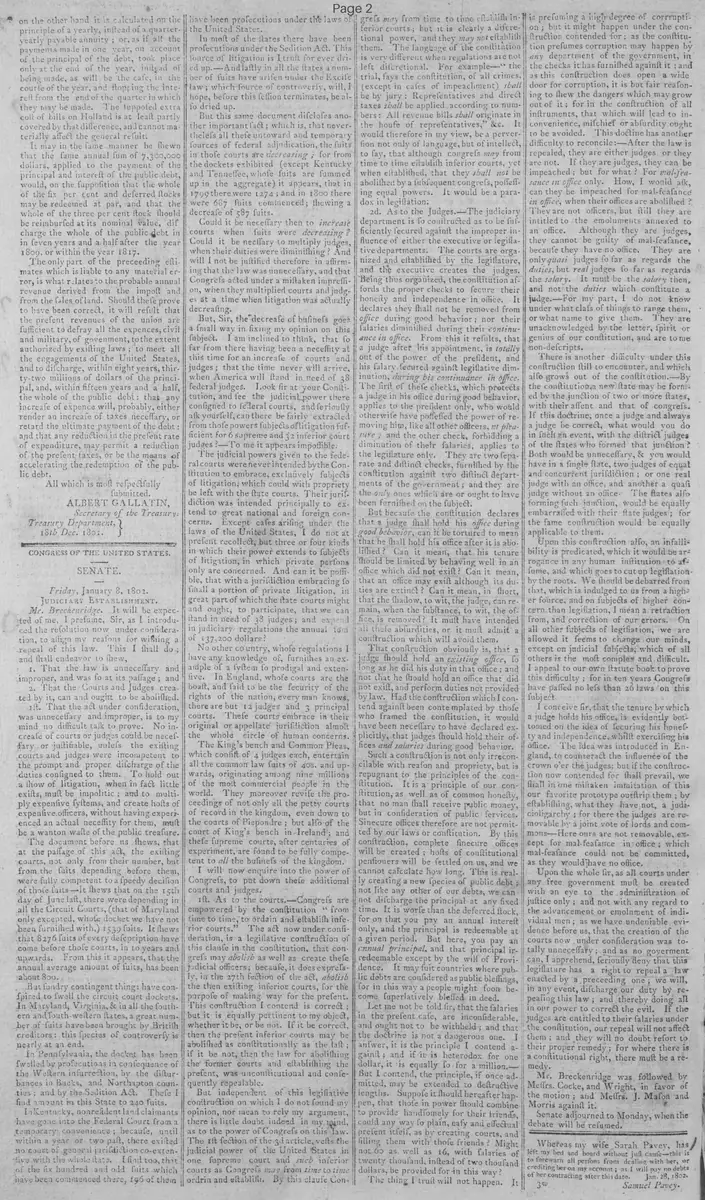
CONGRESS OF THE UNITED STATES.
SENATE.
Friday, January 8, 1802.
JUDICIARY ESTABLISHMENT.
Mr. Breckenridge. It will be expected of me, I presume, Sir, as I introduced the resolution now under consideration, to assign my reasons for wishing a repeal of this law. This I shall do; and shall endeavor to show,
I. That the law is unnecessary and improper, and was so at its passage; and
2. That the Courts and Judges created by it, can and ought to be abolished.
1st. That the act under consideration was unnecessary and improper, is to my mind no difficult task to prove. No increase of courts or judges could be necessary or justifiable, unless the existing courts and judges were incompetent to the prompt and proper discharge of the duties consigned to them. To hold out a show of litigation, when in fact little exists, must be impolitic; and to multiply expensive systems, and create hosts of expensive officers, without having experienced an actual necessity for them, must be a wanton waste of the public treasure.
The document before us shows, that at the passage of this act, the existing courts, not only from their number, but from the suits depending before them, were fully competent to a speedy decision of those suits—It shows that on the 15th day of June last, there were depending in all the Circuit Courts, (that of Maryland only excepted, whose docket we have not been furnished with,) 1539 suits. It shows that 8276 suits of every description have come before those courts, in 10 years and upwards. From this it appears, that the annual average amount of suits, has been about 800.
But sundry contingent things have conspired to swell the circuit court dockets. In Maryland, Virginia, & in all the southern and south-western states, a great number of suits have been brought by British creditors: this species of controversy is nearly at an end.
In Pennsylvania, the docket has been swelled by prosecutions in consequence of the Western insurrection, by the disturbances in Bucks, and Northampton counties; and by the Sedition Act. These I find amount in this State to 240 suits.
In Kentucky, nonresident land claimants have gone into the Federal Court from a temporary convenience; because, until within a year or two past, there existed no court of general jurisdiction co-extensive with the whole state. I find too, that of the six hundred and odd suits which have been commenced there, 196 of them have been prosecutions under the laws of the United States.
In most of the states there have been prosecutions under the Sedition Act. This source of litigation is I trust for ever dried up.--And lastly in all the states a number of suits have arisen under the Excise law; which source of controversy, will, I hope, before this session terminates, be also dried up.
But this same document discloses another important fact; which is, that nevertheless all these untoward and temporary sources of federal adjudication, the suits in those courts are decreasing: for from the dockets exhibited (except Kentucky and Tennessee, whose suits are summed up in the aggregate) it appears, that in 1799 there were 1274; and in 1800 there were 687 suits commenced; shewing a decrease of 587 suits.
Could it be necessary then to increase courts when suits were decreasing? Could it be necessary to multiply judges, when their duties were diminishing? And will I not be justified therefore in affirming that the law was unnecessary, and that Congress acted under a mistaken impression, when they multiplied courts and judges at a time when litigation was actually decreasing.
But, Sir, the decrease of business goes a small way in fixing my opinion on this subject. I am inclined to think, that so far from there having been a necessity at this time for an increase of courts and judges; that the time never will arrive, when America will stand in need of 38 federal judges. Look first at your Constitution, and see the judicial power there consigned to federal courts, and seriously ask yourself, can there be fairly extracted from those powers subjects of litigation sufficient for 6 supreme and 32 inferior court judges?-To me it appears impossible:
The judicial powers given to the federal courts were never intended by the Constitution to embrace, exclusively subjects of litigation; which could with propriety be left with the state courts. Their jurisdiction was intended principally to extend to great national and foreign concerns. Except cases arising under the laws of the United States, I do not at present recollect, but three or four kinds in which their power extends to subjects of litigation, in which private persons only are concerned. And can it be possible, that with a jurisdiction embracing so small a portion of private litigation, in great part of which the state courts might and ought, to participate, that we can stand in need of 38 judges; and expend in judiciary regulations the annual sum of 137,200 dollars?
No other country, whose regulations I have any knowledge of, furnishes an example of a system so prodigal and extensive. In England, whose courts are the boast, and said to be the security of the rights of the nation, every man knows, there are but 12 judges and 3 principal Courts. These courts embrace in their original or appellate jurisdiction almost the whole circle of human concerns.
The King's bench and Common Pleas, which consist of 4 judges each, entertain all the common law suits of 40s. and upwards, originating among nine millions of the most commercial people in the world. They moreover revise the proceedings of not only all the petty courts of record in the kingdom, even down to the courts of Piepowder; but also of the court of King's bench in Ireland: and these supreme courts, after centuries of experiment, are found to be fully competent to all the business of the kingdom.
I will now enquire into the power of Congress, to put down these additional courts and judges.
1st. As to the courts. Congress are empowered by the constitution "from time to time, to ordain and establish inferior courts." The act now under consideration, is a legislative construction of this clause in the constitution, that congress may abolish as well as create these judicial officers; because, it does expressly, in the 27th section of the act, abolish the then existing inferior courts, for the purpose of making way for the present. This construction I contend is correct; but it is equally pertinent to my object, whether it be, or be not. If it be correct, then the present inferior courts may be abolished as constitutionally as the last; if it be not, then the law for abolishing the former courts and establishing the present, was unconstitutional and consequently repealable.
But independent of this legislative construction on which I do not found my opinion, nor mean to rely my argument, there is little doubt indeed in my mind, as to the power of Congress on this law. The 1st section of the 3d article, vests the judicial power of the United States in one supreme court and such inferior courts as Congress may from time to time ordain and establish. By this clause Congress may from time to time establish inferior courts; but it is clearly a discretionary power, and they may not establish them. The language of the constitution is very different when regulations are not left discretionary. For example-"the trial, says the constitution, of all crimes, (except in cases of impeachment) shall be by jury: Representatives and direct taxes shall be applied according to numbers: All revenue bills shall originate in the house of representatives," &c. It would therefore in my view, be a perversion not only of language, but of intellect, to say, that although congress may from time to time establish inferior courts, yet when established, that they shall not be abolished by a subsequent congress, possessing equal powers. It would be a paradox in legislation:
2d. As to the Judges.-The judiciary department is so constructed as to be sufficiently secured against the improper influence of either the executive or legislative departments. The courts are organized and established by the legislature, and the executive creates the judges. Being thus organized, the constitution affords the proper checks to secure their honesty and independence in office. It declares they shall not be removed from office during good behavior; nor their salaries diminished during their continuance in office. From this it results, that a judge after his appointment, is totally out of the power of the president, and his salary secured against legislative diminution, during his continuance in office.
The first of these checks, which protects a judge in his office during good behavior, applies to the president only, who would otherwise have possessed the power of removing him, like all other officers, at pleasure: and the other check, forbidding a diminution of their salaries, applies to the legislature only. They are two separate and distinct checks, furnished by the constitution against two distinct departments of the government; and they are the only ones which are or ought to have been furnished on the subject.
But because the constitution declares that a judge shall hold his office during good behavior, can it be tortured to mean that he shall hold his office after it is abolished? Can it mean, that his tenure should be limited by behaving well in an office which did not exist? Can it mean, that an office may exist although its duties are extinct? Can it mean, in short, that the shadow, to wit, the judge, can remain, when the substance, to wit, the office, is removed? It must have intended all these absurdities, or it must admit a construction which will avoid them.
That construction obviously is, that a judge should hold an existing office, so long as he did his duty in that office; and not that he should hold an office that did not exist, and perform duties not provided by law. Had the construction which I contend against been contemplated by those who framed the constitution, it would have been necessary to have declared explicitly, that judges should hold their offices and salaries during good behavior.
Such a construction is not only irreconcilable with reason and propriety, but is repugnant to the principles of the constitution. It is a principle of our constitution, as well as of common honesty, that no man shall receive public money, but in consideration of public services. Sinecure offices therefore are not permitted by our laws or constitution. By this construction, complete sinecure offices will be created; hosts of constitutional pensioners will be settled on us, and we cannot calculate how long. This is really creating a new species of public debt; not like any other of our debts, we cannot discharge the principal at any fixed time. It is worse than the deferred stock, for on that you pay an annual interest only, and the principal is redeemable at a given period. But here, you pay an annual principal, and that principal irredeemable except by the will of Providence. It may suit countries where public debts are considered as public blessings, for in this way a people might soon become superlatively blessed indeed.
Let me not be told, Sir, that the salaries in the present case, are inconsiderable, and ought not to be withheld; and that the doctrine is not a dangerous one. I answer, it is the principle I contend against; and if it is heterodox for one dollar, it is equally so for a million.—But I contend, the principle, if once admitted, may be extended to destructive lengths. Suppose it should hereafter happen, that those in power should combine to provide handsomely for their friends. Could any way so plain, easy and effectual present itself, as by creating courts, and filling them with those friends? Might not 60 as well as 16, with salaries of twenty thousand, instead of two thousand dollars, be provided for in this way?
The thing I trust will not happen. It is presuming a high degree of corruption; but it might happen under the construction contended for; as the constitution presumes corruption may happen by any department of the government, in the checks it has furnished against it; and as this construction does open a wide door for corruption, it is but fair reasoning to show the dangers which may grow out of it; for in the construction of all instruments, that which will lead to inconvenience, mischief or absurdity ought to be avoided. This doctrine has another difficulty to reconcile:—After the law is repealed, they are either judges or they are not. If they are judges, they can be impeached; but for what? For mal-feasance in office only. How, I would ask, can they be impeached for mal-feasance in office, when their offices are abolished? They are not officers, but still they are entitled to the emoluments annexed to an office. Although they are judges, they cannot be guilty of mal-feasance, because they have no office. They are only quasi judges so far as regards the duties, but real judges so far as regards the salary. It must be the salary then, and not the duties which constitute a judge.-For my part, I do not know under what class of things to range them, or what name to give them. They are unacknowledged by the letter, spirit or genius of our constitution, and are to me non-descripts.
There is another difficulty under this construction still to encounter, and which also grows out of the constitution.-By the constitution, a new state may be formed by the junction of two or more states, with their assent and that of congress. If this doctrine, once a judge and always a judge be correct, what would you do in such an event, with the district judges of the states who formed that junction? Both would be unnecessary, & you would have in a single state, two judges of equal and concurrent jurisdiction; or one real judge with an office, and another a quasi judge without an office. The states also forming such junction, would be equally embarrassed with their state judges; for the same construction would be equally applicable to them.
Upon this construction also, an infallibility is predicated, which it would be arrogance in any human institution to assume, and which goes to cut up legislation by the roots. We should be debarred from that, which is indulged to us from a higher source, and on subjects of higher concern than legislation, I mean a retraction from, and correction of our errors. On all other subjects of legislation, we are allowed it seems to change our minds, except on judicial subjects, which of all others is the most complex and difficult.
I appeal to our own statute book to prove this difficulty; for in ten years Congress have passed no less than 26 laws on this subject
I conceive sir, that the tenure by which a judge holds his office, is evidently bottomed on the idea of securing his honesty and independence, whilst exercising his office. The idea was introduced in England, to counteract the influence of the crown o'er the judges; but if the construction now contended for shall prevail, we shall in one mistaken imitation of this our favorite prototype outstrip them; by establishing, what they have not, a judicioligarchy; for there the judges are removable by a joint vote of lords and commons-Here ours are not removable, except for mal-feasance in office: which mal-feasance could not be committed, as they would have no office.
Upon the whole sir, as all courts under any free government must be created with an eye to the administration of justice only; and not with any regard to the advancement or emolument of individual men; as we have undeniable evidence before us, that the creation of the courts now under consideration was totally unnecessary; and as no government can, I apprehend, seriously deny that this legislature has a right to repeal a law enacted by a preceding one; we will, in any event, discharge our duty by repealing this law; and thereby doing all in our power to correct the evil. If the judges are entitled to their salaries under the constitution, our repeal will not affect them; and they will no doubt resort to their proper remedy; for where there is a constitutional right, there must be a remedy.
Mr. Breckenridge was followed by Messrs. Cocke, and Wright, in favor of the motion; and Messrs. J. Mason and Morris against it.
Senate adjourned to Monday, when the debate will be resumed.
SENATE.
Friday, January 8, 1802.
JUDICIARY ESTABLISHMENT.
Mr. Breckenridge. It will be expected of me, I presume, Sir, as I introduced the resolution now under consideration, to assign my reasons for wishing a repeal of this law. This I shall do; and shall endeavor to show,
I. That the law is unnecessary and improper, and was so at its passage; and
2. That the Courts and Judges created by it, can and ought to be abolished.
1st. That the act under consideration was unnecessary and improper, is to my mind no difficult task to prove. No increase of courts or judges could be necessary or justifiable, unless the existing courts and judges were incompetent to the prompt and proper discharge of the duties consigned to them. To hold out a show of litigation, when in fact little exists, must be impolitic; and to multiply expensive systems, and create hosts of expensive officers, without having experienced an actual necessity for them, must be a wanton waste of the public treasure.
The document before us shows, that at the passage of this act, the existing courts, not only from their number, but from the suits depending before them, were fully competent to a speedy decision of those suits—It shows that on the 15th day of June last, there were depending in all the Circuit Courts, (that of Maryland only excepted, whose docket we have not been furnished with,) 1539 suits. It shows that 8276 suits of every description have come before those courts, in 10 years and upwards. From this it appears, that the annual average amount of suits, has been about 800.
But sundry contingent things have conspired to swell the circuit court dockets. In Maryland, Virginia, & in all the southern and south-western states, a great number of suits have been brought by British creditors: this species of controversy is nearly at an end.
In Pennsylvania, the docket has been swelled by prosecutions in consequence of the Western insurrection, by the disturbances in Bucks, and Northampton counties; and by the Sedition Act. These I find amount in this State to 240 suits.
In Kentucky, nonresident land claimants have gone into the Federal Court from a temporary convenience; because, until within a year or two past, there existed no court of general jurisdiction co-extensive with the whole state. I find too, that of the six hundred and odd suits which have been commenced there, 196 of them have been prosecutions under the laws of the United States.
In most of the states there have been prosecutions under the Sedition Act. This source of litigation is I trust for ever dried up.--And lastly in all the states a number of suits have arisen under the Excise law; which source of controversy, will, I hope, before this session terminates, be also dried up.
But this same document discloses another important fact; which is, that nevertheless all these untoward and temporary sources of federal adjudication, the suits in those courts are decreasing: for from the dockets exhibited (except Kentucky and Tennessee, whose suits are summed up in the aggregate) it appears, that in 1799 there were 1274; and in 1800 there were 687 suits commenced; shewing a decrease of 587 suits.
Could it be necessary then to increase courts when suits were decreasing? Could it be necessary to multiply judges, when their duties were diminishing? And will I not be justified therefore in affirming that the law was unnecessary, and that Congress acted under a mistaken impression, when they multiplied courts and judges at a time when litigation was actually decreasing.
But, Sir, the decrease of business goes a small way in fixing my opinion on this subject. I am inclined to think, that so far from there having been a necessity at this time for an increase of courts and judges; that the time never will arrive, when America will stand in need of 38 federal judges. Look first at your Constitution, and see the judicial power there consigned to federal courts, and seriously ask yourself, can there be fairly extracted from those powers subjects of litigation sufficient for 6 supreme and 32 inferior court judges?-To me it appears impossible:
The judicial powers given to the federal courts were never intended by the Constitution to embrace, exclusively subjects of litigation; which could with propriety be left with the state courts. Their jurisdiction was intended principally to extend to great national and foreign concerns. Except cases arising under the laws of the United States, I do not at present recollect, but three or four kinds in which their power extends to subjects of litigation, in which private persons only are concerned. And can it be possible, that with a jurisdiction embracing so small a portion of private litigation, in great part of which the state courts might and ought, to participate, that we can stand in need of 38 judges; and expend in judiciary regulations the annual sum of 137,200 dollars?
No other country, whose regulations I have any knowledge of, furnishes an example of a system so prodigal and extensive. In England, whose courts are the boast, and said to be the security of the rights of the nation, every man knows, there are but 12 judges and 3 principal Courts. These courts embrace in their original or appellate jurisdiction almost the whole circle of human concerns.
The King's bench and Common Pleas, which consist of 4 judges each, entertain all the common law suits of 40s. and upwards, originating among nine millions of the most commercial people in the world. They moreover revise the proceedings of not only all the petty courts of record in the kingdom, even down to the courts of Piepowder; but also of the court of King's bench in Ireland: and these supreme courts, after centuries of experiment, are found to be fully competent to all the business of the kingdom.
I will now enquire into the power of Congress, to put down these additional courts and judges.
1st. As to the courts. Congress are empowered by the constitution "from time to time, to ordain and establish inferior courts." The act now under consideration, is a legislative construction of this clause in the constitution, that congress may abolish as well as create these judicial officers; because, it does expressly, in the 27th section of the act, abolish the then existing inferior courts, for the purpose of making way for the present. This construction I contend is correct; but it is equally pertinent to my object, whether it be, or be not. If it be correct, then the present inferior courts may be abolished as constitutionally as the last; if it be not, then the law for abolishing the former courts and establishing the present, was unconstitutional and consequently repealable.
But independent of this legislative construction on which I do not found my opinion, nor mean to rely my argument, there is little doubt indeed in my mind, as to the power of Congress on this law. The 1st section of the 3d article, vests the judicial power of the United States in one supreme court and such inferior courts as Congress may from time to time ordain and establish. By this clause Congress may from time to time establish inferior courts; but it is clearly a discretionary power, and they may not establish them. The language of the constitution is very different when regulations are not left discretionary. For example-"the trial, says the constitution, of all crimes, (except in cases of impeachment) shall be by jury: Representatives and direct taxes shall be applied according to numbers: All revenue bills shall originate in the house of representatives," &c. It would therefore in my view, be a perversion not only of language, but of intellect, to say, that although congress may from time to time establish inferior courts, yet when established, that they shall not be abolished by a subsequent congress, possessing equal powers. It would be a paradox in legislation:
2d. As to the Judges.-The judiciary department is so constructed as to be sufficiently secured against the improper influence of either the executive or legislative departments. The courts are organized and established by the legislature, and the executive creates the judges. Being thus organized, the constitution affords the proper checks to secure their honesty and independence in office. It declares they shall not be removed from office during good behavior; nor their salaries diminished during their continuance in office. From this it results, that a judge after his appointment, is totally out of the power of the president, and his salary secured against legislative diminution, during his continuance in office.
The first of these checks, which protects a judge in his office during good behavior, applies to the president only, who would otherwise have possessed the power of removing him, like all other officers, at pleasure: and the other check, forbidding a diminution of their salaries, applies to the legislature only. They are two separate and distinct checks, furnished by the constitution against two distinct departments of the government; and they are the only ones which are or ought to have been furnished on the subject.
But because the constitution declares that a judge shall hold his office during good behavior, can it be tortured to mean that he shall hold his office after it is abolished? Can it mean, that his tenure should be limited by behaving well in an office which did not exist? Can it mean, that an office may exist although its duties are extinct? Can it mean, in short, that the shadow, to wit, the judge, can remain, when the substance, to wit, the office, is removed? It must have intended all these absurdities, or it must admit a construction which will avoid them.
That construction obviously is, that a judge should hold an existing office, so long as he did his duty in that office; and not that he should hold an office that did not exist, and perform duties not provided by law. Had the construction which I contend against been contemplated by those who framed the constitution, it would have been necessary to have declared explicitly, that judges should hold their offices and salaries during good behavior.
Such a construction is not only irreconcilable with reason and propriety, but is repugnant to the principles of the constitution. It is a principle of our constitution, as well as of common honesty, that no man shall receive public money, but in consideration of public services. Sinecure offices therefore are not permitted by our laws or constitution. By this construction, complete sinecure offices will be created; hosts of constitutional pensioners will be settled on us, and we cannot calculate how long. This is really creating a new species of public debt; not like any other of our debts, we cannot discharge the principal at any fixed time. It is worse than the deferred stock, for on that you pay an annual interest only, and the principal is redeemable at a given period. But here, you pay an annual principal, and that principal irredeemable except by the will of Providence. It may suit countries where public debts are considered as public blessings, for in this way a people might soon become superlatively blessed indeed.
Let me not be told, Sir, that the salaries in the present case, are inconsiderable, and ought not to be withheld; and that the doctrine is not a dangerous one. I answer, it is the principle I contend against; and if it is heterodox for one dollar, it is equally so for a million.—But I contend, the principle, if once admitted, may be extended to destructive lengths. Suppose it should hereafter happen, that those in power should combine to provide handsomely for their friends. Could any way so plain, easy and effectual present itself, as by creating courts, and filling them with those friends? Might not 60 as well as 16, with salaries of twenty thousand, instead of two thousand dollars, be provided for in this way?
The thing I trust will not happen. It is presuming a high degree of corruption; but it might happen under the construction contended for; as the constitution presumes corruption may happen by any department of the government, in the checks it has furnished against it; and as this construction does open a wide door for corruption, it is but fair reasoning to show the dangers which may grow out of it; for in the construction of all instruments, that which will lead to inconvenience, mischief or absurdity ought to be avoided. This doctrine has another difficulty to reconcile:—After the law is repealed, they are either judges or they are not. If they are judges, they can be impeached; but for what? For mal-feasance in office only. How, I would ask, can they be impeached for mal-feasance in office, when their offices are abolished? They are not officers, but still they are entitled to the emoluments annexed to an office. Although they are judges, they cannot be guilty of mal-feasance, because they have no office. They are only quasi judges so far as regards the duties, but real judges so far as regards the salary. It must be the salary then, and not the duties which constitute a judge.-For my part, I do not know under what class of things to range them, or what name to give them. They are unacknowledged by the letter, spirit or genius of our constitution, and are to me non-descripts.
There is another difficulty under this construction still to encounter, and which also grows out of the constitution.-By the constitution, a new state may be formed by the junction of two or more states, with their assent and that of congress. If this doctrine, once a judge and always a judge be correct, what would you do in such an event, with the district judges of the states who formed that junction? Both would be unnecessary, & you would have in a single state, two judges of equal and concurrent jurisdiction; or one real judge with an office, and another a quasi judge without an office. The states also forming such junction, would be equally embarrassed with their state judges; for the same construction would be equally applicable to them.
Upon this construction also, an infallibility is predicated, which it would be arrogance in any human institution to assume, and which goes to cut up legislation by the roots. We should be debarred from that, which is indulged to us from a higher source, and on subjects of higher concern than legislation, I mean a retraction from, and correction of our errors. On all other subjects of legislation, we are allowed it seems to change our minds, except on judicial subjects, which of all others is the most complex and difficult.
I appeal to our own statute book to prove this difficulty; for in ten years Congress have passed no less than 26 laws on this subject
I conceive sir, that the tenure by which a judge holds his office, is evidently bottomed on the idea of securing his honesty and independence, whilst exercising his office. The idea was introduced in England, to counteract the influence of the crown o'er the judges; but if the construction now contended for shall prevail, we shall in one mistaken imitation of this our favorite prototype outstrip them; by establishing, what they have not, a judicioligarchy; for there the judges are removable by a joint vote of lords and commons-Here ours are not removable, except for mal-feasance in office: which mal-feasance could not be committed, as they would have no office.
Upon the whole sir, as all courts under any free government must be created with an eye to the administration of justice only; and not with any regard to the advancement or emolument of individual men; as we have undeniable evidence before us, that the creation of the courts now under consideration was totally unnecessary; and as no government can, I apprehend, seriously deny that this legislature has a right to repeal a law enacted by a preceding one; we will, in any event, discharge our duty by repealing this law; and thereby doing all in our power to correct the evil. If the judges are entitled to their salaries under the constitution, our repeal will not affect them; and they will no doubt resort to their proper remedy; for where there is a constitutional right, there must be a remedy.
Mr. Breckenridge was followed by Messrs. Cocke, and Wright, in favor of the motion; and Messrs. J. Mason and Morris against it.
Senate adjourned to Monday, when the debate will be resumed.
What sub-type of article is it?
Historical Event
What themes does it cover?
Justice
Moral Virtue
What keywords are associated?
Judiciary Act Repeal
Federal Courts
Senate Debate
Constitutional Power
Judicial Tenure
1802 Congress
What entities or persons were involved?
Mr. Breckenridge
Messrs. Cocke
Wright
J. Mason
Morris
Where did it happen?
United States Senate
Story Details
Key Persons
Mr. Breckenridge
Messrs. Cocke
Wright
J. Mason
Morris
Location
United States Senate
Event Date
Friday, January 8, 1802
Story Details
Mr. Breckenridge presents arguments for repealing the Judiciary Act, asserting it was unnecessary due to decreasing litigation and excessive cost, and that Congress has the power to abolish the created courts and judges without violating constitutional protections for judicial tenure.