Thank you for visiting SNEWPapers!
Sign up free
Atlanta Daily World
Atlanta, Fulton County, Georgia
What is this article about?
New York consultant Miss Eyelyn C. McKay praises Atlanta's Metropolitan Association for Colored Blind for enabling normal lives for blind individuals, especially Negroes, during a Southern survey for the W.C. Handy Foundation to establish needed branches.
Merged-components note: Continuation of the Consultant Lauds Agency Here For Blind Negroes story from page 1 to page 5.
Clippings
1 of 2
OCR Quality
Full Text
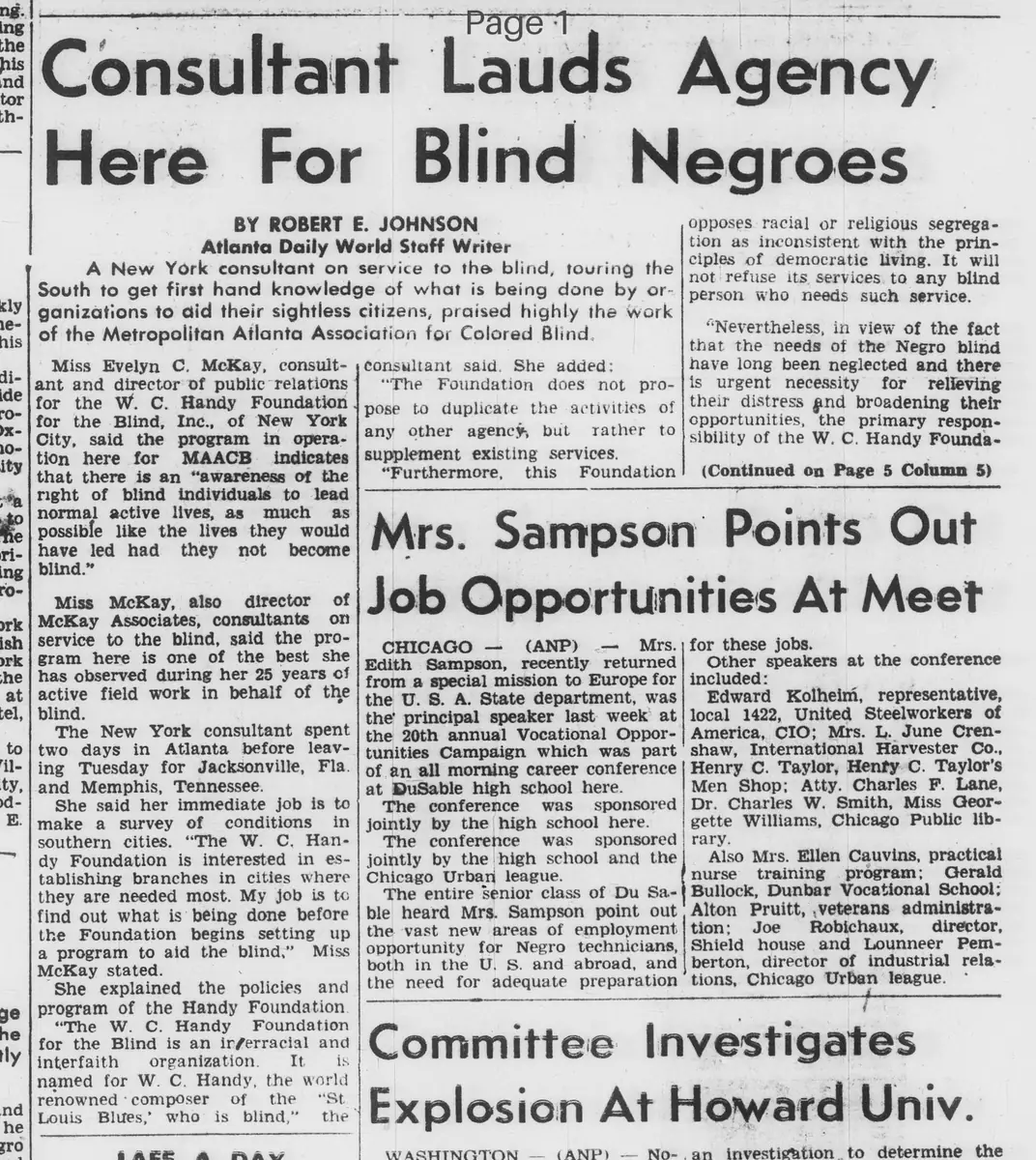
BY ROBERT E. JOHNSON Atlanta Daily World Staff Writer
A New York consultant on service to the blind, touring the South to get first hand knowledge of what is being done by organizations to aid their sightless citizens, praised highly the work of the Metropolitan Atlanta Association for Colored Blind.
Miss Eyelyn C. McKay, consultant and director of public relations for the W. C. Handy Foundation for the Blind, Inc., of New York City, said the program in operation here for MAACB indicates that there is an "awareness of the right of blind individuals to lead normal active lives, as much as possible like the lives they would have led had they not become blind."
Miss McKay, also director of McKay Associates, consultants on service to the blind, said the program here is one of the best she has observed during her 25 years of active field work in behalf of the blind.
The New York consultant spent two days in Atlanta before leaving Tuesday for Jacksonville, Fla. and Memphis, Tennessee.
She said her immediate job is to make a survey of conditions in southern cities. "The W. C. Handy Foundation is interested in establishing branches in cities where they are needed most. My job is to find out what is being done before the Foundation begins setting up a program to aid the blind,"
Miss McKay stated.
She explained the policies and program of the Handy Foundation "The W. C. Handy Foundation for the Blind is an interracial and interfaith organization.
It is named for W. C. Handy, the world renowned composer of the "St Louis Blues," who is blind,"
the consultant said. She added:
"The Foundation does not propose to duplicate the activities of any other agency, but rather to supplement existing services.
Furthermore this Foundation opposes racial or religious segregation as inconsistent with the principles of democratic living. It will not refuse its services to any blind person who needs such service.
Nevertheless, in view of the fact that the needs of the Negro blind have long been neglected and there is urgent necessity for relieving their distress and broadening their opportunities, the primary responsibility of the W. C. Handy Foundation for the Blind shall be to meet the needs of this particular group,
where these needs are not met by existing agencies."
Miss McKay said the Foundation, supported by private contributions, plans to establish local chapters in "those states and cities where services for the Negro blind are not sufficient to meet their needs."
She emphasized that these chapters will cooperate in "every way with other organizations in the community."
The Handy Foundation, with headquarters at 112 East Nineteenth Street, New York City, named W. C. Handy honorary president.
The Honorable Myles A. Paige, special sessions judge of New York, is president. Dr. Rufus E. Clement, president of Atlanta University, is one of the 23 members of the board of directors.
Miss McKay said honorary memberships can be obtained for $5, honorary sponsoring memberships $50 and honorary life memberships $500.
What sub-type of article is it?
What themes does it cover?
What keywords are associated?
What entities or persons were involved?
Where did it happen?
Story Details
Key Persons
Location
Atlanta, Georgia; New York City; Southern Cities Including Jacksonville, Fla. And Memphis, Tennessee
Event Date
Not Specified, Recent Tour Ending Tuesday
Story Details
Miss Eyelyn C. McKay, a New York consultant for the blind, praises the Metropolitan Atlanta Association for Colored Blind's program during her Southern tour to survey services for the blind, particularly Negro blind, for the interracial W.C. Handy Foundation, which aims to supplement existing aid without duplication and opposes segregation.