Thank you for visiting SNEWPapers!
Sign up free
Literary
April 10, 1913
The Frontier
O'neill, O'neill City, Holt County, Nebraska
What is this article about?
Synopsis of a romantic adventure novel set in Queen Anne's court: Lady Prudence Brook, a witty widow in debt, marries condemned highwayman Robin Freemantle to evade creditors, leading to intrigue, reprieve, theft suspicion, and romantic resolution. Followed by Chapter XXVI continuation involving Sir Geoffrey's schemes and Chapter XXVII start with Prue's departure delays.
Clipping
OCR Quality
95%
Excellent
Full Text
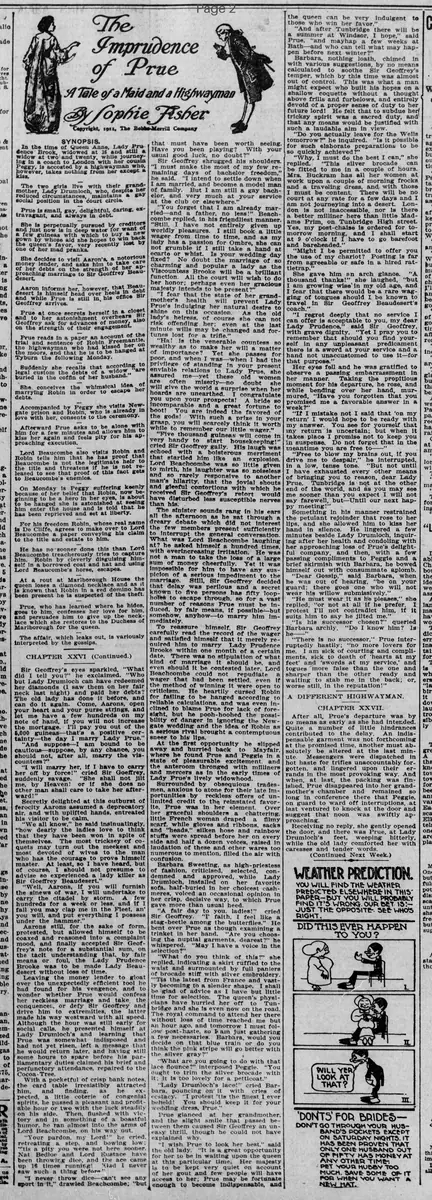
The Synopsis.
In the time of Queen Anne, Lady Prudence Brook, widowed at 16 and still a widow at two and twenty, while journeying in a coach to London with her cousin Peggy, is accosted by a highwayman who, however, takes nothing from her except a kiss.
The two girls live with their grandmother, Lady Drumloch, who, despite her reduced circumstances, maintains a gay social position in the court circle.
Prue is small, gay, delightful, daring, extravagant, and always in debt. She is perpetually pursued by creditors and just now deep in debt for a gown by whose aid she hopes to win back the queen's favor, very recently lost by one of her mad pranks.
She decides to visit Aaron's, a notorious money lender, and asks him to take care of her debts on the strength of her approaching marriage to Sir Geoffrey Beaudesert.
Aaron informs her, however, that Beaudesert is himself head over heels in debt and while Prue is still in his office Sir Geoffrey arrives.
Prue at once secrets herself in a closet while Sir Geoffrey asks for advances of money, also on the strength of their engagement.
Prue reads in a paper an account of the sentence of Robin Freemantle, the highwayman who had kissed her on the moors, and that he is to be hanged at Tyburn the following Monday.
Suddenly she recalls that according to legal custom the debts of a condemned criminal are buried in the coffin of her husband.
She conceives the whimsical idea of marrying Robin in order to escape her debts.
Accompanied by Peggy she visits Newgate prison and Robin, who is already in love with her, consents to the ceremony.
Afterward Prue asks to be alone with him for a few minutes and allows him to kiss her again and feels pity for his approaching execution.
Lord Beaucombe also visits Robin and Robin tells him that he has proof that Beaucombe is not the legitimate heir to the title and threatens if he is not released to see that proof of this fact gets to Beaucombe's enemies.
On Monday as Peggy suffering keenly because of her belief that Robin, now beginning to be a hero in her eyes, is about to be hanged she is astonished at seeing him enter the house and is told that he has been reprieved and set at liberty.
For his freedom Robin, whose real name is De Cliffe, agrees to make over to Lord Beaucombe a paper conveying his claim to the title and estate to him.
He has no sooner done this than Lord Beaucombe treacherously tries to capture him. Robin by cleverly disguising himself in a borrowed coat and hat and using Lord Beaucombe's horse, escapes.
At a rout at Marlborough House the queen loses a diamond necklace and as it is known that Robin in a red domino has been present he is suspected of the theft.
Prue, who has learned where he hides, goes to him, confesses her love for him, and persuades him to give up the necklace which she restores to the Duchess of Marlborough for the queen.
The affair, which leaks out, is variously interpreted by the gossips.
CHAPTER XXVI (Continued.)
Sir Geoffrey's eyes sparkled. "What did I tell you?" he exclaimed. "Who but Lady Drumloch can have redeemed her diamonds (I saw them on her fair neck last night) and paid her debts? The old lady has done it before, and can do it again. Come, Aarons, open your heart and your purse strings, and let me have a few hundreds on my note of hand, if you will not increase the mortgage. I'll pay you out of the 5,000 guineas—that's a positive certainty—the day I marry Lady Prue."
"And suppose—I am bound to be cautious—suppose, by any chance, you should not, after all, marry the viscountess?"
"I will marry her, if I have to carry her off by force!" cried Sir Geoffrey, suddenly savage. "She shall not jilt me, by Heaven! or if she does no other man shall care to take her afterward!"
Secretly delighted at this outburst of ferocity Aarons assumed a deprecatory air, and with uplifted hands, entreated his visitor to be calm.
"We all know," he said insinuatingly, "how dearly the ladies love to think that they have been won in spite of themselves. The most tricksy of coquettes may turn out the meekest and most devoted of wives to the man who has the courage to prove himself master. At least, so I have heard, but of course, I should not presume to advise so experienced a lady killer as Sir Geoffrey Beaudesert."
"Well, Aarons, if you will furnish the sinews of war, I will undertake to carry the citadel by storm. A few hundreds for a week or less, and if I fail you may clap me in the Fleet, an' you will, and put everything I possess under the hammer."
Aarons still, for the sake of form, protested, but allowed himself to be coaxed and reasoned into a compliant mood, and finally accepted Sir Geoffrey's note for a substantial sum, on the tacit understanding that, by fair means or foul, the Lady Prudence Brooke was to be made Lady Beaudesert without loss of time.
Leaving the money lender to gloat over the unexpectedly efficient tool he had found for his vengeance, and to wonder whether Prue would confess her reckless marriage and take the consequences, or defy Sir Geoffrey and drive him to extremities, the latter made his way westward with all speed.
Although the hour was still early for social calls, he presented himself at Lady Drumloch's and learning that Prue was somewhat indisposed and had not yet risen, left a message that he would return later, and having still some hours to spare before his parliamentary duties claimed his brief and perfunctory attendance, repaired to the Cocoa-Tree.
With a pocketful of crisp bank notes, the card table irresistibly attracted him, and finding, as he expected, a little coterie of congenial spirits, he passed a pleasant and profitable hour or two with the luck steadily on his side. Then, flushed with victory and in something of a boastful humor, he ran almost into the arms of Lord Beaudesert, on his way out.
"Your pardon, my Lord!" he cried, retreating a step, and bowing low; "'tis a pity you were not here sooner. Nat Bedloe and Lord Eustace have been throwing dice, and the ace came up 16 times running! Gad I never saw such a thing before!"
"I never throw dice—can't see any sport in it," drawled Beaudesert; "but that must have been worth seeing. Have you been playing? With your usual good luck, no doubt?"
Sir Geoffrey shrugged his shoulders. "I must make the most of my few remaining days of bachelor freedom," he said. "I intend to settle down when I am married, and become a model man of family. But I am still a gay bachelor, and very much at your service at the club or elsewhere."
"You forget that I am already married—and a father, no less!" Beaudesert replied, in his friendliest manner. "Still, I have not entirely given up worldly pleasures. I still book a little wager from time to time, and as my lady has a passion for Ombre, she can not grumble if I still take a hand at ecarte or whist. Is your wedding day fixed? No doubt the marriage of so charming and popular a lady as the Viscountess Brooke will be a brilliant function. All the court will wish to do her honor; perhaps even her gracious majesty intends to be present?"
"I fear that the state of her grandmother's health will prevent Lady Prue's indulging her natural desire to shine on this occasion. As the old lady's heiress, of course she can not risk offending her; even at the last minute wills may be changed and fortunes lost for a trifle."
"Ha! is the venerable countess so wealthy as to make her will a matter of importance? Yet she passes for poor, and when I was—when I had the privilege of standing in your present enviable relations to Lady Prue, she assured me—yet these old women are often miserly—no doubt she will give the world a surprise when her hoards are unearthed. I congratulate you upon your prospects! A bride so incomparable and a great fortune to boot! You are indeed the favored of the gods! With such a prize in your grasp, you will scarcely think it worth while to remember our little wager."
"Five thousand guineas will come in very handy to start housekeeping!" cried Sir Geoffrey gaily. His laugh was echoed with a boisterous merriment that startled him like an explosion.
Lord Beaudesert was so little given to mirth, his laughter was so noiseless and so rarely responsive to another man's hilarity, that the jovial shouts and gleeful contortions with which he received Sir Geoffrey's retort would have disturbed less susceptible nerves than his.
The sinister sounds rang in his ears all the afternoon as he sat through a dreary debate which did not interest the few members present sufficiently to interrupt the general conversation.
What was Lord Beaudesert laughing at? he asked himself a hundred times, with ever-increasing irritation. He was not a man to take the loss of a large sum of money cheerfully. Yet it was impossible for him to have any suspicion of a serious impediment to the marriage. Still, Sir Geoffrey decided that delay was perilous and a secret known to five persons has fifty loopholes to escape through, so for a vast number of reasons Prue must be induced, by fair means, if possible—but somehow, anyhow—to marry him immediately.
To reassure himself, Sir Geoffrey carefully read the record of the wager and satisfied himself that it merely required him to marry Lady Prudence Brooke within one month of a certain date. There was no stipulation of what kind of marriage it should be, and even should it be contested later, Lord Beaudesert could not repudiate a wager that had been settled, even if the method of winning it were open to criticism. He heartily cursed Robin for failing to be hanged according to reliable calculations, and was even inclined to blame Prue for lack of foresight, but he pooh-poohed the possibility of danger in ignoring the Newgate wedding and the idea of Robin as a serious rival brought a contemptuous sneer to his lips.
At the first opportunity he slipped away and hurried back to Mayfair, where he found Prue and Peggy in a state of pleasurable excitement, and the anteroom thronged with milliners and mercers as in the early times of Lady Prue's lively widowhood.
Surrounded by obsequious tradesmen, anxious to atone for their late importunities by reckless offers of unlimited credit to the reinstated favorite, Prue was in her element. Over her graceful shoulders a chattering little French woman draped a filmy scarf, while gloves and ribbons, sacks and heads, silken hose and rainbow stuffs were spread before her on every side and half a dozen voices, raised in laudation of these and other wares too numerous to mention, filled the air with confusion.
Barbara Sweeting, as high-priestess of fashion, criticised, selected, condemned and approved, while Lady Drumloch, installed on her favorite sofa, half-buried in her choicest cashmeres, voiced an occasional opinion in her crisp, decisive way, to which Prue gave more than usual heed.
"A fair day to you, ladies!" cried Sir Geoffrey. "I' faith, I feel like a stag-beetle among the butterflies." He bent over Prue as though examining a trinket in her hand. "Are you choosing the nuptial garments, dearest?" he whispered. "May I have a voice in the selection?"
"What do you think of this?" she replied, indicating a skirt ruffled to the waist and surmounted by full paniers of brocade stiff with silver embroidery. "'Tis the latest from France and vastly becoming to a slender shape. I shall be glad of advice as I have but little time for selection. The queen's physicians have hurried her off to Tunbridge and she is even now on the road. The royal command to attend her there without loss of time reached me but an hour ago, and tomorrow I must follow post-haste, so I am just gathering a few necessaries. Barbara, would you decide on that blue train or do you think the pink stripe will go better with the silver gray?"
"What are you going to do with that lace flounce?" interposed Peggy. "You ought to trim the silver brocade with it; it is too lovely for a petticoat."
"Lady Drumloch's lace!" cried Barbara, pouncing on it with cries of ecstasy. "I protest 'tis the finest I ever beheld! You should keep it for your wedding dress, Prue."
Prue glanced at her grandmother and the slight smile that passed between them caused Sir Geoffrey an uneasy thrill, though he could not have explained why.
"I wish Prue to look her best," said the old lady. "It is a great opportunity for her to be in waiting upon the queen at this particular time. Her majesty is to be kept very quiet on account of her gout and few people will have access to her; Prue may be fortunate enough to become indispensable and the queen can be very indulgent to those who win her favor."
"And after Tunbridge there will be a summer at Windsor, I hope," said Prue, "and mayhap a few weeks at Bath—and who can tell what may happen before next winter?"
Barbara, nothing loath, chimed in with various suggestions, by no means calculated to soothe Sir Geoffrey's temper, which by this time was almost out of control. This was what a man might expect who built his hopes on a shallow coquette without a thought above frills and furbelows, and entirely devoid of a proper sense of duty to her future lord! He felt that to subdue her tricksy spirit was a sacred duty, and that any means would be justified with such a laudable aim in view.
"Do you actually leave for the Wells tomorrow?" he inquired. "Is it possible for such elaborate preparations to be so quickly achieved?"
"Why, I must do the best I can," she replied. "This silver brocade can be fitted to me in a couple of hours. Mrs. Buckram has all her women at work upon a couple of morning frocks and a traveling dress, and with those I must be content. There will be no court at any rate for a few days and I am not journeying into a desert. London is not inaccessible, nor is there a better milliner here than little Madame Prim, on Tunbridge High street. Yes, my post-chaise is ordered for tomorrow morning, and I shall start at 9 o'clock if I have to go barefoot and bareheaded."
"Might I be permitted to offer you the use of my chariot? Posting is far from agreeable or safe in a hired rattletrap."
She gave him an arch glance. "A thousand thanks!" she laughed, "but I am growing wise in my old age, and I fear that there would be a rare wagging of tongues should I be known to travel in Sir Geoffrey Beaudesert's coach."
"I regret deeply that no service I can offer is acceptable to you, my dear Lady Prudence," said Sir Geoffrey, with grave dignity. "Yet I pray you to remember that should you find yourself in any unpleasant predicament there is a sword at your service and a hand not unaccustomed to use it—for that purpose."
Her eyes fell and he was gratified to observe a passing embarrassment in her manner. Taking the propitious moment for his departure, he rose, and while bending over her hand, murmured, "Have you forgotten that you promised me a favorable answer in a week?"
"If I mistake not I said that 'on my return' I would hope to be ready with my answer. You see for yourself that my return is uncertain; but when it takes place I promise not to keep you in suspense. Do not forget that in the meantime you are free to—"
"Free to blow my brains out, if you drive me to despair," he interrupted, in a low, tense tone. "But not until I have exhausted every other means of bringing you to reason, dear Lady Prue. Tunbridge is not at the other end of the world, and as you may see me sooner than you expect I will not say farewell, but—Until our next happy meeting!"
Something in his manner restrained the petulant rejoinder that rose to her lips, and she allowed him to kiss her hand in silence. He lingered a few minutes beside Lady Drumloch, inquiring after her health and condoling with her approaching loss of Prue's delightful company, and then, with a few passing compliments to Peggy and a brief skirmish with Barbara, he bowed himself out with consummate aplomb.
"Dear Gossip," said Barbara, when he was out of hearing, "be on your guard; there goes one who will not wear his willow submissively."
"He must wear it as he pleases," she replied, "or not at all if he prefer. I protest I'll not contradict him, if it suits him to say he jilted me."
"Is his successor chosen?" queried Barbara archly. "Do I know him? Is he—"
"There is no successor," Prue interrupted hastily; "no more lovers for me. I am sick of courting and compliments, sick to death of 'hearts at my feet' and 'swords at my service,' and tongues more false than the one and sharper than the other ready and waiting to stab me in the back; or, worse still, in the reputation!"
A DIFFERENT HIGHWAYMAN.
CHAPTER XXVII.
After all, Prue's departure was by no means as early as she had intended. Quite a number of little hindrances contributed to the delay. An indispensable garment was not forthcoming at the promised time, another must absolutely be altered at the last minute. Messengers were dispatched in hot haste for trifles unaccountably forgotten, and lingered upon their errands in the most provoking way. And when, at last, the packing was finished, Prue disappeared into her grandmother's chamber and remained so long in conference there that Peggy, on guard to ward off interruptions, at last ventured to knock at the door and suggest that noon was swiftly approaching.
Receiving no reply, she gently opened the door, and there was Prue, at Lady Drumloch's feet, weeping bitterly, while the old lady comforted her with caresses and tender words.
(Continued Next Week.)
In the time of Queen Anne, Lady Prudence Brook, widowed at 16 and still a widow at two and twenty, while journeying in a coach to London with her cousin Peggy, is accosted by a highwayman who, however, takes nothing from her except a kiss.
The two girls live with their grandmother, Lady Drumloch, who, despite her reduced circumstances, maintains a gay social position in the court circle.
Prue is small, gay, delightful, daring, extravagant, and always in debt. She is perpetually pursued by creditors and just now deep in debt for a gown by whose aid she hopes to win back the queen's favor, very recently lost by one of her mad pranks.
She decides to visit Aaron's, a notorious money lender, and asks him to take care of her debts on the strength of her approaching marriage to Sir Geoffrey Beaudesert.
Aaron informs her, however, that Beaudesert is himself head over heels in debt and while Prue is still in his office Sir Geoffrey arrives.
Prue at once secrets herself in a closet while Sir Geoffrey asks for advances of money, also on the strength of their engagement.
Prue reads in a paper an account of the sentence of Robin Freemantle, the highwayman who had kissed her on the moors, and that he is to be hanged at Tyburn the following Monday.
Suddenly she recalls that according to legal custom the debts of a condemned criminal are buried in the coffin of her husband.
She conceives the whimsical idea of marrying Robin in order to escape her debts.
Accompanied by Peggy she visits Newgate prison and Robin, who is already in love with her, consents to the ceremony.
Afterward Prue asks to be alone with him for a few minutes and allows him to kiss her again and feels pity for his approaching execution.
Lord Beaucombe also visits Robin and Robin tells him that he has proof that Beaucombe is not the legitimate heir to the title and threatens if he is not released to see that proof of this fact gets to Beaucombe's enemies.
On Monday as Peggy suffering keenly because of her belief that Robin, now beginning to be a hero in her eyes, is about to be hanged she is astonished at seeing him enter the house and is told that he has been reprieved and set at liberty.
For his freedom Robin, whose real name is De Cliffe, agrees to make over to Lord Beaucombe a paper conveying his claim to the title and estate to him.
He has no sooner done this than Lord Beaucombe treacherously tries to capture him. Robin by cleverly disguising himself in a borrowed coat and hat and using Lord Beaucombe's horse, escapes.
At a rout at Marlborough House the queen loses a diamond necklace and as it is known that Robin in a red domino has been present he is suspected of the theft.
Prue, who has learned where he hides, goes to him, confesses her love for him, and persuades him to give up the necklace which she restores to the Duchess of Marlborough for the queen.
The affair, which leaks out, is variously interpreted by the gossips.
CHAPTER XXVI (Continued.)
Sir Geoffrey's eyes sparkled. "What did I tell you?" he exclaimed. "Who but Lady Drumloch can have redeemed her diamonds (I saw them on her fair neck last night) and paid her debts? The old lady has done it before, and can do it again. Come, Aarons, open your heart and your purse strings, and let me have a few hundreds on my note of hand, if you will not increase the mortgage. I'll pay you out of the 5,000 guineas—that's a positive certainty—the day I marry Lady Prue."
"And suppose—I am bound to be cautious—suppose, by any chance, you should not, after all, marry the viscountess?"
"I will marry her, if I have to carry her off by force!" cried Sir Geoffrey, suddenly savage. "She shall not jilt me, by Heaven! or if she does no other man shall care to take her afterward!"
Secretly delighted at this outburst of ferocity Aarons assumed a deprecatory air, and with uplifted hands, entreated his visitor to be calm.
"We all know," he said insinuatingly, "how dearly the ladies love to think that they have been won in spite of themselves. The most tricksy of coquettes may turn out the meekest and most devoted of wives to the man who has the courage to prove himself master. At least, so I have heard, but of course, I should not presume to advise so experienced a lady killer as Sir Geoffrey Beaudesert."
"Well, Aarons, if you will furnish the sinews of war, I will undertake to carry the citadel by storm. A few hundreds for a week or less, and if I fail you may clap me in the Fleet, an' you will, and put everything I possess under the hammer."
Aarons still, for the sake of form, protested, but allowed himself to be coaxed and reasoned into a compliant mood, and finally accepted Sir Geoffrey's note for a substantial sum, on the tacit understanding that, by fair means or foul, the Lady Prudence Brooke was to be made Lady Beaudesert without loss of time.
Leaving the money lender to gloat over the unexpectedly efficient tool he had found for his vengeance, and to wonder whether Prue would confess her reckless marriage and take the consequences, or defy Sir Geoffrey and drive him to extremities, the latter made his way westward with all speed.
Although the hour was still early for social calls, he presented himself at Lady Drumloch's and learning that Prue was somewhat indisposed and had not yet risen, left a message that he would return later, and having still some hours to spare before his parliamentary duties claimed his brief and perfunctory attendance, repaired to the Cocoa-Tree.
With a pocketful of crisp bank notes, the card table irresistibly attracted him, and finding, as he expected, a little coterie of congenial spirits, he passed a pleasant and profitable hour or two with the luck steadily on his side. Then, flushed with victory and in something of a boastful humor, he ran almost into the arms of Lord Beaudesert, on his way out.
"Your pardon, my Lord!" he cried, retreating a step, and bowing low; "'tis a pity you were not here sooner. Nat Bedloe and Lord Eustace have been throwing dice, and the ace came up 16 times running! Gad I never saw such a thing before!"
"I never throw dice—can't see any sport in it," drawled Beaudesert; "but that must have been worth seeing. Have you been playing? With your usual good luck, no doubt?"
Sir Geoffrey shrugged his shoulders. "I must make the most of my few remaining days of bachelor freedom," he said. "I intend to settle down when I am married, and become a model man of family. But I am still a gay bachelor, and very much at your service at the club or elsewhere."
"You forget that I am already married—and a father, no less!" Beaudesert replied, in his friendliest manner. "Still, I have not entirely given up worldly pleasures. I still book a little wager from time to time, and as my lady has a passion for Ombre, she can not grumble if I still take a hand at ecarte or whist. Is your wedding day fixed? No doubt the marriage of so charming and popular a lady as the Viscountess Brooke will be a brilliant function. All the court will wish to do her honor; perhaps even her gracious majesty intends to be present?"
"I fear that the state of her grandmother's health will prevent Lady Prue's indulging her natural desire to shine on this occasion. As the old lady's heiress, of course she can not risk offending her; even at the last minute wills may be changed and fortunes lost for a trifle."
"Ha! is the venerable countess so wealthy as to make her will a matter of importance? Yet she passes for poor, and when I was—when I had the privilege of standing in your present enviable relations to Lady Prue, she assured me—yet these old women are often miserly—no doubt she will give the world a surprise when her hoards are unearthed. I congratulate you upon your prospects! A bride so incomparable and a great fortune to boot! You are indeed the favored of the gods! With such a prize in your grasp, you will scarcely think it worth while to remember our little wager."
"Five thousand guineas will come in very handy to start housekeeping!" cried Sir Geoffrey gaily. His laugh was echoed with a boisterous merriment that startled him like an explosion.
Lord Beaudesert was so little given to mirth, his laughter was so noiseless and so rarely responsive to another man's hilarity, that the jovial shouts and gleeful contortions with which he received Sir Geoffrey's retort would have disturbed less susceptible nerves than his.
The sinister sounds rang in his ears all the afternoon as he sat through a dreary debate which did not interest the few members present sufficiently to interrupt the general conversation.
What was Lord Beaudesert laughing at? he asked himself a hundred times, with ever-increasing irritation. He was not a man to take the loss of a large sum of money cheerfully. Yet it was impossible for him to have any suspicion of a serious impediment to the marriage. Still, Sir Geoffrey decided that delay was perilous and a secret known to five persons has fifty loopholes to escape through, so for a vast number of reasons Prue must be induced, by fair means, if possible—but somehow, anyhow—to marry him immediately.
To reassure himself, Sir Geoffrey carefully read the record of the wager and satisfied himself that it merely required him to marry Lady Prudence Brooke within one month of a certain date. There was no stipulation of what kind of marriage it should be, and even should it be contested later, Lord Beaudesert could not repudiate a wager that had been settled, even if the method of winning it were open to criticism. He heartily cursed Robin for failing to be hanged according to reliable calculations, and was even inclined to blame Prue for lack of foresight, but he pooh-poohed the possibility of danger in ignoring the Newgate wedding and the idea of Robin as a serious rival brought a contemptuous sneer to his lips.
At the first opportunity he slipped away and hurried back to Mayfair, where he found Prue and Peggy in a state of pleasurable excitement, and the anteroom thronged with milliners and mercers as in the early times of Lady Prue's lively widowhood.
Surrounded by obsequious tradesmen, anxious to atone for their late importunities by reckless offers of unlimited credit to the reinstated favorite, Prue was in her element. Over her graceful shoulders a chattering little French woman draped a filmy scarf, while gloves and ribbons, sacks and heads, silken hose and rainbow stuffs were spread before her on every side and half a dozen voices, raised in laudation of these and other wares too numerous to mention, filled the air with confusion.
Barbara Sweeting, as high-priestess of fashion, criticised, selected, condemned and approved, while Lady Drumloch, installed on her favorite sofa, half-buried in her choicest cashmeres, voiced an occasional opinion in her crisp, decisive way, to which Prue gave more than usual heed.
"A fair day to you, ladies!" cried Sir Geoffrey. "I' faith, I feel like a stag-beetle among the butterflies." He bent over Prue as though examining a trinket in her hand. "Are you choosing the nuptial garments, dearest?" he whispered. "May I have a voice in the selection?"
"What do you think of this?" she replied, indicating a skirt ruffled to the waist and surmounted by full paniers of brocade stiff with silver embroidery. "'Tis the latest from France and vastly becoming to a slender shape. I shall be glad of advice as I have but little time for selection. The queen's physicians have hurried her off to Tunbridge and she is even now on the road. The royal command to attend her there without loss of time reached me but an hour ago, and tomorrow I must follow post-haste, so I am just gathering a few necessaries. Barbara, would you decide on that blue train or do you think the pink stripe will go better with the silver gray?"
"What are you going to do with that lace flounce?" interposed Peggy. "You ought to trim the silver brocade with it; it is too lovely for a petticoat."
"Lady Drumloch's lace!" cried Barbara, pouncing on it with cries of ecstasy. "I protest 'tis the finest I ever beheld! You should keep it for your wedding dress, Prue."
Prue glanced at her grandmother and the slight smile that passed between them caused Sir Geoffrey an uneasy thrill, though he could not have explained why.
"I wish Prue to look her best," said the old lady. "It is a great opportunity for her to be in waiting upon the queen at this particular time. Her majesty is to be kept very quiet on account of her gout and few people will have access to her; Prue may be fortunate enough to become indispensable and the queen can be very indulgent to those who win her favor."
"And after Tunbridge there will be a summer at Windsor, I hope," said Prue, "and mayhap a few weeks at Bath—and who can tell what may happen before next winter?"
Barbara, nothing loath, chimed in with various suggestions, by no means calculated to soothe Sir Geoffrey's temper, which by this time was almost out of control. This was what a man might expect who built his hopes on a shallow coquette without a thought above frills and furbelows, and entirely devoid of a proper sense of duty to her future lord! He felt that to subdue her tricksy spirit was a sacred duty, and that any means would be justified with such a laudable aim in view.
"Do you actually leave for the Wells tomorrow?" he inquired. "Is it possible for such elaborate preparations to be so quickly achieved?"
"Why, I must do the best I can," she replied. "This silver brocade can be fitted to me in a couple of hours. Mrs. Buckram has all her women at work upon a couple of morning frocks and a traveling dress, and with those I must be content. There will be no court at any rate for a few days and I am not journeying into a desert. London is not inaccessible, nor is there a better milliner here than little Madame Prim, on Tunbridge High street. Yes, my post-chaise is ordered for tomorrow morning, and I shall start at 9 o'clock if I have to go barefoot and bareheaded."
"Might I be permitted to offer you the use of my chariot? Posting is far from agreeable or safe in a hired rattletrap."
She gave him an arch glance. "A thousand thanks!" she laughed, "but I am growing wise in my old age, and I fear that there would be a rare wagging of tongues should I be known to travel in Sir Geoffrey Beaudesert's coach."
"I regret deeply that no service I can offer is acceptable to you, my dear Lady Prudence," said Sir Geoffrey, with grave dignity. "Yet I pray you to remember that should you find yourself in any unpleasant predicament there is a sword at your service and a hand not unaccustomed to use it—for that purpose."
Her eyes fell and he was gratified to observe a passing embarrassment in her manner. Taking the propitious moment for his departure, he rose, and while bending over her hand, murmured, "Have you forgotten that you promised me a favorable answer in a week?"
"If I mistake not I said that 'on my return' I would hope to be ready with my answer. You see for yourself that my return is uncertain; but when it takes place I promise not to keep you in suspense. Do not forget that in the meantime you are free to—"
"Free to blow my brains out, if you drive me to despair," he interrupted, in a low, tense tone. "But not until I have exhausted every other means of bringing you to reason, dear Lady Prue. Tunbridge is not at the other end of the world, and as you may see me sooner than you expect I will not say farewell, but—Until our next happy meeting!"
Something in his manner restrained the petulant rejoinder that rose to her lips, and she allowed him to kiss her hand in silence. He lingered a few minutes beside Lady Drumloch, inquiring after her health and condoling with her approaching loss of Prue's delightful company, and then, with a few passing compliments to Peggy and a brief skirmish with Barbara, he bowed himself out with consummate aplomb.
"Dear Gossip," said Barbara, when he was out of hearing, "be on your guard; there goes one who will not wear his willow submissively."
"He must wear it as he pleases," she replied, "or not at all if he prefer. I protest I'll not contradict him, if it suits him to say he jilted me."
"Is his successor chosen?" queried Barbara archly. "Do I know him? Is he—"
"There is no successor," Prue interrupted hastily; "no more lovers for me. I am sick of courting and compliments, sick to death of 'hearts at my feet' and 'swords at my service,' and tongues more false than the one and sharper than the other ready and waiting to stab me in the back; or, worse still, in the reputation!"
A DIFFERENT HIGHWAYMAN.
CHAPTER XXVII.
After all, Prue's departure was by no means as early as she had intended. Quite a number of little hindrances contributed to the delay. An indispensable garment was not forthcoming at the promised time, another must absolutely be altered at the last minute. Messengers were dispatched in hot haste for trifles unaccountably forgotten, and lingered upon their errands in the most provoking way. And when, at last, the packing was finished, Prue disappeared into her grandmother's chamber and remained so long in conference there that Peggy, on guard to ward off interruptions, at last ventured to knock at the door and suggest that noon was swiftly approaching.
Receiving no reply, she gently opened the door, and there was Prue, at Lady Drumloch's feet, weeping bitterly, while the old lady comforted her with caresses and tender words.
(Continued Next Week.)
What sub-type of article is it?
Prose Fiction
What themes does it cover?
Love Romance
Social Manners
Political
What keywords are associated?
Queen Anne
Lady Prudence
Highwayman
Debts
Marriage
Court Intrigue
Newgate Prison
Tyburn
Tunbridge
Wager
Literary Details
Key Lines
Suddenly She Recalls That According To Legal Custom The Debts Of A Condemned Criminal Are Buried In The Coffin Of Her Husband.
She Conceives The Whimsical Idea Of Marrying Robin In Order To Escape Her Debts.
Prue, Who Has Learned Where He Hides, Goes To Him, Confesses Her Love For Him, And Persuades Him To Give Up The Necklace Which She Restores To The Duchess Of Marlborough For The Queen.
I Will Marry Her, If I Have To Carry Her Off By Force! Cried Sir Geoffrey, Suddenly Savage.
Free To Blow My Brains Out, If You Drive Me To Despair, He Interrupted, In A Low, Tense Tone.