Thank you for visiting SNEWPapers!
Sign up free
The Columbia Democrat
Bloomsburg, Columbia County, Pennsylvania
What is this article about?
Account of the brutal siege of Gerona by French forces, detailing the Spanish inhabitants' heroic resistance, famine, disease, and eventual surrender after seven months of bombardment and assaults.
Clipping
OCR Quality
Full Text
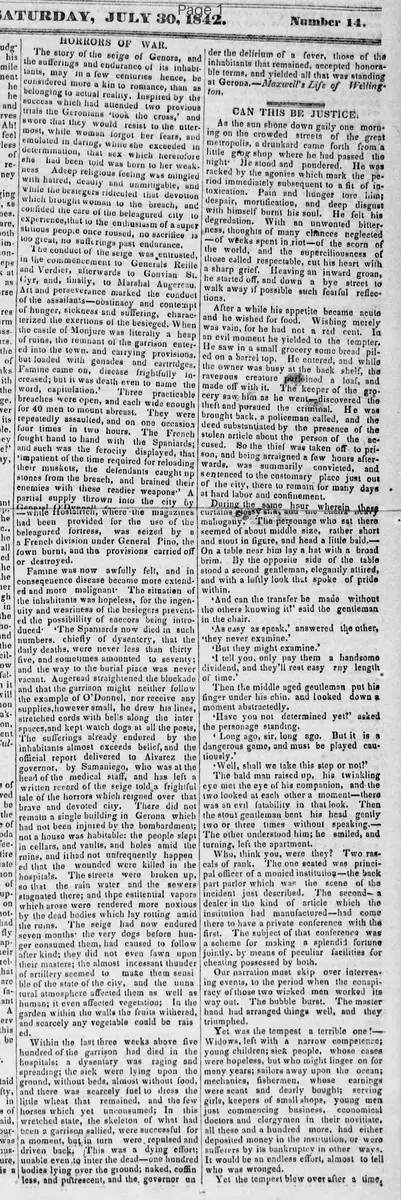
The story of the siege of Gerona, and the sufferings and endurance of its inhabitants, may in a few centuries hence, be considered more akin to romance, than as belonging to actual reality. Inspired by the success which had attended two previous trials the Geronans 'took the cross,' and swore that they would resist to the uttermost, while woman forgot her fears, and emulated in daring, while she exceeded in determination, that sex which heretofore she had been told was born to her weakness. A deep religious feeling was mingled with hatred, deadly and unmingled, and while the besiegers ridiculed that devotion which brought woman to the breach, and confided the care of the beleaguered city to experience, that to the enthusiasm of a superstitious people once roused, no sacrifice is too great, no sufferings past endurance.
The conduct of the siege was entrusted, in the commencement to Generals Reille and Verdier, afterwards to General St. Cyr, and, finally, to Marshal Augereau. Art and perseverance marked the conduct of the assailants—obstinacy and contempt of hunger, sickness and suffering, characterized the exertions of the besieged. When the castle of Monjuic was literally a heap of ruins, the remnant of the garrison entered into the town, and carrying provisions, but loaded with grenades and cartridges. Famine came on, disease frightfully increased; but it was death even to name the word, capitulation. Three practicable breaches were open, and each wide enough for 40 men to mount abreast. They were repeatedly assaulted, and on one occasion four times in two hours. The French fought hand to hand with the Spaniards; and such was the ferocity displayed, that 'impatient of the time required for reloading their muskets, the defendants caught up stones from the breach, and brained their enemies with these readier weapons.' A partial supply thrown into the city by General O'Donnell—while Hostalrich, where the magazines had been provided for the use of the beleaguered fortress, was seized by a French division under General Pino, the town burnt, and the provisions carried off or destroyed.
Famine was now awfully felt, and in consequence disease became more extended and more malignant. The situation of the inhabitants was hopeless, for the ingenuity and watchfulness of the besiegers prevented the possibility of succors being introduced: 'The Spaniards now died in such numbers, chiefly of dysentery, that the daily deaths, were never less than thirty five, and sometimes amounted to seventy; and the way to the burial place was never vacant. Augereau straightened the blockade and that the garrison might neither follow the example of O'Donnell, nor receive any supplies, however small, he drew his lines, stretched cords with bells along the inter spaces, and kept watch dogs at all the posts.
The sufferings already endured by the inhabitants almost exceeds belief, and the official report delivered to Alvarez the governor, by Samaniego, who was at the head of the medical staff, and has left a written record of the siege told a frightful tale of the horrors which reigned over that brave and devoted city. There did not remain a single building in Gerona which had not been injured by the bombardment; not a house was habitable: the people slept in cellars, and vaults, and holes amid the ruins, and it had not unfrequently happened that the wounded were killed in the hospitals. The streets were broken up, so that the rain water and the sewers stagnated there; and the pestilential vapors which arose were rendered more noxious by the dead bodies which lay rotting amid the ruins. The siege had now endured seven months; the very dogs before hunger consumed them, had caused to follow after kind; they did not even fawn upon their masters; the almost incessant thunder of artillery seemed to make them sensible of the state of the city, and the unnatural atmosphere affected them as well as human; it even affected vegetation; In the garden within the walls the fruits withered, and scarcely any vegetable could be raised.
Within the last three weeks above five hundred of the garrison had died in the hospitals; a dysentery was raging and spreading; the sick were lying upon the ground, without beds, almost without food, and there was scarcely fuel to dress the little wheat that remained, and the few horses which yet unconsumed; In this wretched state, the skeleton of what had been a garrison sallied, were successful for a moment, but in turn were repulsed and driven back: This was a dying effort; unable even, to inter the dead—one hundred bodies lying over the ground; naked, coffinless, and putrescent, and the governor under the delirium of a fever, those of the inhabitants that remained, accepted honorable terms, and yielded all that was standing at Gerona.—Maxwell's Life of Wellington.
What sub-type of article is it?
What keywords are associated?
What entities or persons were involved?
Where did it happen?
Foreign News Details
Primary Location
Gerona
Event Date
Seven Months
Key Persons
Outcome
daily deaths from dysentery 35-70; over 500 garrison deaths in last three weeks; eventual surrender on honorable terms after failed sally and governor's fever delirium.
Event Details
French forces under Reille, Verdier, St. Cyr, and Augereau besieged Gerona for seven months, bombarding the city into ruins and creating three wide breaches assaulted repeatedly. Spanish defenders resisted fiercely, fighting hand-to-hand and using stones as weapons, inspired by religious fervor. Famine and dysentery ravaged the population; supplies from O'Donnell were partial, while Pino destroyed magazines at Hostalrich. Blockade tightened with bells and dogs; buildings uninhabitable, dead unburied, vegetation withered. Final sally repulsed, leading to capitulation.