Thank you for visiting SNEWPapers!
Sign up free
Story
February 10, 1943
Midland Cooperator
Minneapolis, Hennepin County, Minnesota
What is this article about?
Public Health Education committee advises that average person gets 2.5 colds yearly; persistent sniffles warrant checking sleep, diet, temperature, clothing, and doctor visit for throat, nose, or ear issues, especially to prevent permanent hearing loss in children.
Clipping
OCR Quality
100%
Excellent
Full Text
Perpetual Sniffler
Should See Doctor
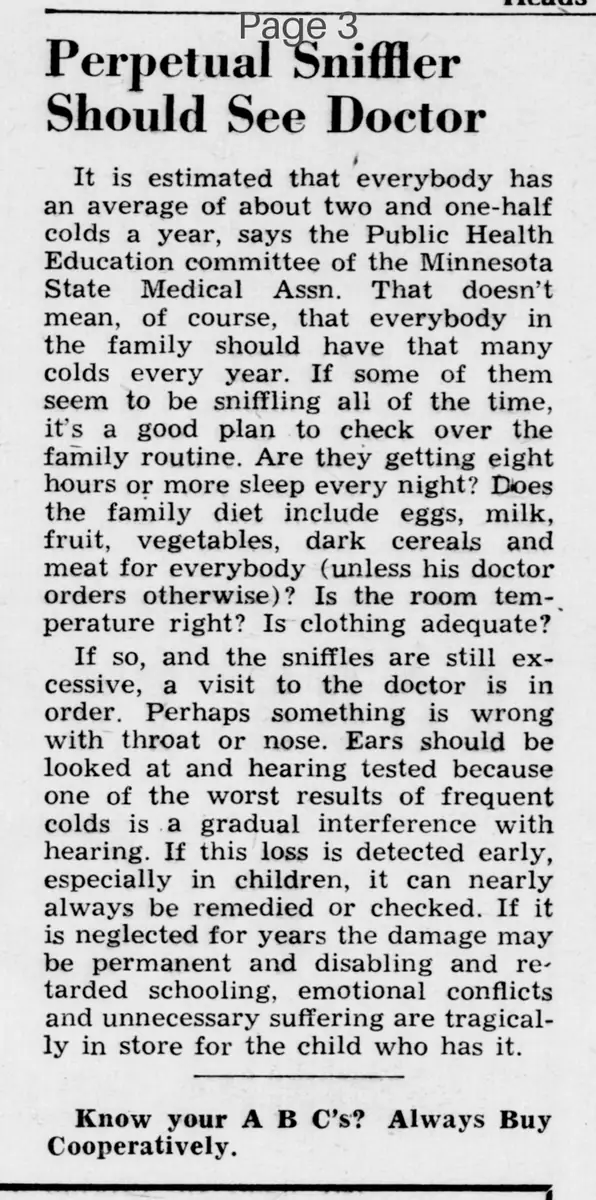
It is estimated that everybody has an average of about two and one-half colds a year, says the Public Health Education committee of the Minnesota State Medical Assn. That doesn't mean, of course, that everybody in the family should have that many colds every year. If some of them seem to be sniffling all of the time, it's a good plan to check over the family routine. Are they getting eight hours or more sleep every night? Does the family diet include eggs, milk, fruit, vegetables, dark cereals and meat for everybody (unless his doctor orders otherwise)? Is the room temperature right? Is clothing adequate? If so, and the sniffles are still excessive, a visit to the doctor is in order. Perhaps something is wrong with throat or nose. Ears should be looked at and hearing tested because one of the worst results of frequent colds is a gradual interference with hearing. If this loss is detected early, especially in children, it can nearly always be remedied or checked. If it is neglected for years the damage may be permanent and disabling and retarded schooling, emotional conflicts and unnecessary suffering are tragically in store for the child who has it.
Know your A B C's? Always Buy Cooperatively.
Should See Doctor
It is estimated that everybody has an average of about two and one-half colds a year, says the Public Health Education committee of the Minnesota State Medical Assn. That doesn't mean, of course, that everybody in the family should have that many colds every year. If some of them seem to be sniffling all of the time, it's a good plan to check over the family routine. Are they getting eight hours or more sleep every night? Does the family diet include eggs, milk, fruit, vegetables, dark cereals and meat for everybody (unless his doctor orders otherwise)? Is the room temperature right? Is clothing adequate? If so, and the sniffles are still excessive, a visit to the doctor is in order. Perhaps something is wrong with throat or nose. Ears should be looked at and hearing tested because one of the worst results of frequent colds is a gradual interference with hearing. If this loss is detected early, especially in children, it can nearly always be remedied or checked. If it is neglected for years the damage may be permanent and disabling and retarded schooling, emotional conflicts and unnecessary suffering are tragically in store for the child who has it.
Know your A B C's? Always Buy Cooperatively.
What sub-type of article is it?
Medical Curiosity
What themes does it cover?
Recovery
Misfortune
What keywords are associated?
Colds
Sniffles
Family Health
Doctor Visit
Hearing Loss
Story Details
Story Details
Advice on managing frequent colds through lifestyle checks and medical consultation to prevent hearing loss, particularly in children.