Thank you for visiting SNEWPapers!
Sign up free
Edwardsville Spectator
Edwardsville, Madison County, Illinois
What is this article about?
Rufus King shares the substance of his U.S. Senate speeches from 1819 advocating Congress's constitutional power to prohibit slavery in new territories like Missouri, citing historical precedents such as the Northwest Ordinance and distinctions between federal and state rights on slavery.
Clipping
OCR Quality
Full Text
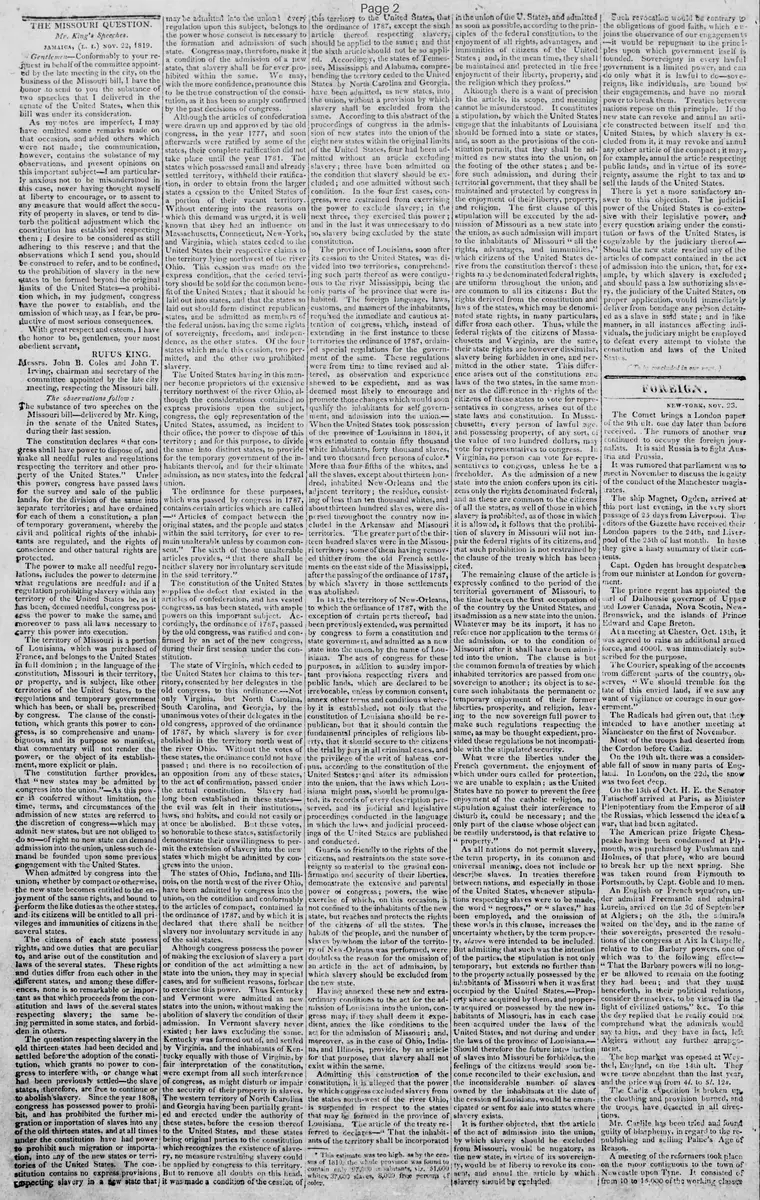
Mr. King's Speeches.
JAMAICA, (L. I.) NOV. 22, 1819.
Gentlemen--Conformably to your request in behalf of the committee appointed by the late meeting in the city, on the business of the Missouri bill, I have the honor to send to you the substance of two speeches that I delivered in the senate of the United States, when this bill was under its consideration.
As my notes are imperfect, I may have omitted some remarks made on that occasion, and added others which were not made; the communication, however, contains the substance of my observations, and present opinions on this important subject--I am particularly anxious not to be misunderstood in this case, never having thought myself at liberty to encourage, or to assent to any measure that would affect the security of property in slaves, or tend to disturb the political adjustment which the constitution has established respecting them: I desire to be considered as still adhering to this reserve; and that the observations which I send you, should be construed to refer, and to be confined to the prohibition of slavery in the new states to be formed beyond the original limits of the United States--a prohibition which, in my judgment, congress have the power to establish, and the omission of which may, as I fear, be productive of most serious consequences.
With great respect and esteem, I have the honor to be, gentlemen, your most obedient servant,
RUFUS KING.
Messrs. John B. Coles and John T. Irving, chairman and secretary of the committee appointed by the late city meeting, respecting the Missouri bill.
The observations follow:
The substance of two speeches on the Missouri bill--delivered by Mr. King, in the senate of the United States, during their last session.
The constitution declares "that congress shall have power to dispose of, and make all needful rules and regulations respecting the territory and other property of the United States." Under this power, congress have passed laws for the survey and sale of the public lands, for the division of the same into separate territories; and have ordained for each of them a constitution, a plan of temporary government, whereby the civil and political rights of the inhabitants are regulated, and the rights of conscience and other natural rights are protected.
The power to make all needful regulations, includes the power to determine what regulations are needful: and if a regulation prohibiting slavery within any territory of the United States be, as it has been, deemed needful, congress possess the power to make the same, and moreover to pass all laws necessary to carry this power into execution.
The territory of Missouri is a portion of Louisiana, which was purchased of France, and belongs to the United States in full dominion; in the language of the constitution, Missouri is their territory, or property, and is subject, like other territories of the United States, to the regulations and temporary government which has been, or shall be, prescribed by congress. The clause of the constitution, which grants this power to congress, is so comprehensive and unambiguous, and its purpose so manifest, that commentary will not render the power, or the object of its establishment, more explicit or plain.
The constitution further provides, that "new states may be admitted by congress into the union."--As this power is conferred without limitation, the time, terms, and circumstances of the admission of new states are referred to the discretion of congress--which may admit new states, but are not obliged to do so--of right no new state can demand admission into the union, unless such demand be founded upon some previous engagement with the United States.
When admitted by congress into the union, whether by compact or otherwise, the new state becomes entitled to the enjoyment of the same rights, and bound to perform the like duties as the other states, and its citizens will be entitled to all privileges and immunities of citizens in the several states.
The citizens of each state possess rights, and owe duties that are peculiar to, and arise out of the constitution and laws of the several states. These rights and duties differ from each other in the different states, and among these differences, none is so remarkable or important as that which proceeds from the constitution and laws of the several states respecting slavery; the same being permitted in some states, and forbidden in others.
The question respecting slavery in the old thirteen states had been decided and settled before the adoption of the constitution, which grants no power to congress to interfere with, or change what had been previously settled--the slave states, therefore, are free to continue or to abolish slavery. Since the year 1808, congress has possessed power to prohibit, and has prohibited the further migration or importation of slaves into any of the old thirteen states, and at all times under the constitution have had power to prohibit such migration or importation, into any of the new states or territories of the United States. The constitution contains no express provisions respecting slavery in a new state that may be admitted into the union: every regulation upon this subject, belongs to the power whose consent is necessary to the formation and admission of such state. Congress may, therefore, make it a condition of the admission of a new state, that slavery shall be for ever prohibited within the same. We may, with the more confidence, pronounce this to be the true construction of the constitution, as it has been so amply confirmed by the past decisions of congress.
Although the articles of confederation were drawn up and approved by the old congress, in the year 1777, and soon afterwards were ratified by some of the states, their complete ratification did not take place until the year 1781. The states which possessed small and already settled territory, withheld their ratification, in order to obtain from the larger states a cession to the United States of a portion of their vacant territory.
Without entering into the reasons on which this demand was urged, it is well known that they had an influence on Massachusetts, Connecticut, New-York, and Virginia, which states ceded to the United States their respective claims to the territory lying northwest of the river Ohio. This cession was made on the express condition, that the ceded territory should be sold for the common benefit of the United States: that it should be laid out into states, and that the states so laid out should form distinct republican states, and be admitted as members of the federal union, having the same rights of sovereignty, freedom, and independence, as the other states. Of the four states which made this cession, two permitted, and the other two prohibited slavery.
The United States having in this manner become proprietors of the extensive territory northwest of the river Ohio, although the cessions contained no express provisions upon the subject, congress, the only representative of the United States, assumed, as incident to their office, the power to dispose of this territory; and for this purpose, to divide the same into distinct states, to provide for the temporary government of the inhabitants thereof, and for their ultimate admission, as new states, into the federal union.
The ordinance for these purposes, which was passed by congress in 1787, contains certain articles which are called "Articles of compact between the original states, and the people and states within the said territory, for ever to remain unalterable unless by common consent." The sixth of those unalterable articles provides, "that there shall be neither slavery nor involuntary servitude in the said territory."
The constitution of the United States supplies the defect that existed in the articles of confederation, and has vested congress, as has been stated, with ample powers on this important subject. Accordingly, the ordinance of 1787, passed by the old congress, was ratified and confirmed by an act of the new congress, during their first session under the constitution.
The state of Virginia, which ceded to the United States her claims to this territory, consented by her delegates in the old congress, to this ordinance.--Not only Virginia, but North Carolina, South Carolina, and Georgia, by the unanimous votes of their delegates in the old congress, approved of the ordinance of 1787, by which slavery is for ever abolished in the territory north west of the river Ohio. Without the votes of these states, the ordinance could not have passed; and there is no recollection of an opposition from any of these states, to the act of confirmation, passed under the actual constitution. Slavery had long been established in these states--the evil was felt in their institutions, laws, and habits, and could not easily or at once be abolished. But these votes, so honorable to these states, satisfactorily demonstrate their unwillingness to permit the extension of slavery into the new states which might be admitted by congress into the union.
The states of Ohio, Indiana, and Illinois, on the north west of the river Ohio, have been admitted by congress into the union, on the condition and conformably to the articles of compact, contained in the ordinance of 1787, and by which it is declared that there shall be neither slavery nor involuntary servitude in any of the said states.
Although congress possess the power of making the exclusion of slavery a part or condition of the act admitting a new state into the union, they may in special cases, and for sufficient reasons, forbear to exercise this power. Thus Kentucky and Vermont were admitted as new states into the union, without making the abolition of slavery the condition of their admission. In Vermont slavery never existed; her laws excluding the same. Kentucky was formed out of, and settled by Virginia, and the inhabitants of Kentucky equally with those of Virginia, by fair interpretation of the constitution, were exempt from all such interference of congress, as might disturb or impair the security of their property in slaves.
The western territory of North Carolina and Georgia having been partially granted and erected under the authority of these states, before the cession thereof to the United States, and these states being original parties to the constitution which recognizes the existence of slavery, no measure restraining slavery could be applied by congress to this territory. But to remove all doubts on this head, it was made a condition of the cession of this territory to the United States, that the ordinance of 1787, except the sixth article thereof respecting slavery, should be applied to the same; and that the sixth article should not be so applied. Accordingly, the states of Tennessee, Mississippi, and Alabama, comprehending the territory ceded to the United States by North Carolina and Georgia, have been admitted, as new states, into the union, without a provision by which slavery shall be excluded from the same. According to this abstract of the proceedings of congress in the admission of new states into the union of the eight new states within the original limits of the United States, four had been admitted without an article excluding slavery; three have been admitted on the condition that slavery should be excluded: and one admitted without such condition. In the four first cases, congress were restrained from exercising the power to exclude slavery; in the next three, they exercised this power; and in the last it was unnecessary to do so, slavery being excluded by the state constitution.
The province of Louisiana, soon after its cession to the United States, was divided into two territories, comprehending such parts thereof as were contiguous to the river Mississippi, being the only parts of the province that were inhabited. The foreign language, laws, customs, and manners of the inhabitants, required the immediate and cautious attention of congress, which, instead of extending in the first instance to these territories the ordinance of 1787, ordained special regulations for the government of the same. These regulations were from time to time revised and altered, as observation and experience shewed to be expedient, and as was deemed most likely to encourage and promote those changes which would soon qualify the inhabitants for self government, and admission into the union.--
When the United States took possession of the province of Louisiana in 1804, it was estimated to contain fifty thousand white inhabitants, forty thousand slaves, and two thousand free persons of color.* More than four fifths of the whites, and all the slaves, except about thirteen hundred, inhabited New-Orleans and the adjacent territory; the residue, consisting of less than ten thousand whites, and about thirteen hundred slaves, were dispersed throughout the country now included in the Arkansaw and Missouri territories. "The greater part of the thirteen hundred slaves were in the Missouri territory; some of them having removed thither from the old French settlements on the east side of the Mississippi, after the passing of the ordinance of 1787, by which slavery in those settlements was abolished."
In 1812, the territory of New-Orleans, to which the ordinance of 1787, with the exception of certain parts thereof, had been previously extended, was permitted by congress to form a constitution and state government, and admitted as a new state into the union, by the name of Louisiana. The acts of congress for these purposes, in addition to sundry important provisions respecting rivers and public lands, which are declared to be irrevocable, unless by common consent, annex other terms and conditions whereby it is established, not only that the constitution of Louisiana should be republican, but that it should contain the fundamental principles of religious liberty, that it should secure to the citizens the trial by jury in all criminal cases, and the privilege of the writ of habeas corpus, according to the constitution of the United States; and after its admission into the union, that the laws which Louisiana might pass, should be promulgated, its records of every description preserved, and its judicial and legislative proceedings conducted in the language in which the laws and judicial proceedings of the United States are published and conducted.
Guards so friendly to the rights of the citizens, and restraints on the state sovereignty so material to the gradual confirmation and security of their liberties, demonstrate the extensive and parental power of congress; powers, the wise exercise of which, on this occasion, is not confined to the inhabitants of the new state, but reaches and protects the rights of the citizens of all the states. The habits of the people, and the number of slaves by whom the labor of the territory of New-Orleans was performed, were doubtless the reason for the omission of an article in the act of admission, by which slavery should be excluded from the new state.
Having annexed these new and extraordinary conditions to the act for the admission of Louisiana into the union, congress may, if they shall deem it expedient, annex the like conditions to the act for the admission of Missouri; and, moreover, as in the case of Ohio, Indiana, and Illinois, provide, by an article for that purpose, that slavery shall not exist within the same.
Admitting this construction of the constitution, it is alleged that the power by which congress excluded slavery from the states north-west of the river Ohio, is suspended in respect to the states that may be formed in the province of Louisiana. The article of the treaty referred to declares--"That the inhabitants of the territory shall be incorporated in the union of the U. States, and admitted as soon as possible, according to the principles of the federal constitution, to the enjoyment of all rights, advantages, and immunities of citizens of the United States; and, in the mean time, they shall be maintained and protected in the free enjoyment of their liberty, property, and the religion which they profess."
Although there is a want of precision in the article, its scope, and meaning cannot be misunderstood. It constitutes a stipulation, by which the United States engage that the inhabitants of Louisiana should be formed into a state or states, and, as soon as the provisions of the constitution permit, that they shall be admitted as new states into the union, on the footing of the other states; and before such admission, and during their territorial government, that they shall be maintained and protected by congress in the enjoyment of their liberty, property, and religion. The first clause of this stipulation will be executed by the admission of Missouri as a new state into the union, as such admission will impart to the inhabitants of Missouri "all the rights, advantages, and immunities," which citizens of the United States derive from the constitution thereof: these rights may be denominated federal rights, are uniform throughout the union, and are common to all its citizens: But the rights derived from the constitution and laws of the states, which may be denominated state rights, in many particulars, differ from each other. Thus, while the federal rights of the citizens of Massachusetts and Virginia, are the same, their state rights are however dissimilar, slavery being forbidden in one, and permitted in the other state. This difference arises out of the constitutions and laws of the two states, in the same manner as the difference in the rights of the citizens of these states to vote for representatives in congress, arises out of the state laws and constitution. In Massachusetts, every person of lawful age, and possessing property, of any sort, to the value of two hundred dollars, may vote for representatives to congress. In Virginia, no person can vote for representatives to congress, unless he be a freeholder. As the admission of a new state into the union confers upon its citizens only the rights denominated federal, and as these are common to the citizens of all the states, as well of those in which slavery is prohibited, as of those in which it is allowed, it follows that the prohibition of slavery in Missouri will not impair the federal rights of its citizens, and that such prohibition is not restrained by the clause of the treaty which has been cited.
The remaining clause of the article is expressly confined to the period of the territorial government of Missouri, to the time between the first occupation of the country by the United States, and its admission as a new state into the union. Whatever may be its import, it has no reference nor application to the terms of the admission, or to the condition of Missouri after it shall have been admitted into the union. The clause is but the common formula of treaties by which inhabited territories are passed from one sovereign to another; its object is to secure such inhabitants the permanent or temporary enjoyment of their former liberties, property, and religion, leaving to the new sovereign full power to make such regulations respecting the same, as may be thought expedient, provided these regulations be not incompatible with the stipulated security.
What were the liberties under the French government, the enjoyment of which under ours called for protection, we are unable to explain; as the United States have no power to prevent the free enjoyment of the catholic religion, no stipulation against their interference to disturb it, could be necessary; and the only part of the clause whose object can be readily understood, is that relative to "property."
As all nations do not permit slavery, the term property, in its common and universal meaning, does not include or describe slaves. In treaties therefore between nations, and especially in those of the United States, whenever stipulations respecting slaves were to be made, the word "negroes," or "slaves," has been employed, and the omission of these words in this clause, increases the uncertainty whether, by the term property, slaves were intended to be included. But admitting that such was the intention of the parties, the stipulation is not only temporary, but extends no further than to the property actually possessed by the inhabitants of Missouri when it was first occupied by the United States.--Property since acquired by them, and property acquired or possessed by the new inhabitants of Missouri, has in each case been acquired under the laws of the United States, and not during and under the laws of the province of Louisiana.--Should therefore the future introduction of slaves into Missouri be forbidden, the feelings of the citizens would soon become reconciled to their exclusion, and the inconsiderable number of slaves owned by the inhabitants at the date of the cession of Louisiana, would be emancipated or sent for sale into states where slavery exists.
It is further objected, that the article of the act of admission into the union, by which slavery should be excluded from Missouri, would be nugatory, as the new state, in virtue of its sovereignty, would be at liberty to revoke its consent, and annul the article by which slavery should be excluded.
Such revocation would be contrary to the obligations of good faith, which enjoins the observance of our engagements--it would be repugnant to the principles upon which government itself is founded. Sovereignty in every lawful government is a limited power, and can do only what it is lawful to do--sovereigns, like individuals, are bound by their engagements, and have no moral power to break them. Treaties between nations repose on this principle. If the new state can revoke and annul an article contracted between itself and the United States, by which slavery is excluded from it, it may revoke and annul any other article of the compact; it may, for example, annul the article respecting public lands, and in virtue of its sovereignty, assume the right to tax and to sell the lands of the United States.
There is yet a more satisfactory answer to this objection. The judicial power of the United States is co-extensive with their legislative power, and every question arising under the constitution or laws of the United States, is cognizable by the judiciary thereof.--Should the new state rescind any of the articles of compact contained in the act of admission into the union, that, for example, by which slavery is excluded: and should pass a law authorizing slavery, the judiciary of the United States, on proper application, would immediately deliver from bondage any person detained as a slave in said state; and in like manner, in all instances affecting individuals, the judiciary might be employed to defeat every attempt to violate the constitution and laws of the United States.
(To be concluded in our next.)
What sub-type of article is it?
What themes does it cover?
What keywords are associated?
What entities or persons were involved?
Where did it happen?
Story Details
Key Persons
Location
United States Senate, Missouri Territory
Event Date
1819 11 22
Story Details
Rufus King outlines arguments from his Senate speeches supporting Congress's authority to prohibit slavery in Missouri as a condition of statehood, referencing constitutional powers, the Northwest Ordinance of 1787, Louisiana Purchase treaty, and historical admissions of states with and without slavery restrictions.