Thank you for visiting SNEWPapers!
Sign up free
The Leavenworth Echo
Leavenworth, Chelan County, Washington
What is this article about?
In a bustling newspaper office, editors Brand and McHenry prepare to publish a damning story and photo exposing Judge Bartelmy's $10,000 bribery attempt to suppress truth. Threats from Bartelmy's son Sylvester, lawyer Dupuy, and others fail to stop them. Meanwhile, reporter Powell's overwrought suicide story is edited down. Judith Bartelmy sneaks into the office amid the chaos.
Merged-components note: Serialized fiction 'The Fourth Estate' with accompanying illustrations; merged sequential components including images due to spatial and reading order proximity.
Clipping
OCR Quality
Full Text
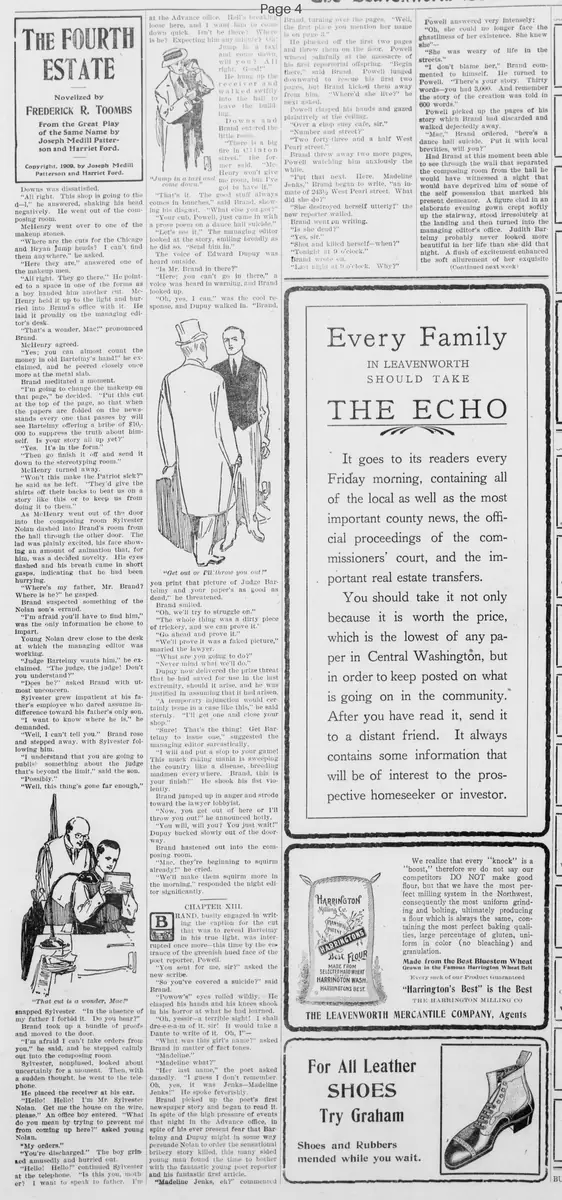
Novelized by FREDERICK R. TOOMBS
From the Great Play of the Same Name by Joseph Medill Patterson and Harriet Ford.
Copyright, 1909, by Joseph Medill Patterson and Harriet Ford.
Downs was dissatisfied.
"All right. This shop is going to the d--l," he answered, shaking his head negatively. He went out of the composing room.
McHenry went over to one of the makeup stones.
"Where are the cuts for the Chicago and Bryan jump heads? I can't find them anywhere," he asked.
"Here they are," answered one of the makeup men.
"All right. They go there." He pointed to a space in one of the forms as a boy handed him another cut. McHenry held it up to the light and hurried into Brand's office with it. He laid it proudly on the managing editor's desk.
"That's a wonder, Mac!" pronounced Brand.
McHenry agreed.
"Yes; you can almost count the money in old Bartelmy's hand!" he exclaimed, and he peered closely once more at the metal slab.
Brand meditated a moment.
"I'm going to change the makeup on that page," he decided. "Put this cut at the top of the page, so that when the papers are folded on the newsstands every one that passes by will see Bartelmy offering a bribe of $10,000 to suppress the truth about himself. Is your story all up yet?"
"Yes. It's in the form."
"Then go finish it off and send it down to the stereotyping room."
McHenry turned away.
"Won't this make the Patriot sick?" he said as he left. "They'd give the shirts off their backs to beat us on a story like this or to keep us from doing it to them."
As McHenry went out of the door into the composing room Sylvester Nolan dashed into Brand's room from the hall through the other door. The lad was plainly excited, his face showing an amount of animation that, for him, was a decided novelty. His eyes flashed and his breath came in short gasps, indicating that he had been hurrying.
"Where's my father, Mr. Brand? Where is he?" he gasped.
Brand suspected something of the Nolan son's errand.
"I'm afraid you'll have to find him," was the only information he chose to impart.
Young Nolan drew close to the desk at which the managing editor was working.
"Judge Bartelmy wants him," he exclaimed. "The judge, the judge! Don't you understand?"
"Does he?" asked Brand with utmost unconcern.
Sylvester grew impatient at his father's employee who dared assume indifference toward his father's only son.
"I want to know where he is," he demanded.
"Well, I can't tell you."
Brand rose and stepped away, with Sylvester following him.
"I understand that you are going to publish something about the judge that's beyond the limit," said the son.
"Possibly."
"Well, this thing's gone far enough,"
"That cut is a wonder, Mac,"
snapped Sylvester. In the absence of my father I forbid it. Do you hear?"
Brand took up a bundle of proofs and moved to the door.
"I'm afraid I can't take orders from you," he said, and he stepped calmly out into the composing room.
Sylvester, nonplused, looked about uncertainly for a moment. Then, with a sudden thought, he went to the telephone.
He placed the receiver at his ear.
"Hello! Hello! I'm Mr. Sylvester Nolan. Get me the house on the wire, please." An office boy entered. "What do you mean by trying to prevent me from coming up here?" asked young Nolan.
"My orders."
"You're discharged." The boy grinned amusedly and hurried out.
"Hello! Hello!" continued Sylvester at the telephone. "Is this you, mother? I want to speak to father. I'm
at the Advance office. Hell's breaking loose here, and I want him to come down quick. Isn't he there? Where is he? Expecting him any minute? Oh, jump in a taxi and come down, will you? All right, good!"
He hung up the receiver and walked swiftly into the hall to leave the building.
Downs and Brand entered the little room.
"There is a big fire in Clinton street," the former said. "McHenry won't give me room, but I've come down."
"That's it. The good stuff always comes in bunches," said Brand, showing his disgust. "What else you got?"
"Your cub, Powell, just came in with a prose poem on a dance hall suicide."
"Let's see it." The managing editor looked at the story, smiling broadly as he did so. "Send him in."
The voice of Edward Dupuy was heard outside.
"Is Mr. Brand in there?"
"Here: you can't go in there,"
a voice was heard in warning, and Brand looked up.
"Oh, yes, I can," was the cool response, and Dupuy walked in. "Brand, you print that picture of Judge Bartelmy and your paper's as good as dead," he threatened.
Brand smiled.
"Oh, we'll try to struggle on."
"The whole thing was a dirty piece of trickery, and we can prove it."
"Go ahead and prove it."
"We'll prove it was a faked picture," snarled the lawyer.
"What are you going to do?"
"Never mind what we'll do."
Dupuy now delivered the prize threat that he had saved for use in the last extremity, should it arise, and he was justified in assuming that it had arisen.
"A temporary injunction would certainly issue in a case like this," he said sternly. "I'll get one and close your shop."
"Sure! That's the thing! Get Bartelmy to issue one," suggested the managing editor sarcastically.
"I will and put a stop to your game! This muck raking mania is sweeping the country like a disease, breeding madmen everywhere. Brand, this is your finish!" He shook his fist violently.
Brand jumped up in anger and strode toward the lawyer lobbyist.
"Now, you get out of here or I'll throw you out!" he announced hotly.
"You will, will you? You just wait!"
Dupuy backed slowly out of the doorway.
Brand hastened out into the composing room.
"Mac, they're beginning to squirm already!" he cried.
"We'll make them squirm more in the morning," responded the night editor significantly.
CHAPTER XIII.
BRAND, busily engaged in writing the caption for the cut that was to reveal Bartelmy in his true light, was interrupted once more—this time by the entrance of the greenish hued face of the poet reporter, Powell.
"You sent for me, sir?" asked the new scribe.
"So you've covered a suicide?" said Brand.
"Powell's" eyes rolled wildly. He clasped his hands and his knees shook in his horror at what he had learned.
"Oh, yessir—a terrible sight! I shall dre-e-e-a-m of it, sir! It would take a Dante to write of it. Oh, I"—
"What was this girl's name?" asked Brand in matter of fact tones.
"Madeline."
"Madeline what?"
"Her last name," the poet asked dazedly. "I guess I don't remember. Oh, yes, it was Jenks—Madeline Jenks!" He spoke feverishly.
Brand picked up the poet's first newspaper story and began to read it.
In spite of the high pressure of events that night in the Advance office, in spite of his ever present fear that Bartelmy and Dupuy might in some way persuade Nolan to order the sensational bribery story killed, this many sided young man found the time to bother with the fantastic young poet reporter and his fantastic first article.
"Madeline Jenks, eh?" commented
Brand, turning over the pages. "Well, the first place you mention her name is on page 3."
He plucked off the first two pages and threw them on the floor. Powell winced painfully at the massacre of his first reportorial offspring. "Begin there," said Brand. Powell lunged downward to rescue his first two pages, but Brand kicked them away from him. "Where'd she live?" he next asked.
Powell clasped his hands and gazed plaintively at the ceiling.
"Over a chop suey cafe, sir."
"Number and street?"
"Two forty-three and a half West Pearl street."
Brand threw away two more pages, Powell watching him anxiously the while.
"Put that next. Here. Madeline Jenks," Brand began to write, "an inmate of 243 West Pearl street. What did she do?"
"She destroyed herself utterly!" the new reporter wailed.
Brand went on writing.
"Is she dead?"
"Yes, sir."
"Shot and killed herself—when?"
"Tonight at 9 o'clock."
Brand wrote on.
"Last night at 9 o'clock. Why?"
Powell answered very intensely:
"Oh, she could no longer face the ghastliness of her existence. She knew she"—
"She was weary of life in the streets."
"I don't blame her." Brand commented to himself. He turned to Powell. "There's your story. Thirty words—you had 3,000. And remember the story of the creation was told in 600 words."
Powell picked up the pages of his story which Brand had discarded and walked dejectedly away.
"Mac," Brand ordered. "here's a dance hall suicide. Put it with local brevities, will you?"
Had Brand at this moment been able to see through the wall that separated the composing room from the hall he would have witnessed a sight that would have deprived him of some of the self possession that marked his present demeanor. A figure clad in an elaborate evening gown crept softly up the stairway, stood irresolutely at the landing and then turned into the managing editor's office. Judith Bartelmy probably never looked more beautiful in her life than she did that night. A flush of excitement enhanced the soft allurement of her exquisite coo
(next week)
What sub-type of article is it?
What themes does it cover?
What keywords are associated?
What entities or persons were involved?
Literary Details
Title
The Fourth Estate
Author
Novelized By Frederick R. Toombs From The Play By Joseph Medill Patterson And Harriet Ford
Subject
Exposing Judge Bartelmy's Bribery In A Newspaper Story
Key Lines