Thank you for visiting SNEWPapers!
Sign up free
Literary
March 10, 1818
Alexandria Gazette & Daily Advertiser
Alexandria, Virginia
What is this article about?
An essay extolling the philosophical depth of King David's Psalms, especially Psalm XIX, as superior to ancient heathen astronomy. It meditates on the heavens as sensory proof of God's providence and creative power, drawing from Genesis and John, urging admiration of divine wisdom in nature.
Merged-components note: Continuation of the literary essay 'Original Miscellany. PROVIDENCE. NO. IV.' across columns, as the text flows sequentially.
Clipping
OCR Quality
95%
Excellent
Full Text
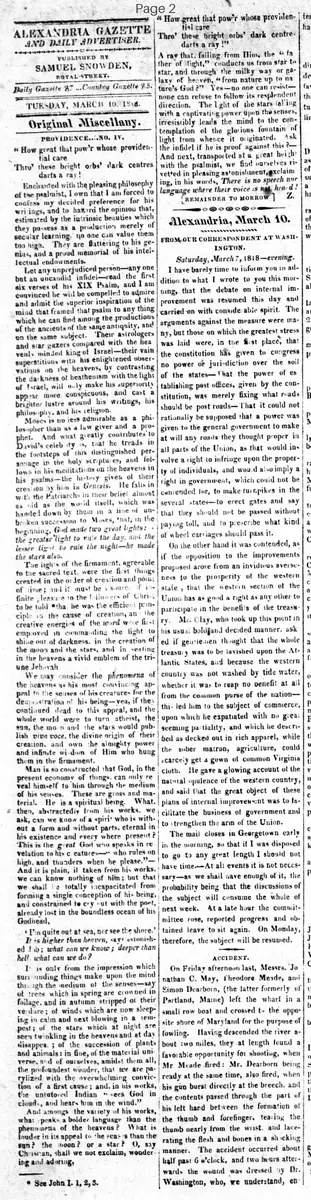
Original Miscellany.
PROVIDENCE. NO. IV.
"How great that pow'r whose providential care
Thro' these bright orbs' dark centres
darts a ray!"
Enchanted with the pleasing philosophy of the psalmist, I own that I am forced to confess my decided preference for his writings, and to hazard the opinion that, estimated by the intrinsic beauties which they possess as a production merely of secular learning, no one can value them too high. They are flattering to his genius, and a proud memorial of his intellectual endowments.
Let any unprejudiced person—any one but an uncandid infidel—read the first six verses of his XIX Psalm, and I am convinced he will be compelled to admire and admit the superior inspiration of the mind that framed that psalm to any thing of the ancients of the same antiquity, and which he can find among the productions on the same subject. Their astrologers and star gazers compared with the heavenly-minded king of Israel—their vain observations on the heavens, by contrasting the darkness of heathenism with the light of Israel, will only make his superiority appear more conspicuous, and cast a brighter lustre around his writings, his philosophy, and his religion.
Moses is no less admirable as a philosopher than as a law giver and a prophet. And what greatly contributes to David's celebrity is, that he treads in the footsteps of this distinguished personage in the holy scriptures, and follows in his meditations on the heavens in his psalms—the history given of their creation by the Patriarchs in their belief almost creates one in Genesis. He falls in as did as the world itself, which was handed down by them in a line of unbroken succession to Moses, that, in the beginning, God made two great lights—the greater light to rule the day, and the lesser light to rule the night—he made the stars also.
The lights of the firmament, agreeable to the sacred text, were the first things created in the order of creation and point of time: and it must be a source of infinite pleasure to the followers of Christ to be told that he was the efficient principle on the cause of creation, and the creative energies of the word were first employed in commanding the light to shine out of darkness, in the creation of the moon and the stars, and in seating in the heavens a vivid emblem of the triune Jehovah.
We may consider the phenomena of the heavens as his most convincing appeal to the senses of his creatures for the demonstration of his being—yea, if these continued dead to this appeal, and the whole world were to turn atheist, the sun, the moon and the stars would publish viva voce the divine origin of their creation, and own the almighty power and infinite wisdom of Him who hung them in the firmament.
Man is so constructed that God, in the present economy of things, can only reveal himself to him through the medium of his senses. These are gross and material. He is a spiritual being. What, then, abstracted from his works, we ask, can we know of a spirit who is without a form and without parts, eternal in his existence and everywhere present?
This is the great God who speaks in revelation to his creatures—who rules on high, and thunders when he please.
And it is plain, if taken from his works, we can know nothing of him; but that we shall be totally incapacitated from forming a single conception of his being, and constrained to cry out with the poet, already lost in the boundless ocean of his Godhead,
"I'm quite out at sea, nor see the shore."
It is higher than heaven, says astonished Job; what can we know? deeper than hell, what can we do?
It is only from the impression which surrounding things make upon the mind through the medium of the senses—say of trees which in spring are crowned in foliage, and in autumn stripped of their verdure; of winds which are now sleeping in calm and next blowing in a tempest; of the stars which at night are seen twinkling in the heavens and at day disappear; of the succession of plants and animals: in fine, of the material universe, and of ourselves, amidst them all, the profoundest wonder, that we are paralyzed with the overwhelming conviction of a first cause: and, in his works, the untutored Indian sees God in cloud, and hears him in the wind.
And among the variety of his works, what speaks a bolder language than the phenomena of the heavens? What is louder in its appeal to the senses than the sun? the moon? or a star? O, say Christian, shall we not exclaim, wondering and adoring,
See John I. 1, 3, 5.
"How great that pow'r whose providential care
Thro' these bright orbs' dark centres
darts a ray!"
A ray that, falling from Him, the "Father of light," conducts us from star to star, and through the milky way or galaxy of heaven, "from nature up to nature's God?" Yes—no one can resist—none can refuse to follow its resplendent direction. The light of the stars falling with a captivating power upon the senses, irresistibly leads the mind to the contemplation of the glorious fountain of light from whence it originated. Ask the infidel if he is proof against this power.
And next, transported at a great height with the psalmist, we find ourselves rivetted in pleasing astonishment, exclaiming, in his words, There is no speech nor language where their voice is not heard!
REMAINDER TO MORROW.
Z.
PROVIDENCE. NO. IV.
"How great that pow'r whose providential care
Thro' these bright orbs' dark centres
darts a ray!"
Enchanted with the pleasing philosophy of the psalmist, I own that I am forced to confess my decided preference for his writings, and to hazard the opinion that, estimated by the intrinsic beauties which they possess as a production merely of secular learning, no one can value them too high. They are flattering to his genius, and a proud memorial of his intellectual endowments.
Let any unprejudiced person—any one but an uncandid infidel—read the first six verses of his XIX Psalm, and I am convinced he will be compelled to admire and admit the superior inspiration of the mind that framed that psalm to any thing of the ancients of the same antiquity, and which he can find among the productions on the same subject. Their astrologers and star gazers compared with the heavenly-minded king of Israel—their vain observations on the heavens, by contrasting the darkness of heathenism with the light of Israel, will only make his superiority appear more conspicuous, and cast a brighter lustre around his writings, his philosophy, and his religion.
Moses is no less admirable as a philosopher than as a law giver and a prophet. And what greatly contributes to David's celebrity is, that he treads in the footsteps of this distinguished personage in the holy scriptures, and follows in his meditations on the heavens in his psalms—the history given of their creation by the Patriarchs in their belief almost creates one in Genesis. He falls in as did as the world itself, which was handed down by them in a line of unbroken succession to Moses, that, in the beginning, God made two great lights—the greater light to rule the day, and the lesser light to rule the night—he made the stars also.
The lights of the firmament, agreeable to the sacred text, were the first things created in the order of creation and point of time: and it must be a source of infinite pleasure to the followers of Christ to be told that he was the efficient principle on the cause of creation, and the creative energies of the word were first employed in commanding the light to shine out of darkness, in the creation of the moon and the stars, and in seating in the heavens a vivid emblem of the triune Jehovah.
We may consider the phenomena of the heavens as his most convincing appeal to the senses of his creatures for the demonstration of his being—yea, if these continued dead to this appeal, and the whole world were to turn atheist, the sun, the moon and the stars would publish viva voce the divine origin of their creation, and own the almighty power and infinite wisdom of Him who hung them in the firmament.
Man is so constructed that God, in the present economy of things, can only reveal himself to him through the medium of his senses. These are gross and material. He is a spiritual being. What, then, abstracted from his works, we ask, can we know of a spirit who is without a form and without parts, eternal in his existence and everywhere present?
This is the great God who speaks in revelation to his creatures—who rules on high, and thunders when he please.
And it is plain, if taken from his works, we can know nothing of him; but that we shall be totally incapacitated from forming a single conception of his being, and constrained to cry out with the poet, already lost in the boundless ocean of his Godhead,
"I'm quite out at sea, nor see the shore."
It is higher than heaven, says astonished Job; what can we know? deeper than hell, what can we do?
It is only from the impression which surrounding things make upon the mind through the medium of the senses—say of trees which in spring are crowned in foliage, and in autumn stripped of their verdure; of winds which are now sleeping in calm and next blowing in a tempest; of the stars which at night are seen twinkling in the heavens and at day disappear; of the succession of plants and animals: in fine, of the material universe, and of ourselves, amidst them all, the profoundest wonder, that we are paralyzed with the overwhelming conviction of a first cause: and, in his works, the untutored Indian sees God in cloud, and hears him in the wind.
And among the variety of his works, what speaks a bolder language than the phenomena of the heavens? What is louder in its appeal to the senses than the sun? the moon? or a star? O, say Christian, shall we not exclaim, wondering and adoring,
See John I. 1, 3, 5.
"How great that pow'r whose providential care
Thro' these bright orbs' dark centres
darts a ray!"
A ray that, falling from Him, the "Father of light," conducts us from star to star, and through the milky way or galaxy of heaven, "from nature up to nature's God?" Yes—no one can resist—none can refuse to follow its resplendent direction. The light of the stars falling with a captivating power upon the senses, irresistibly leads the mind to the contemplation of the glorious fountain of light from whence it originated. Ask the infidel if he is proof against this power.
And next, transported at a great height with the psalmist, we find ourselves rivetted in pleasing astonishment, exclaiming, in his words, There is no speech nor language where their voice is not heard!
REMAINDER TO MORROW.
Z.
What sub-type of article is it?
Essay
What themes does it cover?
Religious
Nature
What keywords are associated?
Providence
Psalm
Heavens
Creation
Divine Power
Scripture
Nature Revelation
What entities or persons were involved?
Z.
Literary Details
Title
Providence. No. Iv.
Author
Z.
Subject
Reflections On Psalm Xix And Divine Providence In The Heavens
Form / Style
Prose Meditation On Scripture And Natural Philosophy
Key Lines
"How Great That Pow'r Whose Providential Care
Thro' These Bright Orbs' Dark Centres
Darts A Ray!"
There Is No Speech Nor Language Where Their Voice Is Not Heard!
In The Beginning, God Made Two Great Lights—The Greater Light To Rule The Day, And The Lesser Light To Rule The Night—He Made The Stars Also.