Thank you for visiting SNEWPapers!
Sign up free
Literary
December 5, 1789
Gazette Of The United States
New York, New York County, New York
What is this article about?
The second installment of 'The Guest' series, contributed anonymously by 'M.', reflects on human miseries as divine tools for punishing and curing vice. Using the character Cleander, whose indulgent wit causes social distress and leads to moral awakening, it argues afflictions foster wisdom and restraint.
Clipping
OCR Quality
96%
Excellent
Full Text
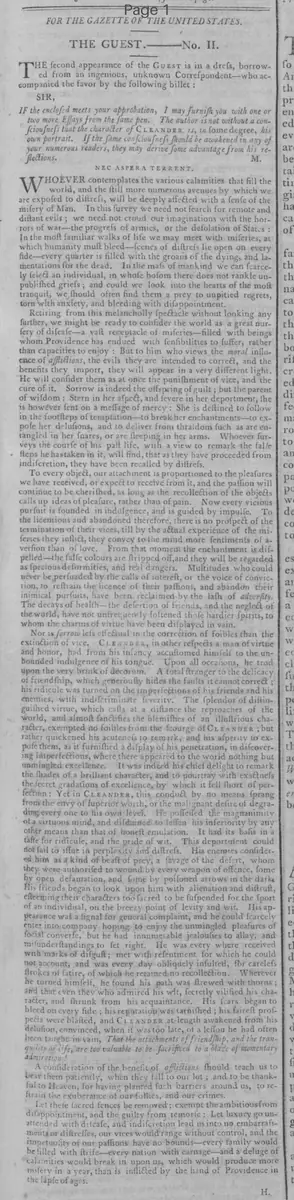
FOR THE GAZETTE OF THE UNITED STATES.
THE GUEST.
No. II.
The second appearance of the Guest is in a dress, borrowed from an ingenious, unknown Correspondent—who accompanied the favor by the following billet:
SIR,
IF the enclosed meets your approbation, I may furnish you with one or two more Essays from the same pen. The author is not without a consciousness that the character of CLEANDER is, in some degree, his own portrait. If the same consciousness should be awakened in any of your numerous readers, they may derive some advantage from his reflections.
M.
NEC ASPERA TERRENT.
The world, and the still more numerous avenues by which we are exposed to distress, will be deeply affected with a sense of the misery of Man. In this survey we need not search for remote and distant evils; we need not crowd our imaginations with the horrors of war—the progress of armies, or the desolation of States:
In the most familiar walks of life we may meet with miseries, at which humanity must bleed—scenes of distress lie open on every side—every quarter is filled with the groans of the dying, and lamentations for the dead. In the mass of mankind we can scarcely select an individual, in whose bosom there does not rankle unpublished griefs; and could we look into the hearts of the most tranquil, we should often find them a prey to unpitied regrets, torn with anxiety, and bleeding with disappointment.
Retiring from this melancholy spectacle without looking any further, we might be ready to consider the world as a great nursery of disease—a vast receptacle of miseries—filled with beings whom Providence has endued with sensibilities to suffer, rather than capacities to enjoy: But to him who views the moral influence of afflictions, the evils they are intended to correct, and the benefits they import, they will appear in a very different light.
He will consider them as at once the punishment of vice, and the cure of it. Sorrow is indeed the offspring of guilt; but the parent of wisdom: Stern in her aspect, and severe in her deportment, she is however sent on a message of mercy: She is destined to follow in the footsteps of temptation—to break her enchantments—to expose her delusions, and to deliver from thraldom such as are entangled in her snares, or are sleeping in her arms. Whoever surveys the course of his past life, with a view to remark the false steps he has taken in it, will find, that as they have proceeded from indiscretion, they have been recalled by distress.
To every object, our attachment is proportioned to the pleasures we have received, or expect to receive from it, and the passion will continue to be cherished, as long as the recollection of the objects calls up ideas of pleasure, rather than of pain. Now every vicious pursuit is founded in indulgence, and is guided by impulse. To the licentious and abandoned therefore, there is no prospect of the termination of their vices, till by the actual experience of the miseries they inflict, they convey to the mind more sentiments of aversion than of love. From that moment the enchantment is dispelled—the false colours are stripped off, and they will be regarded as specious deformities, and real dangers. Multitudes who could never be persuaded by the calls of interest, or the voice of conviction, to restrain the licence of their passions, and abandon their inimical pursuits, have been reclaimed by the lash of adversity.
The decays of health—the desertion of friends, and the neglect of the world, have not unfrequently softened those hardier spirits, to whom the charms of virtue have been displayed in vain.
Nor is sorrow less effectual in the correction of foibles than the extinction of vice. CLEANDER, in other respects a man of virtue and honor, had from his infancy accustomed himself to the unbounded indulgence of his tongue. Upon all occasions, he trod upon the very brink of decorum. A total stranger to the delicacy of friendship, which generously hides the faults it cannot correct; his ridicule was turned on the imperfections of his friends and his enemies, with indiscriminate severity. The splendor of distinguished virtue, which casts at a distance the reproaches of the world, and almost sanctifies the blemishes of an illustrious character, exempted no foibles from the scourge of CLEANDER; but rather quickened his acuteness to remark, and his asperity to expose them, as it furnished a display of his penetration, in discovering imperfections, where there appeared to the world nothing but unmingled excellence. It was indeed his chief delight to remark the shades of a brilliant character, and to portray with exactness the secret gradations of excellence, by which it fell short of perfection: yet in CLEANDER, this conduct by no means sprang from the envy of superior worth, or the malignant desire of degrading every one to his own level. He possessed the magnanimity of a virtuous mind, and disdained to lessen his inferiority by any other means than that of honest emulation. It had its basis in a taste for ridicule, and the pride of wit. This deportment could not fail to issue in perplexity and distress. His enemies considered him as a kind of beast of prey, a savage of the desert, whom they were authorized to wound by every weapon of offence, some by open defamation, and some by poisoned arrows in the dark.
His friends began to look upon him with alienation and distrust, deeming their characters too sacred to be suspended for the sport of an individual, on the airy point of levity and wit. His appearance was a signal for general complaint, and he could scarcely enter into company hoping to enjoy the unmingled pleasures of social converse, but he had innumerable jealousies to allay, and misunderstandings to set right. He was everywhere received with marks of disgust: met with resentment for which he could not account, and was every day obliquely insulted, for careless strokes of satire, of which he retained no recollection. Wherever he turned himself, he found his path was strewed with thorns; and that even they who admired his wit, secretly vilified his character, and shrunk from his acquaintance. His scars began to bleed on every side; his reputation was tarnished; his fairest prospects were blasted, and CLEANDER at length awakened from his delusion, convinced, when it was too late, of a lesson he had often been taught in vain, That the attachments of friendship, and the tranquillity of life, are too valuable to be sacrificed to a blaze of momentary admiration!
A consideration of the benefit of afflictions should teach us to bear them patiently, when they fall to our lot; and to be thankful to Heaven, for having planted such barriers around us, to restrain the exuberance of our follies, and our crimes.
Let these sacred fences be removed; exempt the ambitious from disappointment, and the guilty from remorse: Let luxury go unattended with disease, and indiscretion lead us into no embarrassments or distresses, our vices would range without control, and the impetuosity of our passions have no bounds—every family would be filled with strife—every nation with carnage—and a deluge of calamities would break in upon us, which would produce more misery in a year, than is inflicted by the hand of Providence in the lapse of ages.
THE GUEST.
No. II.
The second appearance of the Guest is in a dress, borrowed from an ingenious, unknown Correspondent—who accompanied the favor by the following billet:
SIR,
IF the enclosed meets your approbation, I may furnish you with one or two more Essays from the same pen. The author is not without a consciousness that the character of CLEANDER is, in some degree, his own portrait. If the same consciousness should be awakened in any of your numerous readers, they may derive some advantage from his reflections.
M.
NEC ASPERA TERRENT.
The world, and the still more numerous avenues by which we are exposed to distress, will be deeply affected with a sense of the misery of Man. In this survey we need not search for remote and distant evils; we need not crowd our imaginations with the horrors of war—the progress of armies, or the desolation of States:
In the most familiar walks of life we may meet with miseries, at which humanity must bleed—scenes of distress lie open on every side—every quarter is filled with the groans of the dying, and lamentations for the dead. In the mass of mankind we can scarcely select an individual, in whose bosom there does not rankle unpublished griefs; and could we look into the hearts of the most tranquil, we should often find them a prey to unpitied regrets, torn with anxiety, and bleeding with disappointment.
Retiring from this melancholy spectacle without looking any further, we might be ready to consider the world as a great nursery of disease—a vast receptacle of miseries—filled with beings whom Providence has endued with sensibilities to suffer, rather than capacities to enjoy: But to him who views the moral influence of afflictions, the evils they are intended to correct, and the benefits they import, they will appear in a very different light.
He will consider them as at once the punishment of vice, and the cure of it. Sorrow is indeed the offspring of guilt; but the parent of wisdom: Stern in her aspect, and severe in her deportment, she is however sent on a message of mercy: She is destined to follow in the footsteps of temptation—to break her enchantments—to expose her delusions, and to deliver from thraldom such as are entangled in her snares, or are sleeping in her arms. Whoever surveys the course of his past life, with a view to remark the false steps he has taken in it, will find, that as they have proceeded from indiscretion, they have been recalled by distress.
To every object, our attachment is proportioned to the pleasures we have received, or expect to receive from it, and the passion will continue to be cherished, as long as the recollection of the objects calls up ideas of pleasure, rather than of pain. Now every vicious pursuit is founded in indulgence, and is guided by impulse. To the licentious and abandoned therefore, there is no prospect of the termination of their vices, till by the actual experience of the miseries they inflict, they convey to the mind more sentiments of aversion than of love. From that moment the enchantment is dispelled—the false colours are stripped off, and they will be regarded as specious deformities, and real dangers. Multitudes who could never be persuaded by the calls of interest, or the voice of conviction, to restrain the licence of their passions, and abandon their inimical pursuits, have been reclaimed by the lash of adversity.
The decays of health—the desertion of friends, and the neglect of the world, have not unfrequently softened those hardier spirits, to whom the charms of virtue have been displayed in vain.
Nor is sorrow less effectual in the correction of foibles than the extinction of vice. CLEANDER, in other respects a man of virtue and honor, had from his infancy accustomed himself to the unbounded indulgence of his tongue. Upon all occasions, he trod upon the very brink of decorum. A total stranger to the delicacy of friendship, which generously hides the faults it cannot correct; his ridicule was turned on the imperfections of his friends and his enemies, with indiscriminate severity. The splendor of distinguished virtue, which casts at a distance the reproaches of the world, and almost sanctifies the blemishes of an illustrious character, exempted no foibles from the scourge of CLEANDER; but rather quickened his acuteness to remark, and his asperity to expose them, as it furnished a display of his penetration, in discovering imperfections, where there appeared to the world nothing but unmingled excellence. It was indeed his chief delight to remark the shades of a brilliant character, and to portray with exactness the secret gradations of excellence, by which it fell short of perfection: yet in CLEANDER, this conduct by no means sprang from the envy of superior worth, or the malignant desire of degrading every one to his own level. He possessed the magnanimity of a virtuous mind, and disdained to lessen his inferiority by any other means than that of honest emulation. It had its basis in a taste for ridicule, and the pride of wit. This deportment could not fail to issue in perplexity and distress. His enemies considered him as a kind of beast of prey, a savage of the desert, whom they were authorized to wound by every weapon of offence, some by open defamation, and some by poisoned arrows in the dark.
His friends began to look upon him with alienation and distrust, deeming their characters too sacred to be suspended for the sport of an individual, on the airy point of levity and wit. His appearance was a signal for general complaint, and he could scarcely enter into company hoping to enjoy the unmingled pleasures of social converse, but he had innumerable jealousies to allay, and misunderstandings to set right. He was everywhere received with marks of disgust: met with resentment for which he could not account, and was every day obliquely insulted, for careless strokes of satire, of which he retained no recollection. Wherever he turned himself, he found his path was strewed with thorns; and that even they who admired his wit, secretly vilified his character, and shrunk from his acquaintance. His scars began to bleed on every side; his reputation was tarnished; his fairest prospects were blasted, and CLEANDER at length awakened from his delusion, convinced, when it was too late, of a lesson he had often been taught in vain, That the attachments of friendship, and the tranquillity of life, are too valuable to be sacrificed to a blaze of momentary admiration!
A consideration of the benefit of afflictions should teach us to bear them patiently, when they fall to our lot; and to be thankful to Heaven, for having planted such barriers around us, to restrain the exuberance of our follies, and our crimes.
Let these sacred fences be removed; exempt the ambitious from disappointment, and the guilty from remorse: Let luxury go unattended with disease, and indiscretion lead us into no embarrassments or distresses, our vices would range without control, and the impetuosity of our passions have no bounds—every family would be filled with strife—every nation with carnage—and a deluge of calamities would break in upon us, which would produce more misery in a year, than is inflicted by the hand of Providence in the lapse of ages.
What sub-type of article is it?
Essay
What themes does it cover?
Moral Virtue
What keywords are associated?
Moral Essay
Afflictions
Vice Correction
Cleander
Sorrow Wisdom
Friendship
Providence
What entities or persons were involved?
M.
Literary Details
Title
The Guest. No. Ii.
Author
M.
Subject
On The Moral Benefits Of Afflictions And Correction Of Vice Through The Example Of Cleander
Form / Style
Prose Essay With Moral Reflection And Character Sketch
Key Lines
Sorrow Is Indeed The Offspring Of Guilt; But The Parent Of Wisdom: Stern In Her Aspect, And Severe In Her Deportment, She Is However Sent On A Message Of Mercy:
Multitudes Who Could Never Be Persuaded By The Calls Of Interest, Or The Voice Of Conviction, To Restrain The Licence Of Their Passions, And Abandon Their Inimical Pursuits, Have Been Reclaimed By The Lash Of Adversity.
Cleander At Length Awakened From His Delusion, Convinced, When It Was Too Late, Of A Lesson He Had Often Been Taught In Vain, That The Attachments Of Friendship, And The Tranquillity Of Life, Are Too Valuable To Be Sacrificed To A Blaze Of Momentary Admiration!
A Consideration Of The Benefit Of Afflictions Should Teach Us To Bear Them Patiently, When They Fall To Our Lot; And To Be Thankful To Heaven, For Having Planted Such Barriers Around Us, To Restrain The Exuberance Of Our Follies, And Our Crimes.