Thank you for visiting SNEWPapers!
Sign up free
Gazette Of The United States
Philadelphia, Philadelphia County, Pennsylvania
What is this article about?
U.S. House of Representatives session debated filling blanks in a bill for Indian trading houses, focusing on funding from War Department surpluses. Postponement to February carried 45-40. Claiborne's resolution for information negatived. Presidential message on expenditures received. Bankruptcy bill reported. Petitions of Randall (released) and Whitney (motion withdrawn) considered. Adjourned with Speaker's note on strangers.
Merged-components note: Relabeled from 'story' to 'domestic_news' as this is a report of congressional proceedings; merged as continuation of the same day's session in adjacent columns.
Clipping
OCR Quality
Full Text
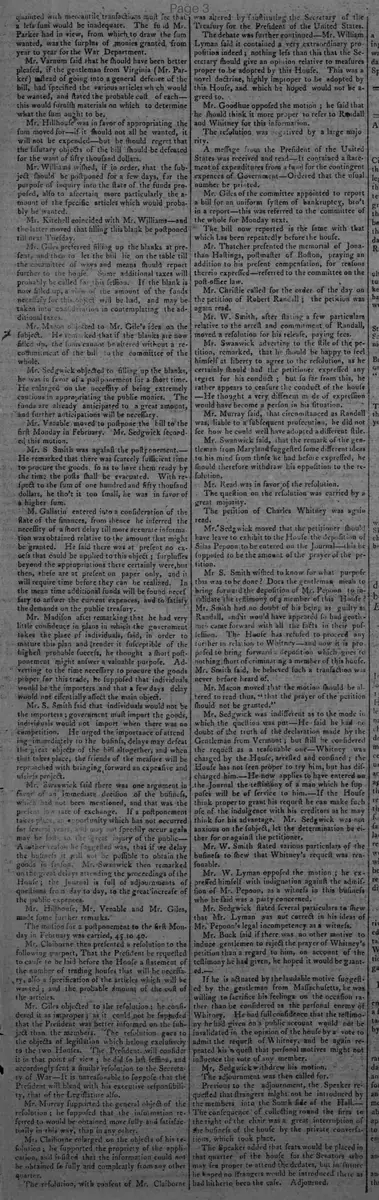
Mr. Varnum said that he should have been better pleased, if the gentleman from Virginia (Mr. Parker) instead of going into a general defence of the bill, had specified the various articles which would be wanted, and stated the probable cost of each—this would furnish materials on which to determine what the sum ought to be.
Mr. Hillhouse was in favor of appropriating the sum moved for—if it should not all be wanted, it will not be expended; but he should regret that the salutary objects of the bill should be defeated for the want of fifty thousand dollars.
Mr. Williams wished, if in order, that the subject should be postponed for a few days, for the purpose of inquiry into the state of the funds proposed, also to ascertain more particularly the amount of the specific articles which would probably be wanted.
Mr. Kitchell coincided with Mr. Williams and the latter moved that filling this blank be postponed till next Tuesday.
Mr. Giles preferred filling up the blanks at present, and then to let the bill lie on the table till the committee of ways and means should report further to the house. Some additional taxes will probably be called for this session. If the blank is now filled up, a view of the amount of the funds necessary for this subject will be had, and may be taken into consideration in contemplating the additional taxes.
Mr. Macon objected to Mr. Giles's idea on the subject. He remarked—that if the blanks are now filled up, the sums cannot be altered without a recommittal of the bill to the committee of the whole.
Mr. Sedgwick objected to filling up the blanks. He was in favor of a postponement for a short time. He enlarged on the necessity of being extremely cautious in appropriating the public monies. The funds are already anticipated to a great amount, and further anticipations will be necessary.
Mr. Venable moved to postpone the bill to the first Monday in February. Mr. Sedgwick seconded this motion.
Mr. S. Smith was against the postponement.—He remarked that there was scarcely sufficient time to procure the goods, so as to have them ready by the time the posts shall be evacuated. With respect to the sum of one hundred and fifty thousand dollars, he thought it too small, he was in favor of a higher sum.
Mr. Gallatin entered into a consideration of the state of the finances, from thence he inferred the necessity of a short delay till more accurate information was obtained relative to the amount that might be granted. He said there was at present no excess that could be applied to this object; surpluses beyond the appropriations there certainly were, but then, these are at present on paper only, and it will require time before they can be realized. In the mean time additional funds will be found necessary to answer the current expenses, and to satisfy the demands on the public treasury.
Mr. Madison after remarking that he had very little confidence in plans in which the government takes the place of individuals, said, in order to mature this plan and render it susceptible of the highest probable success, he thought a short postponement might answer a valuable purpose. Adverting to the time necessary to procure the goods proper for this trade, he supposed that individuals would be the importers and that a few days delay would not essentially affect the main object.
Mr. S. Smith said that individuals would not be the importers; government must import the goods, individuals would not import when there was no competition. He urged the importance of attending immediately to the business, delays may defeat the great objects of the bill altogether; and when that takes place, the friends of the measure will be reproached with bringing forward an expensive and useless project.
Mr. Swanwick said there was one argument in favor of an immediate decision of the business, which had not been mentioned, and that was the present low rate of exchange. If a postponement takes place, an opportunity which has not occurred for several years, and may not speedily occur again may be lost, to the great injury of the public. Another reason he suggested was, that if we delay the business it will not be possible to obtain the goods in season. Mr. Swanwick then remarked on the great delays attending the proceedings of the House; the Journal is full of adjournments of questions from day to day, to the great increase of the public expenses.
Mr. Hillhouse, Mr. Venable and Mr. Giles, made some further remarks.
The motion for a postponement to the first Monday in February was carried, 45 to 40.
Mr. Claiborne then presented a resolution to the following purport, That the President be requested to cause to be laid before the House a statement of the number of trading houses that will be necessary, also a specification of the articles which will be wanted; and the probable amount of the cost of the articles.
Mr. Giles objected to the resolution; he considered it as improper; as it could not be supposed that the President was better informed on the subject than the members. The resolution goes to the objects of legislation which belong exclusively to the two Houses. The President will consider it in that point of view; he did so last session, and accordingly sent a similar resolution to the Secretary of War—It is unreasonable to suppose that the President will blend with his executive responsibility, that of the Legislature also.
Mr. Murray supported the general object of the resolution; he supposed that the information referred to would be obtained more fully and satisfactorily in this way, than in any other.
Mr. Claiborne enlarged on the objects of his resolution; he supported the propriety of the application, and insisted that the information could not be obtained so fully and completely from any other quarter.
The resolution, with consent of Mr. Claiborne was altered by substituting the Secretary of the Treasury for the President of the United States.
The debate was further continued. Mr. William Lyman said it contained a very extraordinary proposition indeed; nothing less than this that the Secretary should give an opinion relative to measures proper to be adopted by this House. This was a novel doctrine, highly improper to be adopted by this House, and which he hoped would not be agreed to.
Mr. Goodhue opposed the motion; he said that he should think it more proper to refer to Randall and Whitney for this information.
The resolution, was negatived by a large majority.
A message from the President of the United States was received and read—It contained a statement of expenditures from a fund for the contingent expenses of Government—Ordered that the usual number be printed.
Mr. Giles of the committee appointed to report a bill for an uniform system of bankruptcy, brought in a report—this was referred to the committee of the whole for Monday next.
The bill now reported is the same with that which has been repeatedly before the house.
Mr. Thatcher presented the memorial of Jonathan Hastings, postmaster of Boston, praying an addition to his present compensation, for reasons therein expressed referred to the committee on the post-office law.
Mr. Christie called for the order of the day on the petition of Robert Randall; the petition was again read.
Mr. W. Smith, after stating a few particulars relative to the arrest and commitment of Randall, moved a resolution for his release, paying fees.
Mr. Swanwick adverting to the title of the petition, remarked, that he should be happy to feel himself at liberty to agree to the resolution, as he certainly should had the petitioner expressed any regret for his conduct; but so far from this, he rather appears to censure the conduct of the house—He thought a very different mode of expression would have become a person in his situation.
Mr. Murray said, that circumstanced as Randall was, liable to a subsequent prosecution, he did not see how he could well have adopted a different title.
Mr. Swanwick said, that the remark of the gentleman from Maryland suggested some different ideas to his mind from those he had before expressed, he should therefore withdraw his opposition to the resolution.
Mr. Read was in favor of the resolution.
The question on the resolution was carried by a great majority.
The petition of Charles Whitney was again read.
Mr. Sedgwick moved that the petitioner should have leave to exhibit to the House, the deposition of Silas Pepoon to be entered on the Journal—this he supposed to be the amount of the prayer of the petition.
Mr. S. Smith wished to know for what purpose this was to be done? Does the gentleman mean to bring forward the deposition of Mr. Pepoon to invalidate the testimony of a member of this House?
Mr. Smith had no doubt of his being as guilty as Randall, and it would have appeared so had gentlemen come forward with all the facts in their possession. The House has refused to proceed any further in relation to Whitney—and now it is proposed to bring forward a deposition which goes to nothing short of criminating a member of this house.
Mr. Smith said, he believed such a transaction was never before heard of.
Mr. Macon moved that the motion should be altered to read thus, "that the prayer of the petition should not be granted."
Mr. Sedgwick was indifferent as to the mode in which the question was put. He said he had no doubt of the truth of the declaration made by the Gentleman from Vermont; but still he considered the request as a reasonable one—Whitney was charged by the House, arrested and confined; the House has not seen proper to try him, but has discharged him.—He now applies to have entered on the Journal the testimony of a man which he supposes will be of service to him. If the House think proper to grant his request he can make such use of the indulgence with his creditors as he may think for his advantage. Mr. Sedgwick was not anxious on the subject, let the determination be either for or against the petitioner.
Mr. W. Smith stated various particulars of the business to show that Whitney's request was reasonable.
Mr. W. Lyman opposed the motion; he expressed himself with indignation against the admission of Mr. Pepoon, as a witness in this business who he said was a party concerned.
Mr. Sedgwick stated several particulars to show that Mr. Lyman was not correct in his ideas of Mr. Pepoon's legal incompetency as a witness.
Mr. Buck said if there was no other motive to induce gentlemen to reject the prayer of Whitney's petition than a regard to him, on account of the testimony he had given, he hoped it would be granted. If he is actuated by the laudable motive suggested by the gentleman from Massachusetts, he was willing to sacrifice his feelings on the occasion rather than be considered as the personal enemy of Whitney. He had full confidence that the testimony he had given on a public account would not be invalidated in the opinion of the house by a vote to admit the request of Whitney. and he again repeated his request that personal motives might not influence the vote of any member.
Mr. Sedgwick withdrew his motion.
The adjournment was then called for.
Previous to the adjournment, the Speaker requested that strangers might not be introduced by the members into the South side of the Hall.—The consequence of collecting round the fires to the right of the chair was a great interruption of the business of the house by the private conversations, which took place.
The Speaker added that seats would be placed in that quarter of the house, for the Senators who may see proper to attend the debates, but in future he hoped no strangers would be introduced there as had hitherto been the case. Adjourned.
What sub-type of article is it?
What keywords are associated?
What entities or persons were involved?
Domestic News Details
Key Persons
Outcome
bill postponed to first monday in february by vote of 45 to 40; claiborne's resolution negatived by large majority; randall's release resolution carried by great majority; whitney's motion withdrawn; bankruptcy report referred; hastings' memorial referred; presidential message printed.
Event Details
House debated funding and specifics for a bill establishing trading houses and procuring goods for evacuated posts, likely related to Indian affairs, with arguments on finances, surpluses, and urgency. Postponement motion carried. Claiborne's resolution for information from Treasury Secretary opposed and defeated. Presidential message on expenditures received and ordered printed. Giles reported bankruptcy bill, referred to committee. Thatcher presented postmaster Hastings' memorial for compensation increase, referred. Randall's petition led to release resolution passed. Whitney's petition for entering Pepoon's deposition debated and motion withdrawn. Speaker addressed stranger interruptions before adjournment.