Thank you for visiting SNEWPapers!
Sign up free
The Enquirer
Richmond, Henrico County, Virginia
What is this article about?
The Enquirer reprints and critiques Philip Doddridge's Senate protest against Virginia General Assembly resolutions expressing confidence in President Jefferson's wisdom, virtue, and firmness amid foreign threats. The editorial defends the resolutions as justified partisan support, refuting Doddridge's charges of inconsistency and overreach.
Merged-components note: Single continuous editorial in The Enquirer: printing Doddridge's protest against resolutions on the President, followed by reflections and analysis, spanning pages.
Clippings
1 of 2
OCR Quality
Full Text
RICHMOND, 8th FEBRUARY.
PROTEST against PROTEST.
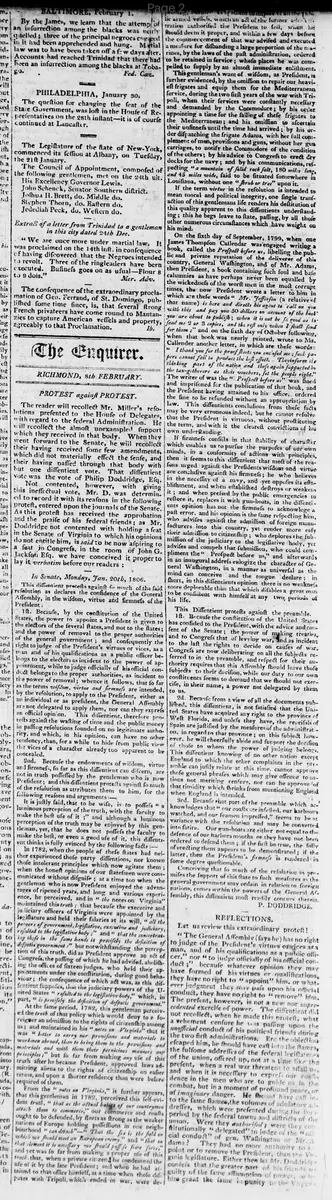
The reader will recollect Mr. Miller's resolutions presented to the House of Delegates, with regard to the federal Administration. He will recollect the almost unexampled support which they received in that body. When they went forward to the Senate, he will recollect their having received some few amendments, which did not materially affect the sense, and their having passed through that body with but one dissentient vote. That dissentient vote was the vote of Philip Doddridge, Esq. Not contented, however, with giving this ineffectual vote, Mr. D. was determined to record it with its reasons in the following protest, entered upon the journals of the Senate. As this protest has received the approbation and the praise of his federal friends; as Mr. Doddridge not contented with holding a seat in the Senate of Virginia to which his opinions do not entitle him, is said to be now aspiring to a seat in Congress, in the room of John G. Jackson Esq. we have conceived it proper to lay it verbatim before our readers :
In Senate, Monday, Jan. 20th, 1806.
This dissentient protests against so much of the said resolution as declares the confidence of the General Assembly, in the wisdom, virtue and firmness of the President :
1st. Because, by the constitution of the United States, the power to appoint a President is given to the electors of the several states, and not to the states; and the power of removal to the proper authorities of the general government; and consequently the right to judge of the President's virtues or vices, as a man and of his qualifications as a public officer belongs to the electors as incident to the power of appointment, while to judge officially of his official conduct belongs to the proper authorities, as incident to the power of removal; whence it follows, that so far as the terms wisdom, virtue and firmness are intended, by the resolution, to apply to the President, either as an individual or as president, the General Assembly are not delegated to apply them, nor can they express an official opinion. This dissentient, therefore protests against the wasting of time and the public money in passing resolutions founded on no legitimate authority, and which, in his opinion, can have no other tendency, than, for a while to hide from public view the vices of a character already too apparent to be concealed.
2nd. Because the endowments of wisdom, virtue and firmness, so far as this dissentient can discern, are not in truth possessed by the gentleman who is now President; and this dissentient protests against so much of the resolution as attributes them to him, for the following reasons and arguments :
It is justly said, that to be wise, is to possess "a luminous perception of the truth, with the faculty to make the best use of it ;" and although a luminous perception of the truth may be enjoyed by this gentleman, yet, that he does not possess the faculty to make the best, or even a good use of it, this dissentient thinks is fully evinced by the following facts :—
In 1782, when the people of these states had neither experienced those party dissensions, nor known those intolerant principles which now agitate them; when the honest opinions of our statesmen were communicated without disguise ; at a time too when the gentleman who is now President enjoyed the advantages of ripened years, and long and various experience, he perceived, and in "the notes on Virginia" maintained this truth ; that because the executive and judiciary officers of Virginia were appointed by the legislature and held their salaries at its will, "all the powers of government, legislative, executive and judiciary, resulted to the legislative body :" and "that the concentrating these in the same hands is precisely the definition of despotic government :" but notwithstanding the perception of this truth. did as President approve an act of Congress, the passing of which he had advised. abolishing the offices of sixteen judges, who held their appointments under the constitution, during good behaviour; the consequence of which act was, as this dissentient supposes, that the judiciary powers of the United States "resulted to the legislative body," which, in part, "is precisely the definition of despotic government."
At the same period, 1782, this gentleman perceived the truth of that policy which would deny to a foreigner an admission to the rights of citizenship among us; and maintained in his "notes on Virginia" that it was "better to carry our provisions and materials to workmen abroad, than to bring them to the provisions and materials and with them their pernicious manners and principles;" but so far from making any use of this truth after he became President, approved laws admitting aliens to the rights of citizenship on easier terms, and upon a shorter residence than were before required of them.
From the "notes on Virginia," it further appears, that this gentleman in 1782, perceived this self-evident truth, "that as the actual habitus of our countrymen attach them to commerce," our commerce and coasts ought to be defended, by fleets as strong as the weaker nations of Europe holding possessions in one neighbourhood "can detach"— That the sea is the field on which we should meet an European enemy" and "that on that element it is necessary we should possess some force." and yet was so far from making a proper use of this truth, that, when a private citizen. he condemned the use of it by the late President; and when he had attained to that office himself, at a time when those disputes with Tripoli, which ended in war, were developing themselves, the administration authorized the President to sell, when he should deem it proper, and within a few days before the commencement of that war advised and executed a measure for disbanding a large proportion of the marines, by the laws of the past administration, ordered to be retained in service; whose places he was compelled to supply by an almost immediate enlistment.
This gentleman's want of wisdom, as President, is further evidenced, by the omission to repair our heaviest frigates and equip them for the Mediterranean service, during the two first years of the war with Tripoli, when their services were constantly necessary and demanded by the Commodore; by his order appointing a time for the sailing of these frigates to the Mediterranean; and his omission to ascertain their unfitness until the time had arrived; by his order dispatching the frigate Adams, with her full complement of men, provisions and guns, without her gun carriages, to notify the Commodore of the condition of the others; by his advice to Congress to erect dry docks for the navy; and by his communications, respecting "a mountain of solid rock salt, 180 miles long. and 45 miles wide, said to be situated somewhere in Louisiana, without one "brush or tree" upon it.
If the term virtue in the resolution is intended to mean moral and political integrity, one single transaction of this gentleman's life renders his destitution of this quality apparent to this dissentient's understanding; this he begs leave to state, passing, by all those other numerous circumstances which have weight on his mind.
On the sixth day of September, 1799, when one James Thompson Callender was engaged writing a book, called the Prospect before us, libelling the public and private reputation of the deliverer of this country, General Washington, and of Mr. Adams, then President, a book containing such foul and base calumnies as have perhaps never been equalled by the wickedness of the worst men in the most corrupt times, the now President wrote a letter to him in which are these words "Mr. Jefferson (a relative of that name) is here and directs his agent to call on you with this and pay you 50 dollars on account of the book you are about to publish; when it is out be so good as to. send me 2 or 3 copies, and the rest only when I shall send for them ;" and on the sixth day of October following, when that book was nearly printed, wrote to Mr. Callender another letter, in which are these words:
"I thank you for the proof sheets you enclosed me: such papers cannot fail to produce the best effect. - They inform the thinking part of the nation and its base again supported by the tax-gatherers as their vouchers, set the people right."
The writer of was the "Prospect before us" was fined and imprisoned for the publication of that book, and the President having attained to his office, ordered the fine to be refunded without an appropriation by law. This dissentient's conclusions from these facts may be very erroneous indeed, but he cannot resolve that the President is virtuous, without prostituting the term, and with it the clearest convictions of his own understanding
FT
If firmness consists in that Stability of character which enables us to pursue the purposes of our own minds, in a conformity of actions with principles, then it seems to this dissentient that most of the reasons urged against the President's wisdom and virtue are conclusive against his firmness; he who believes in the necessity of a navy, and yet opposes its establishment, and when established destroys or weakens it ; and when pressed by the public emergencies to restore it, replaces it with gun-boats, in the dissentient's opinion has not the firmness to acknowledge a past error. and his opinion is the same respecting him, who advises against the admission of foreign manufacturers into this country, yet render more easy their admission to citizenship ; who deplores the submission of the judiciary to the legislative body, yet advises and compels that submission, who could compliment the "Prospect before us," and afterwards in an inaugural address eulogize the character of General Washington, in a manner as universal as the mind can conceive 'and the tongue declare; in short, in this dissentient's opinion there is no weakness more deplorable than that which disables a great man to be consistent with himself at any two periods of his life.
This Dissentient protests against the preamble.
1st. Because the constitution of the United States has confided to the President, with the advice and consent of the Senate; the power of making treaties. and to Congress that of levying war, and as incident to the last the rights to decide on causes of war. Congress are now deliberating on all the subjects referred to in the preamble, and respect for their authority requires that this Assembly should leave those subjects to their decision, while our duty to our own constituents seems to demand that we should not exercise, in their name, a power not delegated by them to us.
2d. Because from a view of all the documents published. this dissentient, is not satisfied that the United States have acquired any right to the province of West Florida, and unless they have, the remonstrals of Spain are justified by the measures of the administration, in regard to that province; on this subject however. he will cheerfully abide and support the decision of those to whom the power of judging belongs.
This dissentient knowing of no other nation except England to which the other complaints in the preamble can justly relate at this time. cannot approve those general phrases which may give offence to nations not meriting censure. nor can he approve of that timidity which shrinks from mentioning England when England is intended.
3rd. Because that part of the preamble which acknowledges that "our coasts are infested, our harbours watched, and our seamen impressed," seems to be at variance with the resolution and may be converted into satire. Our gun-boats are either not equal to the defence of our harbors mouths or they have not been ordered to defend them; if the first be true, the folly of erecting them appears to be demonstrated; if the latter, then the President's firmness is rendered in some degree questionable.
Conceiving that so much of the resolution as promises the support of this state to such measures as the general government may ordain in relation to foreign nations, comes within the powers of the General Assembly, this dissentient most readily concurs therein.
P. DODDRIDGE.
REFLECTIONS
Let us review this extraordinary protest!
"The General Assembly (says he) has no right to judge of the President's virtues or vices as a man, and of his qualifications as a public officer," nor "to judge officially of his official conduct;" because whatever opinion they may have formed of his virtues or qualifications, they have no right to "appoint" him, or whatever judgment they may pass upon his official conduct, they have no right to "remove" him.
The present, however, is not a new nor unprecedented exercise of power. The dissentient did not recollect, when he made this protest, what a vehement censure he was passing upon the unofficial conduct of his political friends during the two first administrations. Ere the objection escaped him, he should have cast into the flames, the fulsome addresses of the federal legislatures of the union, offered up, not at a time like the present, when a real war threatens to assail us, and when it is necessary to express our confidence in the men who are to guide us in the combat, but in a moment of profound peace, or of imaginary danger. He should have cast into the same flames, the volumes of adulatory addresses, which were presented during the same period by the federal towns and districts of the union. Were they authorized : were they constitutionally "delegated" to judge of the "official conduct" of gen. Washington or Mr. Adams? They had no more authority to appoint or to remove the President, than the Virginia legislature. Either then let Mr. Doddridge confess that the greater part of his friends were guilty of the same assumption of power, or grant the same impunity to the Va. legislature.
But it is not precedent alone which justifies the practice; there is nothing in the constitution of Virginia or of the U. S. which virtually forbids it. The last certainly forbids the appointment or removal of the President by the state legislatures; but are not those very different from the power of judging of his official qualifications or conduct? If the power of "official judgment" were co-extensive only with the power of appointment or removal, might not this consequence follow, that though the President should violate the constitution of the United States, & encroach upon the state authorities, the legislature would have no right to "judge" of his conduct, because they neither had the right of appointing nor of removing him? We admit, that though the power of "official judgment" is not prohibited by the constitution, yet that the respect due by the states to the federal authority, and the probable danger of insensible encroachment, should teach them to exercise it with the utmost circumscription. We should not wish, for example, to see the executives of the different states so frequently commenting upon federal matters, or the Legislatures offering up the most adulatory addresses to the President, when the public good does not require the expression of their sentiments. But the present resolution is not from the executive but from the legislature; it is not dictated by a wish to exhibit the triumphs of a party, or to flatter the vanity of their chief, but from a wish to inform foreign nations of the resolution with which we will oppose their aggressions and the confidence with which we will support our present administration. Even the dissenter himself would have "readily concurred" in "so much of the resolution as promises the support of this State to such measures as the general government may ordain in relation to foreign nations," had he not entertained some doubts about our right to the province of West Florida. Even the dissenter himself would have joined in a measure, which was calculated to bear to foreign countries the idea of our unanimity and confidence, had his understanding been unequivocally enlisted on our side. How then can he reconcile it to himself, to deny to the rest of his colleagues the right of avowing their approbation not only of the cause for which we may contend, but of the government who is to conduct us; when that avowal may inspire foreign nations with a greater respect for our unanimity and respect; and when that "official judgement" is neither expressly nor by implication forbidden by either of the constitutions of their country? Let us add, how can Mr. Doddridge reconcile it to the character of a liberal and ingenuous spirit, to attribute "no other tendency" to this Resolution, "than to hide from public view, the vices of a character, already too apparent to be concealed" when it is impossible but he must know how strongly the display of public spirit in a representative government is calculated to modify the measures of an adversary nation?
"To be wise (says our dissenter under this second count) is to possess a luminous perception of the truth, with the faculty to make the best use of it." We will not quibble about definitions; though the present is too vague to admit of a general acquiescence. Many men deserve the character of wise men, who are entirely divested of the "faculty of making the best use" of their extensive information. They are sound philosophers in theory, tho' entirely unacquainted with the details of its application. There is another class of wise men, who possess the character, because they have the "faculty of making the best use" of the little information which they possess. Let not Mr. Doddridge then accuse us of a want of liberality, when for this reason, we give him a seat among the wise men, though he has thought proper to exclude Mr. Jefferson from all pretensions to their society, because with all his extensive information, he has not the faculty of applying it to the best purposes.
Lest the accuracy of the definition, however, be completely admitted; let no one hereafter pass under the character of a wise man, who has not only "a luminous perception of truth," but who has the "faculty to make the best use of it;" of what avail will this be to the dissenter? We ask him, how many truths it is necessary to perceive, to come up to his standard of wisdom? We ask him how many truths a man must lose the faculty of applying, before he can lose his pretensions to wisdom? But we more particularly demand, why, in judging of Mr. Jefferson, he does not look at him for what he is, and why go back 22 years to see what he has been? To prove that Mr. Jefferson is not now a wise man, he must take Mr. J. as he exists, with all his present perceptions and his actual faculties. He must not travel back 22 years and compare his perceptions at that day with his present practice; but he must admit the pretensions of his opponent, if he does not prove him wanting in the faculty of making the best use of those truths, of which he has now a luminous perception.
Mr. Doddridge may indeed escape from this embarrassment, by the paradoxical assertion, that no man is wise who ever changes his perceptions. He must suppose that the fixedness of opinion is the principal attribute of wisdom, and that he only can be a sage, who continues to think in spite of experience, and to cling to prepossessions when every reason has evaporated that gave them colouring. But in the language of an ingenious moralist, we may say: "There is no man knows better than the man of talents, that he was a fool: for there is no man that finds in the records of his memory such astonishing disparities to contrast with each other. He can recollect up to what period he was jejune, and up to what period he was dull. He can call to mind the innumerable errors of speculation he has committed, that would almost disgrace an idiot. His life divides itself in his conception into distinct periods, and he has said to himself ten times in its course, from such a time I began to live: the mass of what went before, was too poor to be recollected with complacence. In reality each of these stages was an improvement upon that which went before; and it is perhaps only at the last of them that he became, what the ignorant vulgar supposed he was from the moment of his birth."
"The Notes on Virginia" were written in the year 1781; the measures which Mr. Doddridge has put into opposition to the opinions of their author, were brought forth in 1801 and 1802. Who can presume to say, how many old opinions he would have discarded or how many new truths he might have perceived, within that long period! It is in vain to say that Mr. Jefferson even at that time "enjoyed the advantages of ripened years, and long and various experience;" for independently of the length of the interval, the importance of the events, and the nature of the experience which it involved, might have eminently changed the perceptions of his understanding. His Notes were written in a crisis of war, when every thing is unfavourable to calm speculation. It was a war, which was about to make his country what it never had been before, independent of a foreign power, which changed the whole course of its existing policy, and even changed the destiny of the whole world by the introduction of a republican government. Every thing was full of
colonies were expiring and coming into life; men knew not what to think of the scenes that were passing before their eyes, much less of grasping at the condition which was to succeed them. A period of peace & independence ensued. The events which it produced were of a different cast from those which had occurred during our colonial condition or during the unsettled tumults of the war. New experiments were made upon the basis of an unsettled country, and the theory of a republican government: new views arose upon the understandings of our statesmen. Even then had Mr. Jefferson been a Methuselah in age, he could not at that time have been a Solomon in wisdom, since he could not say there had been "nothing new to him under the sun."
But how is this inconsistency established between his opinions in 1781, and his actions in 1801? What truths did he perceive during the former period, which he has forgotten or abandoned during the last? Review Mr. Doddridge's statement, and see whether there is a single fact, which establishes the assertion. If we take up his first quotation from "the notes on Virginia" relative to the judiciary department, what a frivolous illustration have we of "much ado about nothing!" Why refer to "the notes" at all for this almost universal definition of despotic power? It is to be found in almost every writer on political checks and balances. It is not the opinion of Mr. Jefferson alone, an inhabitant of Virginia and deciding upon a mere question of national policy; it is the opinion of almost every friend of freedom, on the general structure of government. Why refer to it? because it was not the wish of Mr. D. to prove that Mr. J. had done an act which was hostile to republican government, but one which was at war with his own previous perceptions. Mr. Doddridge methinks, had laid down a most luminous definition of wisdom; he had ransacked the whole course of Mr. Jefferson's long life to prove that he "had no faculty to make use" of his perceptions of truth; and not finding more than two cases, (the one relative to a navy, the other to the migration of foreigners) which seemed to countenance his position, he was willing, aye rather he was compelled, to eke out the exhibition, by bringing in a general maxim of Mr. Jefferson's, not at all admitting of a specific application, to that particular action, but capable of being twisted by a forced construction into a charge of inconsistency. Methinks, it would have been better for Mr. D. to have cut up "the notes" into small phrases, each of them to be susceptible of any application whatever, & by fixing them upon every minute action of Mr. J's life, to prove him guilty of innumerable inconsistencies.
But the fact which he assumes is not more inaccurate, than the conclusion, which he draws from it. There is no exercise, here, of despotic power. The judges did not hold "their appointments under the constitution" but under a repealable law. Why however fatigue the reader by repeating the volume of arguments urged in justification of this measure? Why call up, from their graves, these "sixteen judges" who like Macbeth's witches owe their birth to a midnight hour?
(To be continued.)
What sub-type of article is it?
What keywords are associated?
What entities or persons were involved?
Editorial Details
Primary Topic
Defense Of Virginia Resolutions Supporting President Jefferson Against Doddridge's Protest
Stance / Tone
Strongly Pro Jefferson And Pro Resolution, Critical Of Doddridge And Federalists
Key Figures
Key Arguments