Thank you for visiting SNEWPapers!
Sign up free
Letter to Editor
May 23, 1836
The Watchman
Hartford, Hartford County, Connecticut
What is this article about?
A church deacon responds to a letter by 'M.' defending their pastor's settlement but critiquing his methods for fostering revivals through excessive human excitement rather than relying on divine intervention, advocating patience in admitting converts and sustainable religious practice.
Clipping
OCR Quality
95%
Excellent
Full Text
FOR THE WATCHMAN.
Mr. Editor,
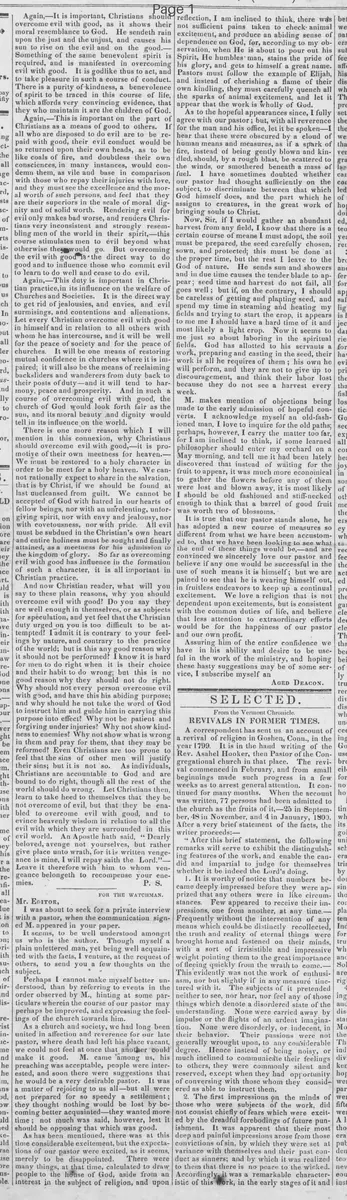
I was about to seek for a private interview with a pastor, when the communication signed M. appeared in your paper. It seems, to be well understood amongst us who is the author. Though myself a plain unlettered man, yet being well acquainted with the facts, I venture, at the request of others, to send you a few thoughts on the subject. Perhaps I cannot make myself better understood, than by referring to events in the order observed by M., hinting at some particulars wherein the course of our pastor may perhaps be improved, and expressing the feelings of the church towards him.
As a church and society, we had long been united in affection and reverence for our late pastor, where death had left his place vacant, we could not feel at once that another could make it good. M. came among us, his preaching was acceptable, people were interested, and soon there were suggestions that he would be a very desirable pastor. It was a matter of rejoicing to us all—but all were not prepared for so speedy a settlement; they thought nothing would be lost by becoming better acquainted-they wanted more time; not much was said, however, lest it should be opposing that which was good.
As has been mentioned, there was at this time considerable excitement, but the expectations of our pastor were excited, as it seems, merely to be disappointed. There were many things, at that time, calculated to draw people to the house of God, aside from an interest in the subject of religion, and upon reflection, I am inclined to think, there was not sufficient pains taken to check animal excitement, and produce an abiding sense of dependence on God, for, according to my observation, when He is about to pour out his Spirit, He humbles man, stains the pride of his glory, and gets to himself a great name. Pastors must follow the example of Elijah, and instead of cherishing a flame of their own kindling, they must carefully quench all the sparks of animal excitement, and let it appear that the work is wholly of God.
As to the hopeful appearances since, I fully agree with our pastor; but, with all reverence for the man and his office, let it be spoken—I hear that these were obscured by a cloud of human means and measures, as if a spark of fire, instead of being gently blown and kindled, should, by a rough blast, be scattered to the winds, or smothered beneath a mass of fuel. I have sometimes doubted whether our pastor had thought sufficiently on the subject, to discriminate between that which God himself does, and the part which he assigns to creatures, in the great work of bringing souls to Christ.
Now, Sir, if I would gather an abundant harvest from any field, I know that there is a certain course of means I must adopt, the soil must be prepared, the seed carefully chosen, sown, and protected; this must be done at the proper time, but the rest I leave to the God of nature. He sends sun and showers and in due time causes the tender blade to appear; seed time and harvest do not fail, all goes well; but if, on the contrary, I should be careless of getting and planting seed, and spend my time in steaming and heating my fields and trying to start the crop, it appears to me I should have a hard time of it and most likely a light crop. Now it seems to me just so about laboring in the spiritual fields. God has allotted to his servants a work, preparing and casting in the seed, their work is all he requires of them; his own he will perform, and they are not to give up to discouragement, and think their labor lost because they do not see a harvest every week.
M. makes mention of objections being made to the early admission of hopeful converts. I acknowledge myself an old-fashioned man, I love to inquire for the old paths; perhaps, however, I carry the matter too far, for I am inclined to think, if some learned philosopher should enter my orchard on a May morning, and tell me it had been lately discovered that instead of waiting for the fruit to appear, it was much more economical to gather the flowers before any of them were lost and blown away, it is most likely I should be old fashioned and stiff-necked enough to think that a barrel of good fruit was worth two of blossoms.
It is true that our pastor stands alone, he has adopted a new course of measures so different from what we have been accustomed to. that we have been looking to see what the end of these things would be,-and are convinced we sincerely love our pastor and believe if any one would be successful in the use of such means it is himself; but we are pained to see that he is wearing himself out, in fruitless endeavors to keep up a continual excitement. We love a religion that is not dependent upon excitements, but is consistent with the common duties of life, and believe that less attention to extraordinary efforts would be for the happiness of our pastor and our own profit.
Assuring him of the entire confidence we have in his ability and desire to be useful in the work of the ministry, and hoping these hasty suggestions may be of some service, I subscribe myself an
Aged Deacon.
Mr. Editor,
I was about to seek for a private interview with a pastor, when the communication signed M. appeared in your paper. It seems, to be well understood amongst us who is the author. Though myself a plain unlettered man, yet being well acquainted with the facts, I venture, at the request of others, to send you a few thoughts on the subject. Perhaps I cannot make myself better understood, than by referring to events in the order observed by M., hinting at some particulars wherein the course of our pastor may perhaps be improved, and expressing the feelings of the church towards him.
As a church and society, we had long been united in affection and reverence for our late pastor, where death had left his place vacant, we could not feel at once that another could make it good. M. came among us, his preaching was acceptable, people were interested, and soon there were suggestions that he would be a very desirable pastor. It was a matter of rejoicing to us all—but all were not prepared for so speedy a settlement; they thought nothing would be lost by becoming better acquainted-they wanted more time; not much was said, however, lest it should be opposing that which was good.
As has been mentioned, there was at this time considerable excitement, but the expectations of our pastor were excited, as it seems, merely to be disappointed. There were many things, at that time, calculated to draw people to the house of God, aside from an interest in the subject of religion, and upon reflection, I am inclined to think, there was not sufficient pains taken to check animal excitement, and produce an abiding sense of dependence on God, for, according to my observation, when He is about to pour out his Spirit, He humbles man, stains the pride of his glory, and gets to himself a great name. Pastors must follow the example of Elijah, and instead of cherishing a flame of their own kindling, they must carefully quench all the sparks of animal excitement, and let it appear that the work is wholly of God.
As to the hopeful appearances since, I fully agree with our pastor; but, with all reverence for the man and his office, let it be spoken—I hear that these were obscured by a cloud of human means and measures, as if a spark of fire, instead of being gently blown and kindled, should, by a rough blast, be scattered to the winds, or smothered beneath a mass of fuel. I have sometimes doubted whether our pastor had thought sufficiently on the subject, to discriminate between that which God himself does, and the part which he assigns to creatures, in the great work of bringing souls to Christ.
Now, Sir, if I would gather an abundant harvest from any field, I know that there is a certain course of means I must adopt, the soil must be prepared, the seed carefully chosen, sown, and protected; this must be done at the proper time, but the rest I leave to the God of nature. He sends sun and showers and in due time causes the tender blade to appear; seed time and harvest do not fail, all goes well; but if, on the contrary, I should be careless of getting and planting seed, and spend my time in steaming and heating my fields and trying to start the crop, it appears to me I should have a hard time of it and most likely a light crop. Now it seems to me just so about laboring in the spiritual fields. God has allotted to his servants a work, preparing and casting in the seed, their work is all he requires of them; his own he will perform, and they are not to give up to discouragement, and think their labor lost because they do not see a harvest every week.
M. makes mention of objections being made to the early admission of hopeful converts. I acknowledge myself an old-fashioned man, I love to inquire for the old paths; perhaps, however, I carry the matter too far, for I am inclined to think, if some learned philosopher should enter my orchard on a May morning, and tell me it had been lately discovered that instead of waiting for the fruit to appear, it was much more economical to gather the flowers before any of them were lost and blown away, it is most likely I should be old fashioned and stiff-necked enough to think that a barrel of good fruit was worth two of blossoms.
It is true that our pastor stands alone, he has adopted a new course of measures so different from what we have been accustomed to. that we have been looking to see what the end of these things would be,-and are convinced we sincerely love our pastor and believe if any one would be successful in the use of such means it is himself; but we are pained to see that he is wearing himself out, in fruitless endeavors to keep up a continual excitement. We love a religion that is not dependent upon excitements, but is consistent with the common duties of life, and believe that less attention to extraordinary efforts would be for the happiness of our pastor and our own profit.
Assuring him of the entire confidence we have in his ability and desire to be useful in the work of the ministry, and hoping these hasty suggestions may be of some service, I subscribe myself an
Aged Deacon.
What sub-type of article is it?
Reflective
Ethical Moral
Persuasive
What themes does it cover?
Religion
Morality
What keywords are associated?
Pastor
Revival
Spiritual Excitement
Church Settlement
Conversions
Divine Dependence
What entities or persons were involved?
Aged Deacon
Mr. Editor
Letter to Editor Details
Author
Aged Deacon
Recipient
Mr. Editor
Main Argument
the writer expresses support for the new pastor but urges him to reduce reliance on artificial excitements in revivals, emphasizing dependence on god, patience in admitting converts, and sustainable spiritual practices over constant stimulation.
Notable Details
References Elijah As Example For Pastors
Farming Analogy For Spiritual Labor
Orchard Analogy For Waiting For Mature Fruit Over Hasty Gathering Of Blossoms