Thank you for visiting SNEWPapers!
Sign up free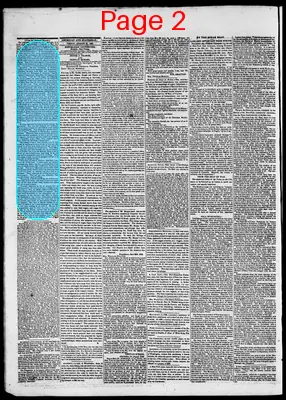
Story
August 21, 1829
Rhode Island American, Statesman And Providence Gazette
Providence, Providence County, Rhode Island
What is this article about?
Critical review of John Mactaggart's book 'Three Years in Canada' (1826-1829), published in London in May, denouncing its vulgar, anti-American content and lack of substance.
Clipping
OCR Quality
95%
Excellent
Full Text
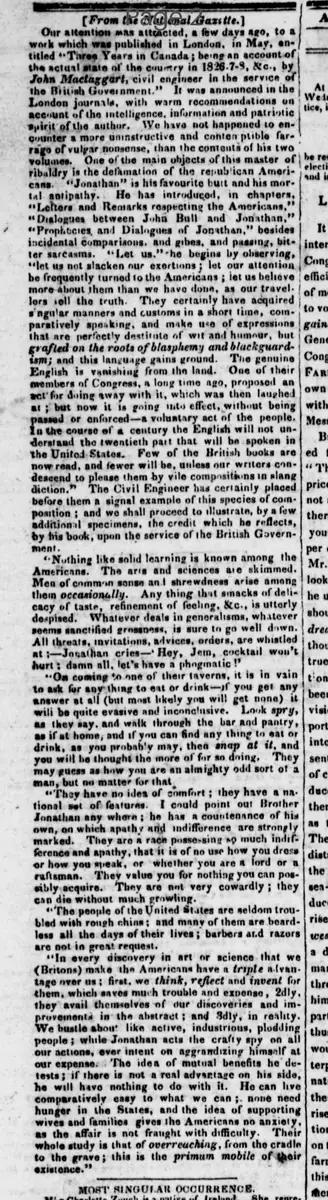
Our attention was attracted, a few days ago, to a work which was published in London, in May, entitled "Three Years in Canada: being an account of the actual state of the country in 1826-7-9, &c., by John Mactaggart, civil engineer in the service of the British Government." It was announced in the London journals, with warm recommendations on account of the intelligence, information and patriotic spirit of the author. We have not happened to encounter a more uninstructive and contemptible rag of vulgar nonsense, than the contents of his two volumes. One of the main objects of this master of ribaldry is the defamation of the republican Americans. "Jonathan" is his favourite butt and his mortal antipathy. He has introduced, in chapters, "Letters and Remarks respecting the Americans," "Dialogues between John Bull and Jonathan," "Prophecies and Dialogues of Jonathan," besides incidental comparisons, and gibes, and passing, bitter sarcasms. "Let us,"—he begins by observing,—"let us not slacken our exertions; let our attention be frequently turned to the Americans; let us believe more about them than we have done, as our travellers sell the truth. They certainly have acquired singular manners and customs in a short time, comparatively speaking, and make use of expressions that are perfectly destitute of wit and humour, but grafted on the roots of blasphemy and blackguardism; and this language gains ground. The genuine English is vanishing from the land. One of their members of Congress, a long time ago, proposed an act for doing away with it, which was then laughed at; but now it is going into effect, without being passed or enforced—a voluntary act of the people. In the course of a century the English will not understand the twentieth part that will be spoken in the United States. Few of the British books are now read, and fewer will be, unless our writers condescend to please them by vile compositions in slang diction." The Civil Engineer has certainly placed before them a signal example of this species of composition; and we shall proceed to illustrate, by a few additional specimens, the credit which he reflects, by his book, upon the service of the British Government.
"Nothing like solid learning is known among the Americans. The arts and sciences are skimmed. Men of common sense and shrewdness arise among them occasionally. Any thing that smacks of delicacy of taste, refinement of feeling, &c., is utterly despised. Whatever deals in generalisms, whatever seems sanctified grossness, is sure to go well down. All threats, invitations, advices, orders, are whistled at; Jonathan cries—'Hey, Jem, cocktail won't hurt: damn all, let's have a phlegmatic!' On coming to one of their taverns, it is in vain to ask for any thing to eat or drink—if you get any answer at all (but most likely you will get none) it will be quite evasive and inconclusive. Look spry, as they say, and walk through the bar and pantry, as if at home, and if you can find any thing to eat or drink, as you probably may, then snap at it, and you will be thought the more of for so doing. They may guess as how you are an almighty odd sort of a man, but no matter for that.
"They have no idea of comfort; they have a national set of features. I could point out Brother Jonathan anywhere; he has a countenance of his own, on which apathy and indifference are strongly marked. They are a race possessing so much indifference and apathy, that it is of no use how you dress or how you speak, or whether you are a lord or a raftsman. They value you for nothing you can possibly acquire. They are not very cowardly; they can die without much growling.
"The people of the United States are seldom troubled with rough chins; and many of them are beardless all the days of their lives; barbers and razors are not in great request.
"In every discovery in art or science that we (Britons) make the Americans have a triple advantage over us; first, we think, reflect and invent for them, which saves much trouble and expense, 2dly, they avail themselves of our discoveries and improvements in the abstract; and 3dly, in reality. We bustle about like active, industrious, plodding people; while Jonathan acts the crafty spy on all our actions, ever intent on aggrandizing himself at our expense. The idea of mutual benefits he detests; if there is not a real advantage on his side, he will have nothing to do with it. He can live comparatively easy to what we can; none need hunger in the States, and the idea of supporting wives and families gives the Americans no anxiety, as the affair is not fraught with difficulty. Their whole study is that of overreaching, from the cradle to the grave; this is the primum mobile of their existence."
"Nothing like solid learning is known among the Americans. The arts and sciences are skimmed. Men of common sense and shrewdness arise among them occasionally. Any thing that smacks of delicacy of taste, refinement of feeling, &c., is utterly despised. Whatever deals in generalisms, whatever seems sanctified grossness, is sure to go well down. All threats, invitations, advices, orders, are whistled at; Jonathan cries—'Hey, Jem, cocktail won't hurt: damn all, let's have a phlegmatic!' On coming to one of their taverns, it is in vain to ask for any thing to eat or drink—if you get any answer at all (but most likely you will get none) it will be quite evasive and inconclusive. Look spry, as they say, and walk through the bar and pantry, as if at home, and if you can find any thing to eat or drink, as you probably may, then snap at it, and you will be thought the more of for so doing. They may guess as how you are an almighty odd sort of a man, but no matter for that.
"They have no idea of comfort; they have a national set of features. I could point out Brother Jonathan anywhere; he has a countenance of his own, on which apathy and indifference are strongly marked. They are a race possessing so much indifference and apathy, that it is of no use how you dress or how you speak, or whether you are a lord or a raftsman. They value you for nothing you can possibly acquire. They are not very cowardly; they can die without much growling.
"The people of the United States are seldom troubled with rough chins; and many of them are beardless all the days of their lives; barbers and razors are not in great request.
"In every discovery in art or science that we (Britons) make the Americans have a triple advantage over us; first, we think, reflect and invent for them, which saves much trouble and expense, 2dly, they avail themselves of our discoveries and improvements in the abstract; and 3dly, in reality. We bustle about like active, industrious, plodding people; while Jonathan acts the crafty spy on all our actions, ever intent on aggrandizing himself at our expense. The idea of mutual benefits he detests; if there is not a real advantage on his side, he will have nothing to do with it. He can live comparatively easy to what we can; none need hunger in the States, and the idea of supporting wives and families gives the Americans no anxiety, as the affair is not fraught with difficulty. Their whole study is that of overreaching, from the cradle to the grave; this is the primum mobile of their existence."
What sub-type of article is it?
Curiosity
Deception Fraud
What themes does it cover?
Deception
Social Manners
What keywords are associated?
Book Review
Anti American
John Mactaggart
Travelogue
Social Critique
What entities or persons were involved?
John Mactaggart
Where did it happen?
London, Canada, United States
Story Details
Key Persons
John Mactaggart
Location
London, Canada, United States
Event Date
1826 7 9
Story Details
A reviewer lambasts John Mactaggart's book for its uninstructive nonsense and defamation of Americans through chapters, dialogues, and sarcasms mocking their language, manners, indifference, and opportunistic nature.