Thank you for visiting SNEWPapers!
Sign up free
Story
March 4, 1944
The Union Times
New Haven, New Haven County, Connecticut
What is this article about?
In Washington, labor organizations like AFL and CIO criticize the Baruch-Hancock report on post-war adjustment for favoring big business, lacking labor representation, and appointing anti-labor figures William L. Clayton and Gen. Frank T. Hines to key roles.
Merged-components note: Merged continuation of the 'On The Scene In Washington' article.
Clipping
OCR Quality
98%
Excellent
Full Text
On The Scene
In
Washington
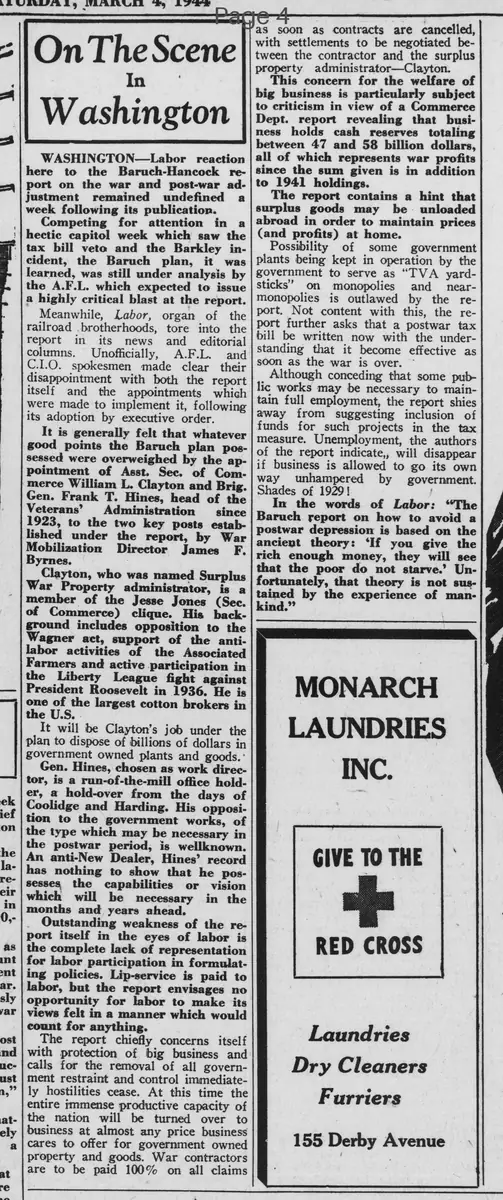
WASHINGTON--Labor reaction here to the Baruch-Hancock report on the war and post-war adjustment remained undefined a week following its publication.
Competing for attention in a hectic capitol week which saw the tax bill veto and the Barkley incident, the Baruch plan, it was learned, was still under analysis by the A.F.L. which expected to issue a highly critical blast at the report.
Meanwhile, Labor, organ of the railroad brotherhoods, tore into the report in its news and editorial columns. Unofficially, A.F.L. and C.I.O. spokesmen made clear their disappointment with both the report itself and the appointments which were made to implement it, following its adoption by executive order.
It is generally felt that whatever good points the Baruch plan possessed were overweighed by the appointment of Asst. Sec. of Commerce William L. Clayton and Brig. Gen. Frank T. Hines, head of the Veterans' Administration since 1923, to the two key posts established under the report, by War Mobilization Director James F. Byrnes.
Clayton, who was named Surplus War Property administrator, is a member of the Jesse Jones (Sec. of Commerce) clique. His background includes opposition to the Wagner act, support of the anti-labor activities of the Associated Farmers and active participation in the Liberty League fight against President Roosevelt in 1936. He is one of the largest cotton brokers in the U.S.
It will be Clayton's job under the plan to dispose of billions of dollars in government owned plants and goods.
Gen. Hines, chosen as work director, is a run-of-the-mill office holder, a hold-over from the days of Coolidge and Harding. His opposition to the government works, of the type which may be necessary in the postwar period, is well known. An anti-New Dealer, Hines' record has nothing to show that he possesses the capabilities or vision which will be necessary in the months and years ahead.
Outstanding weakness of the report itself in the eyes of labor is the complete lack of representation for labor participation in formulating policies. Lip-service is paid to labor, but the report envisages no opportunity for labor to make its views felt in a manner which would count for anything.
The report chiefly concerns itself with protection of big business and calls for the removal of all government restraint and control immediately hostilities cease. At this time the entire immense productive capacity of the nation will be turned over to business at almost any price business cares to offer for government owned property and goods. War contractors are to be paid 100% on all claims as soon as contracts are cancelled, with settlements to be negotiated between the contractor and the surplus property administrator--Clayton.
This concern for the welfare of big business is particularly subject to criticism in view of a Commerce Dept. report revealing that business holds cash reserves totaling between 47 and 58 billion dollars, all of which represents war profits since the sum given is in addition to 1941 holdings.
The report contains a hint that surplus goods may be unloaded abroad in order to maintain prices (and profits) at home.
Possibility of some government plants being kept in operation by the government to serve as "TVA yard-sticks" on monopolies and near-monopolies is outlawed by the report. Not content with this, the report further asks that a postwar tax bill be written now with the understanding that it become effective as soon as the war is over.
Although conceding that some public works may be necessary to maintain full employment, the report shies away from suggesting inclusion of funds for such projects in the tax measure. Unemployment, the authors of the report indicate, will disappear if business is allowed to go its own way unhampered by government.
Shades of 1929!
In the words of Labor:
"The Baruch report on how to avoid a postwar depression is based on the ancient theory: If you give the rich enough money, they will see that the poor do not starve." Unfortunately, that theory is not sustained by the experience of mankind."
In
Washington
WASHINGTON--Labor reaction here to the Baruch-Hancock report on the war and post-war adjustment remained undefined a week following its publication.
Competing for attention in a hectic capitol week which saw the tax bill veto and the Barkley incident, the Baruch plan, it was learned, was still under analysis by the A.F.L. which expected to issue a highly critical blast at the report.
Meanwhile, Labor, organ of the railroad brotherhoods, tore into the report in its news and editorial columns. Unofficially, A.F.L. and C.I.O. spokesmen made clear their disappointment with both the report itself and the appointments which were made to implement it, following its adoption by executive order.
It is generally felt that whatever good points the Baruch plan possessed were overweighed by the appointment of Asst. Sec. of Commerce William L. Clayton and Brig. Gen. Frank T. Hines, head of the Veterans' Administration since 1923, to the two key posts established under the report, by War Mobilization Director James F. Byrnes.
Clayton, who was named Surplus War Property administrator, is a member of the Jesse Jones (Sec. of Commerce) clique. His background includes opposition to the Wagner act, support of the anti-labor activities of the Associated Farmers and active participation in the Liberty League fight against President Roosevelt in 1936. He is one of the largest cotton brokers in the U.S.
It will be Clayton's job under the plan to dispose of billions of dollars in government owned plants and goods.
Gen. Hines, chosen as work director, is a run-of-the-mill office holder, a hold-over from the days of Coolidge and Harding. His opposition to the government works, of the type which may be necessary in the postwar period, is well known. An anti-New Dealer, Hines' record has nothing to show that he possesses the capabilities or vision which will be necessary in the months and years ahead.
Outstanding weakness of the report itself in the eyes of labor is the complete lack of representation for labor participation in formulating policies. Lip-service is paid to labor, but the report envisages no opportunity for labor to make its views felt in a manner which would count for anything.
The report chiefly concerns itself with protection of big business and calls for the removal of all government restraint and control immediately hostilities cease. At this time the entire immense productive capacity of the nation will be turned over to business at almost any price business cares to offer for government owned property and goods. War contractors are to be paid 100% on all claims as soon as contracts are cancelled, with settlements to be negotiated between the contractor and the surplus property administrator--Clayton.
This concern for the welfare of big business is particularly subject to criticism in view of a Commerce Dept. report revealing that business holds cash reserves totaling between 47 and 58 billion dollars, all of which represents war profits since the sum given is in addition to 1941 holdings.
The report contains a hint that surplus goods may be unloaded abroad in order to maintain prices (and profits) at home.
Possibility of some government plants being kept in operation by the government to serve as "TVA yard-sticks" on monopolies and near-monopolies is outlawed by the report. Not content with this, the report further asks that a postwar tax bill be written now with the understanding that it become effective as soon as the war is over.
Although conceding that some public works may be necessary to maintain full employment, the report shies away from suggesting inclusion of funds for such projects in the tax measure. Unemployment, the authors of the report indicate, will disappear if business is allowed to go its own way unhampered by government.
Shades of 1929!
In the words of Labor:
"The Baruch report on how to avoid a postwar depression is based on the ancient theory: If you give the rich enough money, they will see that the poor do not starve." Unfortunately, that theory is not sustained by the experience of mankind."
What sub-type of article is it?
Historical Event
What themes does it cover?
Justice
Misfortune
Social Manners
What keywords are associated?
Baruch Hancock Report
Labor Criticism
Post War Adjustment
Big Business Protection
Afl Cio Disappointment
Clayton Appointment
Hines Appointment
War Profits
What entities or persons were involved?
Baruch
Hancock
William L. Clayton
Frank T. Hines
James F. Byrnes
Jesse Jones
Roosevelt
Where did it happen?
Washington
Story Details
Key Persons
Baruch
Hancock
William L. Clayton
Frank T. Hines
James F. Byrnes
Jesse Jones
Roosevelt
Location
Washington
Story Details
Labor groups criticize the Baruch-Hancock report for protecting big business interests, lacking labor input in policy-making, and appointing anti-labor officials Clayton and Hines to oversee surplus property and work programs.