Thank you for visiting SNEWPapers!
Sign up free
Story
November 22, 1805
The Enquirer
Richmond, Henrico County, Virginia
What is this article about?
Extract from Dr. Cowdery's journal detailing the capture of USS Philadelphia by Tripolitans in 1803, the plundering and initial captivity of the American crew in Tripoli, including mistreatment, confinement, and negotiations with the Bashaw for prisoner exchange.
Clipping
OCR Quality
95%
Excellent
Full Text
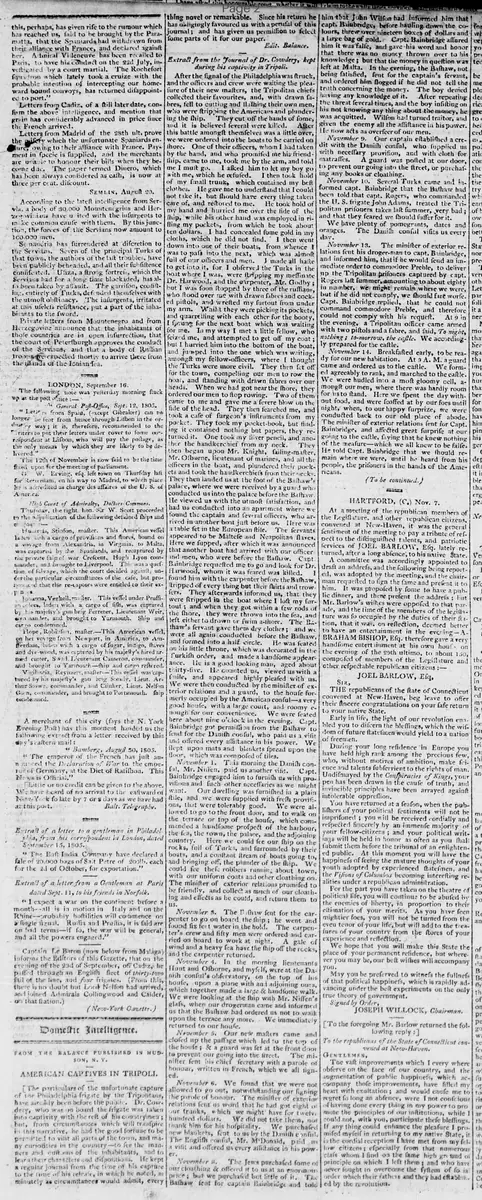
AMERICAN CAPTIVES IN TRIPOLI.
The particulars of the unfortunate capture of the Philadelphia frigate by the Tripolitans, have already been before the public. Dr. Cowdery, who was on board the frigate was taken into captivity with the rest of his countrymen; but, from circumstances which will transpire in this narrative, he had the good fortune to be permitted to visit all parts of the town, and many curiosities in the country—to see the manners and customs of the inhabitants, and to learn their characters and dispositions. He kept a regular journal from the time of his capture to the time of his release, in which he noted, as minutely as circumstances would admit, every thing novel or remarkable. Since his return he has obligingly favoured us with a perusal of this journal; and has given us permission to select some parts of it for our paper.
Edit. Balance.
Extract from the Journal of Dr. Cowdery, kept during his captivity in Tripoli.
After the signal of the Philadelphia was struck, and the officers and crew were waiting the pleasure of their new masters, the Tripolitan chiefs collected their favourites, and, with drawn sabres, fell to cutting and slashing their own men, who were stripping the Americans and plundering the Ship. They cut off the hands of some, and it is believed several were killed. After this battle amongst themselves was a little over, we were ordered into the boats to be carried on shore. One of their officers, whom I had taken by the hand, and who promised me his friendship ship, came to me, took me by the arm, and told me I must go. I asked him to let my boy go with me, which he refused. I then took hold of my small trunk, which contained my best clothes. He gave me to understand that I could not take it; but should have every thing taken care of, and restored to me. He took hold of my hand and hurried me over the side of the ship, while his other hand was employed in rifling my pockets, from which he took about ten dollars. I had concealed some gold in my clothes, which he did not find. I then went down into one of their boats, from whence I was to pass into the next, which was almost full of our officers and men. I made all haste to get into it, for I observed the Turks in the boat where I was, were stripping my messmate Dr. Harwood, and the carpenter, Mr. Godby; but I was soon stopped by three of the ruffians, who stood over me with drawn sabres and cocked pistols, and wrested my surtout from under my arm. Whilst they were picking its pockets, and quarrelling with each other for the booty, I sprung for the next boat which was waiting for me. In my way I met a little fellow, who seized me, and attempted to get off my coat; but I hurried him into the bottom of the boat, and jumped into the one which was waiting, amongst my fellow-officers, where I thought the Turks were more civil. They then set off for the town, compelling our men to row the boat, and standing with drawn sabres over our heads. When we had got near the shore, they ordered our men to stop rowing. Two of them came to me and gave me a severe blow on the side of the head. They then searched me, and took a case of surgeon's instruments from my pocket. They took my pocket-book, but finding it contained nothing but papers, they returned it. One took my silver pencil, and another the handkerchief from my neck. They then began upon Mr. Knight, sailing-master, Mr. Osborne, lieutenant of marines, and all the officers in the boat, and plundered their pockets and took the handkerchiefs from their necks. They then landed us at the foot of the Bashaw's palace, where we were received by a guard who conducted us into the palace before the Bashaw. He viewed us with the utmost satisfaction, and had us conducted into an apartment where we found the captain and several officers, who arrived in another boat just before us. Here was a table set in the European style. The servants appeared to be Maltese and Neapolitan slaves. Here we supped, after which it was announced that another boat had arrived with our officers and men, who were before the Bashaw. Capt. Bainbridge requested me to go and look for Dr. Harwood, whom it was feared was killed. I found him with the carpenter before the Bashaw, stripped of every thing but their shirts and trousers. They afterwards informed us, that they were stripped in the boat where I lost my surtout: and when they got within a few rods of the shore, they were thrown into the sea, and left either to drown or swim ashore. The Bashaw's servant gave them dry clothes; and we were all again conducted before the Bashaw, and formed into a half circle. He was seated on his little throne, which was decorated in the Turkish order, and made a handsome appearance. He is a good looking man, aged about thirty-five. He counted us, viewed us with a smile, and appeared highly pleased with us. We were then conducted by the minister of exterior relations and a guard, to the house formerly occupied by the American consul—a very good house, with a large court, and roomy enough for our convenience. We were seated here about nine o'clock in the evening. Capt. Bainbridge got permission from the Bashaw to send for the Danish consul, who paid us a visit and offered every assistance in his power. We slept upon mats and blankets spread upon the floor, which was composed of tiles.
November 1. This morning the Danish consul, Mr. Nissen, paid us another visit. Capt. Bainbridge engaged him to furnish us with provisions and such other necessaries as we might want. Our dwelling was furnished in a plain style, and we were supplied with fresh provisions, that were tolerably good. We were allowed to go to the front door, and to walk on the terrace or top of the house, which commanded a handsome prospect of the harbour, the sea, the town, the palace, and the adjoining country. Here we could see our ship on the rocks, full of Turks, and surrounded by their boats, and a constant stream of boats going to, and bringing off, the plunder of the ship. We could see these robbers running about town, with our uniform coats and other clothing on. The minister of exterior relations promised to be friendly, and collect as much of our clothing and effects as he could, and return them to us.
November 3. The Bashaw sent for the carpenter to go on board the ship; he went and found six feet water in the hold. The carpenter's crew and fifty men were ordered and carried on board to work at night. A gale of wind and a heavy sea hove the ship off the rocks, and the carpenter returned.
November 4. In the morning lieutenants Hunt and Osborne, and myself, were at the Danish consul's observatory, on the top of his house, upon a plane with an adjoining ours, which together made a large handsome walk. We were looking at the ship with Mr. Nissen's glass, when our drogerman came and informed us that the Bashaw had ordered us not to walk upon the terrace any more. We immediately returned to our house.
November 5. Our new masters came and closed up the passage which led to the top of the house: & a guard was set at the front door to prevent our going into the street. The minister sent his chief secretary with a parole of honour, written in French, which we all signed.
November 6. We found that we were not allowed to go out, notwithstanding our signing the parole of honour. The minister of exterior relations sent us word that he had got eight or ten of our trunks, which we might have for twelve hundred dollars. We did not take them, nor thank him for his hospitality. We purchased new blankets, sent to us by the Danish consul. The English consul, Mr. M'Donald, paid us a visit and offered us every assistance in his power.
November 8. The Jews purchased some of our clothing & offered it to us at an enormous price; but we purchased but little of it. The Bashaw sent for captain Bainbridge and told him that John Wilson had informed him that capt. Bainbridge, before hauling down the colours, threw over nineteen boxes of dollars and a large bag of gold. Capt. Bainbridge assured him it was false, and gave his word and honour that there was no money thrown over to his knowledge; but that the money in question was left at Malta. In the evening, the Bashaw, not being satisfied, sent for the captain's servant, and ordered him flogged if he did not tell the truth concerning the money. The boy denied having any knowledge of it. After repeating the threat several times, and the boy insisting on his not knowing any thing about the money, he was acquitted. Wilson had turned traitor, and given the enemy all the assistance in his power. He now acts as overseer of our men.
November 9. Our captain established a credit with the Danish consul, who supplied us with necessary provision, and with cloth for mattresses. A guard was posted at our door, to prevent our going into the street, or purchasing any books or clothing.
November 10. Several Turks came and informed capt. Bainbridge that the Bashaw had been told that capt. Rogers, who commanded the U. S. frigate John Adams, treated the Tripolitan prisoners taken last summer, very bad; and that they feared we should suffer for it. We have plenty of pomegranates, dates and oranges. The Danish consul visits us every day.
November 13. The minister of exterior relations sent his drogerman to capt. Bainbridge, and informed him, that if he would send an immediate order to commodore Preble, to deliver up the Tripolitan prisoners captured by capt. Rogers last summer, amounting to about eighty in number, we might remain where we were, but if he did not comply, we should fare worse. Capt. Bainbridge replied, that he could not command commodore Preble, and therefore could not comply with his request. At 9 in the evening, a Tripolitan officer came armed with two pistols and a sabre, and said, To night, nothing; to-morrow, the castle. We accordingly prepared for the castle.
November 14. Breakfasted early, to be ready for our new habitation. At 9 A. M. a guard came and ordered us to the castle. We formed agreeably to rank, and marched to the castle. We were huddled into a most gloomy cell, amongst our men, where there was hardly room for us to stand. Here we spent the day without food, and were scoffed at by our foes until night; when, to our happy surprise, we were conducted back to our old place of abode. The minister of exterior relations sent for Capt. Bainbridge, and affected great surprise at our going to the castle, saying that he knew nothing of the measure which we all knew to be false. He told Capt. Bainbridge that we should remain where we were, until he heard from his people, the prisoners in the hands of the Americans.
(To be continued.)
The particulars of the unfortunate capture of the Philadelphia frigate by the Tripolitans, have already been before the public. Dr. Cowdery, who was on board the frigate was taken into captivity with the rest of his countrymen; but, from circumstances which will transpire in this narrative, he had the good fortune to be permitted to visit all parts of the town, and many curiosities in the country—to see the manners and customs of the inhabitants, and to learn their characters and dispositions. He kept a regular journal from the time of his capture to the time of his release, in which he noted, as minutely as circumstances would admit, every thing novel or remarkable. Since his return he has obligingly favoured us with a perusal of this journal; and has given us permission to select some parts of it for our paper.
Edit. Balance.
Extract from the Journal of Dr. Cowdery, kept during his captivity in Tripoli.
After the signal of the Philadelphia was struck, and the officers and crew were waiting the pleasure of their new masters, the Tripolitan chiefs collected their favourites, and, with drawn sabres, fell to cutting and slashing their own men, who were stripping the Americans and plundering the Ship. They cut off the hands of some, and it is believed several were killed. After this battle amongst themselves was a little over, we were ordered into the boats to be carried on shore. One of their officers, whom I had taken by the hand, and who promised me his friendship ship, came to me, took me by the arm, and told me I must go. I asked him to let my boy go with me, which he refused. I then took hold of my small trunk, which contained my best clothes. He gave me to understand that I could not take it; but should have every thing taken care of, and restored to me. He took hold of my hand and hurried me over the side of the ship, while his other hand was employed in rifling my pockets, from which he took about ten dollars. I had concealed some gold in my clothes, which he did not find. I then went down into one of their boats, from whence I was to pass into the next, which was almost full of our officers and men. I made all haste to get into it, for I observed the Turks in the boat where I was, were stripping my messmate Dr. Harwood, and the carpenter, Mr. Godby; but I was soon stopped by three of the ruffians, who stood over me with drawn sabres and cocked pistols, and wrested my surtout from under my arm. Whilst they were picking its pockets, and quarrelling with each other for the booty, I sprung for the next boat which was waiting for me. In my way I met a little fellow, who seized me, and attempted to get off my coat; but I hurried him into the bottom of the boat, and jumped into the one which was waiting, amongst my fellow-officers, where I thought the Turks were more civil. They then set off for the town, compelling our men to row the boat, and standing with drawn sabres over our heads. When we had got near the shore, they ordered our men to stop rowing. Two of them came to me and gave me a severe blow on the side of the head. They then searched me, and took a case of surgeon's instruments from my pocket. They took my pocket-book, but finding it contained nothing but papers, they returned it. One took my silver pencil, and another the handkerchief from my neck. They then began upon Mr. Knight, sailing-master, Mr. Osborne, lieutenant of marines, and all the officers in the boat, and plundered their pockets and took the handkerchiefs from their necks. They then landed us at the foot of the Bashaw's palace, where we were received by a guard who conducted us into the palace before the Bashaw. He viewed us with the utmost satisfaction, and had us conducted into an apartment where we found the captain and several officers, who arrived in another boat just before us. Here was a table set in the European style. The servants appeared to be Maltese and Neapolitan slaves. Here we supped, after which it was announced that another boat had arrived with our officers and men, who were before the Bashaw. Capt. Bainbridge requested me to go and look for Dr. Harwood, whom it was feared was killed. I found him with the carpenter before the Bashaw, stripped of every thing but their shirts and trousers. They afterwards informed us, that they were stripped in the boat where I lost my surtout: and when they got within a few rods of the shore, they were thrown into the sea, and left either to drown or swim ashore. The Bashaw's servant gave them dry clothes; and we were all again conducted before the Bashaw, and formed into a half circle. He was seated on his little throne, which was decorated in the Turkish order, and made a handsome appearance. He is a good looking man, aged about thirty-five. He counted us, viewed us with a smile, and appeared highly pleased with us. We were then conducted by the minister of exterior relations and a guard, to the house formerly occupied by the American consul—a very good house, with a large court, and roomy enough for our convenience. We were seated here about nine o'clock in the evening. Capt. Bainbridge got permission from the Bashaw to send for the Danish consul, who paid us a visit and offered every assistance in his power. We slept upon mats and blankets spread upon the floor, which was composed of tiles.
November 1. This morning the Danish consul, Mr. Nissen, paid us another visit. Capt. Bainbridge engaged him to furnish us with provisions and such other necessaries as we might want. Our dwelling was furnished in a plain style, and we were supplied with fresh provisions, that were tolerably good. We were allowed to go to the front door, and to walk on the terrace or top of the house, which commanded a handsome prospect of the harbour, the sea, the town, the palace, and the adjoining country. Here we could see our ship on the rocks, full of Turks, and surrounded by their boats, and a constant stream of boats going to, and bringing off, the plunder of the ship. We could see these robbers running about town, with our uniform coats and other clothing on. The minister of exterior relations promised to be friendly, and collect as much of our clothing and effects as he could, and return them to us.
November 3. The Bashaw sent for the carpenter to go on board the ship; he went and found six feet water in the hold. The carpenter's crew and fifty men were ordered and carried on board to work at night. A gale of wind and a heavy sea hove the ship off the rocks, and the carpenter returned.
November 4. In the morning lieutenants Hunt and Osborne, and myself, were at the Danish consul's observatory, on the top of his house, upon a plane with an adjoining ours, which together made a large handsome walk. We were looking at the ship with Mr. Nissen's glass, when our drogerman came and informed us that the Bashaw had ordered us not to walk upon the terrace any more. We immediately returned to our house.
November 5. Our new masters came and closed up the passage which led to the top of the house: & a guard was set at the front door to prevent our going into the street. The minister sent his chief secretary with a parole of honour, written in French, which we all signed.
November 6. We found that we were not allowed to go out, notwithstanding our signing the parole of honour. The minister of exterior relations sent us word that he had got eight or ten of our trunks, which we might have for twelve hundred dollars. We did not take them, nor thank him for his hospitality. We purchased new blankets, sent to us by the Danish consul. The English consul, Mr. M'Donald, paid us a visit and offered us every assistance in his power.
November 8. The Jews purchased some of our clothing & offered it to us at an enormous price; but we purchased but little of it. The Bashaw sent for captain Bainbridge and told him that John Wilson had informed him that capt. Bainbridge, before hauling down the colours, threw over nineteen boxes of dollars and a large bag of gold. Capt. Bainbridge assured him it was false, and gave his word and honour that there was no money thrown over to his knowledge; but that the money in question was left at Malta. In the evening, the Bashaw, not being satisfied, sent for the captain's servant, and ordered him flogged if he did not tell the truth concerning the money. The boy denied having any knowledge of it. After repeating the threat several times, and the boy insisting on his not knowing any thing about the money, he was acquitted. Wilson had turned traitor, and given the enemy all the assistance in his power. He now acts as overseer of our men.
November 9. Our captain established a credit with the Danish consul, who supplied us with necessary provision, and with cloth for mattresses. A guard was posted at our door, to prevent our going into the street, or purchasing any books or clothing.
November 10. Several Turks came and informed capt. Bainbridge that the Bashaw had been told that capt. Rogers, who commanded the U. S. frigate John Adams, treated the Tripolitan prisoners taken last summer, very bad; and that they feared we should suffer for it. We have plenty of pomegranates, dates and oranges. The Danish consul visits us every day.
November 13. The minister of exterior relations sent his drogerman to capt. Bainbridge, and informed him, that if he would send an immediate order to commodore Preble, to deliver up the Tripolitan prisoners captured by capt. Rogers last summer, amounting to about eighty in number, we might remain where we were, but if he did not comply, we should fare worse. Capt. Bainbridge replied, that he could not command commodore Preble, and therefore could not comply with his request. At 9 in the evening, a Tripolitan officer came armed with two pistols and a sabre, and said, To night, nothing; to-morrow, the castle. We accordingly prepared for the castle.
November 14. Breakfasted early, to be ready for our new habitation. At 9 A. M. a guard came and ordered us to the castle. We formed agreeably to rank, and marched to the castle. We were huddled into a most gloomy cell, amongst our men, where there was hardly room for us to stand. Here we spent the day without food, and were scoffed at by our foes until night; when, to our happy surprise, we were conducted back to our old place of abode. The minister of exterior relations sent for Capt. Bainbridge, and affected great surprise at our going to the castle, saying that he knew nothing of the measure which we all knew to be false. He told Capt. Bainbridge that we should remain where we were, until he heard from his people, the prisoners in the hands of the Americans.
(To be continued.)
What sub-type of article is it?
Historical Event
Biography
Survival
What themes does it cover?
Misfortune
Survival
Justice
What keywords are associated?
Tripoli Captivity
Uss Philadelphia Capture
American Prisoners
Barbary Wars
Bashaw Negotiations
Crew Plundering
What entities or persons were involved?
Dr. Cowdery
Capt. Bainbridge
Bashaw Of Tripoli
Dr. Harwood
Mr. Godby
Mr. Knight
Mr. Osborne
Mr. Nissen
John Wilson
Where did it happen?
Tripoli
Story Details
Key Persons
Dr. Cowdery
Capt. Bainbridge
Bashaw Of Tripoli
Dr. Harwood
Mr. Godby
Mr. Knight
Mr. Osborne
Mr. Nissen
John Wilson
Location
Tripoli
Event Date
November 1803
Story Details
Following the capture of USS Philadelphia, Dr. Cowdery and the crew endure plundering, beatings, and confinement in Tripoli under the Bashaw; they face threats of worse treatment unless American-held Tripolitan prisoners are exchanged, briefly moved to a castle cell before returning to their quarters.