Thank you for visiting SNEWPapers!
Sign up free
Story
October 7, 1933
The Daily Worker
Chicago, Cook County, Illinois
What is this article about?
Louis Hyman recounts how knitgoods workers were neglected by UTW and ILGWU unions, leading to their dissolution in 1926, and now face strikebreaking by both during their Industrial Union-led strike for gains.
Clipping
OCR Quality
95%
Excellent
Full Text
Knitgoods Strikers
Look to NTWIU
in Fight for Gains
By
LOUIS HYMAN
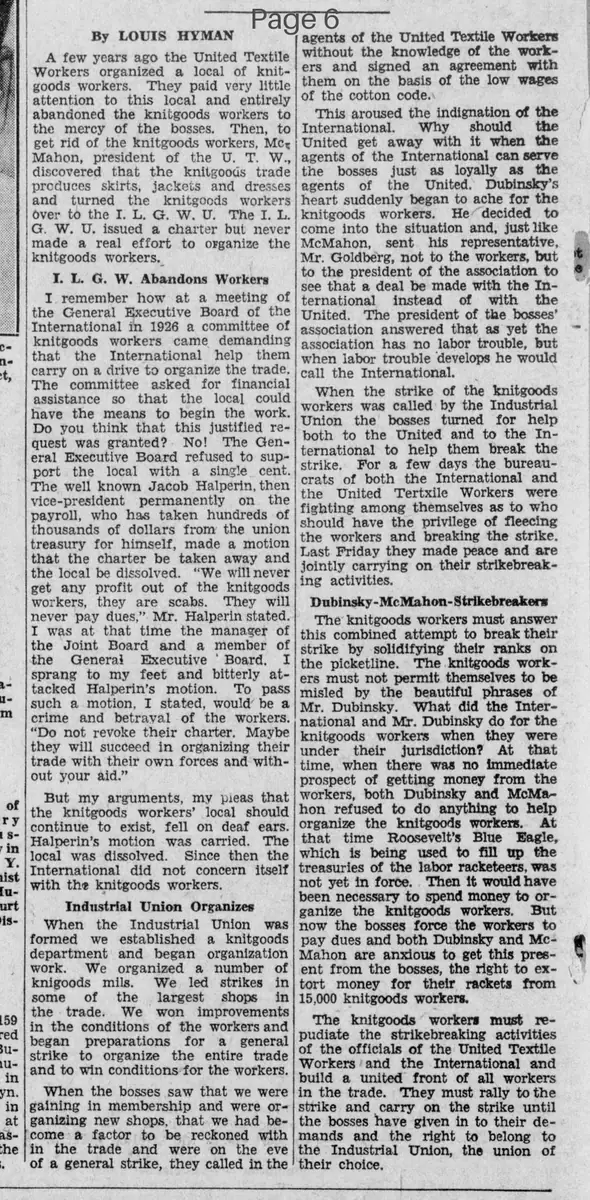
A few years ago the United Textile Workers organized a local of knit-goods workers. They paid very little attention to this local and entirely abandoned the knitgoods workers to the mercy of the bosses. Then, to get rid of the knitgoods workers, McMahon, president of the U. T. W., discovered that the knitgoods trade produces skirts, jackets and dresses and turned the knitgoods workers over to the I. L. G. W. U. The I. L. G. W. U. issued a charter but never made a real effort to organize the knitgoods workers.
I. L. G. W. Abandons Workers
I remember how at a meeting of the General Executive Board of the International in 1926 a committee of knitgoods workers came demanding that the International help them carry on a drive to organize the trade. The committee asked for financial assistance so that the local could have the means to begin the work. Do you think that this justified request was granted? No! The General Executive Board refused to support the local with a single cent. The well known Jacob Halperin, then vice-president permanently on the payroll, who has taken hundreds of thousands of dollars from the union treasury for himself, made a motion that the charter be taken away and the local be dissolved. "We will never get any profit out of the knitgoods workers, they are scabs. They will never pay dues," Mr. Halperin stated. I was at that time the manager of the Joint Board and a member of the General Executive Board. I sprang to my feet and bitterly attacked Halperin's motion. To pass such a motion, I stated, would be a crime and betrayal of the workers. "Do not revoke their charter. Maybe they will succeed in organizing their trade with their own forces and without your aid."
But my arguments, my pleas that the knitgoods workers' local should continue to exist, fell on deaf ears. Halperin's motion was carried. The local was dissolved. Since then the International did not concern itself with the knitgoods workers.
Industrial Union Organizes
When the Industrial Union was formed we established a knitgoods department and began organization work. We organized a number of knitgoods mills. We led strikes in some of the largest shops in the trade. We won improvements in the conditions of the workers and began preparations for a general strike to organize the entire trade and to win conditions for the workers. When the bosses saw that we were gaining in membership and were organizing new shops, that we had become a factor to be reckoned with in the trade and were on the eve of a general strike, they called in the agents of the United Textile Workers without the knowledge of the workers and signed an agreement with them on the basis of the low wages of the cotton code.
This aroused the indignation of the International. Why should the United get away with it when the agents of the International can serve the bosses just as loyally as the agents of the United. Dubinsky's heart suddenly began to ache for the knitgoods workers. He decided to come into the situation and, just like McMahon, sent his representative, Mr. Goldberg, not to the workers, but to the president of the association to see that a deal be made with the International instead of with the United. The president of the bosses' association answered that as yet the association has no labor trouble, but when labor trouble develops he would call the International.
When the strike of the knitgoods workers was called by the Industrial Union the bosses turned for help both to the United and to the International to help them break the strike. For a few days the bureaucrats of both the International and the United Textile Workers were fighting among themselves as to who should have the privilege of fleecing the workers and breaking the strike. Last Friday they made peace and are jointly carrying on their strikebreaking activities.
Dubinsky-McMahon-Strikebreakers
The knitgoods workers must answer this combined attempt to break their strike by solidifying their ranks on the picketline. The knitgoods workers must not permit themselves to be misled by the beautiful phrases of Mr. Dubinsky. What did the International and Mr. Dubinsky do for the knitgoods workers when they were under their jurisdiction? At that time, when there was no immediate prospect of getting money from the workers, both Dubinsky and McMahon refused to do anything to help organize the knitgoods workers. At that time Roosevelt's Blue Eagle, which is being used to fill up the treasuries of the labor racketeers, was not yet in force. Then it would have been necessary to spend money to organize the knitgoods workers. But now the bosses force the workers to pay dues and both Dubinsky and McMahon are anxious to get this present from the bosses, the right to extort money for their rackets from 15,000 knitgoods workers.
The knitgoods workers must repudiate the strikebreaking activities of the officials of the United Textile Workers and the International and build a united front of all workers in the trade. They must rally to the strike and carry on the strike until the bosses have given in to their demands and the right to belong to the Industrial Union, the union of their choice.
Look to NTWIU
in Fight for Gains
By
LOUIS HYMAN
A few years ago the United Textile Workers organized a local of knit-goods workers. They paid very little attention to this local and entirely abandoned the knitgoods workers to the mercy of the bosses. Then, to get rid of the knitgoods workers, McMahon, president of the U. T. W., discovered that the knitgoods trade produces skirts, jackets and dresses and turned the knitgoods workers over to the I. L. G. W. U. The I. L. G. W. U. issued a charter but never made a real effort to organize the knitgoods workers.
I. L. G. W. Abandons Workers
I remember how at a meeting of the General Executive Board of the International in 1926 a committee of knitgoods workers came demanding that the International help them carry on a drive to organize the trade. The committee asked for financial assistance so that the local could have the means to begin the work. Do you think that this justified request was granted? No! The General Executive Board refused to support the local with a single cent. The well known Jacob Halperin, then vice-president permanently on the payroll, who has taken hundreds of thousands of dollars from the union treasury for himself, made a motion that the charter be taken away and the local be dissolved. "We will never get any profit out of the knitgoods workers, they are scabs. They will never pay dues," Mr. Halperin stated. I was at that time the manager of the Joint Board and a member of the General Executive Board. I sprang to my feet and bitterly attacked Halperin's motion. To pass such a motion, I stated, would be a crime and betrayal of the workers. "Do not revoke their charter. Maybe they will succeed in organizing their trade with their own forces and without your aid."
But my arguments, my pleas that the knitgoods workers' local should continue to exist, fell on deaf ears. Halperin's motion was carried. The local was dissolved. Since then the International did not concern itself with the knitgoods workers.
Industrial Union Organizes
When the Industrial Union was formed we established a knitgoods department and began organization work. We organized a number of knitgoods mills. We led strikes in some of the largest shops in the trade. We won improvements in the conditions of the workers and began preparations for a general strike to organize the entire trade and to win conditions for the workers. When the bosses saw that we were gaining in membership and were organizing new shops, that we had become a factor to be reckoned with in the trade and were on the eve of a general strike, they called in the agents of the United Textile Workers without the knowledge of the workers and signed an agreement with them on the basis of the low wages of the cotton code.
This aroused the indignation of the International. Why should the United get away with it when the agents of the International can serve the bosses just as loyally as the agents of the United. Dubinsky's heart suddenly began to ache for the knitgoods workers. He decided to come into the situation and, just like McMahon, sent his representative, Mr. Goldberg, not to the workers, but to the president of the association to see that a deal be made with the International instead of with the United. The president of the bosses' association answered that as yet the association has no labor trouble, but when labor trouble develops he would call the International.
When the strike of the knitgoods workers was called by the Industrial Union the bosses turned for help both to the United and to the International to help them break the strike. For a few days the bureaucrats of both the International and the United Textile Workers were fighting among themselves as to who should have the privilege of fleecing the workers and breaking the strike. Last Friday they made peace and are jointly carrying on their strikebreaking activities.
Dubinsky-McMahon-Strikebreakers
The knitgoods workers must answer this combined attempt to break their strike by solidifying their ranks on the picketline. The knitgoods workers must not permit themselves to be misled by the beautiful phrases of Mr. Dubinsky. What did the International and Mr. Dubinsky do for the knitgoods workers when they were under their jurisdiction? At that time, when there was no immediate prospect of getting money from the workers, both Dubinsky and McMahon refused to do anything to help organize the knitgoods workers. At that time Roosevelt's Blue Eagle, which is being used to fill up the treasuries of the labor racketeers, was not yet in force. Then it would have been necessary to spend money to organize the knitgoods workers. But now the bosses force the workers to pay dues and both Dubinsky and McMahon are anxious to get this present from the bosses, the right to extort money for their rackets from 15,000 knitgoods workers.
The knitgoods workers must repudiate the strikebreaking activities of the officials of the United Textile Workers and the International and build a united front of all workers in the trade. They must rally to the strike and carry on the strike until the bosses have given in to their demands and the right to belong to the Industrial Union, the union of their choice.
What sub-type of article is it?
Historical Event
Deception Fraud
Survival
What themes does it cover?
Betrayal
Deception
Survival
What keywords are associated?
Knitgoods Strike
Union Betrayal
Ilgwu Abandonment
Utw Collusion
Industrial Union Organizing
What entities or persons were involved?
Louis Hyman
Mcmahon
Jacob Halperin
Dubinsky
Goldberg
Story Details
Key Persons
Louis Hyman
Mcmahon
Jacob Halperin
Dubinsky
Goldberg
Event Date
1926 And Recent
Story Details
Knitgoods workers, previously abandoned by UTW and ILGWU, now organized by Industrial Union leading a strike for better conditions; union leaders from ILGWU and UTW collude with bosses to break the strike.