Thank you for visiting SNEWPapers!
Sign up free
The Virginia Gazette
Richmond, Williamsburg, Richmond County, Virginia
What is this article about?
A moral reflection on the nobility of forgiveness over revenge, illustrated by the historical anecdote of Demetrius Poliorcetes, who, after being betrayed by the Athenians, besieges and then generously pardons them, providing food to their city.
Merged-components note: Narrative story about Demetrius Poliorcetes; original label of first part was letter_to_editor but content is historical anecdote, so relabeled to story.
Clippings
1 of 2
OCR Quality
Full Text
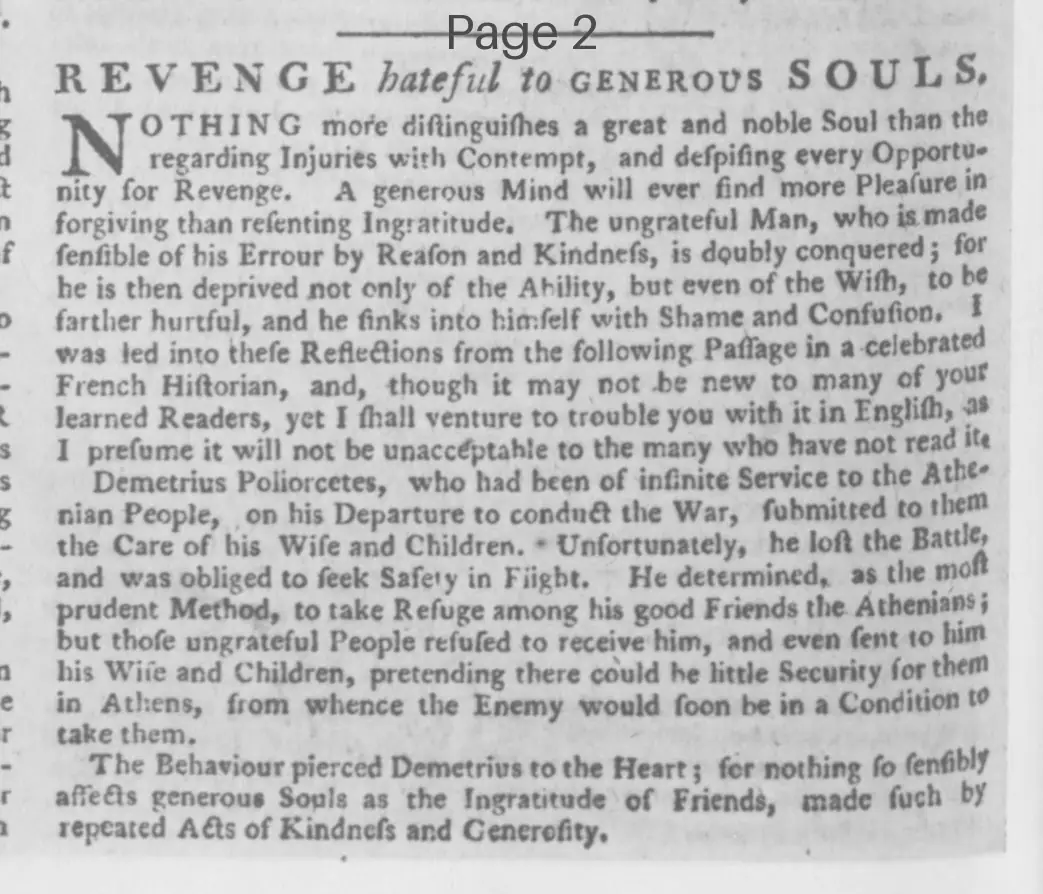
NOTHING more distinguishes a great and noble Soul than the regarding Injuries with Contempt, and despising every Opportunity for Revenge. A generous Mind will ever find more Pleasure in forgiving than resenting Ingratitude. The ungrateful Man, who is made sensible of his Error by Reason and Kindness, is doubly conquered; for he is then deprived not only of the Ability, but even of the Wish, to be farther hurtful, and he sinks into himself with Shame and Confusion. I was led into these Reflections from the following Passage in a celebrated French Historian, and, though it may not be new to many of your learned Readers, yet I shall venture to trouble you with it in English, as I presume it will not be unacceptable to the many who have not read it in the original.
Demetrius Poliorcetes, who had been of infinite Service to the Athenian People, on his Departure to conduct the War, submitted to them the Care of his Wife and Children. Unfortunately, he lost the Battle, and was obliged to seek Safety in Flight. He determined, as the most prudent Method, to take Refuge among his good Friends the Athenians; but those ungrateful People refused to receive him, and even sent to him his Wife and Children, pretending there could be little Security for them in Athens, from whence the Enemy would soon be in a Condition to take them.
The Behaviour pierced Demetrius to the Heart: for nothing so sensibly affects generous Souls as the Ingratitude of Friends, made such by repeated Acts of Kindness and Generosity.
Some Time after, when Fortune had given a happier Turn to the Fate of his Arms, and placed him at the Head of a powerful Army, he turned his Attention towards Athens, and laid Siege to that City. The Athenians, concluding they had no Mercy to expect from Demetrius, resolved to die Sword in Hand, and published an Edict, declaring it instant Death to those who should propose surrendering to that Prince; but they forgot that they had no Corn in the City, and that they should soon be in Want of Bread.
After having a long Time suffered the most cruel Hunger, the most reasonable of the Besieged declared, as their Opinion, that it was better for Demetrius to kill them at one Stroke than to die a lingering Death by Famine. Perhaps, said they, Demetrius may save our Wives and Children. This Advice prevailed, and the Gates of the City were thrown open to the Conqueror.
Demetrius then ordered that all the married Men should be assembled in some spacious Place, that his Soldiers, Sword in Hand, might surround them. Nothing was then seen in that City but Horror and Confusion; Wives embracing their Husbands, Children their Fathers, and taking the last Farewell of each other.
When they were all assembled, Demetrius, who was placed on an Eminence, reproached them for their Ingratitude in the severest Terms, and could not refrain himself from Tears. The Multitude kept Silence, expecting every Moment he would order the Soldiery to massacre them; but how great was their Astonishment when they heard the good Prince say, "My Design is to convince you of your Ingratitude towards me; it was not to an Enemy you refused Assistance, but to a Prince who loved you, who loves you still, and who seeks no other Revenge but in pardoning you and making you happy. Go each of you home; while you have been standing here, my Soldiers, by my Orders, have furnished your Houses with Corn and Bread."
What sub-type of article is it?
What themes does it cover?
What keywords are associated?
What entities or persons were involved?
Where did it happen?
Story Details
Key Persons
Location
Athens
Story Details
Demetrius Poliorcetes aids the Athenians and entrusts his family to them before a war, but they reject him after his defeat. Later, after besieging the starving city, he forgives their ingratitude, reproaches them, and provides food to their homes instead of revenge.