Thank you for visiting SNEWPapers!
Sign up free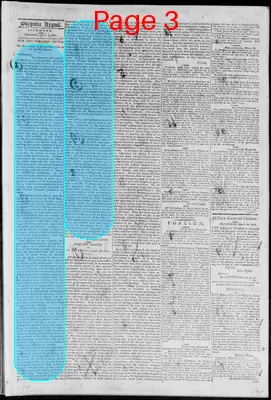
Editorial
April 3, 1810
Virginia Argus
Richmond, Virginia
What is this article about?
An open letter to the U.S. House of Representatives urges maintaining the non-intercourse law, arguing it benefits U.S. trade balance, resists European aggression by Britain and France, and serves as a negotiation tool without causing submission or economic harm.
Clipping
OCR Quality
98%
Excellent
Full Text
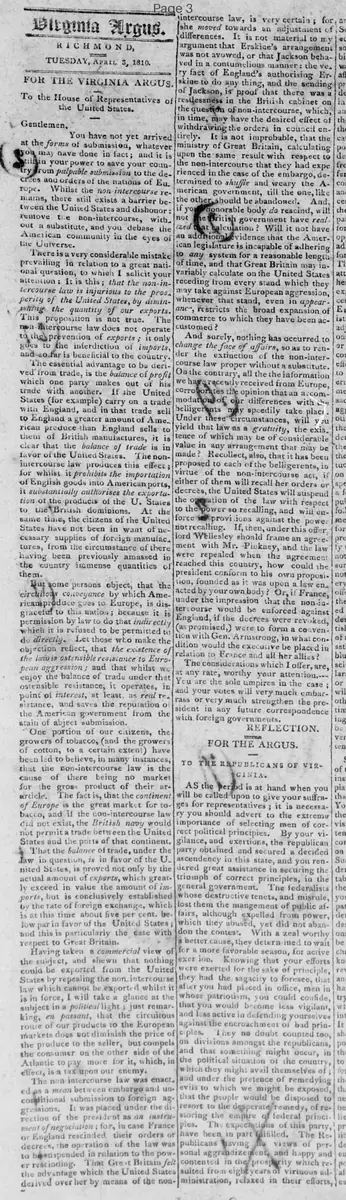
To the House of Representatives of the United States.
Gentlemen,
You have not yet arrived at the terms of submission, whatever you may have done in fact; and it is still in your power to save your country from palpable submission to the decrees and orders of the nations of Europe. Whilst the non-intercourse remains, there still exists a barrier between the United States and dishonor: remove the non-intercourse, without a substitute, and you debase the American community in the eyes of the Universe.
There is a very considerable mistake prevailing in relation to a great national question, to which I solicit your attention: It is this; that the non-intercourse law is injurious to the prosperity of the United States, by diminishing the quantity of our exports.
This proposition is not true. The non-intercourse law does not operate to the prevention of exports; it only goes to the interdiction of imports, and so far is beneficial to the country.
The essential advantage to be derived from trade, is the balance of profit which one party makes out of his trade with another. If the United States (for example) carry on a trade with England, and in that trade sell to England a greater amount of American produce than England sells to them of British manufactures, it is clear that the balance of trade is in favor of the United States. The non-intercourse law produces this effect; for whilst it prohibits the importation of English goods into American ports, it substantially authorises the exportation of the products of the U. States to the British dominions. At the same time, the citizens of the United States have not been in want of necessary supplies of foreign manufactures, from the circumstance of there having been previously amassed in the country immense quantities of them.
But some persons object, that the circuitous conveyance by which American produce goes to Europe, is disgraceful to this nation; because it is permission by law to do that indirectly which it is refused to be permitted to do directly. Let those who make the objection reflect, that the existence of the law is ostensible resistance to European aggression; and that whilst we enjoy the balance of trade under that ostensible resistance, it operates, in point of interest, at least, as real resistance, and saves the reputation of the American government from the stain of abject submission.
One portion of our citizens, the growers of tobacco, (and the growers of cotton, to a certain extent) have been led to believe, in many instances, that the non-intercourse law is the cause of there being no market for the gross product of their article. The fact is, that the continent of Europe is the great market for tobacco, and if the non-intercourse law did not exist, the British navy would not permit a trade between the United States and the ports of that continent.
That the balance of trade, under the law in question, is in favor of the United States, is proved not only by the actual amount of exports, which greatly exceed in value the amount of imports, but is conclusively established by the rate of foreign exchange, which is at this time about five per cent. below par in favor of the United States; and this is particularly the case with respect to Great Britain.
Having taken a commercial view of the subject, and shewn that nothing could be exported from the United States by repealing the non-intercourse law which cannot be exported whilst it is in force, I will take a glance at the subject in a political light; just remarking, en passant, that the circuitous route of our products to the European markets does not diminish the price of the produce to the seller, but compels the consumer on the other side of the Atlantic to pay more for it, which, in effect, is a tax upon our enemy.
The non-intercourse law was enacted as a mean between embargo and unconditional submission to foreign aggressions. It was placed under the direction of the president as an instrument of negociation; for, in case France or England rescinded their orders or decrees, the operation of the law was to be suspended in relation to the power rescinding. That Great Britain felt the advantage which the United States derived over her by means of the non-intercourse law, is very certain; for she moved towards an adjustment of differences. It is not material to my argument that Erskine's arrangement was not avowed, or that Jackson behaved in a contumelious manner: the very fact of England's authorising Erskine to do any thing, and the sending of Jackson, is proof that there was a restlessness in the British cabinet on the question of non-intercourse, which, in time, may have the desired effect of withdrawing the orders in council entirely. It is not improbable, that the ministry of Great Britain, calculating upon the same result with respect to the non-intercourse that they had experienced in the case of the embargo, determined to shuffle and weary the American government, till the one, like the other should be abandoned. And, if your honorable body do rescind, will not the British government have realized that calculation? Will it not have an additional evidence that the American legislature is incapable of adhering to any system for a reasonable length of time, and that Great Britain may invariably calculate on the United States receding from every stand which they may take against European aggression, whenever that stand, even in appearance, restricts the broad expansion of commerce to which they have been accustomed?
And surely, nothing has occurred to change the face of affairs, so as to render the extinction of the non-intercourse law proper without a substitute. On the contrary, all the information we have recently received from Europe, corroborates the opinion that an accommodation of our differences with the belligerents may speedily take place.
Under these circumstances, will you yield that law as a gratuity, the existence of which may be of considerable value in any arrangement that may be made? Recollect, also, that it has been proposed to each of the belligerents, in virtue of the non-intercourse act, if either of them will recall her orders or decrees, the United States will suspend the operation of the law with respect to the power so recalling, and will enforce its provisions against the power not recalling. If, then, under this offer, lord Wellesley should frame an agreement with Mr. Pinkney, and the law were repealed when the agreement reached this country, how could the president conform to his own proposition, founded as it was upon a law enacted by your own body? Or, if France, under the impression that the non-intercourse would be enforced against England, if the decrees were revoked, (as promised,) were to form a convention with Gen. Armstrong, in what condition would the executive be placed in relation to France and all her allies?
The considerations which I offer, are, at any rate, worthy your attention.--- You are the sole umpires in the case; and your votes will very much embarrass or very much strengthen the president in any future correspondence with foreign governments.
Gentlemen,
You have not yet arrived at the terms of submission, whatever you may have done in fact; and it is still in your power to save your country from palpable submission to the decrees and orders of the nations of Europe. Whilst the non-intercourse remains, there still exists a barrier between the United States and dishonor: remove the non-intercourse, without a substitute, and you debase the American community in the eyes of the Universe.
There is a very considerable mistake prevailing in relation to a great national question, to which I solicit your attention: It is this; that the non-intercourse law is injurious to the prosperity of the United States, by diminishing the quantity of our exports.
This proposition is not true. The non-intercourse law does not operate to the prevention of exports; it only goes to the interdiction of imports, and so far is beneficial to the country.
The essential advantage to be derived from trade, is the balance of profit which one party makes out of his trade with another. If the United States (for example) carry on a trade with England, and in that trade sell to England a greater amount of American produce than England sells to them of British manufactures, it is clear that the balance of trade is in favor of the United States. The non-intercourse law produces this effect; for whilst it prohibits the importation of English goods into American ports, it substantially authorises the exportation of the products of the U. States to the British dominions. At the same time, the citizens of the United States have not been in want of necessary supplies of foreign manufactures, from the circumstance of there having been previously amassed in the country immense quantities of them.
But some persons object, that the circuitous conveyance by which American produce goes to Europe, is disgraceful to this nation; because it is permission by law to do that indirectly which it is refused to be permitted to do directly. Let those who make the objection reflect, that the existence of the law is ostensible resistance to European aggression; and that whilst we enjoy the balance of trade under that ostensible resistance, it operates, in point of interest, at least, as real resistance, and saves the reputation of the American government from the stain of abject submission.
One portion of our citizens, the growers of tobacco, (and the growers of cotton, to a certain extent) have been led to believe, in many instances, that the non-intercourse law is the cause of there being no market for the gross product of their article. The fact is, that the continent of Europe is the great market for tobacco, and if the non-intercourse law did not exist, the British navy would not permit a trade between the United States and the ports of that continent.
That the balance of trade, under the law in question, is in favor of the United States, is proved not only by the actual amount of exports, which greatly exceed in value the amount of imports, but is conclusively established by the rate of foreign exchange, which is at this time about five per cent. below par in favor of the United States; and this is particularly the case with respect to Great Britain.
Having taken a commercial view of the subject, and shewn that nothing could be exported from the United States by repealing the non-intercourse law which cannot be exported whilst it is in force, I will take a glance at the subject in a political light; just remarking, en passant, that the circuitous route of our products to the European markets does not diminish the price of the produce to the seller, but compels the consumer on the other side of the Atlantic to pay more for it, which, in effect, is a tax upon our enemy.
The non-intercourse law was enacted as a mean between embargo and unconditional submission to foreign aggressions. It was placed under the direction of the president as an instrument of negociation; for, in case France or England rescinded their orders or decrees, the operation of the law was to be suspended in relation to the power rescinding. That Great Britain felt the advantage which the United States derived over her by means of the non-intercourse law, is very certain; for she moved towards an adjustment of differences. It is not material to my argument that Erskine's arrangement was not avowed, or that Jackson behaved in a contumelious manner: the very fact of England's authorising Erskine to do any thing, and the sending of Jackson, is proof that there was a restlessness in the British cabinet on the question of non-intercourse, which, in time, may have the desired effect of withdrawing the orders in council entirely. It is not improbable, that the ministry of Great Britain, calculating upon the same result with respect to the non-intercourse that they had experienced in the case of the embargo, determined to shuffle and weary the American government, till the one, like the other should be abandoned. And, if your honorable body do rescind, will not the British government have realized that calculation? Will it not have an additional evidence that the American legislature is incapable of adhering to any system for a reasonable length of time, and that Great Britain may invariably calculate on the United States receding from every stand which they may take against European aggression, whenever that stand, even in appearance, restricts the broad expansion of commerce to which they have been accustomed?
And surely, nothing has occurred to change the face of affairs, so as to render the extinction of the non-intercourse law proper without a substitute. On the contrary, all the information we have recently received from Europe, corroborates the opinion that an accommodation of our differences with the belligerents may speedily take place.
Under these circumstances, will you yield that law as a gratuity, the existence of which may be of considerable value in any arrangement that may be made? Recollect, also, that it has been proposed to each of the belligerents, in virtue of the non-intercourse act, if either of them will recall her orders or decrees, the United States will suspend the operation of the law with respect to the power so recalling, and will enforce its provisions against the power not recalling. If, then, under this offer, lord Wellesley should frame an agreement with Mr. Pinkney, and the law were repealed when the agreement reached this country, how could the president conform to his own proposition, founded as it was upon a law enacted by your own body? Or, if France, under the impression that the non-intercourse would be enforced against England, if the decrees were revoked, (as promised,) were to form a convention with Gen. Armstrong, in what condition would the executive be placed in relation to France and all her allies?
The considerations which I offer, are, at any rate, worthy your attention.--- You are the sole umpires in the case; and your votes will very much embarrass or very much strengthen the president in any future correspondence with foreign governments.
What sub-type of article is it?
Foreign Affairs
Economic Policy
War Or Peace
What keywords are associated?
Non Intercourse Law
Trade Balance
European Aggression
British Orders In Council
American Exports
Foreign Negotiation
Economic Resistance
What entities or persons were involved?
House Of Representatives
United States
England
France
Erskine
Jackson
President
Lord Wellesley
Mr. Pinkney
Gen. Armstrong
British Cabinet
Editorial Details
Primary Topic
Defense Of The Non Intercourse Law Against Repeal
Stance / Tone
Strongly Supportive Of Maintaining The Non Intercourse Act
Key Figures
House Of Representatives
United States
England
France
Erskine
Jackson
President
Lord Wellesley
Mr. Pinkney
Gen. Armstrong
British Cabinet
Key Arguments
Non Intercourse Law Prohibits Imports But Allows Exports, Benefiting U.S. Trade Balance.
It Provides Ostensible Resistance To European Aggression Without Actual Submission.
Circuitous Trade Routes Maintain U.S. Reputation And Impose Costs On Enemies.
Tobacco And Cotton Markets Remain Viable Via Europe Despite British Navy Restrictions.
Exports Exceed Imports In Value, With Favorable Foreign Exchange Rates.
Law Serves As Negotiation Tool; Repeal Would Weaken U.S. Position With Belligerents.
Britain Shows Restlessness, Indicating Law's Effectiveness.
Repeal Without Substitute Would Confirm U.S. Inability To Sustain Resistance.
Recent European News Suggests Accommodation Possible, Making Law Valuable In Talks.
Repeal Complicates Presidential Propositions To France And England.