Thank you for visiting SNEWPapers!
Sign up free
Gazette Of The United States, & Philadelphia Daily Advertiser
Philadelphia, Philadelphia County, Pennsylvania
What is this article about?
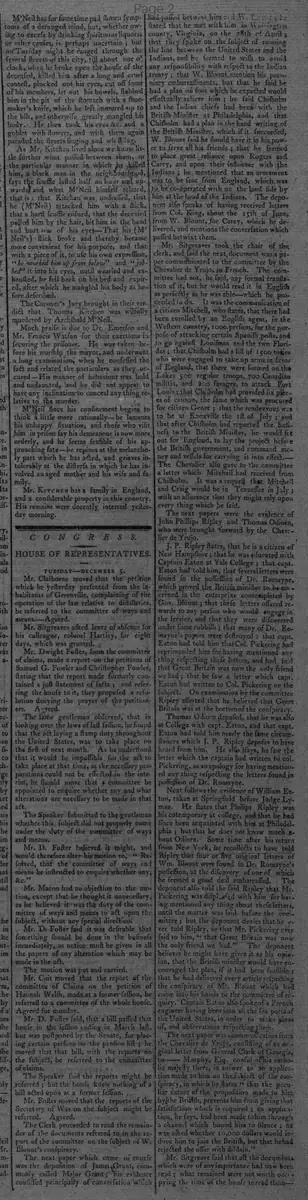
Proceedings of the U.S. House of Representatives on December 5, including referrals of petitions on distilleries and pensions, discussions on stamp duty implementation, reading of documents related to W. Blount's conspiracy, printing orders, and debates on deferred debt and claims like Henry Hill's.
Merged-components note: These components form a single continuous report on Congressional proceedings (domestic news). The third was originally labeled 'story' but fits better as 'domestic_news' for U.S. legislative coverage; merged due to sequential reading order and textual continuity across pages.
Clippings
1 of 2
OCR Quality
Full Text
HOUSE OF REPRESENTATIVES.
TUESDAY—DECEMBER 5.
Mr. Claiborne moved that the petition which he yesterday presented from the inhabitants of Greenville, complaining of the operation of the law relative to distilleries, be referred to the committee of ways and means.—Agreed.
Mr. Sitgreaves asked leave of absence for his colleague, colonel Hartley, for eight days, which was granted.
Mr. Dwight Foster, from the committee of claims, made a report on the petitions of Samuel G. Fowler and Christopher Fowler, stating that the report made, formerly contained a just statement of facts; and referring the house to it, they proposed a resolution denying the prayer of the petitioners. Agreed.
The same gentleman observed, that in looking over the laws of last session, he found that the act laying a stamp duty throughout the United States, was to take place on the first of next month. As he understood that it would be impossible for the act to take place at that time, as the necessary preparations could not be effected in the interim, he should move that committee be appointed to enquire whether any and what alterations are necessary to be made in that act.
The Speaker submitted to the gentleman whether this subject did not properly come under the duty of the committee of ways and means.
Mr. D. Foster believed it might, and would therefore alter his motion to, "Resolved, that the committee of ways and means be instructed to enquire whether any, &c."
Mr. Macon had no objection to the motion, except that he thought it unnecessary, as he believed it was the duty of the committee of ways and means to act upon the subject, without any special direction.
Mr. D. Foster said it was desirable that something should be done in the business immediately, as notice must be given in all the papers of any alteration which may be made in the act.
The motion was put and carried.
Mr. Coit moved that the report of the committee of Claims on the petition of Hannah Welsh, made at a former session, be referred to a committee of the whole house. Agreed for monday.
Mr D. Foster said, that a bill passed that house in the session ending in March last, but was postponed by the Senate, for placing certain persons on the pension list; he moved that that bill, with the reports on the subject, be referred to the committee of claims.
The Speaker said the reports might be referred; but the house knew nothing of a bill acted upon at a former session.
Mr. Foster moved that the reports of the Secretary of War on the subject might be referred. Agreed.
The Clerk proceeded to read the remainder of the documents referred to in the report of the committee on the subject of W. Blount's conspiracy.
The next paper which came of course was the deposition of James, Grant, commonly called Major Grant; his evidence consisted principally of conversation which had passed betwixt him and W. Blount; he stated that he met with him in Washington county, Virginia, on the 28th of April; that they spoke on the subject of running the line between the United States and the Indians, and he seemed to wish to avoid any responsibility with respect to the Indian treaty; that W. Blount mentioned his pecuniary embarrassments, but that he said he had a plan on foot which he expected would effectually relieve him; he said Chisholm and the Indian chiefs had been with the British Minister at Philadelphia, and that Chisholm had a plan in the hand writing of the British Minister, which if it succeeded, W. Blount said he should have it in his power to serve all his friends; that he seemed to place great reliance upon Rogers and Carey, and upon their influence with the Indians: he mentioned that an armament was to be sent from England, which was to be co-operated with on the land side by him at the head of the Indians. The deponent also speaks of having received letters from Col. King, about the 15th of June, from W. Blount, for Carey, which he delivered, and mentions the conversation which passed betwixt them.
Mr. Sitgreaves took the chair of the clerk, and said the next, document was a paper communicated to the committee by the Chevalier de Yrujo, in French. The committee had not, he said, any formal translation of it, but he would read it in English as perfectly as he was able—which he proceeded to do. It was the communication of a citizen Mitchell, who states, that there had been enrolled by an English agent, in the Western country, 1000. persons, for the purpose of attacking certain Spanish posts, and to go against Louisiana and the two Floridas; that Chisholm had a list of 1500 Tories who were engaged to take up arms in favor of England, that there were formed on the Lakes 500 regular troops, 700 Canadian militia, and 200 savages, to attack Fort Louis; that Chisholm had provided six pieces of cannon, the same which was procured for citizen Genet; that the rendezvous was to be at Knoxville the 1st of July; and that after Chisholm had reported the business to the British Minister, he would set out for England, to lay the project before the British government, and command money and vessels for carrying it into effect.
The Chevalier also gave to the committee a letter which Mitchell had received from Chisholm. It was a request that Mitchell and Craig would be in Tennessee in July; with an assurance that they might rely upon every thing which he said.
The next papers were the evidence of John Phillips Ripley and Thomas Odiorn, who were brought forward by the Chevalier de Yrujo.
J. P. Ripley states, that he is a citizen of New Hampshire; that he was educated with Captain Eaton at Yale College; that capt. Eaton had told him, that several letters were found in the possession of Dr. Romayne, which proved the British minister to be concerned in the enterprize contemplated by Gov. Blount; that these letters offered rewards to any person who would engage in the service, and that they were discovered under some rubbish; that many of Dr. Romayne's papers were destroyed: that capt. Eaton had told him that Col. Pickering had reprimanded him for having mentioned any thing respecting these letters, and had said that Great Britain was now the only friend we had; that he saw a letter which capt. Eaton had written to Col. Pickering on the subject. On examination by the committee Ripley asserted that he believed that Great Britain was at the bottom of the conspiracy.
Thomas Odiorn deposed, that he was also at College with capt. Eaton, and that capt. Eaton had told him nearly the same circumstances which J. P. Ripley deposes to have heard from him. He also says, he saw the letter which the captain had written to col. Pickering, as an apology for having mentioned any thing respecting the letters found in possession of Dr. Romayne.
Next follows the evidence of William Eaton, taken at Springfield before Judge Lyman. He states that Philips Ripley was his cotemporary at college, and that he has since been acquainted with him at Philadelphia: but that he does not know much about Odiorn. Some time after his return from New York, he recollects to have told Ripley that four or five original letters of Wm. Blount were found in Dr. Romayne's possession, at the discovery of one of which he seemed a good deal embarrassed. The deponent also told the said Ripley that Mr. Pickering was displeased with him for having mentioned any thing about these letters, until the matter was laid before the committee; but the deponent denies that he ever told Ripley, or that Mr. Pickering ever said to him, "that Great Britain was now the only friend we had." The deponent believes he might have given it as his opinion, that the British minister would have encouraged the plan, if it had been feasible; that he had delivered every article respecting the conspiracy of Mr. Blount which had come into his hands to the committee of enquiry. Captain Eaton also spoke of a French engineer having been into all the sea parts of the United States, in order to make plans of, and observations respecting them.
The next paper was a communication from the Chevalier de Yrujo, consisting of an original letter from General Clark of Georgia, to—Murphy, Esq. consul of his catholic majesty there, in answer to an application made to him on the subject of the conspiracy, in which he states "that the peculiar nature of the proposition made to him by the British, prevents him from giving that satisfaction which is required; an application, he says, had been made to him through a channel which bound him to silence; he was asked whether 10,000 dollars would induce him to join the British, but that he had rejected the offer with disdain."
Mr. Sitgreave said that all the documents which were of any importance had now been read; what remained were not worth occupying the time of the house to read them—
If it were wise, however, they might be gone through.
The Speaker said, that would be determined on a motion being made for printing.
Mr. Otis moved that the report and documents be printed.
All
Mr. Dawson said there were two depositions of James Carey, one before the district judge, and another before the committee; as one only had been read, they did not wholly agree, he trusted, that both would be printed.
Mr. Sitgreaves said, certainly all the papers will be printed.
Mr. Dawson observed that Mr. Byers had given evidence, which,—though not on oath he thought entitled to credit, and ought to be printed, as it corroborated the evidence of Carey.
Mr. Sitgreaves said, it had been usual upon extraordinary and important occasions to order printed more copies of papers than the usual number: he thought this one of those occasions, and moved that 600 copies might be printed, as he supposed the additional expense would be inconsiderable—Agreed.
The Speaker said a communication had been received from the commissioners of the sinking fund, which was read and ordered to be printed.
Mr. Nicholas said, it appeared to him, that when an important object was to be accomplished, and such as the house could form an opinion upon, it was proper to express their sense upon the subject to the committee appointed to consider it, lest they might act from their own opinion, upon a contrary basis, and afterwards have what they had done reversed by the House.
He thought this course necessary with respect to the deferred debt. He wished the attention of the house to be now turned to this object, as it would be recollected that this session would probably be the only opportunity they would have of a fair and full discussion of it, as the next session will of necessity be a short one, and the following one will be too near the period at which resources will be wanted, to have the desired effect. This was, therefore, the time for making the proper provision, which was absolutely necessary, except they were to encroach upon funds destined for other objects. He, therefore, proposed to the house a resolution to the following effect:
“Resolved, That the Committee of Ways and Means be instructed to prepare and report a plan for raising a sum which shall be equal to satisfy the demands which will be made upon the Government in the year 1801, on account of the Deferred Debt."
The Speaker was of opinion that it was necessary, if not to move, at least to have the proposed resolution discussed in committee of the whole. [He read the rule.]
Mr. Nicholas thought the rule had reference to a specific Tax. He could refer to a precedent where the course recommended by the Speaker was not taken. It was the resolution requiring the Secretary of the Treasury to prepare and report a plan for laying a Direct Tax.
The Speaker was doubtful whether the resolution's proposing to instruct the committee of ways and means, took it out of the rule.
Mr. Coit hoped the resolution would lie upon the table till to-morrow—Agreed.
Mr. Coit presented the petition of certain inhabitants of Connecticut, officers of the District Court of the United States, praying for an alteration in the time of holding the said courts. Referred to a select committee.
Mr. Williams presented the petition of Azar Bagley, a soldier in the late war, praying for restitution on account of a certificate which had been received by means of a forged power of attorney. Referred to the committee of claims.
Mr. Harper, from the committee appointed to prepare and report a bill for the relief of Antonia Carmichael, reported a bill which was twice read and ordered to be committed to-morrow.
Mr. Otis presented a petition from Isaac Stevens, late a prisoner at Algiers, which states the hardships the petitioner had experienced; that during his long absence from family and home, his property had been made away with, his wife had been obliged to go out to service, and his children had been dispersed, his own health impaired, and that he was now obliged to subsist upon charity! He prays for some aid which may soothe the decline of his life. Referred to the committee of commerce and manufactures.
Mr. W. C. Claiborne presented the petition of James Grant, of Knoxville, stating, that in pursuance of a process issued by a Committee of that House, he and his papers were seized on the 28th of last July; that he was in custody 65 days, at the expiration of which, he was discharged, at the distance of 700 miles from his own home, from whence he had been dragged by military force, to the great neglect of his business. He prays to be placed, at least, in as good a situation as he was found.—He reckons 20 days for his return home, which added to 65, make 85, and hopes he shall be allowed five dollars a day: for, as he has been guilty of no offence, he trusts he shall go unpunished—Referred to the Committee of Claims.
Mr. Harper called for the order of the day on the report of the committee of claims on the petition of Henry Hill, which was agreed to, and the House accordingly went into a committee of the whole on the subject, Mr. Dent in the chair.
This subject has been frequently before the House, in different shapes, and has occupied much of its time. The petitioner, Henry Hill, is the administrator of Mr. Miller, the administrator of Mr. Banks, whose name has often been before the House, particularly in the settlement of the claim of the widow of General Greene.—
It appears, from an investigation of facts, that the United States, in their account with John Banks, have a double credit for the same sum of 9768 dollars, it being credited to them in the quarter-master's department, and also deducted out of the balance due to John Banks, on his contract account; and, it being an established rule at the Treasury, not to open accounts for a new settlement, which has once been adjusted by the proper officers, the Treasury Department have refused to re-settle this account.—Mr. Hill prays for this balance.
The Committee of Claims are of opinion that it would be improper for them to determine who are the actual or equitable representatives of John Banks, so far as respects this balance; the right of the claimants, in case of controversy, may receive a judicial determination. It is sufficient that the balance be placed to the credit of the person to whom it belonged on the 31st of December 1783, when the sum was retained out of Banks's payment; That Committee, therefore, submit the following resolution to the consideration of the House:
"Resolved, That the accounting officers of the Treasury cause the sum of 9,768 81-90 Dollars, charged to the contract account of John Banks, on the 31st Day of December, 1783, to be credited to the said John Banks; and that the sum so credited, to the account of such other person as, in their opinion, shall be justly chargeable therewith."
Mr. Harper, Mr. Foster and Mr. Findley urged an agreement to this resolution.
Mr. Coit proposed to amend it, by adding a clause of the following effect: "And that they charge the account of the said John Banks with the money paid by the United States to the executors of General Greene, on account of the debts of the said John Banks, or John Banks and Co. bailed and secured by the said General Greene."
After considerable discussion, Mr. Otis moved that the committee rise, in order to have the subject re-committed, that farther facts may be stated. This motion produced also considerable debate, a detail of which we suppose would be uninteresting to our readers. At length the committee rose, and being refused leave to sit again, a motion was made to recommit the report to the committee of claims; when Mr. Otis moved an instruction to the committee to the following effect: "to report a statement of facts relative to the demand which the United States may have upon the balance in question, on account of indemnifying the estate of Gen. Greene, as surety for the said Banks."
This instruction to the committee, after some debate, was agreed to.
Adjourned.
What sub-type of article is it?
What keywords are associated?
What entities or persons were involved?
Domestic News Details
Event Date
Tuesday, December 5
Key Persons
Outcome
motions on petitions and reports agreed or referred to committees; documents on blount's conspiracy read and 600 copies ordered printed; resolution on deferred debt laid on table; henry hill's petition recommitted with instructions.
Event Details
The House handled various petitions and reports, including referrals for distilleries, claims, pensions, and court times; discussed stamp duty alterations; read depositions and communications regarding W. Blount's conspiracy involving British and Indian elements; ordered printing of related documents; debated deferred debt funding; considered relief bills and claims like Henry Hill's involving accounting errors from 1783.