Thank you for visiting SNEWPapers!
Sign up free
The Daily Alaska Empire
Juneau, Juneau County, Alaska
What is this article about?
Drew Pearson reminisces about U.S. positions on military intervention at Pan-American Conferences in 1928 Havana, 1929 Washington, and 1933 Montevideo, contrasting with the 1946 UN in New York, crediting public opinion for U.S. moral progress unlike the Soviet stance on Iran.
Merged-components note: Continuation of Washington Merry-Go-Round column from page 1 to page 4
Clippings
1 of 2
OCR Quality
Full Text
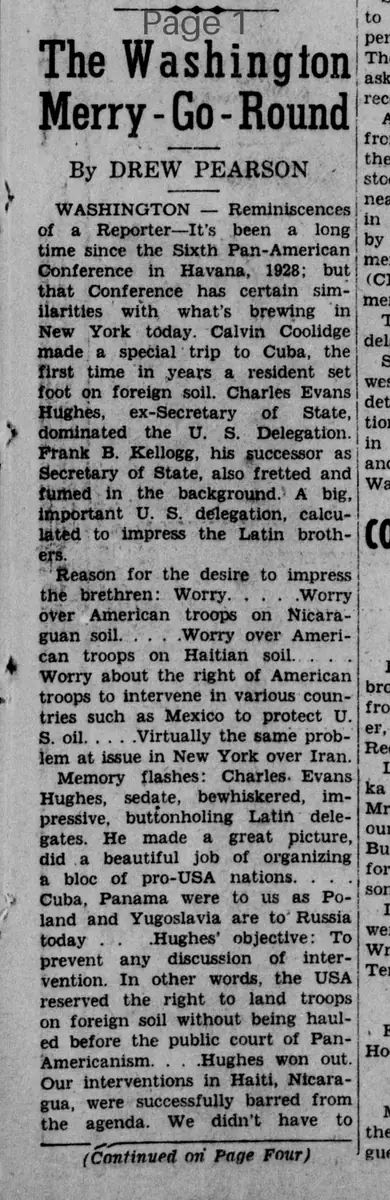
Merry - Go-Round
By DREW PEARSON
WASHINGTON - Reminiscences of a Reporter-It's been a long time since the Sixth Pan-American Conference in Havana, 1928; but that Conference has certain similarities with what's brewing in New York today. Calvin Coolidge made a special trip to Cuba, the first time in years a resident president set foot on foreign soil. Charles Evans Hughes, ex-Secretary of State, dominated the U. S. Delegation. Frank B. Kellogg, his successor as Secretary of State, also fretted and fumed in the background. A big important U. S. delegation, calculated to impress the Latin brethren.
Reason for the desire to impress the brethren: Worry... Worry over American troops on Nicaraguan soil... Worry over American troops on Haitian soil... Worry about the right of American troops to intervene in various countries such as Mexico to protect U. S. oil... Virtually the same problem at issue in New York over Iran.
Memory flashes: Charles Evans Hughes, sedate, bewhiskered, impressive, buttonholing Latin delegates. He made a great picture, did a beautiful job of organizing a bloc of pro-USA nations... Cuba, Panama were to us as Poland and Yugoslavia are to Russia today...
Hughes' objective: To prevent any discussion of intervention. In other words, the USA reserved the right to land troops on foreign soil without being hauled before the public court of Pan-Americanism... Hughes won out. Our interventions in Haiti, Nicaragua, were successfully barred from the agenda. We didn't have to
(Continued on Page Four)
The Washington
Merry-Go-Round
(Continued from Page One)
stage a walk-as the Russians did
at New York.
Biggest test: Whether the USA
would consent to arbitrate disputes
with its Latin neighbors. . . .Hughes
had instructions to duck even this.
The State Department didn't even
want to discuss the matter. It was
a tough fight to bar all debate of
arbitration, but Hughes won out
even on this.
Pan-American Arbitration Con-
ference, Washington, 1929 - U.S.
public opinion, usually ahead of
the Government, by this time had
begun to change. . . .There had
always been resentment against
landing troops in Nicaragua. The
Pulitzers plus other liberal news-
papers poured a torrent of abuse
on the State Department. Even
conservative papers were skeptical
. Charles Evans Hughes was
raked over the coals for opposing
even the discussion of arbitration
at Havana. . . . .Like Russia, we
still demanded the veto, but unlike
Russia, the American people didn't
support their Government. They
were way ahead of it.
Meanwhile two small nations-
Bolivia and Paraguay-started to
tangle in the Chaco. Since the
United States did not have to sub-
mit to arbitration, it was glad to
recommend arbitration for others.
The Chaco dispute was arbitrated
After that we couldn't very well
avoid accepting the principle of
arbitration ourselves. . .
Hughes
and Kellogg went into reverse,
wrcte a sweeping formula for ar-
bitrating disputes. . . However, the
question of landing U.S. troops on
our neighbors' soil still remained
our prerogative. We still retained
the veto. . . And it took years for
the Senate to consider the Arbitra-
tion Treaty finally signed
by
Hughes and Kellogg.
Montevideo, 1933-Cordell Hull
sailed to the Seventh Pan-Ameri-
can Conference a very green Sec-
retary of State. . . .American pub-
lic opinion by then had moved far
ahead of the old swashbuckling
days when we landed troops in La-
tin America at the drop of a hat.
Henry L. Stimson had begun to
pull the Marines out of Nicaragua
and Haiti. There was general dis-
approval of landing troops outside
our borders. . . . So far, however,
we had ducked any official move
by a Pan-American Conference to
deny us the right of armed inter-
vention.
Cordell Hull, sailing for Monte-
video, wanted to continue ducking
. . .After arriving, Hull called on
the Argentine and Chilean For-
eign Ministers, later informed Am-
erican colleagues that Argentine
Saavedra Lamas and Chilean Mi-
guel Cruchaga agreed with him
that the right to intervene by
force must be preserved. He said
they even promised to speak in
favor of the American position,
after which he, Hull, would rise
and support the Argentine and
Chilean Foreign Ministers.
Other U.S. delegates could hardly
believe their ears. For Latin cham-
pionships of the right of armed in-
tervention meant political suicide.
.They went to the session,
however, and listened. The Ar-
gentine Foreign Minister rose,
spoke briefly against intervention.
It could not be tolerated, he said
. . . . Delegates noticed that Cor-
dell Hull suddenly bent over and
began hastily scribbling on a pad
of paper. . . Next came the Chil-
ean Foreign Minister. He also Said
it was time to outlaw the right of
any nation to land troops on the
soil of another. . . .This was just
the opposite of what Mr. Hull
expected. Finally Hull arose and
delivered the new speech he had
been scribbling-a speech backing
up Argentina-Chile, placing the
USA on record against armed in-
tervention. . . .That was partly how
the Good Neighbor policy was born.
Sumner Welles did the rest.
New York, 1946 Today, Russia.
fuming against the United Nations,
is in the same boat as the 'USA
before the Pan-American Union.
Instead of Nicaragua, it's Iran. . . .
But there is an essential difference
. . . In 20 years, the USA moved
far ahead in international moral-
ity-due to the power of public
opinion. The American people, its
press and pulpit, were continually
pushing their Government.
The opposite is true in Russia. The
Russian people know little about
Iran, little about the UN conference, have to take what their Gov-
ernment gives them. A Stars and
Stripes quiz of Red Army soldiers
showed that most of them thought
Churchill was an American. . . .
We have to make allowances for
Russia because in a sense she is
a new nation-sensitive and sus-
picious. But until the Russian
people run their Government, until
we penetrate the Soviet iron cur-
tain and get to know the Russian
people, we face the dismal pros-
pect of turmoil and misunderstandi-
ing for many years to come.
What sub-type of article is it?
What themes does it cover?
What keywords are associated?
What entities or persons were involved?
Where did it happen?
Story Details
Key Persons
Location
Havana, Cuba; Washington, D.C.; Montevideo, Uruguay; New York, Usa
Event Date
1928 1946
Story Details
Drew Pearson recounts U.S. resistance to discussing intervention and arbitration at 1928 Havana and 1929 Washington conferences, eventual acceptance influenced by public opinion, and 1933 Montevideo shift under Hull leading to Good Neighbor policy, contrasting with 1946 Soviet position at UN over Iran.