Thank you for visiting SNEWPapers!
Sign up free
Virginia Argus
Richmond, Virginia
What is this article about?
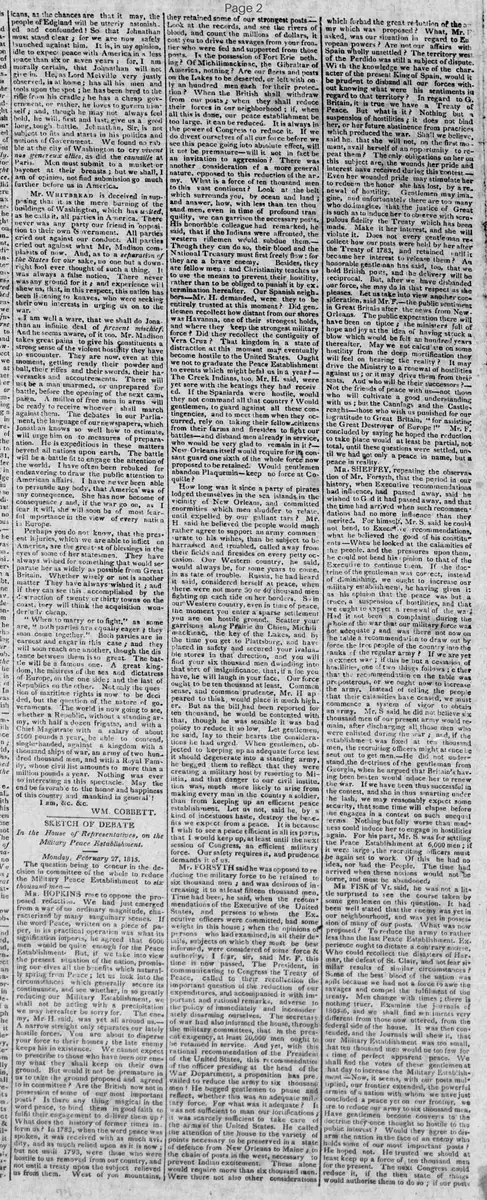
On February 27, 1815, the U.S. House of Representatives debated reducing the military peace establishment to 6,000 men after the War of 1812. Mr. Hopkins, Mr. Forsyth, Mr. Sheffey, and Mr. Fisk of Vermont argued against drastic cuts, citing threats from Britain, Spain, and Native Americans, advocating for at least 10,000-15,000 troops to secure posts and frontiers.
Clipping
OCR Quality
Full Text
In the House of Representatives, on the
Military Peace Establishment.
Monday, February 27, 1815.
The question being to Concur in the de-
cision in committee of the whole to reduce
the Military Peace Establishment to six
thousand men-
Mr. HOPKINS rose to oppose the pro-
posed reduction. We had just emerged
from a war of no ordinary magnitude, cha-
racterized by many sanguinary scenes. If
the word Peace, written on a piece of pa-
per, in its practical operation was what its
signification imports, he agreed that 6000
men would be quite enough for the Peace
Establishment. But, if we take into view
the present situation of the nation, promis-
ing ourselves all the benefits which natural-
ly spring from Peace; let us look into the
circumstances which generally secure its
continuance, and see whether, in so greatly
reducing our Military Establishment, we
shall not be acting with a precipitation
we may hereafter be sorry for. The ene-
my, Mr- H said, was yet all around us.-
A narrow streight only separates our lately
hostile forces. You are about to disperse
your force to their homes; the late enemy
keeps his in existence. We cannot expect
to prescribe to those who have been our en-
emy what they shall keep on their own
ground. But would it not be premature in
us to take the ground proposed and agreed
to in committee? Are the British now not in
possession of some of our most important
posts? Is there any thing magical in the
word peace, to bind them in good faith to
fulfil their engagement to deliver them up?
What does the history of former times in-
form us? In 1783, when the word peace was
spoken, it was received with as much avi-
dity, and as much relied upon as it is now ;
but not until 1793, were those who were
hostile to us removed from our country, and
not until a treaty upon the subject relieved
us from them. West of yon mountains,
they retained some of our strongest posts.-
Look at the records, and see the rivers of
blood, and count the millions of dollars, it
cost you to drive the savages from your fron-
tier who were fed and supported from those
posts. Is the possession of Fort Erie noth-
ing? Of Michilimackinac, the Gibraltar of
America, nothing ? Are our fleets and posts
on the Lakes to be deserted, or left with on-
ly an hundred men each for their protec-
tion? When the British shall withdraw
from our posts; when they shall reduce
their forces in our neighborhood ; if, when
all this is done, our peace establishment be
too large. it can be reduced. It is always in
the power of Congress to reduce it. If we
do divest ourselves of all our force before we
see this peace going into absolute effect, will
it not be premature-will it not in fact be
an invitation to aggression? There was
another consideration of a more general
nature, opposed to this reduction of the ar-
my. What is a force of ten thousand men
to this vast continent? Look at the belt
which surrounds you, by ocean and land ;
and answer, how, with less than ten thou-
sand men, even in time of profound tran-
quility, we can garrison the necessary posts.
His honorable colleague had remarked, he
said, that if the Indians were affronted, the
western riflemen would subdue them.-
Though they can do so, their blood and the
National Treasury must first freely flow : for
they are a brave enemy:
Besides, they
are fellow men : and Christianity teaches us
to use the means to prevent their hostility.
rather than to be obliged to punish it by ex-
termination hereafter. Our Spanish neigh-
bors--Mr. H. demanded, were they to be
entirely trusted at this moment? Did gen-
tlemen recollect how distant from our shores
was Havanna, one of their strongest holds,
and where they keep the strongest military
force ? Did they recollect the Contiguity of
Vera Cruz? That kingdom in a state of
distraction at this moment may eventually
become hostile to the United States. Ought
we not to graduate the Peace Establishment
to events which might befall us in a year?--
The Creek Indians, too, Mr. H. said, were
yet sore with the beatings they had receiv-
ed. If the Spaniards were hostile, would
they not command all that country ? Would
gentlemen, to guard against all these con-
tingencies, and to meet them when they oc-
curred, rely on taking their fellow-citizens
from their farms and firesides to fight our
battles-and disband men already in service,
who would be very glad to remain in it -
New Orleans itself would require for its con-
stant guard one sixth of the whole force now
proposed to be retained. Would gentlemen
abandon Plaquemine-keep no force at Co-
quille?
How long was it since a party of pirates
lodged themselves in the sea islands in the
vicinity of New Orleans, and committed
enormities which men shudder to relate,
until expelled by our gallant tars? Mr.
H. said he believed the people would much
rather agree to support an army commen-
surate to his wishes, than be subject to be
harrassed and troubled, called away from
their fields and firesides on every petty oc-
casion. Our Western country. he said,
would always be, for some years to come,
in a state of trouble. Russia, he had heard
it said, considered herself at peace, when
there. were not more 30 or 40 thousand men
fighting on each side on her borders. Sin
our Western Country, even in time of peace,
the moment you enter a sparse settlement
you are on hostile ground. Scatter your
garrisons along Prairie du Chien, Michili-
mackinac, the key of the Lakes, and by
the time you get to Plattsburg, and have
placed in safety and secured your valuable
stores in that direction, and you will
find your six thousand men dwindling into
that sort of insignificance, that, if a foe you
have, he will laugh in your face. Our force
Ought to be ten thousand at least. Common
sense, and common prudence, Mr. H ap-
peared to think, would place it much high-
er. But as the bill had been reported for
ten thousand, he would be contented with
that, though he was sensible it was bad
policy to reduce it so low. Let gentlemen,
he said. lay to their hearts the Considera-
tions he had urged. When gentlemen, ob-
jected to keeping up an adequate force lest
it should degenerate into a standing army.
he begged them to reflect that they were
creating a military host by resorting to Mi-
ilitia, and that danger to our civil institu-
tion was, much more likely to arise from
making every man in the country a soldier,
than from keeping up an efficient peace
establishment, Let us not, said he, by a
kind of incestuous haste, destroy the bene-
fits we expect from a peace. It is because
I wish to see a peace efficient in all its parts,
that I would keep up, at least until the next
session of Congress, an efficient military
force. Our safety requires it, and prudence
demands it of us.
Mr. FORSYTH said he was opposed to re-
ducing the military force to be retained to
six thousand men ; and was desirous of in-
creasing it to at least fifteen thousand men,
Time had been, he said, when the recom-
mendations of the Executive of the United
States, and persons to whom the Ex-
ecutive officers were committed, had some
weight in this house; when the opinions of
persons who had examined, in all their de-
tails, subjects on which they must be best
informed, were considered of some force &
authority. I fear, sir, said Mr. F. this
time is now passed. The President, in
Communicating to Congress the Treaty of
Peace, called to their recollection the
important question of the reduction of our
expenditures, and accompanied it with im-
portant and rational remarks, adverse to
the policy of immediately and inconsider-
ately disarming ourselves. The secretary
of war had also informed the house, through
the military committees, that in the pres-
ent exigency, at least 20,000 men ought to
be retained in service. And yet, with this
rational recommendation of the President
of the United States, this recommendation
of the officer presiding at the head of the
War Department, a proposition has pre-
vailed to reduce the army to six thousand
men! He begged gentlemen to pause and
reflect, whether this was an adequate mil-
tary force. For what was it adequate? It
was not sufficient to man our fortifications ;
it was scarcely sufficient to take care of
the arms of the United States. He called
the attention of the house to the variety of
points necessary to be preserved in a state
of defence from New Orleans to Maine ; to
the chain of posts in the west, necessary to
prevent Indian excitement. These alone
would require more than six thousand men.
Were there not also other considerations
which forbad the great reduction of the ar-
my which was proposed? What, Mr. F
asked, was our situation in regard to Eu-
ropean powers? Are not our affairs with
Spain wholly unsettled ? The territory west
of the Perdido was still a subject of dispute.
With the knowledge we have of the char-
acter of the present King of Spain, would it
be prudent to disband all our forces with-
out knowing what were his sentiments in
regard to that territory? In regard to G.
Britain, it is true we have a Treaty of
Peace. But what is it? Nothing but a
suspension of hostilities ; it does not bind
her, or her future abstinence from practices
which produced the war. Shall we believe,
said he. that she will not, on the first mo-
ment, avail herself of an opportunity to re-
peat them ? The only obligations on her on
this subject are, the wounds her pride and
interest have received during this contest.-
Even her wounded pride may stimulate her
to redeem the honor she has lost, by a re-
newal of hostility. Gentlemen may ima-
gine, and unfortunately there are too many
who do imagine, that the justice of Great
is such as to induce her to observe with scru-
pulous fidelity the Treaty which has been
made. Make it her interest, and she will
violate it. Does not every gentleman re-
collect how our posts were held by her after
the Treaty of 1783, and retained until it
became her interest to release them? An
honorable gentleman has said, too, that we
hold British posts, and their delivery will be
reciprocal. But, after we have disbanded
our force, she may do in that respect as she
pleases. Let us take into view another con-
sideration, said Mr. F. -the public sentiment
in Great Britain after the news from New.
Orleans. The public expectation there will
have been on tiptoe; the ministers full of
hope and joy at the idea of having struck a
blow which would be felt an hundred years
thereafter. May we not calculate on some
hostility from the deep mortification they
will feel on hearing the reality? It may
drive the Ministry to a renewal of hostilities
against us; or it may drive them from their
seats. And who will be their successors?--
Not the friends of peace with us--not those
who will cultivate a good understanding
with us ; but the Cannings and the Castle-
reaghs-those who wish us punished for our
ingratitude to Great Britain, "for assisting
the Great Destroyer of Europe!" Mr. F.
concluded by saying he hoped the reduction
to take place would at least be partial, not
total, until these questions were settled, un-
til we had not only a peace in name, but a
peace in reality.
MR. SHEFFEY, repeating the observa-
tion of Mr. Forsyth, that the period in our
history, when Executive recommendations
had influence, had passed away, said he
wished to God it had passed away, and that
the time had arrived when such recommen-
dations had no more influence than they
merited. For himself, Mr. S. said he could
not bend, to Executive recommendations,
what he believed the good of his constitu-
ents-When he looked at the calamities of
the people. and the pressures upon them,
he could not bend his opinion to that of the
Executive to Continue them. If the doc-
-trine of the gentleman was correct, instead
of diminishing, we ought to increase our
military establishment, he having given it
as his opinion that the peace was but a
truce, a suspension of hostilities, and that
we ought to expect a renewal of the war
Had it not been a complaint during the
whole of the war that our military force was
not adequate ; and was there not now on
the table a recommendation to draw out by
force the free people of the country into the
ranks of the regular army ? If we are yet
to expect war ; if this be but a cessation of
hostilities, one of two things follows ; either
that the recommendation on the table was
preposterous, or we ought now to increase
the army. Instead of telling the people
that their calamities have ceased, we must
commence a system of vigor to obtain
an army. Mr. S said he did not believe six
thousand men of our present army would re-
main, after discharging all those men who
were enlisted during the war ; and, if the
establishment was fixed at ten thousand
men, the recruiting officers might at once be
sent out to get men.-He did not under-
stand the doctrines of the gentleman from
Georgia, when he argued that Britain's hav-
ing been beaten would induce her to renew
the war. If we have been thus successful in
the contest, and she in thus smarting under
the lash, we may reasonably expect some
security, that some time will elapse before
she engages in a contest on such unequal
terms Nothing but folly worse than mad-
ness could induce her to engage in hostilities
again. For his part, Mr. S. was for settling
the Peace Establishment at 6,000 men; if
it were large , the recruiting officers must
be again set to work. Of this he had no
idea, nor had the People. The time had
arrived when these notions would not be
borne, and must be abandoned:
Mr FISK of Vt. said, he was not a lit-
tle surprised to see the course taken by
some gentlemen on this question. It had
been well stated that the enemy was yet in
our neighbourhood, and was yet in posses-
sion of many of our posts. What was now
proposed ? To reduce the army to rather
less than the last Peace Establishment. Ex-
perience ought to dictate a contrary course.
Who could recollect the disasters of Har-
mar, the defeat of St. Clair, and not fear si-
milar results of similar circumstances ?
Some of the best blood of the nation was
spilt because we had not a force to awe the
savages and compel the fulfilment of the
treaty. Men change with times ; there is
nothing truer. Examine the journals of
1805-6, and we shall find sentiments very
different from those now uttered, from the
federal side of the house. It was then con-
tended, and the Journals will shew it, that
our Military Establishment was too small,
that ten thousand men would be too few for
time of perfect apparent peace. We
shall find the votes of these gentlemen at
that day to increase the Military Establish-
ment-Now, it seems, with our posts mul-
tipled, our frontier extended, the powerful
armies of a nation with whom we have just
concluded a peace yet on our frontier, we
are to reduce our army to six thousand men.
Have gentlemen become converts to the
doctrine they once thought so hostile to the
public interest ? Would they agree to dis-
arm the nation in the face of an enemy who
holds some of our most important posts ?
He hoped not. He trusted we should at
least keep up a force of ten thousand men
for the present. The next Congress could
reduce it, if the then state of things
would authorise them to do so ; if our post
What sub-type of article is it?
What keywords are associated?
What entities or persons were involved?
Where did it happen?
Domestic News Details
Primary Location
House Of Representatives
Event Date
Monday, February 27, 1815
Key Persons
Event Details
Debate on concurring with the committee's decision to reduce the Military Peace Establishment to six thousand men. Mr. Hopkins opposed the reduction, arguing for at least ten thousand men due to ongoing threats from British forces, Spanish neighbors, Creek Indians, and the need to secure western posts and New Orleans. Mr. Forsyth advocated for fifteen thousand men, citing Executive recommendations and unsettled affairs with Spain and Britain. Mr. Sheffey supported the reduction to six thousand, dismissing fears of renewed war. Mr. Fisk of Vermont also opposed reduction, referencing past disasters and calling for at least ten thousand men.