Thank you for visiting SNEWPapers!
Sign up free
The Wilmington Morning Star
Wilmington, New Hanover County, North Carolina
What is this article about?
Profile of the American Youth Congress, a coalition of youth groups formed in 1934 amid disputes, led by young officers like Jack McMichael. It addresses youth problems, faces communism charges, and operates on modest finances in Washington.
Clipping
OCR Quality
Full Text
In Washington
WASHINGTON, Feb. 20. - The American Youth Congress was born in a row. and has been in the center of intermittent rows ever since -most of them over the issue of Communism.
Between rows and meetings- which have been congruous on some occasions- it is run by three young men and a girl.
Properly speaking, it isn't a group but a conglomeration of independent organizations 60 or more of them, with 4,000,000-odd members. Practically speaking, four of these are the congress' backbone: the National Student Federation, the American Student Union. the International Student Service and the United Student Peace Committee.
RELIGION STUDENT
HEADS GROUP
Greatly condensed, here's the lay out:
The officers:
Jack McMichael, chairman. Born in Georgia, graduated from Emory college in 1937, now enrolled at Union Theological Seminary preparing to be a minister. Worked for the Y. M. C. A. after leaving Emory and spent upward of a year in China.
McMichael is tall, slim and good-looking. His is an unpaid office, he was elected to it last June and it's his first Youth Congress office.
Joseph Cadden, executive secretary. A New Yorker, graduated from Brown university in 1931: worked for the National Student Federation and for the International Student Service.
His congress job is full-time, and in theory pays $25 a week. Actually, he took in about $800 last year. He ekes out his income by lecturing on the side.
Frances Williams, administrative secretary. Comes from New Jersey, graduated from the New Jersey College for Women in 1935, and went to work for the Foreign Policy Association.
Her job is full-time, too; like Cadden's it's supposed to pay $25 a week, but really paid about $900 last year.
Abbott Simon, legislative director, Graduate of Harvard and holder of an M. A. from Columbia. He lives in Washington and acts as the congress's contact man on Capitol Hill. His is not a full-time job and carries no pay.
The history:
In 1934 a meeting was called in New York to organize a youth movement. Moving spirit was Viola Ilma, who did most of the original pushing; the meeting broke up in a row, however, and split into two wings.
One of these-Viola's - dwindled and died. The other became the Youth Congress.
The congress went ahead, trying to educate both young people and adults to the existence of a "youth problem," stirring up localities to meet specific youth needs, and so on. It won the friendship of Mrs. Roosevelt and the enmity of Martin Dies.
Its current Washington meeting was called purely as a citizenship institute and was participated in by many bodies not members of the congress, It hadn't even started before charges of communistic influence were flying.
The Finances:
Last year the congress took in and spent slightly more than $15,000. It raised two-thirds of this from registration fees and collections at its meetings and from the sale of literature.
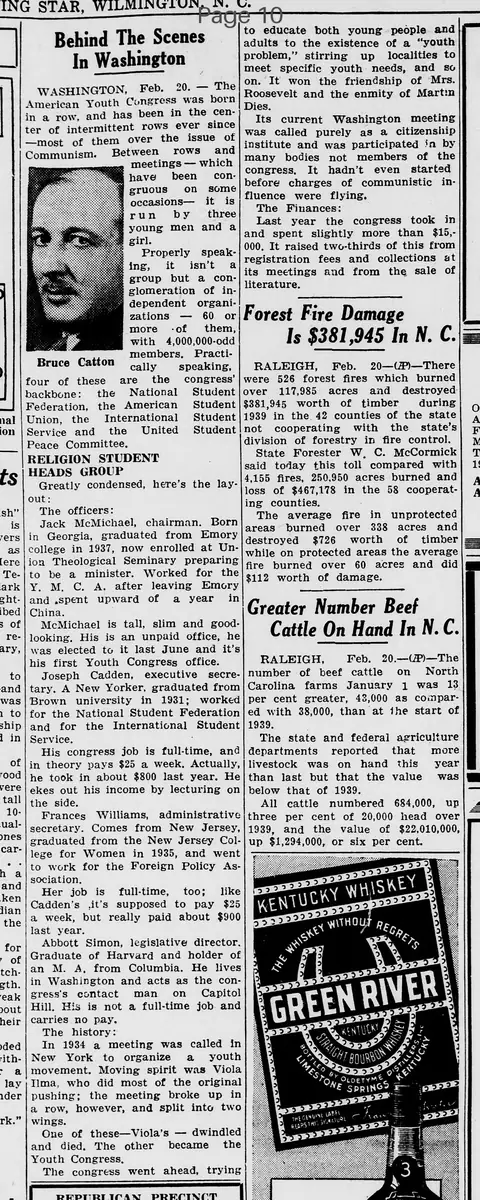
Bruce
Catton
What sub-type of article is it?
What themes does it cover?
What keywords are associated?
What entities or persons were involved?
Where did it happen?
Story Details
Key Persons
Location
Washington
Event Date
1934
Story Details
The American Youth Congress originated from a contentious 1934 meeting in New York that split into factions, with one becoming the congress focused on youth issues. Led by unpaid chairman Jack McMichael and paid staff Joseph Cadden and Frances Williams, plus legislative director Abbott Simon, it comprises over 60 organizations. It faced communism accusations, gained Mrs. Roosevelt's support, and Martin Dies' opposition. Last year, it handled about $15,000 in finances from fees and literature sales.