Thank you for visiting SNEWPapers!
Sign up free
Sentinel Of The Valley
Woodstock, Shenandoah County, Virginia
What is this article about?
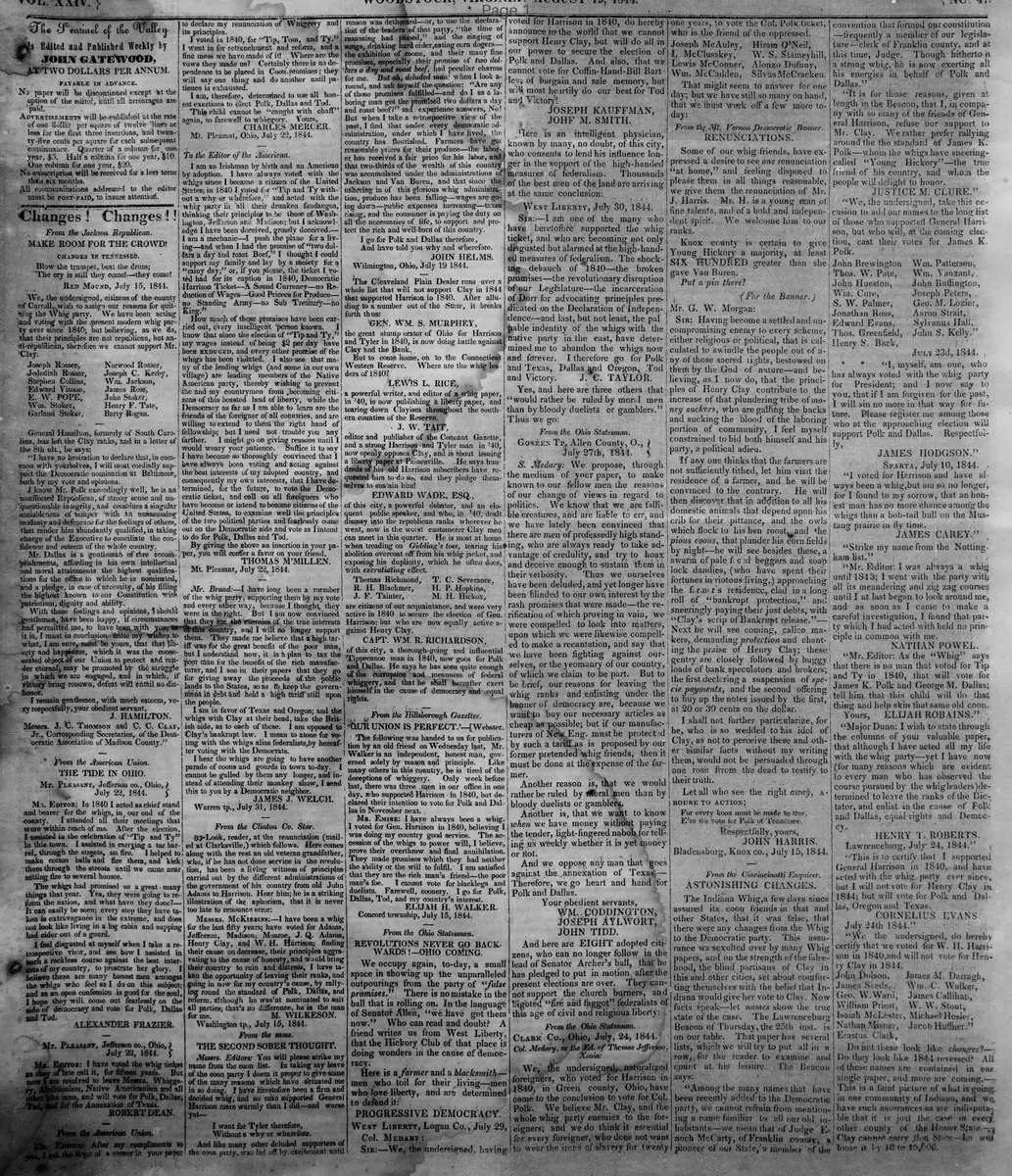
Compilation of public letters and statements from former Whig supporters in Tennessee, Ohio, and Indiana renouncing Henry Clay and declaring support for Democratic nominees James K. Polk and George M. Dallas in the 1844 election, citing broken promises and policy disagreements.
Merged-components note: Sequential components compiling letters and announcements of Whig party members renouncing support for Clay and switching to Democrats, forming a single cohesive domestic news section.
Clipping
OCR Quality
Full Text
From the Jackson Republican.
MAKE ROOM FOR THE CROWD!
CHANGES IN TENNESSEE,
Blow the trumpet, beat the drum;
The cry is still they come!—they come!
Red Mount, July 15, 1844.
We, the undersigned, citizens of the county of Carroll, wish to assign our reasons for quitting the Whig party. We have been acting and voting with the present modern whig party ever since 1840; but believing, as we do, that their principles are not republican, but anti-republican, therefore we cannot support Mr. Clay.
Joseph Rosser,
Norwood Rosser,
Jedediah Rosser,
Joseph C. Kerby,
Stephen Collins,
Wm. Jackson,
Edward Vinson,
James Ross,
E. W. POPE,
John Stoker,
Wm. Stoker,
Henry F. Tate,
Garland Stoker,
Barty Rogan.
General Hamilton, formerly of South Carolina, has left the Clay ranks, and in a letter of the 5th ult., he says:
"I have no hesitation to declare that, in common with yourselves, I will most cordially support the Democratic nomination at Baltimore, both by my vote and opinions.
I know Mr. Polk exceedingly well, he is an unaffected Republican, of strong sense and unquestionable integrity, and combines a singular amiableness of temper with an unassuming modesty and deference for the feelings of others, that render him abundantly qualified, in taking charge of the Executive to conciliate the confidence and esteem of the whole country.
Mr. Dallas is a gentleman of rare accomplishments, affording in his own intellectual and moral attainments the highest qualifications for the office to which he is nominated, and a pledge, in case of necessity, of his filling the highest known to our Constitution with patriotism, dignity and ability.
With these feelings and opinions, I, gentlemen, should have been happy, if circumstances had permitted me, to have been with you; as it is, I must in conclusion unite my wishes to what, I am sure must be yours, that that liberty and happiness, which it was the consecrated object of our Union to protect and render eternal, may be promoted by the struggle in which we are engaged, and in which, if victory bring renown, defeat will entail no dishonor.
I remain gentlemen, with much esteem, very respectfully, your obedient servant,
J. HAMILTON."
Messrs. J. C. THOMSON and C. C. CLAY, Jr., Corresponding Secretaries, of the Democratic Association of Madison County.
From the American Union.
THE TIDE IN OHIO.
Mr. Pleasant, Jefferson co., Ohio,
July 22, 1844.
Mr. Editor: In 1840 I acted as chief standard bearer for the whigs, in our end of the county. I attended all their meetings that were within reach of me. After the election, I assisted in the celebration of "Tip and Ty" in this town. I assisted in carrying a tar barrel, through the streets, on fire. I helped to make cotton balls and fire them, and kick them through the streets until we came near setting fire to several houses.
The whigs had promised us a great many things that year. Yes, they were going to reform the nation, and what have they done?—
It can easily be seen; every step they have taken is extravagance in the extreme, and does not look like living in a log cabin and supping hard cider out of a gourd.
I feel disgusted at myself when I take a retrospective view, and see how I assisted in such a reckless course against the best interests of my country, to prostrate her glory. I believe there are many honest men amongst the whigs who feel as I do on this subject; and as an open confession is good for the soul, I hope they will come out fearlessly on the side of democracy and vote for Polk, Dallas and Tod.
ALEXANDER FRAZIER.
Mr. Pleasant, Jefferson co., Ohio,
July 22, 1844.
Mr. Editor: I have voted the whig ticket as they of late call it, for fifteen years. But now I am resolved to leave Messrs. Whiggery, Abolitionism, Native Americanism and all other like isms, and will vote for Polk, Dallas, Tod and for the Annexation of Texas.
ROBERT DEAN.
From the American Union.
Mr. Editor: After my compliments to you on the favor of a corner in your paper to declare my renunciation of Whiggery and its principles.
I voted in 1840 for "Tip, Tom, and Ty."
I went in for retrenchment and reform, and a fine mess we have made of it! Where are the vows they made us? Certainly there is no dependence to be placed in Coon promises; they will say one thing and do another until patience is exhausted.
I am, therefore, determined to use all honest exertions to elect Polk, Dallas and Tod.
This child cannot be "caught with chaff" again, so farewell to whiggery. Yours,
CHARLES MERCER.
Mt. Pleasant, Ohio, July 22, 1844.
To the Editor of the American
I am an Irishman by birth and an American by adoption. I have always voted with the whigs since I became a citizen of the United States; in 1840 I voted for "Tip and Ty without a why or wherefore," and acted with the whig party in all their drunken fandangos, thinking their principles to be those of Washington, Jefferson and Madison; but I acknowledge I have been deceived, grossly deceived.
I am a mechanic—I push the plane for a living—and when I had the promise of "two dollars a day and roast Beef" I thought I could support my family and lay by a moiety for a "rainy day;" or, if you please, the ticket I voted had for its caption in 1840, Democratic Harrison Ticket: A Sound Currency—no Reduction of Wages—Good Prices for Produce—no Standing Army—no Sub Treasury—no King.
How much of these promises have been carried out, every intelligent person knows.
I know that since the election of "Tip and Ty," my wages instead of being $2 per day have been REDUCED, and every other promise of the whigs has been violated. I also see that many of the leading whigs (and some in our own village) are leading members of the Native American party, thereby wishing to prevent me and my countrymen from becoming citizens of this boasted land of liberty, while the Democracy as far as I am able to learn are the friends of the foreigner of all countries, and are willing to extend to them the right hand of fellowship; but I need not trouble you any farther. I might go on giving reasons until I would weary your patience. Suffice it to say I have become so thoroughly convinced that I have always been voting and acting against the best interests of my adopted country, and consequently my own interests, that I have determined, for the future, to vote the Democratic ticket, and call on all foreigners who have become or intend to become citizens of the United States, to examine well the principles of the two political parties and fearlessly come out on the Democratic side and vote as I intend to do for Polk, Dallas and Tod.
By giving the above an insertion in your paper, you will confer a favor on your friend,
THOMAS MULLEN
Mr. Brand:—I have long been a member of the whig party, supporting them by my vote and every other way, because I thought they were in the right. But I am now convinced that they are the enemies of the true interests of this country, and I will no longer support them. They made me believe that a high tariff was for the great benefit of the poor man, but I understand now, it is a plan to tax the poor man for the benefit of the rich manufacturer, and I see in their papers that they go for giving away the proceeds of the public lands to the States, so as, to keep the government in debt and hold a high tariff still upon the people.
I am in favor of Texas and Oregon; and the whigs with Clay at their head, take the British side, as to each of these. I am opposed to Clay's bankrupt law. I mean to atone for voting with the whigs alias federalists, by hereafter voting with the Democrats.
I hear the whigs are going to have another parade of coons and gourds in town to-day. I cannot be gulled by them any longer, and instead of attending their monkey show, I send this to you by a Democratic neighbor.
JAMES J. WELCH
Warren tp., July 31, 1844.
From the Clinton Co. Star.
Look, reader, at the renunciation (mailed at Clarksville.) which follows. Here comes along with the rest an old veteran grandfather, who, if he has not done service in the revolution, has been a living witness of principles carried out by the different administrations of the government of his country from old John Adams to Harrison. Hear him; he is a striking illustration of the aphorism, that it is never too late to renounce error:
Messrs. McKibbins: I have been a whig for the last fifty years; have voted for Adams, Jefferson, Madison, Monroe, J. Q. Adams, Henry Clay, and W. H. Harrison; finding their cause on decrease, their principles aggravating to the cause of honesty, and would bring their country to ruin and distress, I have taken the opportunity of leaving their ranks, and going in now for my country's cause, by rallying round the standard of Polk, Dallas, and reform, although he wasn't nominated to suit all parties; that's no difference, he is the man for me.
M. WILKESON.
Washington tp., July 15, 1844.
From the same.
THE SECOND SOBER THOUGHT.
Messrs. Editors: You will please strike my name from the coon list. In taking my leave of the coon party I deem it proper to give some of the many reasons which have actuated me in so doing. I have heretofore been a firm and decided whig, and no man supported General Harrison more warmly than I did—and worse yet I went for Tyler therefore,
Without a why or wherefore.
And like many other deluded supporters of the coon party, was led off by excitement until reason was dethroned—or, to use the declaration of the leaders of that party. "the time of reasoning had passed," and the singing of songs, drinking hard cider, eating corn dodgers—the exhibition of coons, and their many fine promises, especially their promise of two dollars a day and roast beef, had peculiar charms for me. But ah, deluded man! when I look around, and ask myself the question: "Are any of those promises fulfilled—and do I as a laboring man get the promised two dollars a day and roast beef?" sad experience answers. No!
But when I take a retrospective view of the past, I find that under every democratic administration, under which I have lived, the country has flourished. Farmers have got reasonable prices for their produce—the laborer has received a fair price for his labor, and that two-thirds of the wealth of this country was accumulated under the administrations of Jackson and Van Buren, and that since the ushering in of this glorious whig administration, produce has been falling—wages are going down—public expenses increasing—taxes rising, and the consumer is paying the duty on all the necessaries of life, to support and protect the rich and well-born of this country.
I go for Polk and Dallas therefore,
And have told you why and wherefore.
JOHN HELMS.
Wilmington, Ohio, July 19 1844.
The Cleaveland Plain Dealer runs over a whole list that will not support Clay in 1844 that supported Harrison in 1840. After alluding to a number out of the State, it breaks forth thus:
GEN. WM. S. MURPHEY,
the great stump orator of Ohio for Harrison and Tyler in 1840, is now doing battle against Clay and the Bank.
But to come home, on to the Connecticut Western Reserve. Where are the whig leaders of 1840?
LEWIS L. RICE.
a powerful writer, and editor of a whig paper in 40, is now publishing a liberty paper, and tearing down Clayism throughout the southern counties of the Reserve.
J. W. TAIT.
editor and publisher of the Coneaut Gazette, and a strong Harrison and Tyler man in 40, now openly opposes Clay, and is about issuing a liberty paper at Painesville. He says hundreds of his old Harrison subscribers have requested him to do so, and they pledge themselves to sustain him!
EDWARD WADE, ESQ.,
of this city, a powerful debator, and an eloquent public speaker, and who, in 40, dealt dismay into the republican ranks wherever he went, now is the worst customer Clay men can meet in this quarter. He is most at home when treading on Giddings's toes, tearing his abolition overcoat off from his whig jacket, and exposing his duplicity, which he often does, with excruciating effect.
Thomas Richmond,
T. C. Severance,
R. H. Blackmer,
H. P. Hopkins,
J. F. Tainter,
M. H. Hickox,
are citizens of our acquaintance, and were very active in 1840 to secure the election of Gen. Harrison; but who are now equally active against Henry Clay.
CAPT. WM. R. RICHARDSON.
of this city, a thorough-going and influential Tippecanoe man in 1840, now goes for Polk and Dallas. He says he has seen quite enough of the corruption and meanness of federal whiggery, and that he shall hereafter exert himself in the cause of democracy and equal rights.
From the Hillsborough Gazette.
OUR UNION IS PERFECT.' —Webster.
The following was handed to us for publication by an old friend on Wednesday last, Mr. Walker is an independent, honest man, governed solely by reason and principle. Like many others in this country, he is tired of the deceptions of whiggery. Only week before last, there were three men in our office in one day, who supported Harrison in 1840, but declared their intention to vote for Polk and Dallas in November next.
Mr. Editor: I have always been a whig.
I voted for Gen. Harrison in 1840, believing I was doing my country good service. The accession of the whigs to power will, I believe, prove their overthrow and final annihilation.
They made promises which they had neither the ability or the will to fulfil. I am satisfied that they are the rich man's friend—the poor man's foe. I cannot vote for blacklegs and duelists. Farewell, coonery. I go for Polk, Dallas, Tod, and my country's interest.
ELIJAH H. WALKER.
Concord township, July 15, 1844.
From the Ohio Statesman.
REVOLUTIONS NEVER GO BACKWARDS! OHIO COMING.
We occupy again, to-day, a small space in showing up the unparalleled outpourings from the party of "false promises." There is no mistake in the ball that is rolling on. In the language of Senator Allen, "we have got them now." Who can read and doubt? A friend writes us from West Liberty, that the Hickory Club of that place is doing wonders in the cause of democracy.
Here is a farmer and a blacksmith men who toil for their living—men who love liberty, and are determined to defend it:
PROGRESSIVE DEMOCRACY.
West Liberty, Logan Co., July 29,
Col. Medary:
Sir: We, the undersigned, having voted for Harrison in 1840, do hereby announce to the world that we cannot support Henry Clay, but will do all in our power to secure the election of Polk and Dallas. And also, that we cannot vote for Coffin-Hand-Bill Bartlett of bargain and sale memory, but will most heartily do our best for Tod and Victory!
JOSEPH KAUFFMAN,
JOHN M. SMITH.
Here is an intelligent physician, known by many, no doubt, of this city, who consents to lend his influence longer in the support of the high-handed measures of federalism. Thousands of the best men of the land are arriving at the same conclusion:
West Liberty, July 30, 1844.
Sir:—I am one of the many who have heretofore supported the whig ticket, and who are becoming not only disgusted but alarmed at the high-handed measures of federalism. The shocking debauch of 1840—the broken promises—the revolutionary disruption of our Legislature—the incarceration of Dorr for advocating principles predicated on the Declaration of Independence—and last, but not least, the palpable identity of the whigs with the native party in the east, have determined me to abandon the whigs now and forever. I therefore go for Polk and Texas, Dallas and Oregon, Tod and Victory.
J. C. TAYLOR.
Yes, and here are three others that "would rather be ruled by moral men than by bloody duelists or gamblers."
Thus we go:
From the Ohio Statesman.
Goshen Tp., Allen County, O.,
July 27th, 1844.
S. Medary: We propose, through the medium of your paper, to make known to our fellow men the reasons of our change of views in regard to politics. We know that we are fallible creatures, and are liable to err, and we have lately been convinced that there are men of professedly high standing, who are always ready to take advantage of credulity, and try to hoax and deceive enough to sustain them in their verbosity. Thus we ourselves have been deluded, and yet longer have been blinded to our own interest by the rash promises that were made—the verification of which proving in vain, we were compelled to look into matters, upon which we were likewise compelled to make a recantation, and say that we have been fighting against ourselves, or the yeomanry of our country, of which we claim to be part. But to be brief, our reasons for leaving the whig ranks and enlisting under the banner of democracy are, because we want to buy our necessary articles as cheap as possible; but if our manufacturers of New Eng. must be protected by such a tariff as is proposed by our former pretended whig friends, then it must be done at the expense of the farmer.
Another reason is, that we would rather be ruled by moral men than by bloody duelists or gamblers.
Another is, that we want to know when we have money without paying the tender, light-fingered nabob for telling us weekly whether it is yet money or not.
And we oppose any man that goes against the annexation of Texas.
Therefore, we go heart and hand for Polk and Dallas.
Your obedient servants,
WM. CODDINGTON,
JOSEPH AYLSWORTH,
JOHN TIDD.
And here are EIGHT adopted citizens, who can no longer follow in the lead of Senator Archer's ball, that he has pledged to put in motion, after the present elections are over. They cannot support the church burners, and bigoted "fire and faggot" federalists of this age of civil and religious liberty:
From the Ohio Statesman.
Clark Co., Ohio, July, 24, 1844.
Col. Medary, or the Ed. of Thomas Jefferson, Xenia:
We, the undersigned, naturalized foreigners, who voted for Harrison in 1840, in Green county, Ohio, have come to the conclusion to vote for Col. Polk. We believe Mr. Clay, and the whole whig party enemies to the foreigners; and we do think it essential for every foreigner, who does not want to wear the irons of slavery for twenty-one years, to vote the Col. Polk ticket, who is the friend of the oppressed.
Joseph McAuley, Hiram O'Neil,
I. McCluskey,
W. S. Staneyhill
Lewis McConner, Alonzo Dufuny,
Wm. McCadden, Silvus McCracken.
That might seem to answer for one day; but we have still so many on hand, that we must work off a few more to-day:
From the Mt. Vernon Democratic Banner.
RENUNCIATIONS.
Some of our whig friends, have expressed a desire to see one renunciation "at home," and feeling disposed to please them in all things reasonable, we give them the renunciation of Mr. J. Harris. Mr. H. is a young man of fine talents, and of a bold and independent spirit. We welcome him to our ranks.
Knox county is certain to give Young Hickory a majority, at least SIX HUNDRED greater than she gave Van Buren.
Put a pin there!
(For the Banner.)
Mr. G. W. Morgan:
Sir: Having become a settled and uncompromising enemy to every scheme, either religious or political, that is calculated to swindle the people out of any of those sacred rights, bestowed on them by the God of nature—and believing, as I now do, that the principles of Henry Clay contribute to the increase of that plundering tribe of money suckers, who are galling the backs and sucking the blood of the laboring portion of community, I feel myself constrained to bid both himself and his party, a political adieu.
If any one thinks that the farmers are not sufficiently tithed, let him visit the residence of a farmer, and he will be convinced to the contrary. He will then discover that in addition to all his domestic animals that depend upon his crib for their pittance, and the owls which flock to his hen roost, and the pious coons, that plunder his corn fields by night—he will see besides these, a swarm of pale faced beggars and soap lock dandies, (who have spent their fortunes in riotous living,) approaching the farmer's residence, clad in a long roll of "bankrupt protection," and sneeringly paying their just debts, with "Clay's scrip of Bankrupt release."
Next he will see coming, calico makers, demanding protection and chanting the praise of Henry Clay; these gentry are closely followed by buggy loads of bank speculators and brokers; the first declaring a suspension of specie payments, and the second offering to buy up the notes issued by the first, at 20 or 30 cents on the dollar.
I shall not further particularize, for he, who is so wedded to his idol of Clay, as not to perceive these and other similar facts without my writing them, would not be persuaded though one rose from the dead to testify to their truth.
Let all who see the right away, AROUSE TO ACTION;
For every coon must be made to tree,
E're we vote for Polk of Tennessee.
Respectfully, yours,
JOHN HARRIS.
Bladensburg, Knox co., July 15, 1844.
From the Cincinnati Enquirer.
ASTONISHING CHANGES.
The Indiana Whig, a few days since assured its coon friends in that and other States, that it was false, that there were any changes from the Whig to the Democratic party. This assurance was exulted over by many Whig papers, and on the strength of the falsehood, the blind partisans of Clay in this and other cities; set about comforting themselves with the belief that Indiana would give her vote to Clay. Now facts speak—let names show the true state of the case. The Lawrenceburg Beacon of Thursday, the 25th inst. is on our table. That paper has several lists, which we will try to put all in a row, for the reader to examine and count at his leisure. The Beacon says:
"Among the many names that have been recently added to the Democratic party, we cannot refrain from mentioning a name familiar to all our old inhabitants—we mean that of Judge Loch McCarty, of Franklin county, pioneer of our State, a member of the convention that formed our constitution—frequently a member of our legislature—clerk of Franklin county, and at this time, Judge. Though hitherto a strong whig, he is now exerting all his energies in behalf of Polk and Dallas."
"It is for those reasons, given at length in the Beacon, that I, in company with so many of the friends of General Harrison, refuse our support to Mr. Clay. We rather prefer rallying around the standard of James K. Polk—whom the whigs have sneeringly called "Young Hickory"—the true friend of his country, and whom the people will delight to honor.
JUSTICE M. CLURE."
"We, the undersigned, take this occasion to add our names to the long list of those who supported General Harrison, but who will, at the coming election, cast their votes for James K. Polk.
John Brewington
Wm. Patterson,
Thos. W. Pate,
Wm. Vanzant,
John Hueston,
John Bullington,
Wm. Cure,
Joseph Peters,
S. W. Palmer,
Geo. M. Lozier,
Jonathan Ross,
Aaron Strait,
Edward Evans,
Sylvanus Hall;
Thos. Greenfield,
John S. Kelly."
Henry S. Back,
"I, myself, am one, who has always voted with the whig party for President; and I now say to you, that if I am forgiven for the past, I will sin no more in that way for future. Please register me among those who at the approaching election will support Polk and Dallas. Respectfully,
JAMES HODGSON."
Sparta, July 10, 1844.
"I voted for Harrison and have always been a whig, but am so no longer, for I found to my sorrow, that an honest man has no more chance among the whigs than a bob-tail bull on the Muskingum prairie in fly time.
JAMES CAREY."
"Strike my name from the Nottingham list."
"Mr. Editor: I was always a whig until 1843; I went with the party with all its meandering and zig zag courses until I at last began to look around me, and as soon as I came to make a careful investigation, I found that party which I had acted with held no principle in common with me.
NATHAN POWEL."
"Mr. Editor: As the "Whig" says that there is no man that voted for Tip and Ty in 1840, that will vote for James K. Polk and George M. Dallas; tell him that this child will do that thing and help skin that same old coon.
Yours, ELIJAH ROBBINS."
"Major Dunn: I wish to state through the columns of your valuable paper, that although I have acted all my life with the whig party—yet I have now (for many reasons which are evident to every man who has observed the course pursued by the whig leaders) determined to leave the ranks of the Dictator, and enlist in the cause of Polk and Dallas, equal rights and Democracy.
HENRY T. ROBERTS."
Lawrenceburg, July 24, 1844.
This is to certify that I supported General Harrison in 1840, and have acted with the whig party ever since, but I will not vote for Henry Clay in 1844; but will vote for Polk and Dallas, Oregon and Texas.
CORNELIUS EVANS.
July 24th 1844.
"We the undersigned, do hereby certify that we voted for W. H. Harrison in 1840, and will not vote for Henry Clay in 1844.
John Dolson,
James M. Darragh,
James Seeds,
Wm. C. Walker,
Geo. W. Ward,
James Callihan,
William Priest,
W. W. Stout,
Isaiah McLester
Michael Hosler,
Nathan Misner,
Jacob Hufner."
Erastus Clark,
Do not these look like changes?-
Do they look like 1844 reversed? All of these names are contained in one single paper, and more are coming. This is a faint picture of what is going on in one community of Indiana, and we have such assurances as are indisputable that it is just the case in every other county of the Hoosier State.-
Clay cannot carry that State—he will lose it by 10 to 15,000.
What sub-type of article is it?
What keywords are associated?
What entities or persons were involved?
Where did it happen?
Domestic News Details
Primary Location
Tennessee, Ohio, Indiana
Event Date
July 1844
Key Persons
Outcome
dozens of former whig voters and leaders publicly renounce support for henry clay and commit to voting for james k. polk and george m. dallas, predicting democratic victories in ohio and indiana.
Event Details
Various citizens from Tennessee, Ohio, and Indiana, who previously supported the Whig party and William Henry Harrison in 1840, publish letters in Democratic newspapers renouncing the Whigs due to unfulfilled promises on wages, tariffs, and reforms, opposition to Native Americanism, and support for Texas annexation and Democratic principles; they pledge votes for Polk, Dallas, and local candidates like Tod.