Thank you for visiting SNEWPapers!
Sign up free
Story
October 18, 1855
Washington Sentinel
Washington, District Of Columbia
What is this article about?
Orson Pratt of Great Salt Lake City, Utah, announces his 1854 discovery of a law governing planetary rotation based on densities, masses, and diameters, allowing calculation of rotation periods.
Clipping
OCR Quality
98%
Excellent
Full Text
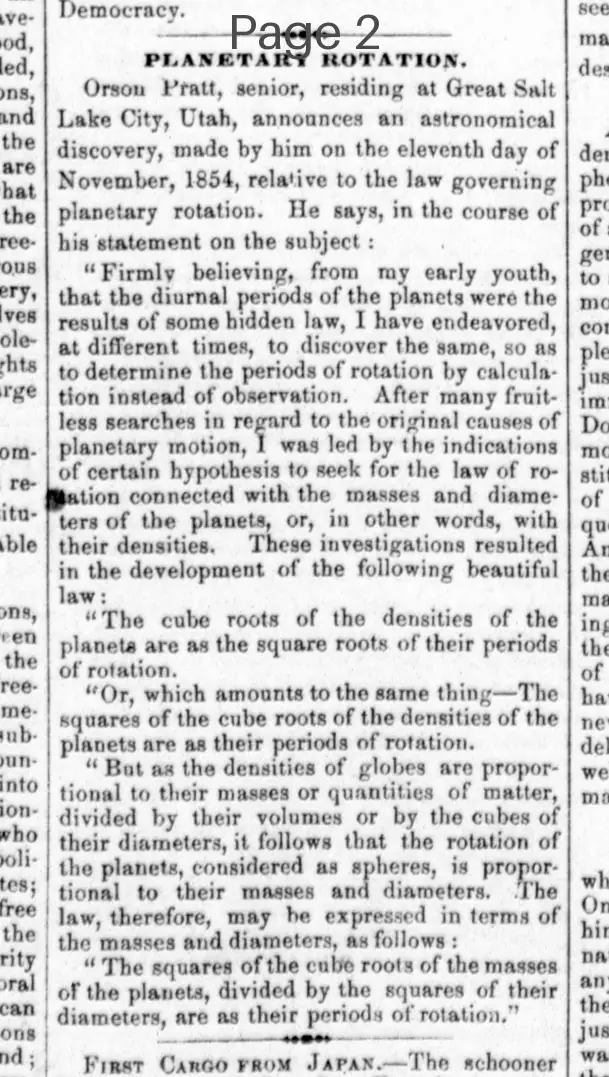
PLANETARY ROTATION.
Orson Pratt, senior, residing at Great Salt Lake City, Utah, announces an astronomical discovery, made by him on the eleventh day of November, 1854, relative to the law governing planetary rotation. He says, in the course of his statement on the subject:
"Firmly believing, from my early youth that the diurnal periods of the planets were the results of some hidden law, I have endeavored, at different times, to discover the same, so as to determine the periods of rotation by calculation instead of observation. After many fruitless searches in regard to the original causes of planetary motion, I was led by the indications of certain hypothesis to seek for the law of rotation connected with the masses and diameters of the planets, or, in other words, with their densities. These investigations resulted in the development of the following beautiful law:
"The cube roots of the densities of the planets are as the square roots of their periods of rotation.
"Or, which amounts to the same thing—The squares of the cube roots of the densities of the planets are as their periods of rotation.
"But as the densities of globes are proportional to their masses or quantities of matter, divided by their volumes or by the cubes of their diameters, it follows that the rotation of the planets, considered as spheres, is proportional to their masses and diameters. The law, therefore, may be expressed in terms of the masses and diameters, as follows:
"The squares of the cube roots of the masses of the planets, divided by the squares of their diameters, are as their periods of rotation."
Orson Pratt, senior, residing at Great Salt Lake City, Utah, announces an astronomical discovery, made by him on the eleventh day of November, 1854, relative to the law governing planetary rotation. He says, in the course of his statement on the subject:
"Firmly believing, from my early youth that the diurnal periods of the planets were the results of some hidden law, I have endeavored, at different times, to discover the same, so as to determine the periods of rotation by calculation instead of observation. After many fruitless searches in regard to the original causes of planetary motion, I was led by the indications of certain hypothesis to seek for the law of rotation connected with the masses and diameters of the planets, or, in other words, with their densities. These investigations resulted in the development of the following beautiful law:
"The cube roots of the densities of the planets are as the square roots of their periods of rotation.
"Or, which amounts to the same thing—The squares of the cube roots of the densities of the planets are as their periods of rotation.
"But as the densities of globes are proportional to their masses or quantities of matter, divided by their volumes or by the cubes of their diameters, it follows that the rotation of the planets, considered as spheres, is proportional to their masses and diameters. The law, therefore, may be expressed in terms of the masses and diameters, as follows:
"The squares of the cube roots of the masses of the planets, divided by the squares of their diameters, are as their periods of rotation."
What sub-type of article is it?
Curiosity
Historical Event
What themes does it cover?
Triumph
What keywords are associated?
Planetary Rotation
Astronomical Discovery
Density Law
Orson Pratt
Utah
What entities or persons were involved?
Orson Pratt, Senior
Where did it happen?
Great Salt Lake City, Utah
Story Details
Key Persons
Orson Pratt, Senior
Location
Great Salt Lake City, Utah
Event Date
Eleventh Day Of November, 1854
Story Details
Orson Pratt announces discovery of law: cube roots of planetary densities proportional to square roots of rotation periods, expressible in terms of masses and diameters.