Thank you for visiting SNEWPapers!
Sign up free
Editorial
October 30, 1874
Springfield Weekly Republican
Springfield, Hampden County, Massachusetts
What is this article about?
Editorial discusses the risks of mutual life insurance associations, citing expert warnings of inevitable insolvency, while questioning state interference amid failures of regular companies. Advocates personal liberty in such decisions but urges caution.
Clipping
OCR Quality
98%
Excellent
Full Text
LIFE INSURANCE ASSOCIATIONS.
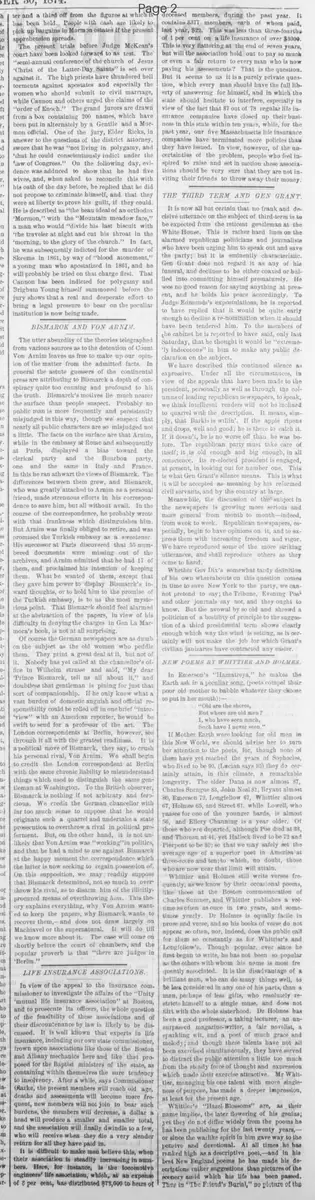
In view of the appeal to the insurance commissioner to investigate the affairs of the "Unity mutual life insurance association" at Boston, and to prosecute its officers, the whole question of the feasibility of these associations and of their discountenance by law is likely to be discussed. It is well known that experts in life insurance, including our own state commissioner, frown upon associations like those of the Boston and Albany mechanics here and like that proposed for the Baptist ministers of the state, as containing within themselves the sure tendency to insolvency. After a while, says Commissioner Hurlburt, the present members will reach old age, deaths and assessments will become more frequent, new members will not join to bear such burdens, the members will decrease, a dollar a head will produce a smaller and smaller total, and the association will finally dwindle to a few, who will receive when they die a very slender return for all they have paid in.
It is difficult to make men believe this, when their association is steadily increasing in numbers. Here, for instance, is the locomotive engineers' life association, which, at an expense of ¾ per cent, has distributed $2,000 to heirs of deceased members, during the past year. It contains 887 members, each of whom paid, last year, $22. This was less than three-fourths of 1 per cent on a life insurance of over $3,000. This is very flattering at the end of seven years, but will the association hold out to pay so much or even a fair return to every man who is now paying his assessments? That is the question.
But it seems to us it is a purely private question, which every man should have the full liberty of answering for himself, and in which the state should hesitate to interfere, especially in view of the fact that 87 out of 78 regular life insurance companies have closed up their business in this state within ten years, while, for the past year, our five Massachusetts life insurance companies have terminated more policies than they have issued. In view, however, of the uncertainties of the problem, people who feel inspired to raise and set in motion these associations should be very sure that they are not inviting their friends to throw away their money.
In view of the appeal to the insurance commissioner to investigate the affairs of the "Unity mutual life insurance association" at Boston, and to prosecute its officers, the whole question of the feasibility of these associations and of their discountenance by law is likely to be discussed. It is well known that experts in life insurance, including our own state commissioner, frown upon associations like those of the Boston and Albany mechanics here and like that proposed for the Baptist ministers of the state, as containing within themselves the sure tendency to insolvency. After a while, says Commissioner Hurlburt, the present members will reach old age, deaths and assessments will become more frequent, new members will not join to bear such burdens, the members will decrease, a dollar a head will produce a smaller and smaller total, and the association will finally dwindle to a few, who will receive when they die a very slender return for all they have paid in.
It is difficult to make men believe this, when their association is steadily increasing in numbers. Here, for instance, is the locomotive engineers' life association, which, at an expense of ¾ per cent, has distributed $2,000 to heirs of deceased members, during the past year. It contains 887 members, each of whom paid, last year, $22. This was less than three-fourths of 1 per cent on a life insurance of over $3,000. This is very flattering at the end of seven years, but will the association hold out to pay so much or even a fair return to every man who is now paying his assessments? That is the question.
But it seems to us it is a purely private question, which every man should have the full liberty of answering for himself, and in which the state should hesitate to interfere, especially in view of the fact that 87 out of 78 regular life insurance companies have closed up their business in this state within ten years, while, for the past year, our five Massachusetts life insurance companies have terminated more policies than they have issued. In view, however, of the uncertainties of the problem, people who feel inspired to raise and set in motion these associations should be very sure that they are not inviting their friends to throw away their money.
What sub-type of article is it?
Economic Policy
Legal Reform
What keywords are associated?
Life Insurance
Mutual Associations
Insolvency Risks
State Regulation
Insurance Commissioner
What entities or persons were involved?
Unity Mutual Life Insurance Association
Commissioner Hurlburt
Locomotive Engineers' Life Association
Massachusetts Life Insurance Companies
Editorial Details
Primary Topic
Feasibility And Risks Of Mutual Life Insurance Associations
Stance / Tone
Skeptical Of Associations' Long Term Viability, Cautious Against State Interference
Key Figures
Unity Mutual Life Insurance Association
Commissioner Hurlburt
Locomotive Engineers' Life Association
Massachusetts Life Insurance Companies
Key Arguments
Mutual Associations Tend Toward Insolvency As Members Age And New Ones Decline
Experts Like Commissioner Hurlburt Warn Of Decreasing Assessments And Poor Returns
Current Success In Young Associations Is Misleading
State Should Not Interfere In Private Insurance Decisions
Regular Insurance Companies Have High Failure Rates In The State