Thank you for visiting SNEWPapers!
Sign up free
Fowle's New Hampshire Gazette And General Advertiser
Portsmouth, Rockingham County, New Hampshire
What is this article about?
Extract of a letter from an American sea captain captive in Algiers, dated June 22, 1786, detailing the failed negotiation by Mr. Lamb for peace treaty and redemption of 21 American prisoners from the Dey, including demands, Algerine naval strength, and advice on future diplomacy.
Clipping
OCR Quality
Full Text
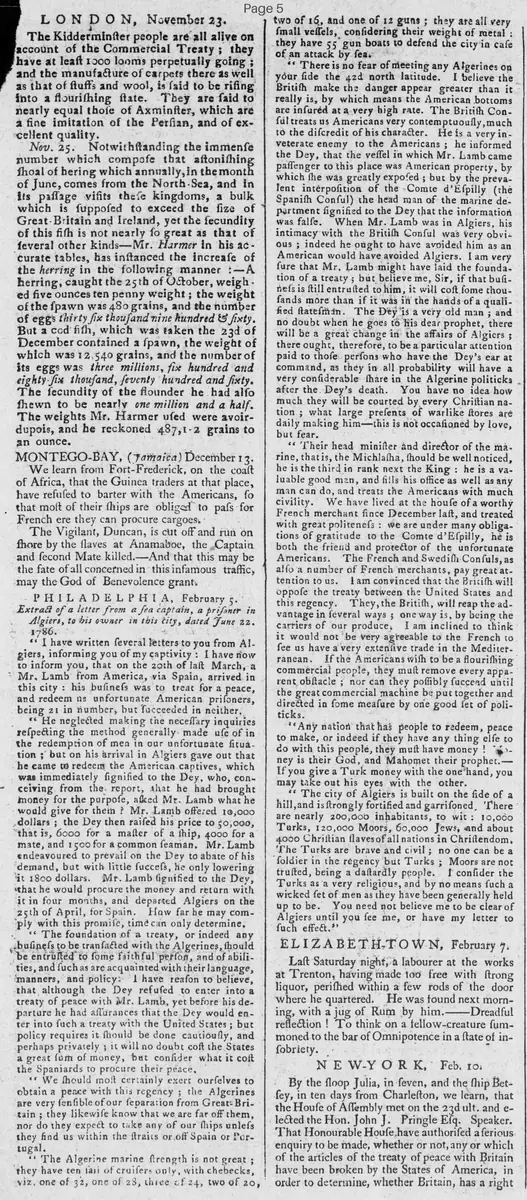
Extract of a letter from a sea captain, a prisoner in Algiers, to his owner in this city, dated June 22, 1786.
"I have written several letters to you from Algiers, informing you of my captivity: I have now to inform you, that on the 20th of last March, a Mr. Lamb from America, via Spain, arrived in this city: his business was to treat for a peace, and redeem us unfortunate American prisoners, being 21 in number, but succeeded in neither.
"He neglected making the necessary inquiries respecting the method generally made use of in the redemption of men in our unfortunate situation; but on his arrival in Algiers gave out that he came to redeem the American captives, which was immediately signified to the Dey, who, conceiving from the report, that he had brought money for the purpose, asked Mr. Lamb what he would give for them? Mr. Lamb offered 10,000 dollars; the Dey then raised his price to 50,000, that is, 6000 for a master of a ship, 4000 for a mate, and 1500 for a common seaman. Mr. Lamb endeavoured to prevail on the Dey to abate of his demand, but with little success, he only lowering it 1800 dollars. Mr. Lamb signified to the Dey, that he would procure the money and return with it in four months, and departed Algiers on the 25th of April, for Spain. How far he may comply with this promise, time can only determine.
"The foundation of a treaty, or indeed any business to be transacted with the Algerines, should be entrusted to some faithful person, and of abilities, and such as are acquainted with their language, manners, and policy: I have reason to believe, that although the Dey refused to enter into a treaty of peace with Mr. Lamb, yet before his departure he had assurances that the Dey would enter into such a treaty with the United States: but policy requires it should be done cautiously, and perhaps privately; it will no doubt cost the States a great sum of money, but consider what it cost the Spaniards to procure their peace.
"We should most certainly exert ourselves to obtain a peace with this regency; the Algerines are very sensible of our separation from Great-Britain; they likewise know that we are far off them, nor do they expect to take any of our ships unless they find us within the straits or off Spain or Portugal.
"The Algerine marine strength is not great; they have ten sail of cruisers only, with chebecks, viz. one of 32, one of 28, three of 24, two of 20, two of 16, and one of 12 guns; they are all very small vessels, considering their weight of metal: they have 55 gun boats to defend the city in case of an attack by sea.
There is no fear of meeting any Algerines on your side the 42d north latitude. I believe the British make the danger appear greater than it really is, by which means the American bottoms are insured at a very high rate. The British Consul treats us Americans very contemptuously, much to the discredit of his character. He is a very inveterate enemy to the Americans; he informed the Dey, that the vessel in which Mr. Lamb came passenger to this place was American property, by which she was greatly exposed; but by the prevalent interposition of the Comte d'Epilly (the Spanish Consul) the head man of the marine department signified to the Dey that the information was false. When Mr. Lamb was in Algiers, his intimacy with the British Consul was very obvious; indeed he ought to have avoided him as an American would have avoided Algiers. I am very sure that Mr. Lamb might have laid the foundation of a treaty; but believe me, Sir, if that business is still entrusted to him, it will cost some thousands more than if it was in the hands of a qualified statesman. The Dey is a very old man; and no doubt when he goes to his dear prophet, there will be a great change in the affairs of Algiers; there ought, therefore, to be a particular attention paid to those persons who have the Dey's ear at command, as they in all probability will have a very considerable share in the Algerine politics after the Dey's death. You have no idea how much they will be courted by every Christian nation; what large presents of warlike stores are daily making him--this is not occasioned by love, but fear.
"Their head minister and director of the marine, that is, the Michlafha, should be well noticed, he is the third in rank next the King: he is a valuable good man, and fills his office as well as any man can do, and treats the Americans with much civility. We have lived at the house of a worthy French merchant since December last, and treated with great politeness: we are under many obligations of gratitude to the Comte d'Espilly, he is both the friend and protector of the unfortunate Americans. The French and Swedish Consuls, as also a number of French merchants, pay great attention to us. I am convinced that the British will oppose the treaty between the United States and this regency. They, the British, will reap the advantage in several ways; one way is, by being the carriers of our produce. I am inclined to think it would not be very agreeable to the French to see us have a very extensive trade in the Mediterranean. If the Americans wish to be a flourishing commercial people, they must remove every apparent obstacle; nor can they possibly succeed until the great commercial machine be put together and directed in some measure by one good set of politics.
"Any nation that has people to redeem, peace to make, or indeed if they have any thing else to do with this people, they must have money!--money is their God, and Mahomet their prophet.--If you give a Turk money with the one hand, you may take out his eyes with the other.
"The city of Algiers is built on the side of a hill, and is strongly fortified and garrisoned. There are nearly 200,000 inhabitants, to wit: 10,000 Turks, 120,000 Moors, 60,000 Jews; and about 4000 Christian slaves of all nations in Christendom. The Turks are brave and civil; no one can be a soldier in the regency but Turks; Moors are not trusted, being a dastardly people. I consider the Turks as a very religious, and by no means such a wicked set of men as they have been generally held up to be. You need not believe me to be clear of Algiers until you see me, or have my letter to such effect."
What sub-type of article is it?
What keywords are associated?
What entities or persons were involved?
Where did it happen?
Foreign News Details
Primary Location
Algiers
Event Date
Dated June 22, 1786
Key Persons
Outcome
negotiation failed; 21 american prisoners not redeemed; dey demanded 50,000 dollars (6000 for ship master, 4000 for mate, 1500 for seaman), lowered by 1800 dollars; mr. lamb promised to return with money in four months.
Event Details
Mr. Lamb arrived in Algiers on March 20, 1786, to negotiate peace and redeem 21 American captives but failed due to inadequate preparation and low offer of 10,000 dollars against Dey's demand. He departed April 25, 1786, for Spain. Letter advises careful, knowledgeable approach for future treaty, notes Algerine awareness of American independence, describes their 10 small cruisers and 55 gunboats, British opposition, and local support from Spanish and French consuls.