Thank you for visiting SNEWPapers!
Sign up free
Staunton Spectator
Staunton, Virginia
What is this article about?
A correspondent provides a detailed sketch of John Randolph's speech at Buckingham Court, covering his withdrawal from the political canvass, criticisms of Judge Buford and others, support for Andrew Jackson, and various political and personal anecdotes.
Clipping
OCR Quality
Full Text
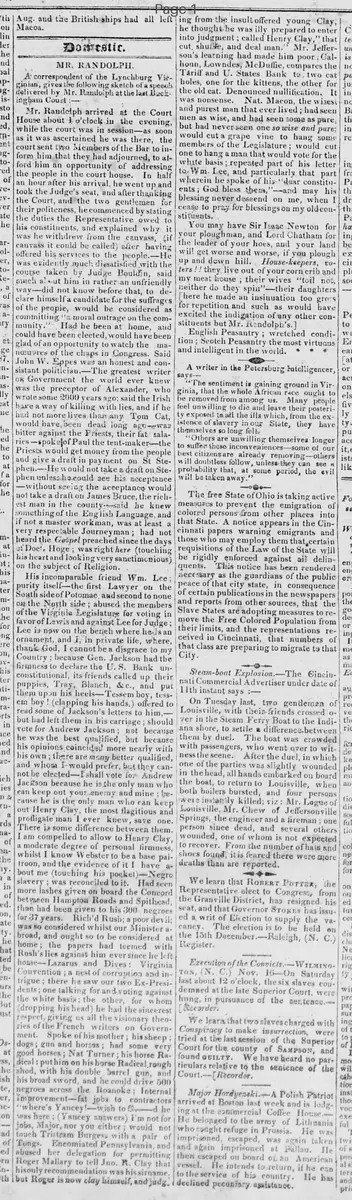
MR. RANDOLPH.
A correspondent of the Lynchburg Virginian, gives the following sketch of a speech delivered by Mr. Randolph at the last Buckingham Court:
Mr. Randolph arrived at the Court House about 9 o'clock in the evening, while the court was in session—as soon as it was ascertained he was there, the court sent two Members of the Bar to inform him that they had adjourned, to afford him an opportunity of addressing the people in the court house. In half an hour after his arrival, he went up and took the Judge's seat, and after thanking the Court, and the two gentlemen for their politeness, he commenced by stating the duties the Representative owed to his constituents, and explained why it was he withdrew from the canvass, (if canvass it could be called) after having offered his services to the people.—He was evidently much dissatisfied with the course taken by Judge Buford, said much about him in rather an unfriendly way—did not know before that, to declare himself a candidate for the suffrages of the people, would be considered as committing "a moral outrage on the community." Had he been at home, and could have been elected, would have been glad of an opportunity to watch the manœuvres of the chaps in Congress. Said John W. Eppes was an honest and consistent politician.—The greatest writer on Government the world ever knew was the preceptor of Alexander, who wrote some 2000 years ago; said the Irish have a way of killing with lies, and if he had not more lives than any Tom Cat, would have been dead long ago—was bitter against the Priests, their fat salaries—spoke of Paul the tent-maker—the Priests would get money from the people and give a draft in payment on St. Stephen.—He would not take a draft on St. Stephen unless he could see his acceptance—without seeing the acceptance would not take a draft on James Bruce, the richest man in the county—said he knew something of the English Language, and if not a master workman, was at least a very respectable Journeyman; had not heard the Gospel preached since the days of Doct. Hoge; was right here (touching his heart and looking very sanctimonious) on the subject of Religion.
His incomparable friend Wm. Lee; purity itself—the first Lawyer on the South side of Potomac, and second to none on the North side; abused the members of the Virginia Legislature for voting in favor of Lewis and against Lee for Judge; Lee is now on the bench where he is an ornament, and I, in private life, where, thank God, I cannot be a disgrace to my Country ; because Gen. Jackson had the firmness to declare the U.S. Bank unconstitutional, its friends called up their puppies, Tray, Blanch, &c., and put them upon his heels—Tessem boy, tessem boy ! (clapping his hands.) offered to read some of Jackson's letters to him,—but had left them in his carriage; should vote for Andrew Jackson; not because he was the best qualified, but because his opinions coincided more nearly with his own; there are many better qualified, and whom I would prefer, but they cannot be elected—I shall vote for Andrew Jackson because he is, the only man who can keep out your enemy and mine ; because he is the only man who can keep out Henry Clay, the most flagitious and profligate man I ever knew, save one. There is some difference between them. I am compelled to allow to Henry Clay, a moderate degree of personal firmness, whilst I know Webster to be a base poltroon, and the evidence of it I have about me (touching his pocket)—Negro slavery ; was reconciled to it. Had seen more lashes given on board the Concord between Hampton Roads and Spithead, than had been given to his 300 negroes for 37 years. Rich'd Rush; a poor devil: was so considered whilst our Minister abroad, and ought so to be considered at home; the papers had teemed with Rush's lies against him ever since he left home—Lazarus and Dives: Virginia Convention ; a nest of corruption and intrigue; there he saw our two Ex-Presidents; one talking for and voting against the white basis: the other, for whom (dropping his head) he had the sincerest respect, giving us all the visionary theories of the French writers on Government. Spoke of his mother; his sheep ; dogs; gun and horses; had some very good horses; Nat Turner; his horse Radical : put him on his horse Radical, rough shod, with his double barrel gun, and his broad sword, and he could drive 500 negroes across the Roanoke; Internal Improvement—fat jobs to contractors "where's Yancey! wish to S-d he was here ; (Yancey answers) I'm not for jobs, Major, nor you either; would not touch Tristram Burgess with a pair of Tongs. Encomiated Pennsylvania, and abused her delegation for permitting Roger Mallary to tell Jno. K. Clay that his only recommendation was his surname. but Roger is now clay himself, and judging from the insult offered young Clay,
he thought he was illy prepared to enter into judgment ; called Henry Clay "that cut, shuffle, and deal man." Mr. Jefferson's learning had made him poor : Calhoun, Lowndes, McDuffie, compares the Tariff and U. States Bank to two cat boles, one for the kittens, the other for the old cat. Denounced nullification. It was nonsense. Nat. Macon, the wisest and purest man that ever lived ; had seen men as wise, and had seen some as pure, but had never seen one so wise and pure; would cut a grape vine to hang some members of the Legislature; would cut one to hang a man that would vote for the white basis; repeated part of his letter to. Wm. Lee, and particularly that part wherein he spoke of his "dear constituents; God bless them,"—and may his blessing never descend on me, when I cease to pray for blessings on my old constituents.
You may have Sir Isaac Newton for your ploughman, and Lord Chatham for the leader of your hoes, and your land will get worse and worse, if you plough up and down hill. House-keepers, co- ters !! they live out of your corn crib and my meat house ; their wives "toil not, neither do they spin"—their daughters [here he made an insinuation too gross for repetition and such as would have excited the indignation of any other constituents but Mr. Randolph's.]
What sub-type of article is it?
What keywords are associated?
What entities or persons were involved?
Where did it happen?
Domestic News Details
Primary Location
Buckingham Court
Event Date
Last Buckingham Court
Key Persons
Event Details
Mr. Randolph delivered a speech at Buckingham Court after the court adjourned for him. He explained his withdrawal from the political canvass due to dissatisfaction with Judge Buford's actions, praised John W. Eppes and Andrew Jackson, criticized Henry Clay and Webster, discussed religion, slavery, the Virginia Convention, internal improvements, and other political topics, while sharing personal anecdotes.