Thank you for visiting SNEWPapers!
Sign up free
Gazette Of The United States
New York, New York County, New York
What is this article about?
Report from Paris on the opening of the French States General by King Louis XVI on May 5, 1789, detailing royal attendance, speeches by Necker and Garde des Sceaux, debates on voting by orders vs. headcount, clergy and nobility divisions, and elections of delegates like Guy Target and honors for Intendant de la Tour.
Clipping
OCR Quality
Full Text
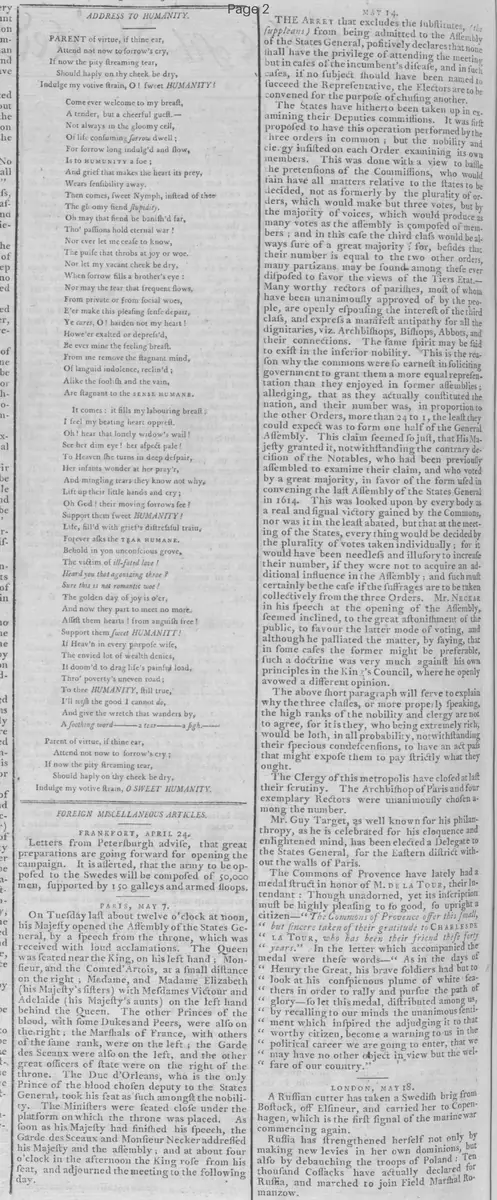
On Tuesday last about twelve o'clock at noon, his Majesty opened the Assembly of the States General, by a speech from the throne, which was received with loud acclamations. The Queen was seated near the King, on his left hand ; Monsieur, and the Comte d'Artois, at a small distance on the right ; Madame, and Madame Elizabeth (his Majesty's sisters) with Mesdames Victor and Adelaide (his Majesty's aunts) on the left hand behind the Queen. The other Princes of the blood, with some Dukes and Peers, were also on the right; the Marshals of France, with others of the same rank, were on the left ; the Garde des Sceaux were also on the left, and the other great officers of state were on the right of the throne. The Duc d'Orleans, who is the only Prince of the blood chosen deputy to the States General, took his seat as such amongst the nobility. The Ministers were seated close under the platform on which the throne was placed. As soon as his Majesty had finished his speech, the Garde des Sceaux and Monsieur Necker addressed his Majesty and the assembly ; and at about four o'clock in the afternoon the King rose from his seat, and adjourned the meeting to the following day.
The Arret that excludes the substitutes, (the suppleans) from being admitted to the Assembly of the States General, positively declares that none shall have the privilege of attending the meeting but in cases of the incumbent's disease, and in such cases, if no subject should have been named to succeed the Representative, the Electors are to be convened for the purpose of choosing another.
The States have hitherto been taken up in examining their Deputies commissions. It was first proposed to have this operation performed by the three orders in common ; but the nobility and clergy insisted on each Order examining its own members. This was done with a view to baffle the pretensions of the Commissions, who would fain have all matters relative to the states to be decided, not as formerly by the plurality of orders, which would make but three votes, but by the majority of voices, which would produce as many votes as the assembly is composed of members ; and in this case the third class would be always sure of a great majority ; for, besides that their number is equal to the two other orders, many partisans may be found among these ever disposed to favor the views of the Tiers Etat.—
Many worthy rectors of parishes, most of whom have been unanimously approved of by the people, are openly espousing the interest of the third class, and express a manifest antipathy for all the dignitaries, viz. Archbishops, Bishops, Abbots, and their connections. The same spirit may be said to exist in the inferior nobility. This is the reason why the commons were so earnest in soliciting government to grant them a more equal representation than they enjoyed in former assemblies; alleging, that as they actually constituted the nation, and their number was, in proportion to the other Orders, more than 24 to 1, the least they could expect was to form one half of the General Assembly. This claim seemed so just, that His Majesty granted it, notwithstanding the contrary decision of the Notables, who had been previously assembled to examine their claim, and who voted by a great majority, in favor of the form used in convening the last Assembly of the States General in 1614. This was looked upon by everybody as a real and signal victory gained by the Commons, nor was it in the least abated, but that at the meeting of the States, every thing would be decided by the plurality of votes taken individually; for it would have been needless and illusory to increase their number, if they were not to acquire an additional influence in the Assembly ; and such must certainly be the case if the suffrages are to be taken collectively from the three Orders. Mr. NECKER in his speech at the opening of the Assembly, seemed inclined, to the great astonishment of the public, to favour the latter mode of voting, and although he palliated the matter, by saying, that in some cases the former might be preferable, such a doctrine was very much against his own principles in the King's Council, where he openly avowed a different opinion.
The above short paragraph will serve to explain why the three classes, or more properly speaking, the high ranks of the nobility and clergy are not to agree, for it is they, who being extremely rich, would be loth, in all probability, notwithstanding their precious condescensions, to have an act pass that might expose them to pay strictly what they ought.
The Clergy of this metropolis have closed at last their scrutiny. The Archbishop of Paris and four exemplary Rectors were unanimously chosen among the number.
Mr. Guy Target, as well known for his philanthropy, as he is celebrated for his eloquence and enlightened mind, has been elected a Delegate to the States General, for the Eastern district without the walls of Paris.
The Commons of Provence have lately had a medal struck in honor of M. DE LA TOUR, their Intendant : Though unadorned, yet its inscription must be highly pleasing to so good, so upright a citizen—"The Commons of Provence offer this small, but sincere token of their gratitude to CHARLES DE LA TOUR, who has been their friend these forty years." In the letter which accompanied the medal were these words—"As in the days of Henry the Great, his brave soldiers had but to look at his conspicuous plume of white feathers in order to rally and pursue the path of glory—so let this medal, distributed among us, by recalling to our minds the unanimous sentiment which inspired the adjudging it to that worthy citizen, become a warning to us in the political career we are going to enter that we may have no other object in view but the welfare of our country."
What sub-type of article is it?
What keywords are associated?
What entities or persons were involved?
Where did it happen?
Foreign News Details
Primary Location
Paris
Event Date
Tuesday Last, May 7, 1789
Key Persons
Outcome
assembly opened with royal speech and addresses; adjourned to next day; debates on deputy commissions and voting by orders vs. headcount; elections of clergy and delegates; medal struck for intendant de la tour.
Event Details
King opened States General assembly on Tuesday last at noon with speech from throne, attended by Queen, royals, nobles, and officials; Duc d'Orleans seated among nobility; speeches by Garde des Sceaux and Necker; adjourned at 4 PM. Rules exclude substitutes except in illness. Orders examine own commissions separately to counter Tiers Etat push for headcount voting. Clergy and lower nobility support third estate; king granted doubled representation to commons despite Notables' opposition. Necker's speech favors order voting, surprising public. Clergy scrutiny closed with Archbishop and rectors chosen. Guy Target elected delegate. Provence commons honor Intendant de la Tour with medal.