Thank you for visiting SNEWPapers!
Sign up free
Letter to Editor
September 12, 1840
The New England Weekly Review
Hartford, Hartford County, Connecticut
What is this article about?
A letter from Amherst, dated August 26, 1840, describes the college commencement exercises, including the procession, prayer by President Herman Humphrey, and detailed reviews of student orations, disputations, and poems by various speakers.
Clipping
OCR Quality
95%
Excellent
Full Text
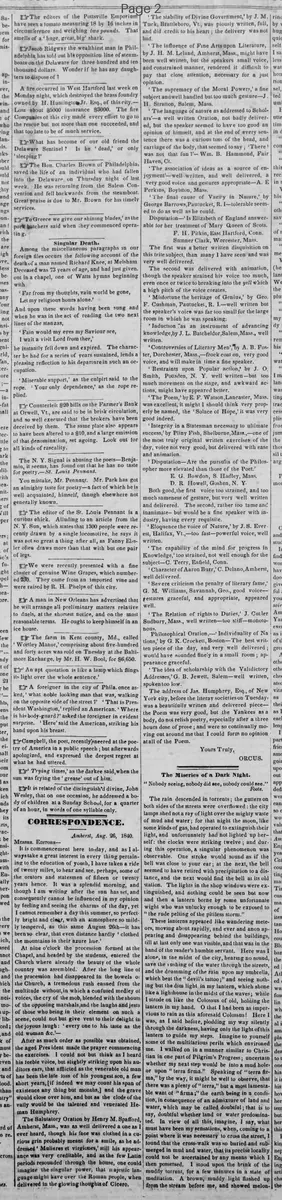
CORRESPONDENCE.
Amherst, Aug. 26, 1840.
Messrs. Editors—
It is commencement here to-day, and as I always
take a great interest in every thing pertaining
to the education of youth, I have taken a ride
of twenty miles, to hear and see, perhaps, some of
the orators and statesmen of fifteen or twenty
years hence. It was a splendid morning, and
though I am writing after the sun has set, and
consequently cannot be influenced in my opinion
by feeling and seeing the charms of the day, yet
I cannot remember a day this summer, so perfectly
bright and clear, with an atmosphere so mildly
tempered, as this same August 26th—it has
been so clear, that even distance hardly 'clothed
the mountains in their azure hue.'
At nine o'clock the procession formed at the
Chapel, and headed by the students, entered the
Church where already the beauty of the whole
country was assembled. After the long line of
the procession had disappeared in the bowels of
the Church, a tremendous rush ensued from the
multitude without, in which a confused medley of
voices, the cry of the mob, blended with the shouts
of the opposing marshals, and the laughs and jests
of those who being in their element on such a
scene, could not but give vent to their delight in
the joyous laugh: 'every one to his taste as the
old woman &c.'—
After as much order as possible was obtained
the aged President made the prayer commencing
the exercises. I could not but think as I heard
his feeble voice, but slightly striking upon his auditors'
ears, that afflicted as the venerable old man
has been the late loss of his youngest son, a few
short years, [if indeed we may count his span of
existence any thing but months,] and the grave
would close over him, and but as the clods of the
valley would be the talented and venerated Herman
Humphrey.
The Salutatory Oration by Henry M. Spafford
Amherst, Mass., was as well delivered a one as I
ever heard, though his face was clothed in a curious
grin probably meant for a smile, as he addressed
'Mulieres et virgines,' still his appearance
was very creditable, and as the few Latin
periods resounded through the house, one could
imagine the singular power, that majestic language
might have over the Roman people, when
delivered in the glowing thoughts of Cicero.
'The stability of Divine Government,' by J. M.
Tuck, Brattleboro, Vt., was piously written, full,
and did credit to his heart; the delivery was not
bad.
'The influence of Fine Arts upon Literature,
by J. H. M. Leland, Amherst, Mass., might have
been well written, but the speakers small voice
and constrained manner, rendered it difficult to
pay that close attention, necessary for a just
opinion.
'The supremacy of the Moral Powers,' a fine
subject and well handled but too much gesture—J.
H. Stratton, Salem, Mass.
'The language of nature as addressed to Scholars'—
a well written Oration, not badly delivered,
but the speaker seemed to have too good an
opinion of himself, and at the end of every sentence
there was a curious toss of the head, and
carriage of the body, that seemed to say ; 'There
was not that fine ?'— Wm. B. Hammond, Fair
Haven, Ct.
'The association of ideas as a source of enjoyment'—
well written, and well delivered, a
very good voice and gestures appropriate—A. E.
Perkins, Boylston, Mass.
'The final cause of Vanity in Nature,' by
George Barrows, Pawtucket, R. I. Intolerable seemed
to do as well as he could.
Disputation—'Is Elizabeth of England answerable
for her treatment of Mary Queen of Scots.'
F. H. Pitkin, East Hartford, Conn.
Sumner Clark, Worcester, Mass.
The first was a better written disquisition on
this trite subject, than many I have seen and was
very well delivered.
The second was delivered with animation,
though the speaker strained his voice too much,
even once or twice to breaking into the yell which
a high pitch of the voice creates.
'Misfortune the heritage of Genius,' by Geo.
F. Cushman, Pawtucket, R. I.—well written but
the speaker's voice was far too small for the large
room in which he was speaking:
'Induction as an instrument of advancing
knowledge, by J. L. Batchelder, Salem, Mass., well
written.
'Controversies of Literary Men'. by A. B. Foster,
Dorchester, Mass., frock coat on, very good
voice, and will make in time a fine speaker.
Restraints upon Popular action. by J. O.
Smith, Potsdam, N. Y. well written—but too
much movement on the stage. and awkward actions.
might have appeared better
The Poem,' by E. F. Watson, Lancaster, Mass.
was excellent, it might I should think very properly
be named, the 'Solace of Hope,' it was very
good indeed.
'Integrity in a Statesman necessary to ultimate
success,' by Pliny Fish, Shelburne, Mass.,—one of
the most truly original written exercises of the
day, voice not very good, but delivered with ease
and animation.
'Disputation—Are the pursuits of the Philosopher
more elevated than those of the Poet.'
E. G. Bowdon, S. Hadley. Mass
D. R. Howell, Goshen, N. Y.
Both good, the first voice too strained, and too
much sameness of gesture, but very well written
and delivered. The second. rather too tame and
inanimate— but would be a fine speaker with industry,
having every requisite
'Eloquence the voice of Nature,' by J. S. Everest,
Halifax, Vt.,—too fast—powerful voice, well
written.
'The capability of the mind for progress in
Knowledge,' too strained, not well enough for the
subject—C. Terry, Enfield, Conn.
'Character of Aaron Burr.' C. Delano, Amherst
well delivered.
'Severe criticism the penalty of literary fame,'
G. M. Williams, Savannah, Geo., good voice—
gestures graceful, and appropriate, appeared
well.
The Relation of rights to Duties,' J. Cutler
Sudbury, Mass., well written—too stiff—monotonous.
Philosophical Oration,---'Individuality of Nations,'
by G. K. Crockett, Boston—The best written
piece of the day, and very well delivered;
would have sounded finely in a small room; appearance
graceful.
The idea of scholarship with the Valedictory
Addresses.' G. B. Jewett, Salem—well written
spoken too low.
The address of Jas. Humphrey, Esq., of New
York city, before the literary societies on Tuesday
was a beautifully written and delivered piece—
the Poem was very good, but the Yankees as a
body, do not relish poetry, especially after a three
hours dose of prose ; and were so continually moving
out around me that I could form no opinion
at all of the Poem.
Yours Truly,
ORCUS.
Amherst, Aug. 26, 1840.
Messrs. Editors—
It is commencement here to-day, and as I always
take a great interest in every thing pertaining
to the education of youth, I have taken a ride
of twenty miles, to hear and see, perhaps, some of
the orators and statesmen of fifteen or twenty
years hence. It was a splendid morning, and
though I am writing after the sun has set, and
consequently cannot be influenced in my opinion
by feeling and seeing the charms of the day, yet
I cannot remember a day this summer, so perfectly
bright and clear, with an atmosphere so mildly
tempered, as this same August 26th—it has
been so clear, that even distance hardly 'clothed
the mountains in their azure hue.'
At nine o'clock the procession formed at the
Chapel, and headed by the students, entered the
Church where already the beauty of the whole
country was assembled. After the long line of
the procession had disappeared in the bowels of
the Church, a tremendous rush ensued from the
multitude without, in which a confused medley of
voices, the cry of the mob, blended with the shouts
of the opposing marshals, and the laughs and jests
of those who being in their element on such a
scene, could not but give vent to their delight in
the joyous laugh: 'every one to his taste as the
old woman &c.'—
After as much order as possible was obtained
the aged President made the prayer commencing
the exercises. I could not but think as I heard
his feeble voice, but slightly striking upon his auditors'
ears, that afflicted as the venerable old man
has been the late loss of his youngest son, a few
short years, [if indeed we may count his span of
existence any thing but months,] and the grave
would close over him, and but as the clods of the
valley would be the talented and venerated Herman
Humphrey.
The Salutatory Oration by Henry M. Spafford
Amherst, Mass., was as well delivered a one as I
ever heard, though his face was clothed in a curious
grin probably meant for a smile, as he addressed
'Mulieres et virgines,' still his appearance
was very creditable, and as the few Latin
periods resounded through the house, one could
imagine the singular power, that majestic language
might have over the Roman people, when
delivered in the glowing thoughts of Cicero.
'The stability of Divine Government,' by J. M.
Tuck, Brattleboro, Vt., was piously written, full,
and did credit to his heart; the delivery was not
bad.
'The influence of Fine Arts upon Literature,
by J. H. M. Leland, Amherst, Mass., might have
been well written, but the speakers small voice
and constrained manner, rendered it difficult to
pay that close attention, necessary for a just
opinion.
'The supremacy of the Moral Powers,' a fine
subject and well handled but too much gesture—J.
H. Stratton, Salem, Mass.
'The language of nature as addressed to Scholars'—
a well written Oration, not badly delivered,
but the speaker seemed to have too good an
opinion of himself, and at the end of every sentence
there was a curious toss of the head, and
carriage of the body, that seemed to say ; 'There
was not that fine ?'— Wm. B. Hammond, Fair
Haven, Ct.
'The association of ideas as a source of enjoyment'—
well written, and well delivered, a
very good voice and gestures appropriate—A. E.
Perkins, Boylston, Mass.
'The final cause of Vanity in Nature,' by
George Barrows, Pawtucket, R. I. Intolerable seemed
to do as well as he could.
Disputation—'Is Elizabeth of England answerable
for her treatment of Mary Queen of Scots.'
F. H. Pitkin, East Hartford, Conn.
Sumner Clark, Worcester, Mass.
The first was a better written disquisition on
this trite subject, than many I have seen and was
very well delivered.
The second was delivered with animation,
though the speaker strained his voice too much,
even once or twice to breaking into the yell which
a high pitch of the voice creates.
'Misfortune the heritage of Genius,' by Geo.
F. Cushman, Pawtucket, R. I.—well written but
the speaker's voice was far too small for the large
room in which he was speaking:
'Induction as an instrument of advancing
knowledge, by J. L. Batchelder, Salem, Mass., well
written.
'Controversies of Literary Men'. by A. B. Foster,
Dorchester, Mass., frock coat on, very good
voice, and will make in time a fine speaker.
Restraints upon Popular action. by J. O.
Smith, Potsdam, N. Y. well written—but too
much movement on the stage. and awkward actions.
might have appeared better
The Poem,' by E. F. Watson, Lancaster, Mass.
was excellent, it might I should think very properly
be named, the 'Solace of Hope,' it was very
good indeed.
'Integrity in a Statesman necessary to ultimate
success,' by Pliny Fish, Shelburne, Mass.,—one of
the most truly original written exercises of the
day, voice not very good, but delivered with ease
and animation.
'Disputation—Are the pursuits of the Philosopher
more elevated than those of the Poet.'
E. G. Bowdon, S. Hadley. Mass
D. R. Howell, Goshen, N. Y.
Both good, the first voice too strained, and too
much sameness of gesture, but very well written
and delivered. The second. rather too tame and
inanimate— but would be a fine speaker with industry,
having every requisite
'Eloquence the voice of Nature,' by J. S. Everest,
Halifax, Vt.,—too fast—powerful voice, well
written.
'The capability of the mind for progress in
Knowledge,' too strained, not well enough for the
subject—C. Terry, Enfield, Conn.
'Character of Aaron Burr.' C. Delano, Amherst
well delivered.
'Severe criticism the penalty of literary fame,'
G. M. Williams, Savannah, Geo., good voice—
gestures graceful, and appropriate, appeared
well.
The Relation of rights to Duties,' J. Cutler
Sudbury, Mass., well written—too stiff—monotonous.
Philosophical Oration,---'Individuality of Nations,'
by G. K. Crockett, Boston—The best written
piece of the day, and very well delivered;
would have sounded finely in a small room; appearance
graceful.
The idea of scholarship with the Valedictory
Addresses.' G. B. Jewett, Salem—well written
spoken too low.
The address of Jas. Humphrey, Esq., of New
York city, before the literary societies on Tuesday
was a beautifully written and delivered piece—
the Poem was very good, but the Yankees as a
body, do not relish poetry, especially after a three
hours dose of prose ; and were so continually moving
out around me that I could form no opinion
at all of the Poem.
Yours Truly,
ORCUS.
What sub-type of article is it?
Informative
Reflective
What themes does it cover?
Education
What keywords are associated?
Amherst College
Commencement 1840
Student Orations
President Humphrey
Education Event
What entities or persons were involved?
Orcus
Messrs. Editors
Letter to Editor Details
Author
Orcus
Recipient
Messrs. Editors
Main Argument
the letter provides a detailed eyewitness account of the amherst college commencement on august 26, 1840, highlighting the event's atmosphere, president humphrey's prayer, and critiques of the student orations and disputations.
Notable Details
Mentions President Herman Humphrey's Recent Loss Of His Youngest Son And Frail Health
Salutatory Oration In Latin Addressing 'Mulieres Et Virgines'
Various Orations On Topics Like Divine Government, Fine Arts, Moral Powers, And Individuality Of Nations
Disputations On Elizabeth And Mary Queen Of Scots, And Philosopher Vs. Poet
Address By Jas. Humphrey, Esq., Of New York