Thank you for visiting SNEWPapers!
Sign up free
Fowle's New Hampshire Gazette And General Advertiser
Portsmouth, Rockingham County, New Hampshire
What is this article about?
John Sullivan responds to anonymous accusations by 'Honetus' in the New-Hampshire Gazette, refuting three charges: fraudulently obtaining Congress funds for seizing powder from Fort William and Mary, conceding fishery rights in peace negotiations, and accepting a bribe as Attorney-General from Mrs. Boyd. He provides detailed defenses, historical context, and supporting certificates from witnesses.
Clipping
OCR Quality
Full Text
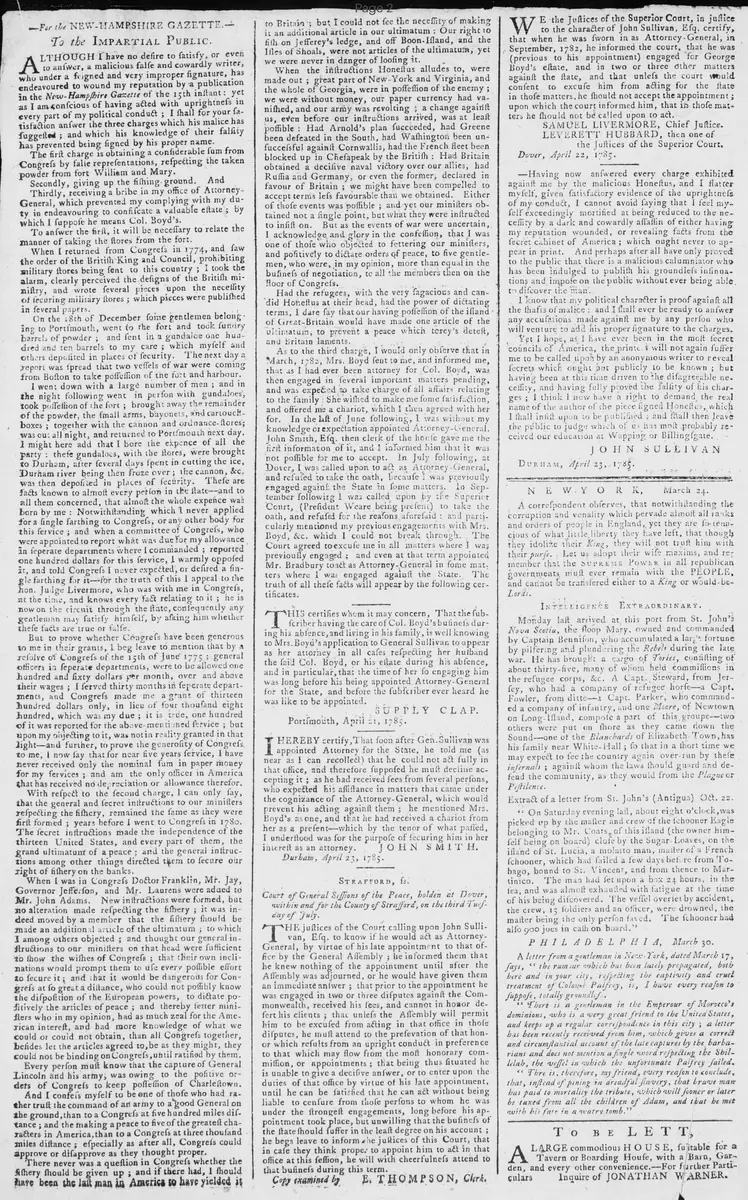
To the IMPARTIAL Public.
ALTHOUGH I have no desire to satisfy, or even to answer, a malicious false and cowardly writer, who under a feigned and very improper signature, has endeavoured to wound my reputation by a publication as I am conscious of having acted with uprightness in every part of my political conduct; I shall for your satisfaction answer the three charges which his malice has suggested; and which his knowledge of their falsity has prevented being signed by his proper name.
The first charge is obtaining a considerable sum from Congress by false representations, respecting the taken powder from fort William and Mary.
Secondly, giving up the fishing-ground. And Thirdly, receiving a bribe in my office of Attorney-General, which prevented my complying with my duty in endeavouring to confiscate a valuable estate; by which I suppose he means Col. Boyd's.
To answer the first, it will be necessary to relate the manner of taking the stores from the fort.
When I returned from Congress in 1774, and saw the order of the British King and Council, prohibiting military stores being sent to this country; I took the alarm, clearly perceived the designs of the British ministry, and wrote several pieces upon the necessity of securing military stores; which pieces were published in several papers.
On the 18th of December some gentlemen belonging to Portsmouth, went to the fort and took sundry barrels of powder; and sent in a gundaloe one hundred and ten barrels to my care; which myself and others deposited in places of security. The next day a report was spread that two vessels of war were coming from Boston to take possession of the fort and harbour.
I went down with a large number of men; and in the night following went in person with gundaloes, took possession of the fort; brought away the remainder of the powder, the small arms, bayonets, and cartouch-boxes; together with the cannon and ordnance-stores; was out all night, and returned to Portsmouth next day.
I might here add that I bore the expense of all the party: these gundaloes, with the stores, were brought to Durham, after several days spent in cutting the ice, Durham river being then froze over; the cannon, &c. was then deposited in places of security. These are facts known to almost every person in the state--and to all them concerned, that almost the whole expense was borne by me: Notwithstanding which I never applied for a single farthing to Congress, or any other body for this service; and when a committee of Congress, who were appointed to report what was due for my allowance in separate departments where I commanded; reported one hundred dollars for this service, I warmly opposed it, and told Congress I never expected, or desired a single farthing for it--for the truth of this I appeal to the hon. Judge Livermore, who was with me in Congress, at the time, and knows every fact relating to it; he is now on the circuit through the state, consequently any gentleman may satisfy himself, by asking him whether these facts are true or false.
But to prove whether Congress have been generous to me in their grants, I beg leave to mention that by a resolve of Congress of the 15th of June 1775; general officers in separate departments, were to be allowed one hundred and sixty dollars per month, over and above their wages; I served thirty months in separate departments, and Congress made me a grant of thirteen hundred dollars only, in lieu of four thousand eight hundred, which was my due; it is true, one hundred of it was reported for the above-mentioned service; but upon my objecting to it, was not in reality granted in that light-and further, to prove the generosity of Congress to me, I now say that for near five years service, I have never received only the nominal sum in paper money for my services; and am the only officer in America that has received no depreciation or allowance therefor.
With respect to the second charge, I can only say, that the general and secret instructions to our ministers respecting the fishery, remained the same as they were first formed; years before I went to Congress in 1780.
The secret instructions made the independence of the thirteen United States, and every part of them, the grand ultimatum of a peace; and the general instructions among other things directed them to secure our right of fishery on the banks.
When I was in Congress Doctor Franklin, Mr. Jay, Governor Jefferson, and Mr. Laurens were added to Mr. John Adams. New instructions were formed, but no alteration made respecting the fishery; it was indeed moved by a member that the fishery should be made an additional article of the ultimatum; to which I among others objected; and thought our general instructions to our ministers on that head were sufficient to show the wishes of Congress; that their own inclinations would prompt them to use every possible effort to secure it; and that it would be dangerous for Congress at so great a distance, who could not possibly know the disposition of the European powers, to dictate positively the articles of peace; and thereby fetter ministers who in my opinion, had as much zeal for the American interest, and had more knowledge of what we could or could not obtain, than all Congress together, besides let the articles agreed to, be as they might, they could not be binding on Congress, until ratified by them.
Every person must know that the capture of General Lincoln and his army, was owing to the positive orders of Congress to keep possession of Charlestown.
And I confess myself to be one of those who had rather trust the command of an army to a good General on the ground, than to a Congress at five hundred miles distance; and the making a peace to five of the greatest characters in America, than to a Congress at three thousand miles distance; especially as after all, Congress could approve or disapprove as they thought proper.
There never was a question in Congress whether the fishery should be given up; and if there had, I should have been the last man in America to have yielded it to Britain; but I could not see the necessity of making it an additional article in our ultimatum: Our right to fish on Jefferey's ledge, and off Boon-Island, and the Isles of Shoals, were not articles of the ultimatum, yet we were never in danger of losing it.
When the instructions Honetus alludes to, were made out; great part of New-York and Virginia, and the whole of Georgia, were in possession of the enemy; we were without money, our paper currency had vanished, and our army was revolting; a change against us, even before our instructions arrived, was at least possible: Had Arnold's plan succeeded, had Greene been defeated in the South, had Washington been unsuccessful against Cornwallis, had the French fleet been blocked up in Chesapeake by the British: Had Britain obtained a decisive naval victory over our allies, had Russia and Germany, or even the former, declared in favour of Britain; we might have been compelled to accept terms less favourable than we obtained. Either of those events was possible; and yet our ministers obtained not a single point, but what they were instructed to insist on. But as the events of war were uncertain, I acknowledge and glory in the confession, that I was one of those who objected to fettering our ministers, and positively to dictate orders of peace, to five gentlemen, who were, in my opinion, more than equal in the business of negotiation, to all the members then on the floor of Congress.
Had the refugees, with the very sagacious and candid Honestus at their head, had the power of dictating terms, I dare say that our having possession of the island of Great-Britain would have made one article of the ultimatum, to prevent a peace which tories detest, and Britain laments.
As to the third charge, I would only observe that in March, 1782, Mrs. Boyd sent to me, and informed me, that as I had ever been attorney for Col. Boyd, was then engaged in several important matters pending, and was expected to take charge of all affairs relating to the family: She wished to make me some satisfaction, and offered me a chariot, which I then agreed with her for. In the 1st of June following, I was without my knowledge or expectation appointed Attorney-General.
John Smith, Esq. then clerk of the house gave me the first information of it, and I informed him that it was not possible for me to accept. In July following, at Dover, I was called upon to act as Attorney-General, and refused to take the oath, because I was previously engaged against the State in some matters. In September following I was called upon by the Superior Court, (President Weare being present) to take the oath. and refused for the reasons aforesaid: and particularly mentioned my previous engagements with Mrs. Boyd, &c. which I could not break through. The Court agreed to excuse me in all matters where I was previously engaged; and even at that term appointed Mr. Bradbury to act as Attorney-General in some matters where I was engaged against the State. The truth of all these facts will appear by the following certificates.
I, HIS certifies whom it may concern, That the subscriber having the care of Col. Boyd's business during his absence, and living in his family, is well knowing to Mrs. Boyd's application to General Sullivan to appear as her attorney in all cases respecting her husband the said Col. Boyd. or his estate during his absence. and in particular, that the time of her so engaging him was long before his being appointed Attorney-General for the State. and before the subscriber ever heard he was like to be appointed.
SUPPLY CLAP.
Portsmouth, April 21, 1785.
I HEREBY certify, That soon after Gen. Sullivan was appointed Attorney for the State, he told me (as near as I can recollect) that he could not act fully in that office. and therefore supposed he must decline accepting it: as he had received fees from several persons, who expected his assistance in matters that came under the cognizance of the Attorney-General, which would prevent his acting against them; he mentioned Mrs. Boyd's as one, and that he had received a chariot from her as a present-which by the tenor of what passed, I understood was for the purpose of securing him in her interest as an attorney. : JOHN SMITH.
Durham, April 23, 1785.
STRAFFORD, ss:
Court of General Sessions of the Peace, holden at Dover, within and for the County of Strafford, on the third Tuesday of July.
THE justices of the Court calling upon John Sullivan, Esq. to know if he would act as Attorney-General, by virtue of his late appointment to that office by the General Assembly; he informed them that he knew nothing of the appointment until after the Assembly was adjourned, or he would have given them an immediate answer; that prior to the appointment he was engaged in two or three disputes against the Commonwealth, received his fees, and cannot in honor desert his clients; that unless the Assembly will permit him to be excused from acting in that office in those disputes, he must attend to the preservation of that honor which results from an upright conduct in preference to that which may flow from the most honorary commission, or appointments; that being thus situated he is unable to give a decisive answer, or to enter upon the duties of that office by virtue of his late appointment, until he can be satisfied that he can act without being liable to censure from those persons to whom he was under the strongest engagements, long before his appointment took place, but unwilling that the business of the state should suffer in the least degree on his account; he begs leave to inform the justices of this Court, that in case they think proper to appoint him to act in that office at this session, he will with cheerfulness attend to that business during this term.
Copy examined by
E. THOMPSON, Clerk.
We the Justices of the Superior Court, in justice to the character of John Sullivan, Esq. certify, that when he was sworn in as Attorney-General, in September, 1782, he informed the court, that he was (previous to his appointment) engaged for George Boyd's estate, and in two or three other matters against the state, and that unless the court would consent to excuse him from acting for the state in those matters, he should not accept the appointment; upon which the court informed him, that in those matters he should not be called upon to act.
SAMUEL LIVERMORE, Chief Justice.
LEVERETT HUBBARD, then one of the Justices of the Superior Court.
Dover, April 22, 1785.
-Having now answered every charge exhibited against me by the malicious Honetus, and I flatter myself, given satisfactory evidence of the uprightness of my conduct, I cannot avoid saying that I feel myself exceedingly mortified at being reduced to the necessity by a dark and cowardly assassin of either having my reputation wounded, or revealing facts from the secret cabinet of America; which ought never to appear in print. And perhaps after all have only proved to the public that there is a malicious calumniator who has been indulged to publish his groundless insinuations and impose on the public without ever being able to discover the man.
I know that my political character is proof against all the shafts of malice: and I shall ever be ready to answer any accusations made against me by any person who will venture to add his proper signature to the charges.
Yet I hope, as I have ever been in the most secret councils of America, the printer will not again suffer me to be called upon by an anonymous writer to reveal secrets which ought not publicly to be known; but having been at this time driven to the disagreeable necessity, and having fully proved the falsity of his charges; I think I now have a right to demand the real name of the author of the piece signed Honestus, which I shall insist upon to be published; and shall then leave the public to judge which of us has most probably received our education at Wapping or Billingsgate.
JOHN SULLIVAN
DURHAM, April 23, 1785.
What sub-type of article is it?
What themes does it cover?
What keywords are associated?
What entities or persons were involved?
Letter to Editor Details
Author
John Sullivan
Recipient
To The Impartial Public.
Main Argument
john sullivan refutes three false charges by 'honetus': (1) fraudulently obtaining funds from congress for the fort william and mary powder seizure, which he funded himself and opposed reimbursement for; (2) conceding fishery rights, which he argues were adequately instructed without needing ultimatum status; (3) accepting a bribe as attorney-general from mrs. boyd, which predated his appointment and was handled ethically with court exemptions.
Notable Details