Thank you for visiting SNEWPapers!
Sign up free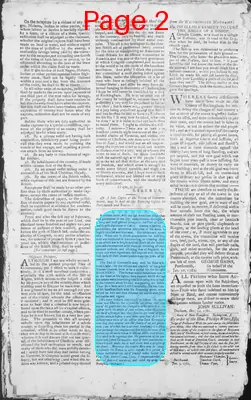
The New Hampshire Gazette And General Advertiser
Portsmouth, Exeter, Rockingham County, New Hampshire
What is this article about?
A private letter with American dispatches praises the Earl of Cornwallis, likening him to Caesar for his army's discipline and leadership during marches. Satirical commentary mocks this portrayal, suggesting he resembles Nero and alludes to defeat and capture.
Clipping
OCR Quality
Full Text
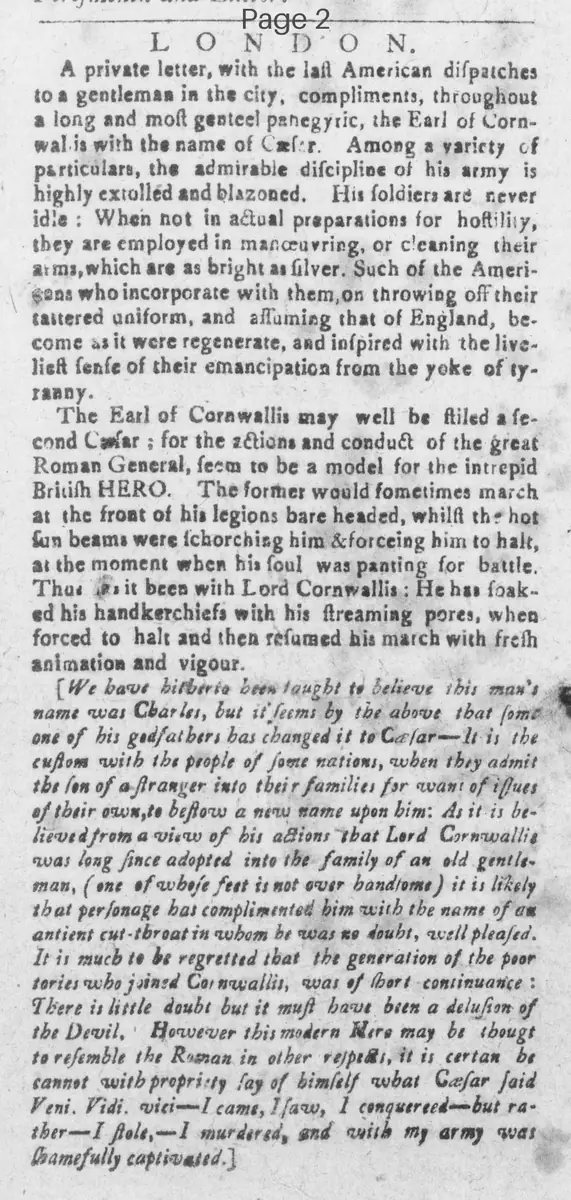
A private letter, with the last American dispatches to a gentleman in the city, compliments, throughout a long and most genteel panegyric, the Earl of Cornwallis with the name of Caesar. Among a variety of particulars, the admirable discipline of his army is highly extolled and blazoned. His soldiers are never idle: When not in actual preparations for hostility, they are employed in manoeuvring, or cleaning their arms, which are as bright as silver. Such of the Americans who incorporate with them, on throwing off their tattered uniform, and assuming that of England, become as it were regenerate, and inspired with the liveliest sense of their emancipation from the yoke of tyranny.
The Earl of Cornwallis may well be styled a second Caesar; for the actions and conduct of the great Roman General, seem to be a model for the intrepid British HERO. The former would sometimes march at the front of his legions bare headed, whilst the hot sun beams were scorching him & forcing him to halt, at the moment when his soul was panting for battle.
Thus has it been with Lord Cornwallis: He has soaked his handkerchiefs with his streaming pores, when forced to halt and then resumed his march with fresh animation and vigour.
[We have hitherto been taught to believe this man's name was Charles, but it seems by the above that some one of his godfathers has changed it to Caesar--It is the custom with the people of some nations, when they admit the son of a stranger into their families for want of issue of their own, to bestow a new name upon him: As it is believed from a view of his actions that Lord Cornwallis was long since adopted into the family of an old gentleman, (one of whose feet is not over handsome) it is likely that personage has complimented him with the name of an ancient cut-throat in whom he was no doubt, well pleased.
It is much to be regretted that the generation of the poor tories who joined Cornwallis, was of short continuance: There is little doubt but it must have been a delusion of the Devil, However this modern Nero may be thought to resemble the Roman in other respects, it is certain he cannot with propriety say of himself what Caesar said Veni. Vidi. vici--I came, I saw, I conquered--but rather--I stole,--I murdered, and with my army was shamefully captivated.]
What sub-type of article is it?
What keywords are associated?
What entities or persons were involved?
Where did it happen?
Foreign News Details
Primary Location
America
Key Persons
Outcome
the generation of the poor tories who joined cornwallis was of short continuance; with my army was shamefully captivated.
Event Details
A private letter with the last American dispatches compliments the Earl of Cornwallis with the name of Caesar, extolling the admirable discipline of his army. His soldiers are never idle, employed in manoeuvring or cleaning their arms. Americans who join them become inspired with emancipation from tyranny. Cornwallis is styled a second Caesar, marching bare-headed like the Roman general, soaking his handkerchiefs with sweat but resuming with vigour. Satirical commentary mocks this, suggesting his name was changed to Caesar by adoption into a family, regrets the short continuance of tories who joined him as a delusion of the Devil, and contrasts him to Nero, unable to claim 'Veni, Vidi, Vici' but rather 'I stole, I murdered, and with my army was shamefully captivated.'