Thank you for visiting SNEWPapers!
Sign up free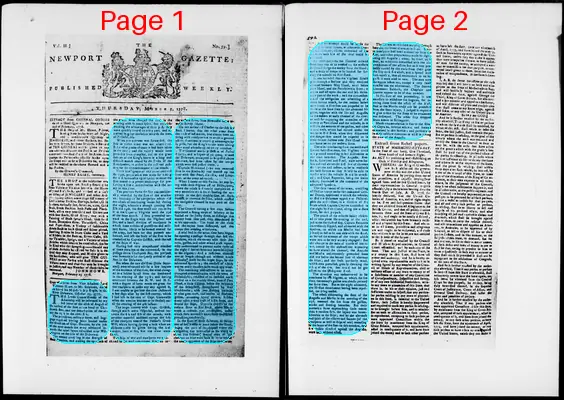
The Newport Gazette
Newport, Newport County, Rhode Island
What is this article about?
Vice Admiral Lord Howe's letter reports British naval and army operations in the Chesapeake Bay and Delaware River in 1777, including the landing at Elk River, victory at Brandywine, advance on Philadelphia, and efforts to clear river defenses against American forces.
Merged-components note: This is a continuous letter from Vice Admiral Howe detailing military operations, split across pages 1 and 2.
Clippings
1 of 2
OCR Quality
Full Text
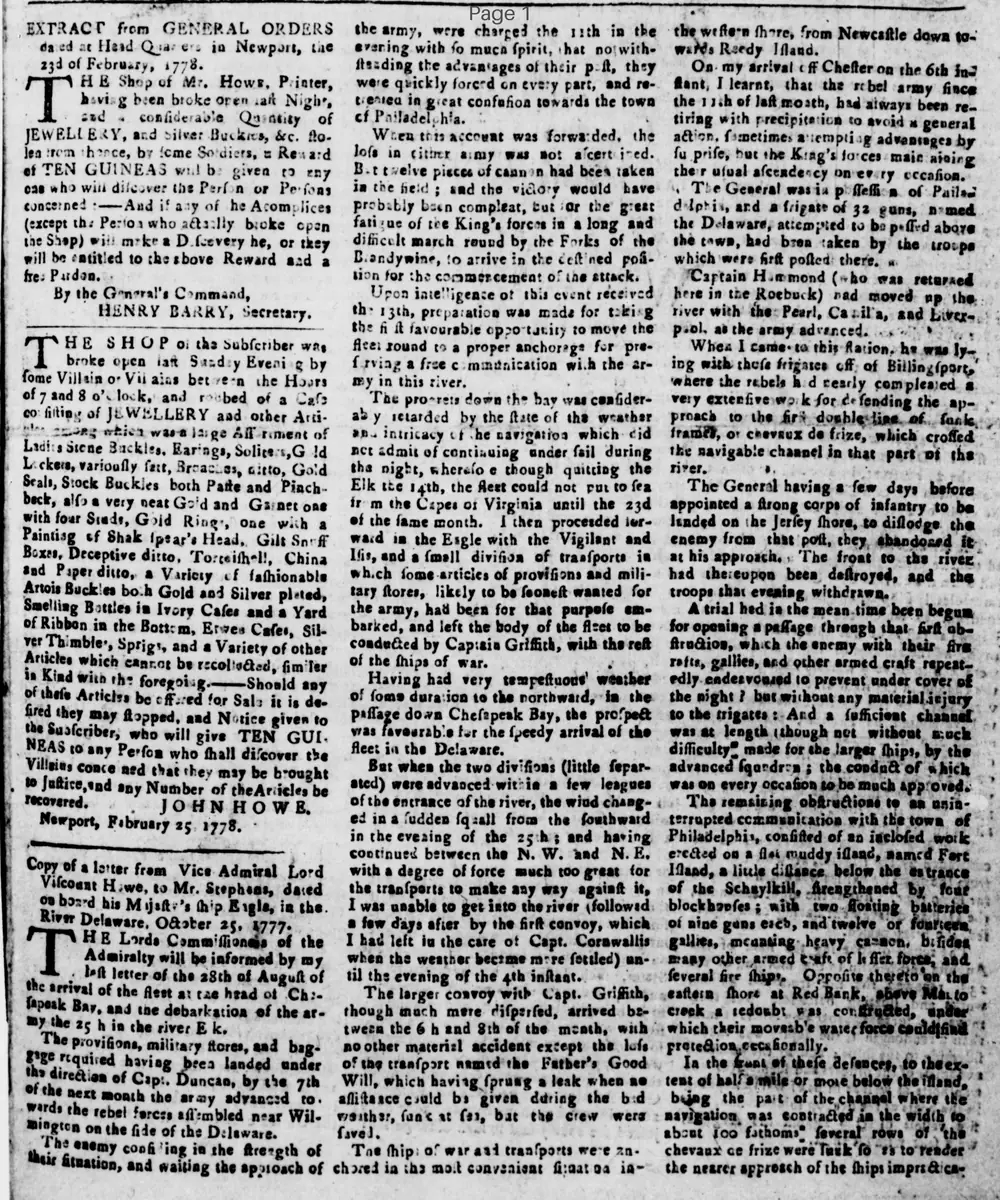
The Lords Commissioners of the Admiralty will be informed by my last letter of the 1st of August of the arrival of the fleet at the head of Chesapeake Bay, and the debarkation of the army the 25th in the river Elk.
The provisions, military stores, and baggage required having been landed under the direction of Capt. Duncan, by the 7th of the next month the army advanced towards the rebel forces assembled near Wilmington on the side of the Delaware. The enemy consisting in the strength of their situation, and waiting the approach of the army, were charged the 11th in the evening with so much spirit, that notwithstanding the advantages of their post, they were quickly forced on every part, and retreated in great confusion towards the town of Philadelphia.
When this account was forwarded, the loss in their army was not ascertained. But twelve pieces of cannon had been taken in the field; and the victory would have probably been complete, but for the great fatigue of the King's forces in a long and difficult march round by the Forks of the Brandywine, to arrive in the destined position for the commencement of the attack.
Upon intelligence of this event received the 13th, preparation was made for taking the first favourable opportunity to move the fleet round to a proper anchorage for preserving a free communication with the army in this river.
The progress down the bay was considerably retarded by the state of the weather and intricacy of the navigation which did not admit of continuing under sail during the night, therefore though quitting the Elk the 14th, the fleet could not put to sea in the Capes of Virginia until the 23d of the same month. I then proceeded forward in the Eagle with the Vigilant and Iris, and small division of transports in which some articles of provisions and military stores, likely to be soonest wanted for the army, had been for that purpose embarked, and left the body of the fleet to be conducted by Captain Griffith, with the rest of the ships of war.
Having had very tempestuous weather of some duration to the northward, in the passage down Chesapeake Bay, the prospect was favourable for the speedy arrival of the fleet in the Delaware.
But when the two divisions (little separated) were advanced within a few leagues of the entrance of the river, the wind changed in a sudden squall from the southward in the evening of the 25th; and having continued between the N. W. and N. E. with a degree of force much too great for the transports to make any way against it, I was unable to get into the river (followed a few days after by the first convoy, which I had left in the care of Capt. Cornwallis when the weather became more settled) until the evening of the 4th instant.
The larger convoy with Capt. Griffith, though much more dispersed, arrived between the 6th and 8th of the month, with no other material accident except the loss of the transport named the Father's Good Will, which having sprung a leak when no assistance could be given during the bad weather, sunk at sea, but the crew were saved.
The ships of war and transports were anchored in the most convenient station on the western Shore, from Newcastle downwards Reedy Island.
On my arrival off Chester on the 6th instant, I learnt, that the rebel army since the 11th of last month, had always been retiring with precipitation to avoid a general action, sometimes attempting advantages by a surprise, but the King's forces maintaining their usual ascendency on every occasion.
The General was in possession of Philadelphia, and a frigate of 32 guns, named the Delaware, attempted to be passed above the town, had been taken by the troops which were first posted there.
Captain Hammond (who was returned here in the Roebuck) had moved up the river with the Pearl, Camilla, and Liverpool, as the army advanced.
When I came to this station, he was lying with those frigates off of Billingsport, where the rebels had nearly completed a very extensive work of defending the approach to the first double gripe of sunk frames, or chevaux de frize, which crossed the navigable channel in that part of the river.
The General having a few days before appointed a strong corps of infantry to be landed on the Jersey shore, to dislodge the enemy from that post, they abandoned it at his approach. The front to the river had thereupon been destroyed, and the troops that evening withdrawn.
A trial had in the mean-time been begun for opening a passage through that first obstruction, which the enemy with their fire rafts, galleys, and other armed craft repeatedly endeavoured to prevent under cover of the night; but without any material injury to the frigates:—And a sufficient channel was at length (though not without much difficulty made for the larger ships, by the advanced Squadron; the conduct of which was on every occasion to be much approved.
The remaining obstructions to an uninterrupted communication with the town of Philadelphia, consisted of an enclosed work erected on a small muddy island, named Fort Island, a little distance below the entrance of the Schuylkill, strengthened by four blockhouses; with two floating batteries of nine guns each, and twelve or fourteen galleys, mounting heavy cannon, besides many other armed craft of lesser force; and several fire ships. Opposite thereto on the eastern Shore at Red Bank above Mantua creek a redoubt was constructed, under which their moveable water force could find protection occasionally.
In the front of these defences, to the extent of half a mile or more below the island, being the part of the channel where the navigation was contracted in the width to about 100 fathoms several rows of the chevaux de frize were sunk so as to render the nearer approach of the ships impracticable; and no attempt could be made for any sunken frames, or otherwise clearing the channels, till the command of the two forts on each side of the river could be obtained.
For these purposes the General ordered some batteries to be erected on the western shores to dislodge the enemy from the island; and a body of troops to be landed for forcing the redoubt on Red-Bank.
It was intended that the Vigilant should pass through a shallow and very confined channel between Hog Island, next below Fort Island, and the Pennsylvania shore; to arrive and set upon the rear and less defensible part of the work; and the circumstances of the navigation not admitting of a direct serious attack, for the reasons before mentioned, a diversion was proposed to be made at the same time by the advanced frigates, together with the Iris and Augusta, in the eastern or main channel of the river, as well for engaging the attention of the enemy at Fort-Island and the redoubt, as to restrain the motions of the gallies, and other armed craft, which had retired under the works at Red Bank, when they discovered the danger they would be exposed to in their former stations near Fort Island from our batteries on the western shore.
The wind continuing from the northward several successive days, the Vigilant could not proceed according to her destination at the time intended. The Augusta, Roebuck, Liverpool and Pearl, were nevertheless ordered above the first line of chevaux de frize: on the 22d instant, to be in readiness for such service as they should be able to render when the redoubt should be attacked: and Capt. Reynolds, being the senior officer, succeeded to the command of the advanced squadron.
The detachment of the army, consisting of Hessians troops under the command Colonel Donop, appointed to attack the redoubt, crossed the Delaware opposite to Philadelphia the 22d instant, in a division of flat boats which Captain Clayton conducted in the night by Fort Island, along the western Shore, for that purpose.
The attack of the redoubt being observed to take place the evening of the 22d, just upon the close of day, Captain Reynolds immediately slipped, and advanced with the squadron, (to which the Merlin had been joined) as fast as he was able with the flood, to second the attempt of the troops which were seen to be very warmly engaged: But the change in the natural course of the river, caused by the obstructions appearing to have altered the channel, the Augusta and Merlin unfortunately grounded some distance below the second line of chevaux de frize: and the fresh northerly wind, which then prevailed, greatly checking the rising of the tide, they could not be got afloat on the subsequent flood.
The diversion was endeavoured to be continued by the frigates, at which the fire from the enemy's gallies was chiefly pointed for some time. But as the night advanced, the Hessian detachment having been repulsed, the firing ceased.
The rebels discovering the state of the Augusta and Merlin in the morning of the 23d, renewed the fire from the gallies, works and floating batteries, But their movable force approaching little nearer than a random shot, the injury was inconsiderable to the ships: and by the alertness and Spirit of the officers and seamen (of the transports as well as Ships of war) attending in the boats of the fleet on this occasion, four fire vessels directed against the Augusta, were sent without effect.
What sub-type of article is it?
What themes does it cover?
What keywords are associated?
What entities or persons were involved?
Where did it happen?
Story Details
Key Persons
Location
River Delaware, Chesapeake Bay, Philadelphia
Event Date
October 25, 1777
Story Details
British forces land at Elk River, defeat rebels at Brandywine on September 11, advance to Philadelphia; fleet navigates to Delaware despite weather delays; efforts to clear river obstructions including attacks on Fort Island and Red Bank redoubt face setbacks with ships grounding and Hessian repulse.