Thank you for visiting SNEWPapers!
Sign up free
Story
January 4, 1798
Gazette Of The United States, & Philadelphia Daily Advertiser
Philadelphia, Philadelphia County, Pennsylvania
What is this article about?
A letter to the editor critiques a Philadelphia chief justice's charge to a grand jury on libel laws, arguing their absurdity, partiality towards political parties, and failure to protect press freedom, especially against French actions and local printers' attacks on Washington.
Clipping
OCR Quality
95%
Excellent
Full Text
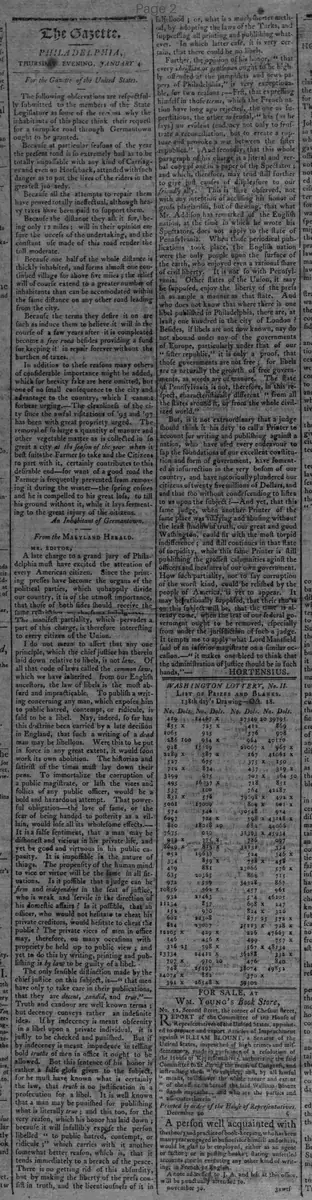
From the Maryland Herald.
MR. EDITOR,
A late charge to a grand jury of Philadelphia must have excited the attention of every American citizen. Since the printing press have become the organs of the political parties, which unhappily divide our country, it is of the utmost importance, that those of both sides should receive the same restrictions
The manifest partiality, which pervades a part of this charge, is therefore interesting to every citizen of the Union.
I do not mean to assert that any one principle, which the chief justice has therein laid down relative to libels, is not law. Of all that code of laws called the common law, which we have inherited from our English ancestors, the law of libels is the most absurd and impracticable. To publish a writing concerning any man, which exposes him to public hatred, contempt, or ridicule, is said to be a libel. Nay, indeed, so far has this doctrine been carried by a late decision in England, that such a writing of a dead man may be libellous. Were this to be put in force in any great extent, it would soon work its own abolition. The historian and satirist of the times must lay down their pens. To immortalize the corruption of a public magistrate, or lash the vices and follies of any public officer, would be a bold and hazardous attempt. That powerful obligation the love of fame, or the fear of being handed to posterity as a villain, would lose all its wholesome effects.
It is a false sentiment, that a man may be dishonest and vicious in his private life, and yet be good and virtuous in his public capacity. It is impossible in the nature of things. The propensity of the human mind to vice or virtue will be the same in all situations. Is it possible that a judge can be firm and independent in the seat of justice, who is weak and servile in the direction of his domestic affairs ? Is it possible, that an officer, who would not hesitate to cheat his private creditors, would hesitate to cheat the public ? The private vices of men in office may, therefore, on many occasions with propriety be held up to public view ; and yet to do this by writing, printing and publishing is by law to be guilty of a libel.
The only sensible distinction made by the chief justice on this subject, is-" that men have only to take care in their publications, that they are decent, candid, and true."
Truth and candour are well known terms ; but decency conveys rather an indefinite idea. If by indecency is meant obscenity in a libel upon a private individual, it is justly to be checked and punished. But if by indecency is meant impudence in telling bold truths of men in office it ought to be allowed. But this sentence of his honor is rather a false gloss given to the subject. for he must have known what is certainly the law, that truth is no justification in a prosecution for a libel. It is well known that a man may be punished for publishing what is literally true ; and this too, for the very reason, which his honor has laid down ; because it will infallibly expose the person libelled " to public hatred, contempt, or ridicule ;" which carries with it another somewhat better reason, which is, that it tends immediately to a breach of the peace.
There is no getting rid of this absurdity, but by making the liberty of the press consist in truth. and the licentiousness of it in falsehood ; or, what is a much shorter method, by adopting the laws of the Turks, and suppressing all printing and publishing whatever. In which latter case, it is very certain, that there could be no libels.
Further, the opinion of his honor, " that every christian,or gentleman ought to be highly offended at the pamphlets and news-papers of Philadelphia," is very exceptionable, for two reasons ;-First, that expressing himself in those terms, which the French nation have long ago rejected, the one as superstitious, the other as feudal, " has (as he says) an evident tendency not only to frustrate a reconciliation, but to create a rupture and provoke a war between the sister republics." And secondly, that this whole paragraph of his charge is a literal and verbal copy of one in a paper of the Spectator ; and which, therefore, may tend still further to offend our " friendly ally. "This is here observed, not with any intention of accusing his honor of gross plagiarism, but of shewing, that what Mr. Addison has remarked of the English nation, at the time in which he wrote his Spectators, does not apply to the state of Pennsylvania. When those periodical publications took place, the English nation were the only people upon the surface of the earth, who enjoyed even a rational share of civil liberty. It is not so with Pennsylvania. "Other states of the Union, it may be supposed, enjoy the liberty of the press in as ample a manner as that state. And who does not know that where there is one libel published in Philadelphia, there are, at least, one hundred in the city of London?
Besides, if libels are not now known, nay do not abound under any of the governments of Europe, particularly under that of our " sister republic," it is only a proof, that those governments are not free ; for libels are as naturally the growth of free governments, as weeds are of manure. The state of Pennsylvania is not, therefore, in this respect, characteristically different " from all the states around it, or from the whole civilized world "
But, is it not extraordinary that a judge should think it his duty to call a Printer to account for writing and publishing against a nation, who have used every endeavour to sap the foundations of our excellent constitution and form of government, have fomented an insurrection in the very bosom of our country, and have notoriously plundered our citizens of twenty five millions of Dollars, and that too without condescending to listen to us upon the subject ?And yet, that this same judge, when another Printer of the same place was vilifying and abusing without the least shadow of truth, our great and good Washington, could sit with the most torpid indifference ; and still continues in that state of torpidity, while this same Printer is still publishing the grossest calumnies against the officers and measures of our own government.
How such partiality, not to say corruption of the worst kind, could be relished by the people of America, is yet to appear. It may be rationally supposed, that their thoughts on this subject will be; that the time is already come, when the seat of our federal government ought to be removed, especially from under the jurisdiction of such a judge.
It tempts me to apply what Lord Mansfield said of an inferior magistrate on a similar occasion.-" it makes one bleed to think that the administration of justice should be in such hands,"
T. HORTENSIUS.
MR. EDITOR,
A late charge to a grand jury of Philadelphia must have excited the attention of every American citizen. Since the printing press have become the organs of the political parties, which unhappily divide our country, it is of the utmost importance, that those of both sides should receive the same restrictions
The manifest partiality, which pervades a part of this charge, is therefore interesting to every citizen of the Union.
I do not mean to assert that any one principle, which the chief justice has therein laid down relative to libels, is not law. Of all that code of laws called the common law, which we have inherited from our English ancestors, the law of libels is the most absurd and impracticable. To publish a writing concerning any man, which exposes him to public hatred, contempt, or ridicule, is said to be a libel. Nay, indeed, so far has this doctrine been carried by a late decision in England, that such a writing of a dead man may be libellous. Were this to be put in force in any great extent, it would soon work its own abolition. The historian and satirist of the times must lay down their pens. To immortalize the corruption of a public magistrate, or lash the vices and follies of any public officer, would be a bold and hazardous attempt. That powerful obligation the love of fame, or the fear of being handed to posterity as a villain, would lose all its wholesome effects.
It is a false sentiment, that a man may be dishonest and vicious in his private life, and yet be good and virtuous in his public capacity. It is impossible in the nature of things. The propensity of the human mind to vice or virtue will be the same in all situations. Is it possible that a judge can be firm and independent in the seat of justice, who is weak and servile in the direction of his domestic affairs ? Is it possible, that an officer, who would not hesitate to cheat his private creditors, would hesitate to cheat the public ? The private vices of men in office may, therefore, on many occasions with propriety be held up to public view ; and yet to do this by writing, printing and publishing is by law to be guilty of a libel.
The only sensible distinction made by the chief justice on this subject, is-" that men have only to take care in their publications, that they are decent, candid, and true."
Truth and candour are well known terms ; but decency conveys rather an indefinite idea. If by indecency is meant obscenity in a libel upon a private individual, it is justly to be checked and punished. But if by indecency is meant impudence in telling bold truths of men in office it ought to be allowed. But this sentence of his honor is rather a false gloss given to the subject. for he must have known what is certainly the law, that truth is no justification in a prosecution for a libel. It is well known that a man may be punished for publishing what is literally true ; and this too, for the very reason, which his honor has laid down ; because it will infallibly expose the person libelled " to public hatred, contempt, or ridicule ;" which carries with it another somewhat better reason, which is, that it tends immediately to a breach of the peace.
There is no getting rid of this absurdity, but by making the liberty of the press consist in truth. and the licentiousness of it in falsehood ; or, what is a much shorter method, by adopting the laws of the Turks, and suppressing all printing and publishing whatever. In which latter case, it is very certain, that there could be no libels.
Further, the opinion of his honor, " that every christian,or gentleman ought to be highly offended at the pamphlets and news-papers of Philadelphia," is very exceptionable, for two reasons ;-First, that expressing himself in those terms, which the French nation have long ago rejected, the one as superstitious, the other as feudal, " has (as he says) an evident tendency not only to frustrate a reconciliation, but to create a rupture and provoke a war between the sister republics." And secondly, that this whole paragraph of his charge is a literal and verbal copy of one in a paper of the Spectator ; and which, therefore, may tend still further to offend our " friendly ally. "This is here observed, not with any intention of accusing his honor of gross plagiarism, but of shewing, that what Mr. Addison has remarked of the English nation, at the time in which he wrote his Spectators, does not apply to the state of Pennsylvania. When those periodical publications took place, the English nation were the only people upon the surface of the earth, who enjoyed even a rational share of civil liberty. It is not so with Pennsylvania. "Other states of the Union, it may be supposed, enjoy the liberty of the press in as ample a manner as that state. And who does not know that where there is one libel published in Philadelphia, there are, at least, one hundred in the city of London?
Besides, if libels are not now known, nay do not abound under any of the governments of Europe, particularly under that of our " sister republic," it is only a proof, that those governments are not free ; for libels are as naturally the growth of free governments, as weeds are of manure. The state of Pennsylvania is not, therefore, in this respect, characteristically different " from all the states around it, or from the whole civilized world "
But, is it not extraordinary that a judge should think it his duty to call a Printer to account for writing and publishing against a nation, who have used every endeavour to sap the foundations of our excellent constitution and form of government, have fomented an insurrection in the very bosom of our country, and have notoriously plundered our citizens of twenty five millions of Dollars, and that too without condescending to listen to us upon the subject ?And yet, that this same judge, when another Printer of the same place was vilifying and abusing without the least shadow of truth, our great and good Washington, could sit with the most torpid indifference ; and still continues in that state of torpidity, while this same Printer is still publishing the grossest calumnies against the officers and measures of our own government.
How such partiality, not to say corruption of the worst kind, could be relished by the people of America, is yet to appear. It may be rationally supposed, that their thoughts on this subject will be; that the time is already come, when the seat of our federal government ought to be removed, especially from under the jurisdiction of such a judge.
It tempts me to apply what Lord Mansfield said of an inferior magistrate on a similar occasion.-" it makes one bleed to think that the administration of justice should be in such hands,"
T. HORTENSIUS.
What sub-type of article is it?
Historical Event
Crime Story
What themes does it cover?
Justice
Deception
Moral Virtue
What keywords are associated?
Libel Law
Freedom Of Press
Chief Justice Charge
Philadelphia Grand Jury
Political Partiality
Press Restrictions
What entities or persons were involved?
T. Hortensius
Chief Justice
Washington
Lord Mansfield
Mr. Addison
Where did it happen?
Philadelphia, Pennsylvania
Story Details
Key Persons
T. Hortensius
Chief Justice
Washington
Lord Mansfield
Mr. Addison
Location
Philadelphia, Pennsylvania
Event Date
Late Charge
Story Details
Critique of a chief justice's charge to a Philadelphia grand jury on libel laws, highlighting their absurdity, political partiality, and failure to justify truth in publications, while defending press freedom against French criticisms and local attacks on U.S. figures.