Thank you for visiting SNEWPapers!
Sign up free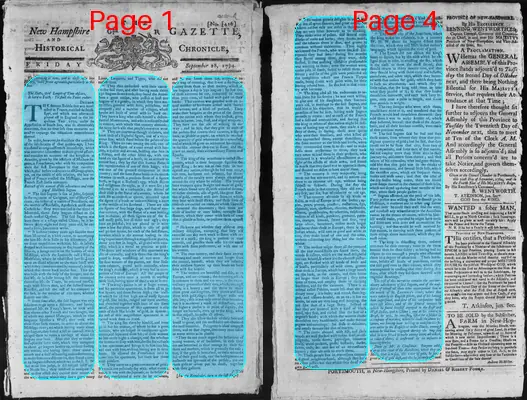
The New Hampshire Gazette And Historical Chronicle
Portsmouth, Greenland, Rockingham County, New Hampshire
What is this article about?
Introductory note links the Mississippi and South Sea Bubbles to credulity inspired by Matthew Sagean's translated French manuscript account of discovering the gold-rich kingdom of Acaniba in the Americas. The narrative details Sagean's background, journey from Fort St. Louis up the Mississippi, encounters with Acanibans, their customs, wealth, idols, commerce, and the French explorers' experiences.
Merged-components note: This is a continuation of the literary narrative from page 1 to page 4, as explicitly indicated by the text 'For the Remainder, turn to the last Page'.
Clippings
1 of 2
OCR Quality
Full Text
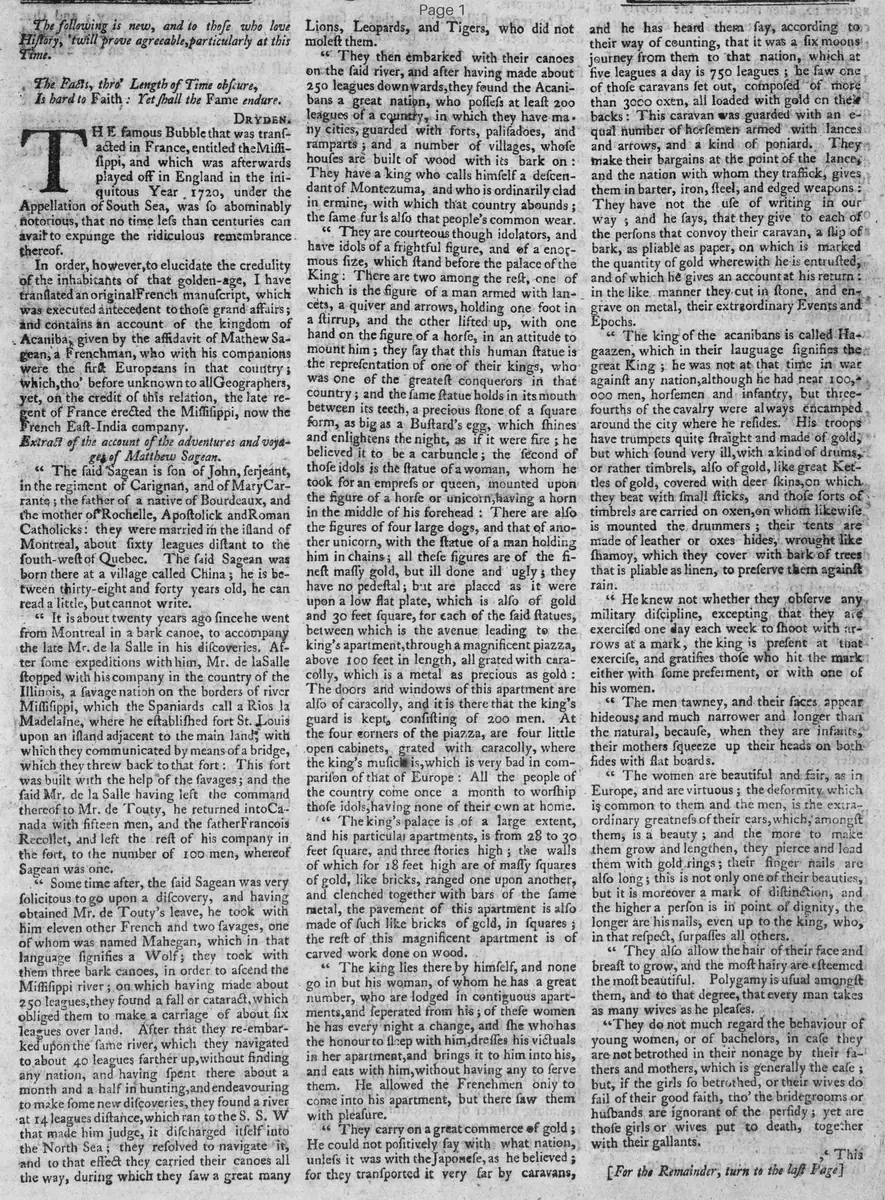
History, 'twill prove agreeable, particularly at this
Time.
The Facts, thro' Length of Time obscure,
Is hard to Faith: Yet shall the Fame endure.
DRYDEN.
The famous Bubble that was transacted
in France, entitled the Mississippi,
and which was afterwards
played off in England in the iniquitous
Year 1720, under the
Appellation of South Sea, was so abominably
notorious, that no time less than centuries can
avail to expunge the ridiculous remembrance
thereof.
In order, however, to elucidate the credulity
of the inhabitants of that golden-age, I have
translated an original French manuscript, which
was executed antecedent to those grand affairs;
and contains an account of the kingdom of
Acaniba; given by the affidavit of Matthew Sa-
gean, a Frenchman, who with his companions
were the first Europeans in that country:
which tho' before unknown to all Geographers.
yet, on the credit of this relation, the late re-
gent of France erected the Mississippi, now the
French East-India company.
Extract of the account of the adventures and voya-
ges of Matthew Sagean.
The said Sagean is son of John, serjeant,
in the regiment of Carignan, and of Mary Car-
rante: the father a native of Bourdeaux. and
the mother of Rochelle. Apostolick and Roman
Catholics: they were married in the island of
Montreal, about sixty leagues distant to the
south-west of Quebec. The said Sagean was
born there at a village called China; he is be-
tween thirty-eight and forty years old, he can
read a little. but cannot write.
It is about twenty years ago since he went
from Montreal in a bark canoe, to accompany
the late Mr. de la Salle in his discoveries. Af-
ter some expeditions with him. Mr. de la Salle
stopped with his company in the country of the
Illinois. a savage nation on the borders of river
Mississippi. which the Spaniards call a Rio de la
Madelaine. where he established fort St. Louis
upon an island adjacent to the main land. with
which they communicated by means of a bridge,
which they threw back to that fort: This fort
was built with the help of the savages: and the
said Mr. de la Salle having left the command
thereof to Mr. de Tonti, he returned into Ca-
nada with fifteen men, and the father Francois
Recollet. and left the rest of his company in
the fort, to the number of 100 men, whereof
Sagean was one.
Some time after, the said Sagean was very
solicitous to go upon a discovery, and having
obtained Mr. de Tonti's leave. he took with
him eleven other French and two savages. one
of whom was named Mahegan, which in that
language signifies a Wolf; they took with
them three bark canoes, in order to ascend the
Mississippi river; on which having made about
250 leagues, they found a fall or cataract, which
obliged them to make a carriage of about six
leagues over land. After that they re-embarked
upon the same river, which they navigated
to about 40 leagues further up, without finding
any nation, and having spent there about a
month and a half in hunting, and endeavouring
to make some new discoveries, they found a river
at 14 leagues distance, which ran to the S. S. W.
that made him judge, it discharged itself into
the North Sea; they resolved to navigate it,
and to that effect they carried their canoes all
the way, during which they saw a great many
Lions, Leopards, and Tigers, who did not
molest them.
They then embarked with their canoes
on the said river, and after having made about
250 leagues down wards, they found the Acani-
bans a great nation, who possess at least 200
leagues of a country, in which they have ma-
ny cities, guarded with forts, palisadoes, and
ramparts; and a number of villages, whose
houses are built of wood with its bark on:
They have a king who calls himself a descen-
dent of Montezuma, and who is ordinarily clad
in ermine, with which that country abounds;
the same fur is also that people's common wear.
They are courteous though idolators, and
have idols of a frightful figure, and of enormous size, which stand before the palace of the
King: There are two among the rest, one of
which is the figure of a man armed with lan-
cets, a quiver and arrows, holding one foot in
a stirrup, and the other lifted up, with one
hand on the figure of a horse. in an attitude to
mount him; they say that this human statue is
the representation of one of their kings, who
was one of the greatest conquerors in that
country; and the same statue holds in its mouth
between its teeth, a precious stone of a square
form, as big as a Butard's egg, which shines
and enlightens the night. as if it were fire; he
believed it to be a carbuncle: the second of
those idols is the statue of a woman. whom he
took for an empress or queen, mounted upon
the figure of a horse or unicorn, having a horn
in the middle of his forehead: There are also
the figures of four large dogs, and that of ano-
ther unicorn, with the statue of a man holding
him in chains; all these figures are of the fi-
net may gold, but ill done and ugly; they
have no pedestal; but are placed as it were
upon a low flat plate. which is also of gold
and 20 feet square, for each of the said statues.
between which is the avenue leading to the
king's apartment, through a magnificent piazza,
above 100 feet in length, all grated with cara-
colly, which is a metal as precious as gold:
The doors and windows of this apartment are
also of caracolly, and it is there that the king's
guard is kept, consisting of 200 men. At
the four corners of the piazza, are four little
open cabinets, grated with caracolly, where
the king's music is, which is very bad in com-
parison of that of Europe: All the people of
the country come once a month to worship
those idols, having none of their own at home.
The king's palace is of a large extent,
and his particular apartments, is from 28 to 30
feet square, and three stories high; the walls
of which for 18 feet high are of massy squares
of gold, like bricks, ranged one upon another,
and clenched together with bars of the same
metal, the pavement of this apartment is also
made of such like bricks of gold, in squares;
the rest of this magnificent apartment is of
carved work done on wood.
The king lies there by himself, and none
go in but his woman, of whom he has a great
number, who are lodged in contiguous apart-
ments, and separated from his; of these women
he has every night a change, and she who has
the honour to sleep with him, dresses his victuals
in her apartment, and brings it to him into his,
and eats with him, without having any to serve
them. He allowed the Frenchmen only to
come into his apartment, but there saw them
with pleasure.
They carry on a great commerce of gold;
He could not positively say with what nation,
unless it was with the Japonee, as he believed;
for they transported it very far by caravans,
and he has heard them say, according to
their way of counting, that it was a six moons
journey from them to that nation, which at
five leagues a day is 750 leagues; he saw one
of those caravans set out, composed of more
than 5000 oxen, all loaded with gold on their
backs: This caravan was guarded with an e-
qual number of horsemen armed with lances
and arrows, and a kind of poniard. They
make their bargains at the point of the lance;
and the nation with whom they traffic, gives,
them in barter, iron, steel; and edged weapons:
They have not the use of writing in our
way; and he says, that they give to each of
the persons that convoy their caravan. a slip of
bark, as pliable as paper, on which is marked
the quantity of gold wherewith he is entrusted,
and of which he gives an account at his return:
in the like manner they cut in stone, and en-
grave on metal, their extraordinary Events and
Epochs.
The king of the Acanibans is called Ha-
gaazen, which in their language signifies the
great King; he was not at that time in war
against any nation, although he had near 100,
000 men, horsemen and infantry, but three-
fourths of the cavalry were always encamped
around the city where he resides. His troops
have trumpets quite straight and made of gold,
but which sound very ill, with a kind of drums,
or rather timbrels, also of gold, like great Ket-
tles of gold, covered with deer skins, on which
they beat with small sticks, and those sorts of
timbrels are carried on oxen, on whom likewise
is mounted the drummers; their tents are
made of leather or oxen hides, wrought like
camoy, which they cover with bark of trees
that is pliable as linen, to preserve them against
rain.
He knew not whether they observe any
military discipline, excepting that they are
exercised one day each week to shoot with ar-
rows at a mark, the king is present at that
exercise, and gratifies those who hit the mark
either with some presentment, or with one of
his women.
The men tawney, and their faces, appear
hideous: and much narrower and longer than
the natural, because, when they are infants.
their mothers squeeze up their heads on both
sides with flat boards.
The women are beautiful and fair, as in
Europe, and are virtuous; the deformity which
is common to them and the men, is the extra-
ordinary greatness of their ears, which, amongst
them, is a beauty; and the more to make
them grow and lengthen, they pierce and load
them with gold rings; their finger nails are
also long; this is not only one of their beauties,
but it is moreover a mark of distinction, and
the higher a person is in point of dignity, the
longer are his nails, even up to the king, who,
in that respect. surpasses all others.
They also allow the hair of their face and
breast to grow, and the most hairy are esteemed
the most beautiful. Polygamy is usual amongst
them, and to that degree, that every man takes
as many wives as he pleases.
They do not much regard the behaviour of
young women, or of bachelors, in case they
are not betrothed in their nonage by their fa-
th ers and mothers, which is generally the case:
but, if the girls so betrothed, or their wives do
fail of their good faith, tho' the bridegrooms or
husbands are ignorant of the perfidy; yet are
those girls or wives put to death, together
with their gallants.
[For the Remainder, turn to the last Page]
We This nation greatly delights in mirth, and they are all great dancers, and great eaters, but observe neither rule nor order in their meals: they are very sober however as to drinking. They make wine of palms, and several other drinks of roots and herbs; they smoke much, and the tobacco there is fine, and grows in common without cultivation. They highly welcomed the French, who were the first Europeans they had seen; during five months they stayed among them, they were daily feasted, so that nothing useful or pleasurable was wanting to them; even the women were, under pain of death, forbid to refuse them any favour; and six of the girls were poniarded on the complaints which one Francis Turpin made, being drunk with palm wine, for their having refused him. So stocked in that country with Lucretia.
The king used all his endeavours to retain them for his service; he was even willing to give one of his daughters, then fourteen years old, in marriage to the said Sagean, and told him at his departure, that he would be guardian of her for him, having made Sagean promise to return: and as each of the French had a fusil and ammunition, and fearing that the king or others of that nation might be desirous of having any of them, they made a mystery of them, in saying, those were spirits who were their familiars, and who killed all who approached them, except themselves, in the same manner as the birds and beasts, when they commanded them so to do: and to make fusils more mysterious to them, they took care never to load them in their presence, who continued in a wonderful astonishment at the sight of the effects of those arms, and feared so much that they dared not to approach them, and shewed no desire to have any of them.
We The country is very temperate, being never too hot nor too cold, and its natives live there to an extreme old age, without being subject to sickness. During the stay the French made in that country, they did not see any sick, nor die, but of caducity or old age.
That country abounds in all kinds of fruits, as well of Europe as of the Indies; apples, pears, prunes, peaches, nectarines, figs, almonds, nuts, chestnuts, cherries, mulberries, filberts, gooseberries, strawberries, raspberries, melons of all kinds, pumpkins, gourds, pomegranates, oranges, lemons, sweet and sour, very large olives, pomegranates, raisins much larger and better than those in Europe; there is also Indian wheat, wild oats as good and white as rice, they make bread of one and the other, without cultivating any thing but the Indian wheat.
The verdure reigns there all the year, and all the year round fruits are found there, the woods & valleys, which are the most delightful one can behold, & where are the choicest pasturages, are stocked with all kinds of birds and of beasts, particularly of wild oxen, greater than those in Europe, which have a large bunch on the back, as the camels, and their horns are larger than those in Europe; they tame some of them, and employ them in carrying burthens, and for the caravans. There is an animal called Pithion, much less than the ordinary oxen; it is bulky and round, short legged; and cloven-hoofed, as an ox; it has no horns, its ears are very long and hanging, the tail like that of a large sheep. Instead of hair they are covered with a kind of black wool, very fine, and curled like the hair of a negro's head; with which the women clothe themselves very handsomely, and make thereof pagnes and coverings. Its flesh is delicious, and nearly savours like that of mutton.
The rivers abound with fish, and their woods are well stocked with Indian fowl, wood-pidgeons, turtle doves, partridges, common fowls, wood-peckers, geese, bustards, ducks, swans, teals, &c. and are of an extraordinary bigness; they use nets to catch them.
Those people live in marvellous concord and good neighbourhood, although they have no other justice but that which they do of their own good will.
There is nevertheless a kind of punishment established by the king's order, which is a sort of pillory, where the malefactors and the seditious are exposed.
The capital city of the Acanibans, where the king makes his residence, is in a country W. N. W. about six leagues distant from the river, which they call Milli in that nation's language, which signifies the river of gold.
We The French did not obtain the king's leave to depart, but by the oath which he obliged them to take, in attesting the sky, which is the oath to them the most sacred, that they should return in thirty moons time, and that they should bring with them coral and turtles, porcelain, and other toys, which they bartered with that nation for gold, which they have in such an abundance, and which they set so little value, that the king told them to take what they pleased of it; so that they loaded themselves therewith, and each took sixty ingots, very near a palm in length, and about four pounds in weight.
The two savages who were with them, would have none of it, and wondered that the French would load themselves therewith: they told them it was to make kettles of, which they believed, because that those of the Acanibans, and all their kitchen-utensils, were made of that precious metal.
The said Sagean said he had not seen those mines, from whence they draw that prodigious quantity of gold; but he said, that they could not be far from that city, since two of his companions, and some men of that nation, did not employ more than three days in their journey to, and return from thence; and that others of his comrades, who had gone thither, told him that that gold was in the chinks of many mountains, and several little hills, which the excessive rains, which are frequent there, loosen and wash away; and that the time of the dry season being come, there are found great heaps thereof in the channel of those hills, which are dried up during four months of the year, when those people gather it.
Sagean affirmed, on the peril of his life, if any person was willing that he should go to Mississippi, it mattered not to what part soever of that river he could then well find the way, and conduct any whomsoever to the Acaniban nation by the means of canoes, which he himself would make, provided he might have tools and some men with arms and ammunition for hunting; and that would be well received by that nation, in carrying with them presents of those things above mentioned, which they set the most value.
The king in dismissing them, ordered 200 men for their convoy; more to do them honour than for their safety; as having had no risques to run amongst a people who esteemed them to a degree of adoration. Those horsemen, besides all kinds of provisions, carried the said gold even to their canoes, which they accompanied in coasting that river during five days, after which they bid them farewell with frightful shoutings."
The rest of this narrative contains the extraordinary adventures of said Sagean, and of the massacres of almost all them who accompanied him to the mouth of St. Lawrence's river, where they were taken by an English pirate, and of his having been imprisoned, and some of his companions who were left alive; and of the several voyages in which he found himself engaged to the East and West-Indies, and to China; and at his return to Brest, he was, by necessity, listed for a soldier in a company of marines, where he made the above relation, not having been willing to unbosom this secret either to the English or to the Dutch, among whom he had been engaged during the long stay that he was forced to make among them, all which, as related above, is confirmed by his answers to interrogatories.
Done by Mr. de Cloueaux? Sagean adds, that on this river of the Acanibans, which they call Milli, that is to say, the river of gold, he saw a great deal of gold dust, and this he solemnly affirmed.
What sub-type of article is it?
What themes does it cover?
What keywords are associated?
What entities or persons were involved?
Literary Details
Title
Extract Of The Account Of The Adventures And Voyages Of Matthew Sagean
Author
Matthew Sagean
Subject
Account Of The Kingdom Of Acaniba
Form / Style
Narrative Of Travels And Discoveries In Prose
Key Lines