Thank you for visiting SNEWPapers!
Sign up free
The Virginia Gazette
Williamsburg, Virginia
What is this article about?
In this theological letter, the author defends the finite duration of future punishments using arguments from reason, scripture, and ancient philosophers like Plato, countering the Orthodox Layman's claims of eternal punishment and the limits of human reason in religious matters.
Merged-components note: This is a continuation of the same letter to the editor across pages 1 and 2, debating theological points on finite vs. eternal punishments.
Clippings
1 of 2
OCR Quality
Full Text
SIR,
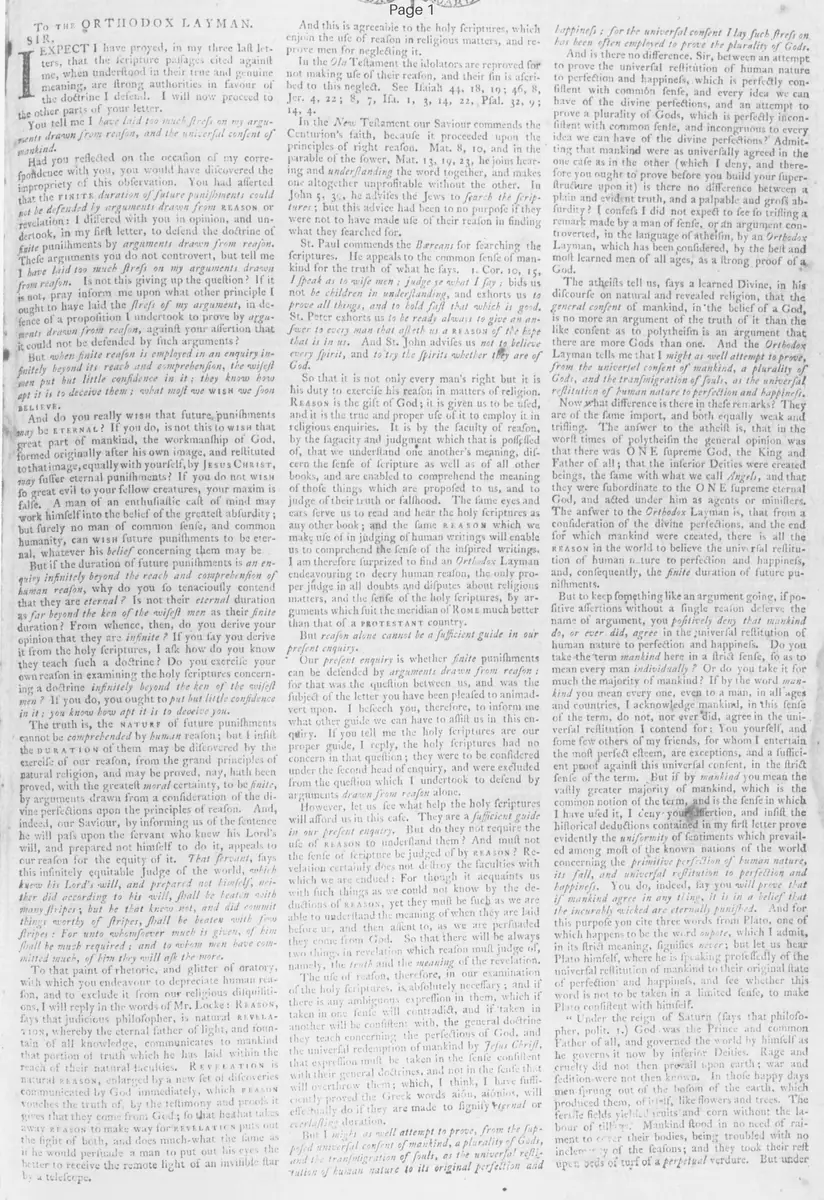
I expect I have proved, in my three last letters, that the scripture passages cited against me, when understood in their true and genuine meaning, are strong authorities in favour of the doctrine I defend. I will now proceed to the other parts of your letter.
You tell me I have laid too much stress on my arguments drawn from reason, and the universal consent of mankind.
Had you reflected on the occasion of my correspondence with you, you would have discovered the impropriety of this observation. You had asserted that the finite duration of future punishments could not be defended by arguments drawn from reason or revelation: I differed with you in opinion, and undertook, in my first letter, to defend the doctrine of finite punishments by arguments drawn from reason.
These arguments you do not controvert, but tell me I have laid too much stress on my arguments drawn from reason. Is not this giving up the question? If it is not, pray inform me upon what other principle I ought to have laid the stress of my argument, in defence of a proposition I undertook to prove by arguments drawn from reason, against your assertion that it could not be defended by such arguments?
But when finite reason is employed in an enquiry infinitely beyond its reach and apprehension, the wisest men put but little confidence in it: they know how apt it is to deceive them; what most we wish we soon believe.
And do you really wish that future punishments may be eternal? If you do, is not this to wish that great part of mankind, the workmanship of God, formed originally after his own image, and restored to that image, equally with yourself, by Jesus Christ, may suffer eternal punishments? If you do not wish so great evil to your fellow creatures, your maxim is false. A man of an enthusiastic cast of mind may work himself into the belief of the greatest absurdity; but surely no man of common sense, and common humanity, can wish future punishments to be eternal, whatever his belief concerning them may be.
But if the duration of future punishments is an enquiry infinitely beyond the reach and comprehension of human reason, why do you so tenaciously contend that they are eternal? Is not their eternal duration as far beyond the ken of the wisest men as their finite duration? From whence, then, do you derive your opinion that they are infinite? If you say you derive it from the holy scriptures, I ask how do you know they teach such a doctrine? Do you exercise your own reason in examining the holy scriptures concerning a doctrine infinitely beyond the ken of the wisest men? If you do, you ought to put but little confidence in it; you know how apt it is to deceive you.
The truth is, the nature of future punishments cannot be comprehended by human reason; but I insist the duration of them may be discovered by the exercise of our reason, from the grand principles of natural religion, and may be proved, nay, hath been proved, with the greatest moral certainty, to be finite, by arguments drawn from a consideration of the divine perfections upon the principles of reason. And indeed, our Saviour, by informing us of the sentence he will pass upon the servant who knew his Lord's will, and prepared not himself to do it, appeals to our reason for the equity of it. That servant, says this infinitely equitable Judge of the world, which knew his Lord's will, and prepared not himself, neither did according to his will, shall be beaten with many stripes; but he that knew not, and did commit things worthy of stripes, shall be beaten with few stripes: For unto whomsoever much is given, of him shall be much required; and to whom men have committed much, of him they will ask the more.
To that paint of rhetoric, and glitter of oratory, with which you endeavour to depreciate human reason, and to exclude it from our religious inquiries, I will reply in the words of Mr. Locke: Reason, says that judicious philosopher, is natural revelation, whereby the eternal Father of light, and fountain of all knowledge, communicates to mankind that portion of truth which he has laid within the reach of their natural faculties. Revelation is natural reason, enlarged by a new set of discoveries communicated by God immediately, which reason vouches the truth of, by the testimony and proofs it gives that they come from God; so that he that takes away reason to make way for revelation, puts out the light of both, and does much what the same as if he would persuade a man to put out his eyes the better to receive the remote light of an invisible star by a telescope.
And this is agreeable to the holy scriptures, which enjoin the use of reason in religious matters, and reprove men for neglecting it.
In the Old Testament the idolators are reproved for not making use of their reason, and their sin is ascribed to this neglect. See Isaiah 44, 18, 19; 46, 8, Jer. 4, 22; 8, 7, Isa. 1, 3, 14, 22, Psal. 32,9; 14, 4.
In the New Testament our Saviour commends the Centurion's faith, because it proceeded upon the principles of right reason. Mat. 8, 10, and in the parable of the sower, Mat. 13, 19, 23, he joins hearing and understanding the word together, and makes one altogether unprofitable without the other. In John 5, 3, he advises the Jews to search the scriptures; but this advice had been to no purpose if they were not to have made use of their reason in finding what they searched for.
St. Paul commends the Beraeans for searching the scriptures. He appeals to the common sense of mankind for the truth of what he says. I Cor. 10, 15, I speak as to wise men; judge ye what I say; bids us not be children in understanding, and exhorts us to prove all things, and to hold fast that which is good.
St. Peter exhorts us to be ready always to give an answer to every man that asketh us a reason of the hope that is in us. And St. John advises us not to believe every spirit, and to try the spirits whether they are of God.
So that it is not only every man's right but it is his duty to exercise his reason in matters of religion.
Reason is the gift of God; it is given us to be used, and it is the true and proper use of it to employ it in religious inquiries. It is by the faculty of reason, by the sagacity and judgment which that is possessed of, that we understand one another's meaning, discern the sense of scripture as well as of all other books, and are enabled to comprehend the meaning of those things which are proposed to us, and to judge of their truth or falsehood. The same eyes and ears serve us to read and hear the holy scriptures as any other book; and the same reason which we make use of in judging of human writings will enable us to comprehend the sense of the inspired writings.
I am therefore surprised to find an Orthodox Layman endeavouring to decry human reason, the only proper judge in all doubts and disputes about religious matters, and the sense of the holy scriptures, by arguments which suit the meridian of Rome much better than that of a Protestant country.
But reason alone cannot be a sufficient guide in our present enquiry.
Our present enquiry is whether finite punishments can be defended by arguments drawn from reason; for that was the question between us, and was the subject of the letter you have been pleased to animadvert upon. I beseech you, therefore, to inform me what other guide we can have to assist us in this enquiry. If you tell me the holy scriptures are our proper guide, I reply, the holy scriptures had no concern in that question; they were to be considered under the second head of enquiry, and were excluded from the question which I undertook to defend by arguments drawn from reason alone.
However, let us see what help the holy scriptures will afford us in this case. They are a sufficient guide in our present enquiry. But do they not require the use of reason to understand them? And must not the sense of scripture be judged of by reason? Revelation certainly does not destroy the faculties with which we are endowed: For though it acquaints us with such things as we could not know by the deductions of reason, yet they must be such as we are able to understand the meaning of when they are laid before us, and then assent to, as we are persuaded they come from God. So that there will be always two things in revelation which reason must judge of, namely, the truth and the meaning of the revelation.
The use of reason, therefore, in our examination of the holy scriptures, is absolutely necessary: and if there is any ambiguous expression in them, which if taken in one sense will contradict, and if taken in another will be consistent with, the general doctrine they teach concerning the universal redemption of mankind by Jesus Christ, and that expression must be taken in the sense consistent with their general doctrines, and not in the sense that will overthrow them; which, I think, I have sufficiently done if they are made to signify eternal or everlasting duration.
But I might as well attempt to prove, from the supposed universal consent of mankind, a plurality of Gods, and the transmigration of souls, as the universal restitution of human nature to its original perfection and happiness: for the universal consent I lay such stress on has been often employed to prove the plurality of Gods.
And is there no difference, Sir, between an attempt to prove the universal restitution of human nature to perfection and happiness, which is perfectly consistent with common sense, and every idea we can have of the divine perfections, and an attempt to prove a plurality of Gods, which is perfectly inconsistent with common sense, and incongruous to every idea we can have of the divine perfections? Admitting that mankind were as universally agreed in the one case as in the other (which I deny, and therefore you ought to prove before you build your superstructure upon it) is there no difference between a plain and evident truth, and a palpable and gross absurdity? I confess I did not expect to see so trifling a remark made by a man of sense, or an argument controverted, in the language of atheism, by an Orthodox Layman, which has been considered, by the best and most learned men of all ages, as a strong proof of a God.
The atheists tell us, says a learned Divine, in his discourse on natural and revealed religion, that the general consent of mankind, in the belief of a God, is no more an argument of the truth of it than the like consent as to polytheism is an argument that there are more Gods than one. And the Orthodox Layman tells me that I might as well attempt to prove, from the universal consent of mankind, a plurality of Gods, and the transmigration of souls, as the universal restitution of human nature to perfection and happiness.
Now what difference is there in these remarks? They are of the same import, and both equally weak and trifling. The answer to the atheist is, that in the worst times of polytheism the general opinion was that there was one supreme God, the King and Father of all; that the inferior Deities were created beings, the same with what we call Angels, and that they were subordinate to the one supreme eternal God, and acted under him as agents or ministers.
The answer to the Orthodox Layman is, that from a consideration of the divine perfections, and the end for which mankind were created, there is all the reason in the world to believe the universal restitution of human nature to perfection and happiness, and, consequently, the finite duration of future punishments.
But to keep something like an argument going, if positive assertions without a single reason deserve the name of argument, you positively deny that mankind do, or ever did, agree in the universal restitution of human nature to perfection and happiness. Do you take the term mankind here in a strict sense, so as to mean every man individually? Or do you take it for much the majority of mankind? If by the word mankind you mean every one, even to a man, in all ages and countries, I acknowledge mankind, in this sense of the term, do not, nor ever did, agree in the universal restitution I contend for: You yourself, and some few others of my friends, for whom I entertain the most perfect esteem, are exceptions, and a sufficient proof against this universal consent, in the strict sense of the term. But if by mankind you mean the vastly greater majority of mankind, which is the common notion of the term, and is the sense in which I have used it, I deny your assertion, and insist the historical deductions contained in my first letter prove evidently the uniformity of sentiments which prevailed among most of the known nations of the world concerning the primitive perfection of human nature, its fall, and universal restitution to perfection and happiness. You do, indeed, say you will prove that if mankind agree in any thing, it is in a belief that the incurably wicked are eternally punished. And for this purpose you cite three words from Plato, one of which happens to be the word oupote, which I admit, in its strict meaning, signifies never; but let us hear Plato himself, where he is speaking professedly of the universal restitution of mankind to their original state of perfection and happiness, and see whether this word is not to be taken in a limited sense, to make Plato consistent with himself.
"Under the reign of Saturn (says that philosopher, polit. 1.) God was the Prince and common Father of all, and governed the world by himself as he governs it now by inferior Deities. Rage and cruelty did not then prevail upon earth; war and sedition were not then known. In those happy days men sprung out of the bosom of the earth, which produced them, of itself, like flowers and trees. The fertile fields yielded fruits and corn without the labour of till. Mankind stood in no need of raiment to cover their bodies, being troubled with no inclemency of the seasons; and they took their rest upon beds of turf of a perpetual verdure. But under
In the reign of Jupiter, Saturn, the Master of the Universe, having quitted, as it were, the reins of his empire, hid himself in an inaccessible retreat: The inferior Gods who governed under him retired likewise: the very foundations of the world were shaken by motions contrary to its principle and its end, and it lost its beauty and its lustre. Then it was that good and evil were blended together; but in the end, lest the world should be plunged in an eternal abyss of confusion, God, the author of the primitive order, will appear again, and resume the reins of the empire; THEN HE WILL CHANGE, AMEND, EMBELLISH, AND RESTORE THE WHOLE FRAME OF NATURE, AND PUT AN END TO DECAY OF AGE, DISEASES, AND DEATH."
Again, in his dialogue under the title of Phædrus, he says "every soul which follows God faithfully into the super-celestial place preserves itself pure, and without blemish; but if it takes up with nectar and ambrosia, and does not attend on Jupiter's chariot, to go and contemplate truth, it grows heavy and sluggish; it breaks its wings, it falls upon the earth, and enters a human body more or less vile, according as it has been more or less elevated. Souls less degenerated than others dwell in the bodies of philosophers; the most despicable of all animate the bodies of tyrants and evil Princes. Their condition alters after death, and becomes more or less happy, according as they have loved virtue or vice in their lifetime. AFTER TEN THOUSAND years souls will be reunited TO THEIR ORIGIN. During that space of time their wings grow again, and are renewed." This doctrine of Plato's, concerning the fall and restoration of souls, is explained by Macrobius in his commentary on Scipio's dream. Chap. 3, 12, 13.
We see, then, that the doctrine of the primitive perfection of nature, its fall, and restitution, are equally asserted by this philosopher. How is it possible, then, that he should intend to mean, by the three words you cite from his Phædo, that great part of mankind were to remain in Tartarus forever, in the strict sense of the word. He declares positively that God will RESTORE THE WHOLE FRAME OF NATURE to its original perfection and happiness which it lost under the reign of Jupiter. Those sinners, therefore, whom he describes by the emphatical term incurable, will continue in Tartarus, and never be released from it till God shall resume the reins of the empire, when all the evils that happened under Jupiter's government shall be removed, the whole frame of nature shall be restored to its original perfection and happiness, and an end be put to the decay of age, diseases, and death.
And, indeed, not only Plato but all the ancient philosophers were of this opinion, and in this important circumstance differed widely from that which is commonly supposed to be the christian doctrine, but which, I think, has no foundation in reason or scripture, namely, that whereas we are taught to believe that only a part of the human race are to have the benefit of this restitution, and quite exclude from it all the fallen Angels, and a great part of mankind, they, on the contrary, extend this restitution to all beings whatsoever, as will appear to those who consult Cudworth's Intellectual System, Ramsay's Cyrus, and Burnet's Archæologi Philosophica.
Your quotations from Virgil and Ovid are certainly strong and convincing proofs that the doctrine of infinite punishments was received in Italy. In your first quotation from Virgil, the poet says that an hundred tongues, and an hundred mouths, are not sufficient to describe the various punishments inflicted on the wicked in Tartarus, or Hell; but he does not say a single word concerning the duration of those punishments; a conclusive proof, without doubt, that Virgil believed that future punishments were eternal! In your second quotation, the poet speaks of a huge vulture which preyed continually upon the liver and entrails of an unhappy Sufferer, which grew again as they were devoured by this gormandizing vulture: If this is an instance to your purpose, I freely leave it to you in its fullest force, after referring you to Lucretius's fine allegory upon this fable. But perhaps your third quotation will effectually prove the point in question: It is this,
Sedet æternum que sedebit, infelix Theseus.
To explain this passage to those readers who may not be acquainted with the heathen mythology, I beg leave to inform them that this unhappy Theseus was a famous hero, and went to Hell with design to assist a friend of his, in stealing Pluto's wife, who, it seems, was a great beauty. Being arrived in Tartarus, which Ovid says is a very dark place, he and his friend sat down upon a rock, from whence he could not rise again. This was inflicted on them as a punishment for their daring attempt to steal the Queen of Hell from her husband, who, by the by, had before stolen her from her mother. This punishment Virgil speaks of in the passage before us, and because he describes this continual sitting of Theseus by the word æternum, you suppose he means that it was to be of everlasting duration: But, unluckily for you, this same unhappy Theseus, who sedet, æternum que sedebit, was delivered from his eternal confinement by his friend Hercules, and afterwards performed many heroic exploits upon earth, the history of which, Virgil, who was a great mythologist, was perfectly acquainted with. If this is not satisfactory, and you still insist that the word æternum signifies everlasting duration, I beg the favour of you to explain this passage in Ovid's third fable, ver erat æternum: According to your construction of the word æternum it must be rendered the spring was of everlasting duration. But this can-
What sub-type of article is it?
What themes does it cover?
What keywords are associated?
What entities or persons were involved?
Letter to Editor Details
Recipient
Orthodox Layman
Main Argument
the author defends the finite duration of future punishments using reason, universal consent, and scriptural interpretation, arguing that eternal punishment contradicts divine justice and mercy, and counters the opponent's dismissal of reason in theology.
Notable Details