Thank you for visiting SNEWPapers!
Sign up free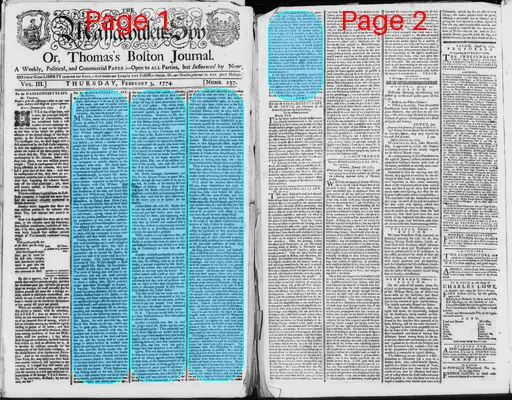
The Massachusetts Spy, Or, Thomas's Boston Journal
Boston, Suffolk County, Massachusetts
What is this article about?
A letter to Mr. Thomas of the Massachusetts Spy details the violent assault and legal persecution of settler R. John Butler and family in Putney, VT, by New York claimants, arguing the land belongs to Massachusetts under original charters and urging the legislature to defend settlers' rights against New York jurisdiction.
Merged-components note: This is a continuation of the same letter to the editor across pages, as the text flows directly from the end of the page 1 component to the start of the page 2 component.
Clippings
1 of 2
OCR Quality
Full Text
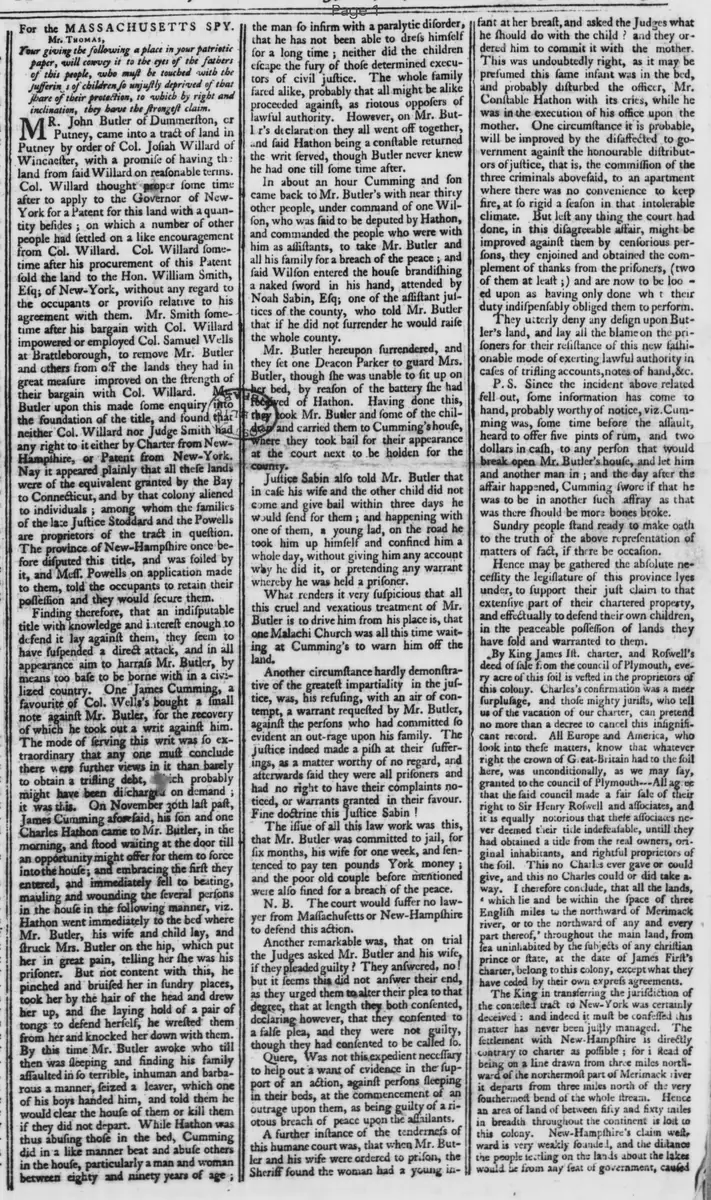
Mr. Thomas,
Your giving the following a place in your patriotic paper, will convey it to the eyes of the fathers of this people, who must be touched with the sufferings of children so unjustly deprived of that share of their protection, to which by right and inclination, they have the strongest claim.
R. John Butler of Dummerston, Vt. Putney, came into a tract of land in Putney by order of Col. Josiah Willard of Winchester, with a promise of having the land from said Willard on reasonable terms.
Col. Willard thought proper some time after to apply to the Governor of New-York for a Patent for this land with a quantity besides; on which a number of other people had settled on a like encouragement from Col. Willard. Col. Willard some time after his procurement of this Patent sold the land to the Hon. William Smith, Esq; of New-York, without any regard to the occupants or proviso relative to his agreement with them. Mr. Smith some time after his bargain with Col. Willard empowered or employed Col. Samuel Wells at Brattleborough, to remove Mr. Butler and others from off the lands they had in great measure improved on the strength of their bargain with Col. Willard.
Butler upon this made some enquiry into the foundation of the title, and found that neither Col. Willard nor Judge Smith had any right to it either by Charter from New-Hampshire, or Patent from New-York.
Nay it appeared plainly that all these lands were of the equivalent granted by the Bay to Connecticut, and by that colony aliened to individuals; among whom the families of the late Justice Stoddard and the Powells are proprietors of the tract in question.
The province of New-Hampshire once before disputed this title, and was foiled by it, and Messrs. Powells on application made to them, told the occupants to retain their possession and they would secure them.
Finding therefore, that an indisputable title with knowledge and interest enough to defend it lay against them, they seem to have suspended a direct attack, and in all appearance aim to harass Mr. Butler, by means too base to be borne with in a civilized country. One James Cumming, a favourite of Col. Wells's bought a small note against Mr. Butler, for the recovery of which he took out a writ against him.
The mode of serving this writ was so extraordinary that any one must conclude there were further views in it than barely to obtain a trifling debt, such probably might have been discharged on demand; it was this. On November 20th last past, James Cumming aforesaid, his son and one Charles Hathon came to Mr. Butler, in the morning, and stood waiting at the door till an opportunity might offer for them to force into the house; and embracing the first they entered, and immediately fell to beating, mauling and wounding the several persons in the house in the following manner, viz.
Hathon went immediately to the bed where Mr. Butler, his wife and child lay, and struck Mrs. Butler on the hip, which put her in great pain, telling her she was his prisoner. But not content with this, he pinched and bruised her in sundry places, took her by the hair of the head and drew her up, and she laying hold of a pair of tongs to defend herself, he wrested them from her and knocked her down with them.
By this time Mr. Butler awoke who till then was sleeping and finding his family assaulted in so terrible, inhuman and barbarous a manner, seized a lever, which one of his boys handed him, and told them he would clear the house of them or kill them if they did not depart. While Hathon was thus abusing those in the bed, Cumming did in a like manner beat and abuse others in the house, particularly a man and woman between eighty and ninety years of age; the man so infirm with a paralytic disorder, that he has not been able to dress himself for a long time; neither did the children escape the fury of those determined executors of civil justice. The whole family fared alike, probably that all might be alike proceeded against, as riotous opposers of lawful authority. However, on Mr. Butler's declaration they all went off together, and said Hathon being a constable returned the writ served, though Butler never knew he had one till some time after.
In about an hour Cumming and son came back to Mr. Butler's with near thirty other people, under command of one Wilson, who was said to be deputed by Hathon, and commanded the people who were with him as assistants, to take Mr. Butler and all his family for a breach of the peace; and said Wilson entered the house brandishing a naked sword in his hand, attended by Noah Sabin, Esq; one of the assistant justices of the county, who told Mr. Butler that if he did not surrender he would raise the whole county.
Mr. Butler hereupon surrendered, and they set one Deacon Parker to guard Mrs. Butler, though she was unable to sit up on her bed, by reason of the battery she had received of Hathon. Having done this, they took Mr. Butler and some of the children and carried them to Cumming's house, where they took bail for their appearance at the court next to be holden for the county.
Justice Sabin also told Mr. Butler that in case his wife and the other child did not come and give bail within three days he would send for them; and happening with one of them, a young lad, on the road he took him up himself and confined him a whole day, without giving him any account why he did it, or pretending any warrant whereby he was held a prisoner.
What renders it very suspicious that all this cruel and vexatious treatment of Mr. Butler is to drive him from his place is, that one Malachi Church was all this time waiting at Cumming's to warn him off the land.
Another circumstance hardly demonstrative of the greatest impartiality in the justice, was, his refusing, with an air of contempt, a warrant requested by Mr. Butler, against the persons who had committed so evident an outrage upon his family. The justice indeed made a pish at their sufferings, as a matter worthy of no regard, and afterwards said they were all prisoners and had no right to have their complaints noticed, or warrants granted in their favour.
Fine doctrine this Justice Sabin!
The issue of all this law work was this, that Mr. Butler was committed to jail, for six months, his wife for one week, and sentenced to pay ten pounds York money: and the poor old couple before mentioned were also fined for a breach of the peace.
N. B. The court would suffer no lawyer from Massachusetts or New-Hampshire to defend this action.
Another remarkable was, that on trial the Judges asked Mr. Butler and his wife, if they pleaded guilty? They answered, no! but it seems this did not answer their end, as they urged them to alter their plea to that degree, that at length they both consented, declaring however, that they consented to a false plea, and they were not guilty, though they had consented to be called so.
Quere, Was not this expedient necessary to help out a want of evidence in the support of an action, against persons sleeping in their beds, at the commencement of an outrage upon them, as being guilty of a riotous breach of peace upon the assailants.
A further instance of the tenderness of this humane court was, that when Mr. Butler and his wife were ordered to prison, the Sheriff found the woman had a young infant at her breast, and asked the Judges what he should do with the child? and they ordered him to commit it with the mother.
This was undoubtedly right, as it may be presumed this same infant was in the bed, and probably disturbed the officer, Mr. Constable Hathon with its cries, while he was in the execution of his office upon the mother. One circumstance it is probable, will be improved by the disaffected to government against the honourable distributors of justice, that is, the commission of the three criminals aforesaid, to an apartment where there was no convenience to keep fire, at so rigid a season in that intolerable climate. But let any thing the court had done, in this disagreeable affair, might be improved against them by censorious persons, they enjoined and obtained the compliment of thanks from the prisoners, (two of them at least;) and are now to be looked upon as having only done what their duty indispensably obliged them to perform.
They utterly deny any design upon Butler's land, and lay all the blame on the prisoners for their resistance of this new fashionable mode of exerting lawful authority in cases of trifling accounts, notes of hand, &c.
P. S. Since the incident above related fell out, some information has come to hand, probably worthy of notice, viz. Cumming was, some time before the assault, heard to offer five pints of rum, and two dollars in cash, to any person that would break open Mr. Butler's house, and let him and another man in; and the day after the affair happened, Cumming swore if that he was to be in another such affray as that was there should be more bones broke.
Sundry people stand ready to make oath to the truth of the above representation of matters of fact, if there be occasion.
Hence may be gathered the absolute necessity the legislature of this province lies under, to support their just claim to that extensive part of their chartered property, and effectually to defend their own children, in the peaceable possession of lands they have sold and warranted to them.
By King James First's charter, and Rowell's deed of sale from the council of Plymouth, every acre of this soil is vested in the proprietors of this colony. Charles's confirmation was a mere surplusage, and those mighty jurists, who tell us of the vacating of our charter, can pretend no more than a decree to cancel this insignificant record. All Europe and America, who look into these matters, know that whatever right the crown of Great-Britain had to the soil here, was unconditionally, as we may say, granted to the council of Plymouth---All agree that the said council made a fair sale of their right to Sir Henry Roswell and associates, and it is equally notorious that these associates never deemed their title indefeasible, until they had obtained a title from the real owners, original inhabitants, and rightful proprietors of the soil. This no Charles ever gave or could give, and this no Charles could or did take away. I therefore conclude, that all the lands, which lie and be within the space of three English miles to the northward of Merrimack river, or to the northward of any and every part thereof,' throughout the main land, from sea to sea uninhabited by the subjects of any christian prince or state, at the date of James First's charter, belong to this colony, except what they have ceded by their own express agreements.
The King in transferring the jurisdiction of the contested tract to New-York was certainly deceived: and indeed it must be confessed this matter has never been justly managed. The settlement with New-Hampshire is directly contrary to charter as possible; for instead of being on a line drawn from three miles northward of the northermost part of Merrimack river it departs from three miles north of the very southermost bend of the whole stream. Hence an area of land of between fifty and sixty miles in breadth throughout the continent is lost to this colony. New-Hampshire's claim westward is very weakly founded, and the distance the people settling on the lands about the lakes would be from any seat of government, caused
district to be added to New-York, probably as the capital they could most readily come at. And had nothing but jurisdiction been claimed by that province, or any of its inhabitants, things might have gone well enough, but too severely have many poor new settlers felt the effect of a claim of another nature, a claim to right of soil founded, as they soberly tell us, on the charter granted by Charles II. to James Duke of York. The strength of this foundation being too inconsiderable to merit much attention at this day, I would humbly propose it to the consideration of our political sagacious, whether it be not their duty to interpose in behalf of their oppressed children, and represent to our common Sovereign, the inconvenience and hardship so great a number of his subjects must labour under, while they remain under a jurisdiction, designed not to protect but harass and despoil them of their hard earned pittances.
A fair state of these interesting matters laid before his Majesty would undoubtedly incline his Royal mind to compassionate their condition, and restore them to the arms of their natural parents and brethren, who far from wishing to make a prey of them, would yield them every assistance in their power to make them become a flourishing settlement.
SYMPATHOS.
What sub-type of article is it?
What themes does it cover?
What keywords are associated?
What entities or persons were involved?
Letter to Editor Details
Author
Sympathos.
Recipient
Mr. Thomas,
Main Argument
the letter recounts the violent and unjust treatment of settler r. john butler by new york agents to evict him from land in putney, vt, asserting that the land rightfully belongs to massachusetts under original charters, and urges the legislature to defend settlers' claims against new york jurisdiction.
Notable Details