Thank you for visiting SNEWPapers!
Sign up free
The Alexandria Herald
Alexandria, Virginia
What is this article about?
A citizen argues in the Alexandria Herald that the local common council's flour inspection regulations exceed the authority delegated by Congress, citing changes to inspectors' fees, fine distributions, and added duties like providing certificates, which violate the federal act's provisions.
Clipping
OCR Quality
Full Text
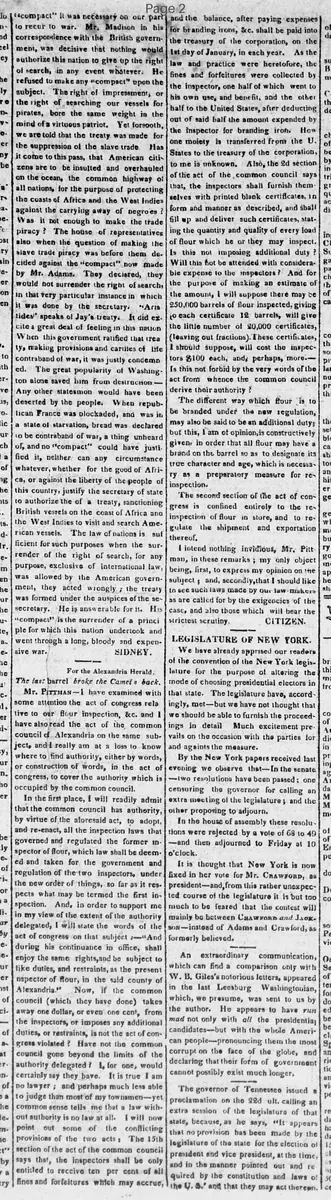
The last barrel broke the Camel's back.
Mr. Pittman—I have examined with some attention the act of congress relative to our flour inspection, &c, and I have also read the act of the common council of Alexandria on the same subject, and I really am at a loss to know where to find authority, either by words, or construction of words, in the act of congress, to cover the authority which is occupied by the common council.
In the first place, I will readily admit that the common council has authority, by virtue of the aforesaid act, to adopt, and re-enact, all the inspection laws that governed and regulated the former inspector of flour, which law shall be deemed and taken for the government and regulation of the two inspectors, under the new order of things, so far as it respects what may be termed the first inspection. And, in order to support me in my view of the extent of the authority delegated, I will state the words of the act of congress on that subject—"And during his continuance in office, shall enjoy the same rights, and be subject to like duties, and restraints, as the present inspector of flour, in the said county of Alexandria." Now, if the common council (which they have done) takes away one dollar, or even one cent, from the inspectors, or imposes any additional duties, or restraints, is not the act of congress violated? Have not the common council gone beyond the limits of the authority delegated? I, for one, would certainly say they have. It is true I am no lawyer; and perhaps much less able to judge than most of my townsmen—yet common sense tells me that a law without authority is no law at all. I will now point out some of the conflicting provisions of the two acts: The 15th section of the act of the common council says that, the inspectors shall be only entitled to receive ten per cent of all fines and forfeitures which may accrue, and the balance, after paying expenses for branding irons, &c. shall be paid into the treasury of the corporation, on the 1st day of January, in each year. As the law and practice were heretofore, the fines and forfeitures were collected by the inspector, one half of which went to his own use, and benefit, and the other half to the United States, after deducting out of said half the amount expended by the inspector for branding irons. How one moiety is transferred from the U. States to the treasury of the corporation, to me is unknown. Also, the 2d section of the act of the common council says that, the inspectors shall furnish themselves with printed blank certificates, in form and manner as described, and shall fill up and deliver such certificates, stating the quantity and quality of every load of flour which he or they may inspect. Is this not imposing additional duty? Will this not be attended with considerable expense to the inspectors? And for the purpose of making an estimate of the amount, I will suppose there may be 250,000 barrels of flour inspected, giving to each certificate 12 barrels, will give the little number of 20,000 certificates, (leaving out fractions). These certificates, I should suppose, will cost the inspectors 100 each, and perhaps, more. Is this not forbid by the very words of the act from whence the common council derive their authority?
The different way which flour is to be branded under the new regulation, may also be said to be an additional duty; but this, I am of opinion, is constructively given; in order that all flour may have a brand on the barrel so as to designate its true character and age, which is necessary as a preparatory measure for re-inspection.
The second section of the act of congress is confined entirely to the re-inspection of flour in store, and to regulate the shipment and exportation thereof.
I intend nothing invidious, Mr. Pittman, in these remarks; my only object being, first, to express my opinion on the subject; and, secondly, that I should like to see such laws made by our law-makers as are called for by the exigencies of the case, and also those which will bear the strictest scrutiny.
CITIZEN.
What sub-type of article is it?
What themes does it cover?
What keywords are associated?
What entities or persons were involved?
Letter to Editor Details
Author
Citizen.
Recipient
Mr. Pittman
Main Argument
the alexandria common council's flour inspection act exceeds the authority granted by congress by altering inspectors' compensation, redistributing fines from the u.s. to the corporation, and imposing new duties like providing certificates, violating the federal act's requirement to maintain the same rights, duties, and restraints as the previous inspector.
Notable Details