Thank you for visiting SNEWPapers!
Sign up free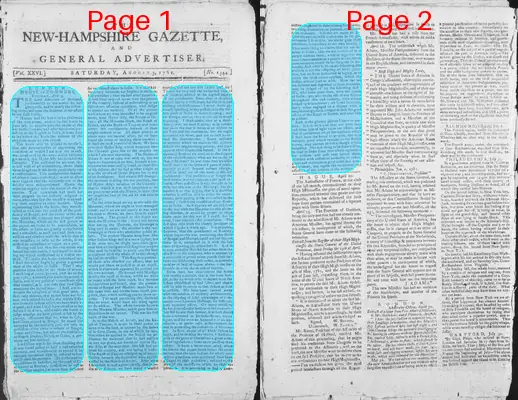
The New Hampshire Gazette And General Advertiser
Portsmouth, Exeter, Rockingham County, New Hampshire
What is this article about?
In a House of Commons speech on April 9, the Lord Advocate of Scotland reports on British affairs in the East Indies, criticizing deviations from Lord Clive's defensive policy, detailing wars with Hyder Ally and the Marattas, financial exhaustion, lost alliances, and proposing reforms to restore order and confidence.
Merged-components note: Continuation of the parliamentary speech on affairs in India from page 1 to page 2; relabeled from editorial to foreign_news as it is a report on international events.
Clippings
1 of 2
OCR Quality
Full Text
HOUSE OF COMMONS.
TUESDAY, April 9.
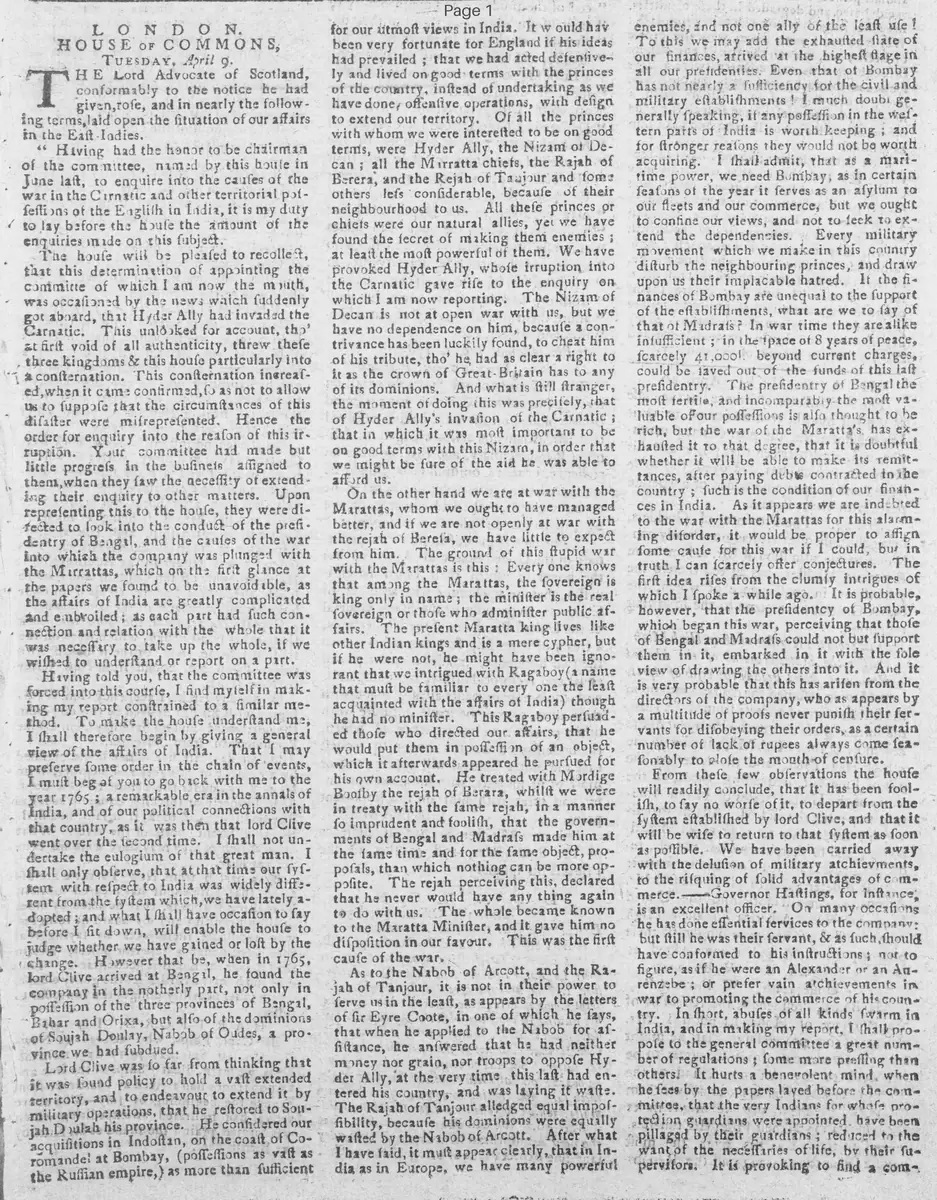
The Lord Advocate of Scotland, conformably to the notice he had given, rose, and in nearly the following terms, laid open the situation of our affairs in the East-Indies.
Having had the honor to be chairman of the committee named by this house in June last, to enquire into the causes of the war in the Carnatic and other territorial possessions of the English in India, it is my duty to lay before the house the amount of the enquiries made on this subject.
The house will be pleased to recollect, that this determination of appointing the committee of which I am now the mouth, was occasioned by the news which suddenly got abroad, that Hyder Ally had invaded the Carnatic. This unlooked for account, though at first void of all authenticity, threw these three kingdoms & this house particularly into a consternation. This consternation increased, when it came confirmed, so as not to allow us to suppose that the circumstances of this disaster were misrepresented. Hence the order for enquiry into the reason of this irruption. Your committee had made but little progress in the business assigned to them, when they saw the necessity of extending their enquiry to other matters. Upon representing this to the house, they were directed to look into the conduct of the presidency of Bengal, and the causes of the war into which the company was plunged with the Marattas, which on the first glance at the papers we found to be unavoidable, as the affairs of India are greatly complicated and embroiled: as each part had such connection and relation with the whole that it was necessary to take up the whole, if we wished to understand or report on a part.
Having told you, that the committee was forced into this course, I find myself in making my report constrained to a similar method. To make the house understand me, I shall therefore begin by giving a general view of the affairs of India. That I may preserve some order in the chain of events, I must beg of you to go back with me to the year 1765; a remarkable era in the annals of India, and of our political connections with that country, as it was then that Lord Clive went over the second time. I shall not undertake the eulogium of that great man. I shall only observe, that at that time our system with respect to India was widely different from the system which we have lately adopted; and what I shall have occasion to say before I sit down, will enable the house to judge whether we have gained or lost by the change. However that be, when in 1765, Lord Clive arrived at Bengal, he found the company in the northerly part, not only in possession of the three provinces of Bengal, Bahar and Orixa, but also of the dominions of Soujah Doulah, Nabob of Oude, a province we had subdued.
Lord Clive was so far from thinking that it was sound policy to hold a vast extended territory, and to endeavour to extend it by military operations, that he restored to Soujah Doulah his province. He considered our possessions at Bombay, (possessions as vast as acquisitions in Indostan, on the coast of Coromandel, or the Russian empire,) as more than sufficient for our utmost views in India. It would have been very fortunate for England if his ideas had prevailed: that we had acted defensively and lived on good terms with the princes of the country, instead of undertaking as we have done, offensive operations, with design to extend our territory. Of all the princes with whom we were interested to be on good terms, were Hyder Ally, the Nizam of Decan: all the Maratta chiefs, the Rajah of Berar, and the Rajah of Tanjour and others less considerable, because of their neighbourhood to us. All these princes or chiefs were our natural allies, yet we have found the secret of making them enemies; at least the most powerful of them. We have provoked Hyder Ally, whose irruption into the Carnatic gave rise to the enquiry on which I am now reporting. The Nizam of Decan is not at open war with us, but we have no dependence on him, because a contrivance has been luckily found, to cheat him of his tribute, tho' he had as clear a right to it as the crown of Great-Britain has to any of its dominions. And what is still stranger, the moment of doing this was precisely, that of Hyder Ally's invasion of the Carnatic: that in which it was most important to be on good terms with this Nizam, in order that we might be sure of the aid he was able to afford us.
On the other hand we are at war with the Marattas, whom we ought to have managed better. and if we are not openly at war with the rajah of Berea, we have little to expect from him. The ground of this stupid war with the Marattas is this: Every one knows that among the Marattas, the sovereign is king only in name: the minister is the real sovereign or those who administer public affairs. The present Maratta king lives like other Indian kings and is a mere cipher, but if he were not, he might have been ignorant that we intrigued with Ragaboy (a name that must be familiar to every one the least acquainted with the affairs of India) though he had no minister. This Ragaboy persuaded those who directed our affairs, that he would put them in possession of an object, which it afterwards appeared he pursued for his own account. He treated with Madajee Boonslah the rajah of Berar, whilst we were in treaty with the same rajah, in a manner so imprudent and foolish, that the governments of Bengal and Madras made him at the same time and for the same object, proposals, than which nothing can be more opposite. The rajah perceiving this, declared that he never would have any thing again to do with us. The whole became known to the Maratta Minister, and it gave him no disposition in our favour. This was the first cause of the war.
As to the Nabob of Arcot, and the Rajah of Tanjour, it is not in their power to serve us in the least, as appears by the letters of Sir Eyre Coote, in one of which he says, that when he applied to the Nabob for assistance, he answered that he had neither money nor grain, nor troops to oppose Hyder Ally, at the very time this last had entered his country, and was laying it waste. The Rajah of Tanjour alleged equal impossibility, because his dominions were equally wasted by the Nabob of Arcot. After what I have said, it must appear clearly, that in India as in Europe, we have many powerful enemies, and not one ally of the least use!
To this we may add the exhausted state of our finances, arrived at the highest stage in all our presidencies. Even that of Bombay has not nearly a sufficiency for the civil and military establishments! I much doubt generally speaking, if any possession in the western parts of India is worth keeping; and for stronger reasons they would not be worth acquiring. I shall admit, that as a maritime power, we need Bombay: as in certain seasons of the year it serves as an asylum to our fleets and our commerce. but we ought to confine our views, and not to seek to extend the dependencies. Every military movement which we make in this country disturb the neighbouring princes, and draw upon us their implacable hatred. If the finances of Bombay are unequal to the support of the establishments, what are we to say of that of Madras? In war time they are alike insufficient; in the space of 8 years of peace, scarcely 40,000l. beyond current charges, could be saved out of the funds of this last presidency. The presidency of Bengal the most fertile, and incomparably the most valuable of our possessions is also thought to be rich, but the war of the Marattas, has exhausted it to that degree, that it is doubtful whether it will be able to make its remittances, after paying debts contracted in the country: such is the condition of our finances in India. As it appears we are indebted to the war with the Marattas for this alarming disorder, it would be proper to assign some cause for this war if I could, but in truth I can scarcely offer conjectures. The first idea rises from the clumsy intrigues of which I spoke a while ago. It is probable, however, that the presidency of Bombay, which began this war, perceiving that those of Bengal and Madras could not but support them in it, embarked in it with the sole view of drawing the others into it. And it is very probable that this has arisen from the directors of the company, who as appears by a multitude of proofs never punish their servants for disobeying their orders, as a certain number of lack of rupees always come seasonably to close the mouth of censure.
From these few observations the house will readily conclude, that it has been foolish, to say no more of it, to depart from the system established by Lord Clive, and that it will be wise to return to that system as soon as possible. We have been carried away with the delusion of military achievements, to the risking of solid advantages of commerce.--Governor Hastings, for instance: is an excellent officer. On many occasions he has done essential services to the company: but still he was their servant, & as such, should have conformed to his instructions; not to figure, as if he were an Alexander or an Annibale; or prefer vain achievements in war to promoting the commerce of his country. In short, abuses of all kinds swarm in India, and in making my report, I shall propose to the general committee a great number of regulations; some more pressing than others. It hurts a benevolent mind, when he sees by the papers laid before the committee, that the very Indians for whose protection guardians were appointed, have been pillaged by their guardians; reduced to the want of the necessaries of life, by their supervisors. It is provoking to find a committee employed in determining boundaries, requiring Zemindars, as presents, exorbitant sums of money. Is it thus we mean to inspire the nations with confidence in our government? It is thus, we are to gain their affections, so necessary to our own security? Thus every thing proclaims that we are detested in India; that we are considered as a people without faith; without regard to the most solemn treaties; as a people in sine, whose extermination would be for the good of humanity. And what is above all distressing, this aversion is not the offspring of blind prejudice, but we have demerited so highly, as to justify the most odious epithets, which the Indian princes load us with. How far we are debased and degraded in these countries, may be judged of by the following fact: We, who some years since, were the oracle of India; we, who on the rise of any dispute throughout this vast country, were always lately when engaged in a dispute with a neighbouring prince, obliged to seek the good offices of the Rajah of Berara, and take him as arbiter.
Such is the gloomy picture I have to present. It is to be hoped that our arms may that if parliament adopt the measures which I shall have the honor to propose, the most valuable jewel which remains to the British crown, may recover its lustre though a little tarnished. The first thing to be done will be to send to India some men whose reputation for wisdom will pass over before them, cloathed with unlimited authority to restore peace and to introduce good order into every department, and regain the confidence and affection of the princes of the country.
What sub-type of article is it?
What keywords are associated?
What entities or persons were involved?
Where did it happen?
Foreign News Details
Primary Location
East Indies
Event Date
Tuesday, April 9
Key Persons
Outcome
exhausted finances in all presidencies; wars with hyder ally and marattas; loss of alliances with local princes including nizam of decan and rajah of berar; british detested in india; proposals for reforms and return to defensive policy.
Event Details
The Lord Advocate reports on committee findings into causes of Hyder Ally's invasion of the Carnatic and broader Indian affairs, tracing from Lord Clive's 1765 policy of defensive alliances and territorial restraint, which was abandoned for aggressive expansions leading to wars, financial strain, and enmity with key princes like Hyder Ally, Marattas, and Nizam. Intrigues with Ragaboy soured relations with Berar. Local rulers like Nabob of Arcot and Rajah of Tanjour unable to assist. Abuses by British officials pillage locals. Proposes sending wise commissioners to restore peace, order, and confidence.