Thank you for visiting SNEWPapers!
Sign up free
Story
November 12, 1822
The New Hampshire Gazette
Portsmouth, Rockingham County, New Hampshire
What is this article about?
In a 1820 New Hampshire case, Smith sued deputy sheriff Conner for trespass after being arrested in Exeter and forcibly taken 15 miles to Portsmouth jail instead of the local one. The court ruled the officer could choose any county jail, finding for the defendant.
Clipping
OCR Quality
98%
Excellent
Full Text
For the N. H. GAZETTE.
LAW INTELLIGENCE.
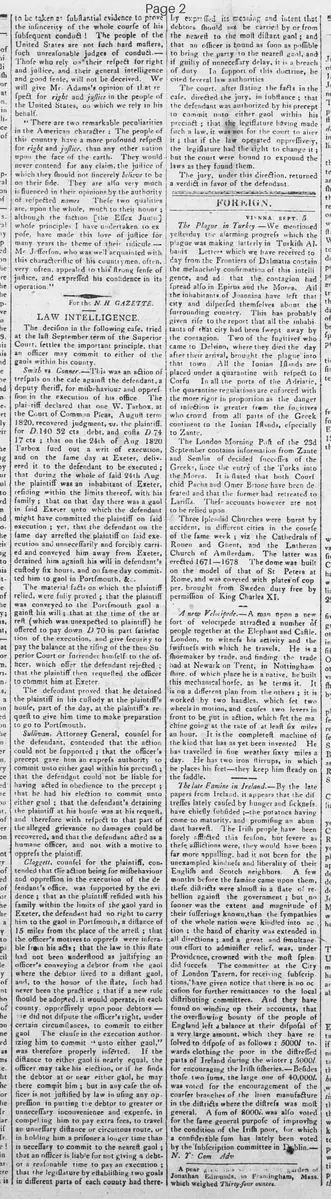
The decision in the following case, tried at the last September term of the Superior Court, settles the important principle, that an officer may commit to either of the gaols within his county.
Smith vs. Conner.--This was an action of trespass on the case against the defendant, a deputy sheriff, for misbehaviour and oppression in the execution of his office. The plaintiff declared that one W. Tarbox, at the Court of Common Pleas, August term 1820, recovered judgment, vs. the plaintiff, for $140 32 cts debt, and costs $74 17 cts: that on the 24th of Aug 1820 Tarbox sued out a writ of execution, and on the same day at Exeter, delivered it to the defendant to be executed; that during the whole of said 24th Aug the plaintiff was an inhabitant of Exeter, residing within the limits thereof, with his family: that on that day there was a gaol in said Exeter unto which the defendant might have committed the plaintiff on said execution; yet, that the defendant on the same day arrested the plaintiff on said execution and unnecessarily and forcibly carried and conveyed him away from Exeter, detained him against his will in defendant's custody six hours, and on same day committed him to gaol in Portsmouth. &c.
The material facts on which the plaintiff relied, were fully proved: that the plaintiff was conveyed to the Portsmouth gaol against his will; that at the time of the arrest (which was unexpected to plaintiff) he offered to pay down $70 in part satisfaction of the execution, and give security to pay the balance at the rising of the then Superior Court or surrender himself to the officer, which offer the defendant rejected: that the plaintiff then requested the officer to commit him at Exeter.
The defendant proved that he detained the plaintiff in his custody at the plaintiff's house, part of the day, at the plaintiff's request to give him time to make preparation to go to Portsmouth.
Sullivan, Attorney General, counsel for the defendant, contended that the action could not be supported; that the officer's precept gave him an express authority to commit unto either gaol within his precinct; that the defendant could not be liable for having acted in obedience to the precept; that he had his election to commit unto either gaol: that the defendant's detaining the plaintiff at his house was at his request, and therefore with respect to that part of the alleged grievance no damages could be recovered, and that the defendant acted as a humane officer, and not with a motive to oppress the plaintiff.
Claggett, counsel for the plaintiff, contended that the action being for misbehaviour and oppression in the execution of the defendant's office, was supported by the evidence: that as the plaintiff resided with his family within the limits of the gaol yard in Exeter, the defendant had no right to carry him to the gaol in Portsmouth, a distance of 15 miles from the place of the arrest: that the officer's motives to oppress were inferable from his acts: that the law in this state had not been understood as justifying an officer's conveying a debtor from the gaol where the debtor lived to a distant gaol, and, to the honor of the state, such had never been the practice: that if a new rule should be adopted, it would operate, in each county, oppressively upon poor debtors-- he did not dispute the officer's right, under certain circumstances, to commit to either gaol. The clause in the execution authorizing him to commit "unto either gaol," was therefore properly inserted. If the distance to either gaol is nearly equal, the officer may take his election, or if he finds the debtor at or near either gaol, he may there commit him: but in any case the officer is not justified by law in using any oppression in putting the debtor to greater or unnecessary inconvenience and expense, in compelling him to pay extra fees, to travel an unnecessary distance or circuitous route, or in holding him a prisoner a longer time than is necessary to commit to the nearest gaol; that an officer is liable for not giving a debtor a reasonable time to pay an execution; that the legislature by establishing two gaols in different parts of each county had thereby expressed its meaning and intent that debtors should not be carried by or from the nearest to the most distant gaol; and that an officer is bound as soon as possible to bring the party to the nearest gaol, and if guilty of unnecessary delay, it is a breach of duty. In support of this doctrine, he cited several law authorities.
The court, after stating the facts in the case, directed the jury, in substance; that the defendant was authorized by his precept to commit unto either gaol within his precinct: that the legislature having made such a law, it was not for the court to alter it; that if the law operated oppressively, the legislature had the right to change it but the court were bound to expound the laws as they found them.
The jury, under this direction, returned a verdict in favor of the defendant.
LAW INTELLIGENCE.
The decision in the following case, tried at the last September term of the Superior Court, settles the important principle, that an officer may commit to either of the gaols within his county.
Smith vs. Conner.--This was an action of trespass on the case against the defendant, a deputy sheriff, for misbehaviour and oppression in the execution of his office. The plaintiff declared that one W. Tarbox, at the Court of Common Pleas, August term 1820, recovered judgment, vs. the plaintiff, for $140 32 cts debt, and costs $74 17 cts: that on the 24th of Aug 1820 Tarbox sued out a writ of execution, and on the same day at Exeter, delivered it to the defendant to be executed; that during the whole of said 24th Aug the plaintiff was an inhabitant of Exeter, residing within the limits thereof, with his family: that on that day there was a gaol in said Exeter unto which the defendant might have committed the plaintiff on said execution; yet, that the defendant on the same day arrested the plaintiff on said execution and unnecessarily and forcibly carried and conveyed him away from Exeter, detained him against his will in defendant's custody six hours, and on same day committed him to gaol in Portsmouth. &c.
The material facts on which the plaintiff relied, were fully proved: that the plaintiff was conveyed to the Portsmouth gaol against his will; that at the time of the arrest (which was unexpected to plaintiff) he offered to pay down $70 in part satisfaction of the execution, and give security to pay the balance at the rising of the then Superior Court or surrender himself to the officer, which offer the defendant rejected: that the plaintiff then requested the officer to commit him at Exeter.
The defendant proved that he detained the plaintiff in his custody at the plaintiff's house, part of the day, at the plaintiff's request to give him time to make preparation to go to Portsmouth.
Sullivan, Attorney General, counsel for the defendant, contended that the action could not be supported; that the officer's precept gave him an express authority to commit unto either gaol within his precinct; that the defendant could not be liable for having acted in obedience to the precept; that he had his election to commit unto either gaol: that the defendant's detaining the plaintiff at his house was at his request, and therefore with respect to that part of the alleged grievance no damages could be recovered, and that the defendant acted as a humane officer, and not with a motive to oppress the plaintiff.
Claggett, counsel for the plaintiff, contended that the action being for misbehaviour and oppression in the execution of the defendant's office, was supported by the evidence: that as the plaintiff resided with his family within the limits of the gaol yard in Exeter, the defendant had no right to carry him to the gaol in Portsmouth, a distance of 15 miles from the place of the arrest: that the officer's motives to oppress were inferable from his acts: that the law in this state had not been understood as justifying an officer's conveying a debtor from the gaol where the debtor lived to a distant gaol, and, to the honor of the state, such had never been the practice: that if a new rule should be adopted, it would operate, in each county, oppressively upon poor debtors-- he did not dispute the officer's right, under certain circumstances, to commit to either gaol. The clause in the execution authorizing him to commit "unto either gaol," was therefore properly inserted. If the distance to either gaol is nearly equal, the officer may take his election, or if he finds the debtor at or near either gaol, he may there commit him: but in any case the officer is not justified by law in using any oppression in putting the debtor to greater or unnecessary inconvenience and expense, in compelling him to pay extra fees, to travel an unnecessary distance or circuitous route, or in holding him a prisoner a longer time than is necessary to commit to the nearest gaol; that an officer is liable for not giving a debtor a reasonable time to pay an execution; that the legislature by establishing two gaols in different parts of each county had thereby expressed its meaning and intent that debtors should not be carried by or from the nearest to the most distant gaol; and that an officer is bound as soon as possible to bring the party to the nearest gaol, and if guilty of unnecessary delay, it is a breach of duty. In support of this doctrine, he cited several law authorities.
The court, after stating the facts in the case, directed the jury, in substance; that the defendant was authorized by his precept to commit unto either gaol within his precinct: that the legislature having made such a law, it was not for the court to alter it; that if the law operated oppressively, the legislature had the right to change it but the court were bound to expound the laws as they found them.
The jury, under this direction, returned a verdict in favor of the defendant.
What sub-type of article is it?
Historical Event
Crime Story
What themes does it cover?
Justice
Misfortune
What keywords are associated?
Court Case
Deputy Sheriff
Debtor Arrest
Jail Commitment
Legal Oppression
New Hampshire Law
What entities or persons were involved?
Smith
Conner
W. Tarbox
Sullivan
Claggett
Where did it happen?
Exeter, Portsmouth, New Hampshire
Story Details
Key Persons
Smith
Conner
W. Tarbox
Sullivan
Claggett
Location
Exeter, Portsmouth, New Hampshire
Event Date
August 1820
Story Details
Deputy sheriff Conner arrested Smith in Exeter on an execution for debt but took him to Portsmouth jail 15 miles away instead of the local Exeter jail, detaining him six hours. Smith sued for oppression. The court ruled the officer could commit to any county jail, verdict for defendant.