Thank you for visiting SNEWPapers!
Sign up free
The Augusta Courier
Augusta, Richmond County, Georgia
What is this article about?
In the 1957 Virginia gubernatorial race, segregation in public schools is the key issue. Democratic candidate Almond Jr., backed by the Byrd machine, supports Virginia's strict no-integration plan, while Republican Ted Dalton favors North Carolina's pupil assignment approach permitting limited mixing. Election set for November 5.
Clipping
OCR Quality
Full Text
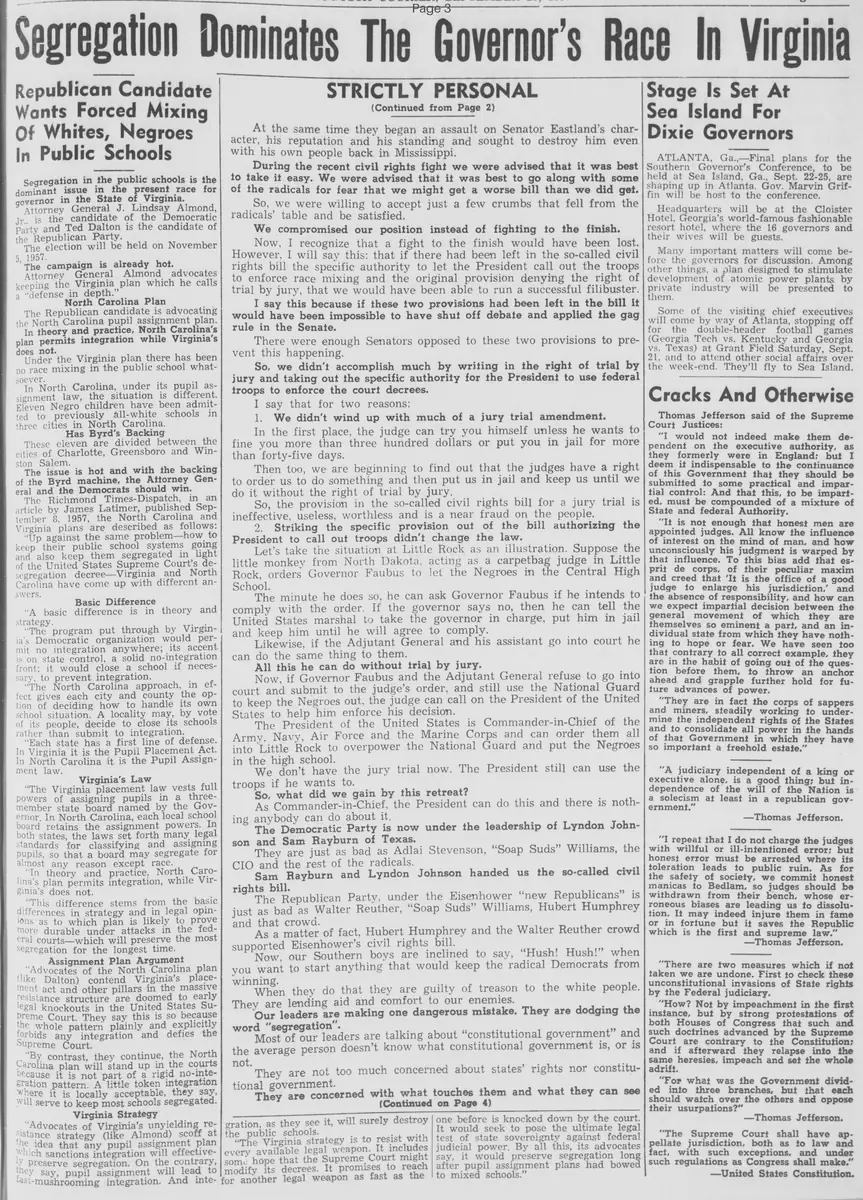
Republican Candidate Wants Forced Mixing Of Whites, Negroes In Public Schools
Segregation in the public schools is the dominant issue in the present race for governor in the State of Virginia. Almond Jr. is the candidate of the Democratic Party and Ted Dalton is the candidate of the Republican Party. The election will be held on November 5, 1957.
The campaign is already hot. Attorney General Almond advocates keeping the Virginia plan which he calls a "defense in depth."
North Carolina Plan
The Republican candidate is advocating the North Carolina pupil assignment plan. In theory and practice, North Carolina's plan permits integration while Virginia's does not.
Under the Virginia plan there has been no race mixing in the public school whatsoever.
In North Carolina, under its pupil assignment law, the situation is different. Eleven Negro children have been admitted to previously all-white schools in three cities in North Carolina.
Has Byrd's Backing
These eleven are divided between the cities of Charlotte, Greensboro and Winston-Salem.
The issue is hot and with the backing of the Byrd machine, the Attorney General and the Democrats should win.
The Richmond Times-Dispatch, in an article by James Latimer, published September 8, 1957, the North Carolina and Virginia plans are described as follows:
"Up against the same problem—how to keep their public school systems going and also keep them segregated in light of the United States Supreme Court's desegregation decree—Virginia and North Carolina have come up with different answers.
Basic Difference
"A basic difference is in theory and strategy.
"The program put through by Virginia's Democratic organization would permit no integration anywhere; its accent is on state control, a solid no-integration front; it would close a school if necessary, to prevent integration.
"The North Carolina approach, in effect gives each city and county the option of deciding how to handle its own school situation. A locality may, by vote of its people, decide to close its schools rather than submit to integration.
"Each state has a first line of defense. In Virginia it is the Pupil Placement Act. In North Carolina it is the Pupil Assignment law.
Virginia's Law
The Virginia placement law vests full powers of assigning pupils in a three-member state board named by the Governor. In North Carolina, each local school board retains the assignment powers. In both states, the laws set forth many legal standards for classifying and assigning pupils, so that a board may segregate for almost any reason except race.
"In theory and practice, North Carolina's plan permits integration, while Virginia's does not.
"This difference stems from the basic differences in strategy and in legal opinions as to which plan is likely to prove more durable under attacks in the federal courts—which will preserve the most segregation for the longest time.
Assignment Plan Argument
"Advocates of the North Carolina plan (like Dalton) contend Virginia's placement act and other pillars in the massive resistance structure are doomed to early legal knockouts in the United States Supreme Court. They say this is so because the whole pattern plainly and explicitly forbids any integration and defies the Supreme Court.
"By contrast, they continue, the North Carolina plan will stand up in the courts because it is not part of a rigid no-integration pattern. A little token integration where it is locally acceptable, they say, will serve to keep most schools segregated.
Virginia Strategy
"Advocates of Virginia's unyielding resistance strategy (like Almond) scoff at the idea that any pupil assignment plan which sanctions integration will effectively preserve segregation. On the contrary, they say, pupil assignment will lead to fast-mushrooming integration. And integration, as they see it, will surely destroy the public schools.
"The Virginia strategy is to resist with every available legal weapon. It includes measures to modify its decrees. It promises to reach some hope that the Supreme Court might [yield] for another legal weapon as fast as one before is knocked down by the court.
It would seek to pose the ultimate legal test of state sovereignty against federal judicial power. By all this, its advocates say, it would preserve segregation long after pupil assignment plans had bowed to mixed schools."
What sub-type of article is it?
What themes does it cover?
What keywords are associated?
What entities or persons were involved?
Where did it happen?
Story Details
Key Persons
Location
Virginia
Event Date
November 5, 1957
Story Details
The 1957 Virginia gubernatorial election centers on school segregation, with Democrat Almond Jr. supporting Virginia's strict no-integration Pupil Placement Act and Republican Dalton advocating North Carolina's Pupil Assignment plan allowing limited integration in some cities. Almond has Byrd machine backing and expects victory.