Thank you for visiting SNEWPapers!
Sign up free
Lynchburg Virginian
Lynchburg, Virginia
What is this article about?
Proceedings of the Virginia House of Delegates on February 13 and 15, 1830, including debates and votes on bills for tobacco inspection in Lynchburg, amending the Chesapeake and Ohio Canal charter to allow western section commencement, extending bank charters, infrastructure resolutions for roads and packet boats, a census bill (postponed), and the 7 percent state stock.
Merged-components note: Continuation of the Virginia Legislature report across page break, with garbled OCR text in second component indicating same logical unit on legislative proceedings.
Clippings
1 of 2
OCR Quality
Full Text
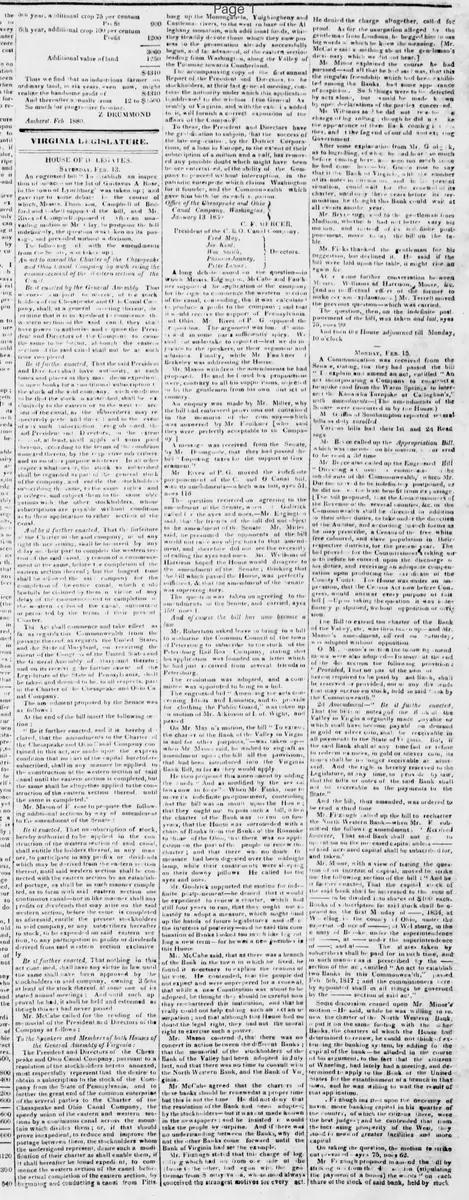
HOUSE OF DELEGATES.
SATURDAY. FEB. 13.
An engrossed bill "To establish an inspection of tobacco on the lot of Gustavus A. Rose in the town of Lynchburg" was taken up; and gave rise to some debate in the course of which, Messrs. Thomson, Campbell of Bedford and Labell supported the bill, and Mr. Rives of Campbell opposed it. After an unavailing motion of Mr. Clay, to postpone the bill indefinitely, the question was taken on its passage, and prevailed without a division.
The following bill with the amendments from the Senate, was taken up:
An act to amend the Charter of the Chesapeake and Ohio Canal company by authorizing the commencement of the western section of the Canal
Be it enacted by the General Assembly That whenever a majority of the stockholders of the Chesapeake and Ohio Canal Company, shall, at a general meeting thereof, determine that it is expedient to commence the western section of the said canal, they shall have power to authorize and require the President and Directors of the Company to cause the same to be begun, although the eastern section of the said canal shall not be at such time completed
Be it further enacted, That the said President and Directors shall have authority, at such times and places as they may deem expedient to open books for a conditional subscription to the stock of the said company. such condition to be that the stock so subscribed, shall be exclusively to the eastern or to the western section of the canal, as the subscribers may respectively prefer and direct : and in the event of any such subscription being obtained. the said President and Directors, to the extent of, or, at least, shall apply all sums paid hereon, according to the terms of the condition annexed thereto, by the respective subscribers and to no other purpose whatever In all other respects whatever, the stock so subscribed shall be regarded as part of the general stock of the company, and entitle the stockholders subscribing the same, to the same rights and privileges, and subject them to the same obligations with the other stockholders. whose subscriptions are payable without condition as to their application to either section of the canal.
And be it further enacted, That the forfeiture of the Charter of the said company, or of any right thence arising, shall not be incurred by any delay on their part to complete, the western section of the said canal. by reason of a commencement of the same, before the completion of the eastern section thereof; but the longest time shall be allowed the said company for the completion of the entire canal. which could lawfully be claimed by them in virtue of any delay of the commencement or completion of the western section of the canal. authorized or permitted by the terms of their present Charter,
This Act shall commence and take effect as far as regards this Commonwealth from the passage thereof as regards the United States and the State of Maryland, on receiving the assent of the Congress of the United States and the General Assembly of Maryland thereto; and on its receiving the further assent of the Legislature of the State of Pennsylvania, shall be taken and deemed to be, in all respects. part of the Charter of the Chesapeake and Ohio Canal Company.
The amendment proposed by the Senate was as follows:
At the end of the bill insert the following section:
"Be it further enacted, and it is hereby declared, that the amendments to the Charter of the Chesapeake and Ohio Canal Company contained in this act, are made upon the express condition that no part of the capital heretofore subscribed, shall in any manner be applied to the construction of the western section of said canal until the eastern section is completed, but the same shall be altogether applied to the construction of the eastern section thereof, until the same is completed.
Mr. Mason of F. rose to propose the following additional sections by way of amendment to the amendment of the Senate:
Be it enacted. That no subscription of stock. hereby authorised to be applied in the construction of the western section of said canal, shall entitle the holders thereof, in any manner, to participate in any profits or dividends which may be derived from the eastern section thereof, until said western section shall be connected with the eastern section by an established portage, as shall be in such manner completed, as to form with said eastern section one continuous canal—nor in like manner shall any profits or dividends that may arise on the said western section, before the same is completed as aforesaid, entitle the present stockholders in said company, or any subscribers hereafter to stock, to be expended on said eastern section, to any participation in profits or dividends derived from said western section exclusively
Be it further enacted, That nothing in this act contained, shall have any virtue in law until the same shall have been approved by the stockholders in said company, owning 3 5ths at least of the stock thereof. at some one of its stated annual meetings: And until such approval be had, it shall be held and esteemed as though this act had never passed
Mr. McCabe called for the reading of the memorial of the President and Directors of the Company as follows:
To the Speakers and Members of both Houses of the General Assembly of Virginia:
The President and Directors of the Chesapeake and Ohio Canal Company, pursuant to a resolution of the stockholders hereto annexed, most respectfully represent that the desire to obtain a subscription to the stock of the Company from the State of Pennsylvania, and to further the great end of the common enterprise of the several parties to the Charter of the Chesapeake and Ohio Canal Company, the speedy union of the eastern and western sections by a continuous canal across the mountain which divides them; or, if that should prove inexpedient, to reduce and improve the portage between them, the stockholders whom the undersigned represent, desire such a modification of their charter as shall enable them, if it shall hereafter be found expedient, to commence the western section of the canal before the actual completion of the eastern section, by beginning and conducting a canal from Pittsburgh up the Monongahela, Youghiogheny and Castleman's rivers, to the western base of the Alleghany mountain, with additional feeds, while they steadily devote those which they now possess to the prosecution already successfully begun, and far advanced, of the eastern section leading from Washington, along the Valley of the Potomac towards Cumberland.
The accompanying copy of the first annual Report of the President and Directors, to the stockholders. at their last general meeting, contains the authority under which this application is addressed to the wisdom of the General Assembly of Virginia, and with the exhibits added to it, will furnish a correct exposition of the affairs of the Company.
To these, the President and Directors have the gratification to subjoin, that the success of the late negotiation , by the District Corporations, of a loan in Europe, to the extent of their subscription of a million and a half, has removed any possible doubt which might have been before entertained, of the ability of the Company to proceed without interruption. in the patriotic enterprise which claims Washington for its founder, and the Commonwealth which gave him birth for its earliest patron.
Office of the Chesapeake and Ohio Canal Company, Washington, January 13 1830.
C. E. MERCER.
President of the C & O. Canal Company.
Fred May,
Jas Kent,
Wm Smith.
Directors.
Phineas Janney,
Peter Lenox,
A long debate ensued on the question—in which Messrs. Edgington. McCabe and Faulkner supported the application of the company for the right to commence the western section of the canal, contending, that it was calculated to produce a profit to the company ; and that it would receive the support of Pennsylvania and Ohio. Mr. Rives of P. G. opposed the proposition. The argument was long and in some parts sufficiently spicy. We shall not attempt to report it—lest we do injustice to the speakers, or their argument and allusions Finally. while Mr. Faulkner (Berkeley was addressing the House Mr. Mason withdrew the amendments he had proposed. He said he found his propositions were, contrary to all his suppositions, opposed by the gentlemen from his own district of country.
An enquiry was made by Mr. Miller, why the bill had embraced provisions not contained in the memorial. of the company—which was answered by Mr. Faulkner [who said they were perfectly acceptable to the Company ]
A message was received from the Senate, by Mr Devereux, that they had passed the bill · Imposing taxes for the support of Government
Mr Rives of P. G. moved the indefinite postponement of the C. and O Canal bill, with its amendments—which was lost, ayes 51. noes 116
The question recurred on agreeing to the amendment of the Senate, when Mr. Goulrick called for the ayes and noes.—Mr Edgington said. that the friends of the bill did not object to the amendment of the Senate Mr. Miller. said. he presumed the opponents of the bill would not raise any objections to that amendment, and therefore did not see the necessity of calling the ayes and noes. Mr. Williams of Harrison hoped the House would disagree to the amendment of the Senate ; thinking that the bill which passed the House, was perfectly sufficient,&that the amendment of the Senate was supererogatory.
The question was taken on agreeing to the amendments of the Senate, and carried, ayes 150 noes 91
And of course the bill has now become a law
Mr. Robertson asked leave to bring in a bill to authorise the Common Council of the town of Petersburg to subscribe to the stock of the Petersburg Rail Road Company, stating that his application was founded on a letter which he had just received from several friends in Petersburg.
The resolution was adopted, and a committee was appointed to bring in a bill.
The engrossed bill Amending the acts concerning Idiots and Lunatics, and to provide for clothing the Public Guard," was taken up on motion of Mr. Atkinson of I. of Wight, and passed
On Mr. Mason's motion, the bill " To extend the charter of the Bank of the Valley in Virginia and for other purposes,"—was taken up— when Mr Mason said, he wished to engraft as amendment upon the bill all the provisions, that had been introduced into the Virginia Bank Bill, as far as they would apply
He then proposed this amendment by adding the words .And as modified by the several laws now in force"— When Mr Rives. rose to move its indefinite postponement, contending that the bill was an insult upon the House ; that they ought not to pass such a bill, when the charter of the Bank was to run on four years, that the House was surrounded with a chain of Banks from the Bank of the Roanoke to those of the Ohio, that there was no application on the part of the people to renew this charter ; and that there was no doubt the measure had been digested over the midnight lamp, while their constituents were sleeping on their downy pillows He called for the ayes and noes.
Mr. Goulrick supported the motion for indefinite postponement—he deemed that it would be inexpedient to renew a charter, which had still four years to run, that they ought not so hastily to adopt a measure, which might bind up the hands of future legislatures and affect the interests of posterity—and he said this combination of Banks looked too much like log rolling a new term—for he was a new member in this House
Mr. McCabe said, that as there was a branch of the Bank in the town in which he lived, he found it necessary to explain the reasons of his vote. He contended, that the people did not expect and were unprepared for a renewal, that while a new Constitution was about to be adopted, he thought they should be careful how they re-chartered this institution, and that he really could not help calling such an act an usurpation ; and that although this House had no doubt the legal right, they had not the moral right to exercise such a power.
Mr. Mason contended.that there was no concert in action between the different Banks ; that the memorial of the stockholders of the Bank of the Valley had been adopted in duly last, and that there was no time to consult with the North Western Bank, and the Bank of Virginia.
Mr McCabe agreed that the charters of these banks should be renewed at a proper time but this is not the time He did not deny that the resolution of the Bank had been adopted; by the stockholders—but it was not made known in the newspapers; and he insisted it would take the people by surprise. And if there was no understanding between the Banks, why did not the other Banks come forward until the Bank of Virginia had set the example.
Mr. Fitzhugh stated that this charge of log rolling which had run from one side of the House to the other, had begun with, the gentleman from Scott county, whose mind always conceived the strangest motives for every act. He denied the charge altogether, called for proof. As for the usurpation alleged by the gentleman from Loudoun—he begged him to use big words of which he knew the meaning. [Mr. McCabe said something about the gentleman's dictionary which we did not hear.]
Mr Minor explained the course he had pursued—and all that he had said was. that this the singular friendship which had been exhibited among the Banks, had some appearance of suspicion . Such things were to be detected by acts alone, but should be made known by open. full declarations of the parties concerned.
Mr Williams said he did not charge of log rolling : though he did not like the appearance of these Bank companies coming in .ther, and at the fag end of our old and expiring Government
After some explanation from Mr. Goulrick. as to logrolling, of which he had heard so much before coming here. and seen too much since he had come here—Mr. Goudie rose to say that if the Bank of Virginia, with the number of its notes in circulation and in its present situation, could wait for the renewal of its charter, until only three years before its termination he thought this Bank could wait at all events another year.
Mr. Bryce suggested to the gentleman from Madison, whether he had not better stay his motion. and instead of its indefinite postponement, move to lay the bill on the table
Mr. Rives thanked the gentleman for his suggestion, but declined it." He said if the bill were laid upon the table, it might rise again &c
At some further conversation between Messrs. Williams of Harrison. Moore. &c, [and an actual effort of the former to make certain explanations.] Mr. Terrell moved the previous question—which was carried.
The question, then, on the indefinite postponement of the bill, was taken and lost, ayes 76, noes 99
And then the House adjourned till Monday 10 o'clock
Monday, FEB. 15.
A Communication was received from the Senate, stating, that they had passed the bill "To explain and amend an act, entitled "An act incorporating a Company to construct a turnpike road from the Warm Springs to intersect the Kanawha Turnpike at Callaghan's," with amendments—(The amendments of the Senate were concurred in by the House.)
Mr Griffin of Southampton reported several bills as duly enrolled
Various bills had their 1st and 2d Readings
Mr. Bryce called up the Appropriation Bill, which was amended on his motion, and ordered to be read a 3d time
Mr Bryce also called up the Engrossed Bill "Directing a Census of the white inhabitants of this Commonwealth" which Mr. Dorton moved to be indefinitely postponed, as he did not see the least benefit from its passage.
The bill proposed, That the Commissioners of the Revenue of the several counties, &c. in the Commonwealth shall be directed in addition to their other duties, to take under the direction of the Auditor, and according to such forms as he may prescribe, a Census of the free white free coloured, and slave population in their respective districts, for the present year. The bill provided for the Commissioner taking an oath before he entered upon the discharge of his duties, and receiving an adequate compensation upon producing the certificate of the County Court. The House was under an impression, that the Census Act now before Congress, would answer every purpose of this bill [ —Upon taking the question it was indefinitely postponed, without opposition or division.
The Bill to extend the charter of the Bank of the Valley, etc. was then taken up—and Mr. Mason's amendment, offered on Saturday, was adopted without opposition
On Mr. Mason's motion the following amendments were also adopted—to insert at the end of the 4th section the following provision " Provided, That no part of the sum of herein required to be paid by said Bank, shall be reserved or provided, out of any dividends that may accrue on stock, held in said Bank by the Commonwealth."
2d Amendment—" Be it further enacted, That the bills or notes of the Bank of the Valley in Virginia originally made payable or which shall have become payable on demand in gold or silver coin, shall be receivable in all payments to the State of Virginia. But, if the said Bank shall at any time fail or refuse to redeem its notes, in gold or silver coin, its issues shall be no longer receivable as aforesaid. And the right is hereby reserved to the Legislature, at any time, to provide by law, that the bills or notes of the said Bank shall not be receivable in the payments to the State,"
And the bill, thus amended, was ordered to be read a third time
Mr. Fitzhugh called up the bill to recharter the North Western Bank—when Mr. F. submitted the following amendment: Resolved however, That said Bank shall not go into operation on the increased capital unless of said increased capital shall be subscribed for, and taken.'
Mr. Minor, with a view of testing the question of an increase of capital, moved to strike out the following section of the bill :" And be it further enacted. That the capital stock of the said bank shall be increased to the sum of $1,000,000 to be divided into shares of $100 each. Books of subscription for said stock shall be opened on the first Monday of —, 1834, at Wheeling, in the county of Ohio, under the superintendence of —; at Wheeling, in the county of Brooke under the superintendence of —; at — under the superintendence of —; and at— The shares taken by subscribers shall be paid for in such time, and in such manner as is prescribed by the — section of the act, entitled " An act to establish two Banks in this Commonwealth," passed Feb 5th, 1817; and the commissioners hereby appointed shall in all things be governed by the — section of said act.'
Some discussion ensued upon Mr. Minor's motion —He said, while he was willing to re-new the charter of the North Western Bank, to put it on the same footing with the other Banks, the charters of which the House had determined to renew, he could not think of extending the banking system, by adding to the capital of the bank—he alluded in the course of his argument, to the fact that the citizens of Wheeling, had lately had a meeting, and determined to apply to the Bank of the United States for the establishment of a branch in that town, and he was willing to wait the result of that application.
Fitzhugh insisted upon the necessity of having more banking capital in his quarter of the country, of which the citizens there, were the best judges ; and he contended that from the increasing prosperity of the West, they stood in need of greater facilities and more capital
On taking the question, the motion to strike out prevailed—ayes 75, noes 62.
Mr Fitzhugh proposed to amend the bill by striking out from the 4th section (stipulating the payment of a bonus) the words "on each share of the stock of said bank, held by stock. Boldly other than the Commonwealth, by to stockholder other than the Co. Commonwealth, annual dividend. Commencing the — day of — this, and continuing until the said sum of dollars be paid—and forgetting The following 'A suit cy in — sicr trul on of the Commonwealth's stock therein: said sum to be paid in annual instalments comp: thencing the , day ol Thus amendment was adopted—and then the bill was ordered to its third reading.
A resolution was read from the Committee of Roads, &c. for authorizing a packet boat to be established by David Staples, for the purpose of carrying passengers between Lynchburg and Richmond, to pass through the locks of the James River Company, free of tolls for one year at least, at all hours, and in preference to all other boats or vessels—Mr. Thompson observed, that the boat of Mr. Staples was now ready to descend the river; that it was an experiment which he thought worthy of encouragement; and that if it answered the purpose intended, it would be a great accommodation to travellers—that it was intended for passengers only, and what was asked, was to facilitate the run of the boat, by giving it the privilege of passing the locks in preference to other boats. Mr. T. remarked, that if gentlemen objected to its passing free of toll, that feature might hereafter be struck out of the bill—Mr. Upshaw supported the resolution on account of the convenience which it promised to offer: saying, that he believed it was a privilege always extended to packet boats on canals.—The resolution was then agreed to—is also another resolution from the same Committee, for repealing the act of the last session of the Legislature 'incorporating a company to construct a turnpike road from Lynchburg to the lower end of the James River Company's canal in Bedford county;' and for passing another act, authorizing a road to be opened from Lynchburg to the toll house, through Campbell and Bedford, to the mouth of the sugar-tree branch, &c.—Also, a resolution from the Committee of Propositions and Grievances, for authorising a separate election in Charlotte county:—Also, certain resolutions from the Committee of Roads and Internal Navigation, founded on the resolutions of the James River Company, relative to the Kanawha Turnpike, &c. The Committee report, 1st, that it is expedient to exempt from toll on the Kanawha turnpike and bridges, all persons going to public worship on the Sabbath, or to or from any funeral; to or from any election of Members of the Legislature or of Congress; all militia officers or privates, going to muster, with their horses; all grand jurors or venire-men, with their horses, going to or returning from any court; 2d, that it is inexpedient to declare by law that part of the old State road between Callahan's, in the county of Alleghany, and the town of Lewisburg, &c. to be vacated and no longer considered as a public highway; 3d, that it is inexpedient to provide that if any road be opened by a county court or individuals, by which the payment of tolls at any gate or bridges of the K. Turnpike may be avoided, it shall be lawful for the company to erect a gate at such place, and to collect the customary toll; and 4th, that it is inexpedient to increase the salary of the Agent superintending the Western improvements to $1000 per annum.
A bill 'concerning the 7 per cent. stock of the State of Virginia,' was called up by Mr. Eppes, who proposed several amendments to the amendments of the committee—Mr. Eppes supported them at considerable length—Messrs. Bruce and Harvie, were opposed to them. Mr. Terrill moved the indefinite postponement of the whole subject, which was lost. The debate still continued; when Mr. Watts moved to postpone the bill till the 31st of March. This gave rise to a discussion of a point of order, whether the indefinite postponement and the motion to postpone till the 31st March were not the same motion. The Chair decided it was, and Mr. Watts was about to avail himself of the proposition of the Chair to appeal to the House, when at the suggestion of a member, Mr. Watts waived the motion and moved to postpone the bill till the 10th March [virtually to reject it]. Mr. Boyd supported the motion, and contended that the question really was, whether by extinguishing or changing the 7 per cent. stock, which belonged to the Literary Fund, the Legislature was to cut down the dividend of that fund, to such a degree, that it could admit of no annual augmentation; none that could go to the establishment of Colleges or Academies; none that could be distributed beyond the present appropriation of $45,000 to the education of the poor people of the State. On taking the question, Mr. Watts' motion prevailed—and the House immediately adjourned.
What sub-type of article is it?
What keywords are associated?
What entities or persons were involved?
Where did it happen?
Domestic News Details
Primary Location
Virginia
Event Date
Saturday, Feb. 13, 1830 And Monday, Feb. 15, 1830
Key Persons
Outcome
passage of tobacco inspection bill; canal charter amendment bill passed with senate amendments (ayes 150, noes 91); petersburg rail road subscription bill introduced; idiots and lunatics bill passed; bank of the valley charter extension bill advanced with amendments; north western bank recharter bill advanced without capital increase (strike out ayes 75, noes 62); packet boat resolution agreed; various road and turnpike resolutions reported; 7% stock bill postponed to march 10.
Event Details
The Virginia House of Delegates debated and acted on multiple bills including tobacco inspection in Lynchburg, amendments to the Chesapeake and Ohio Canal charter allowing conditional commencement of the western section, extensions of bank charters for Bank of the Valley and North Western Bank, resolutions for packet boats and roads, a census bill (postponed), appropriation bill amendments, and postponement of the 7% state stock bill amid debates on policy, timing, and logrolling accusations.