Thank you for visiting SNEWPapers!
Sign up free
Story
January 14, 1863
Daily Ohio Statesman
Columbus, Franklin County, Ohio
What is this article about?
In the U.S. House, Mr. Stevens argues that seceded Southern States are no longer in the Union but conquered provinces, justifying confiscation of rebel property as a war measure. He debates with Mr. Dunlap and others, predicting eventual adoption of radical measures like arming slaves and exiling rebels.
Clipping
OCR Quality
95%
Excellent
Full Text
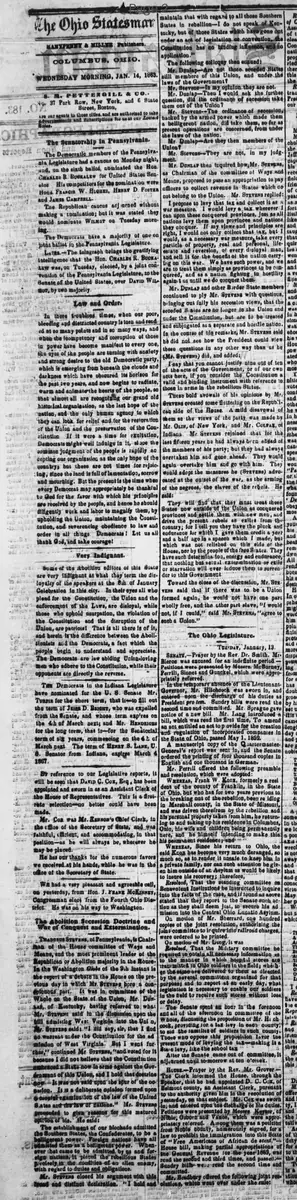
The Abolition Secession Doctrine and
War of Conquest and Extermination.
In the House on the report of the Judiciary
committee on the resolution introduced by Mr.
Lazear, of Kentucky, asking information as to
the power of Congress to confiscate the property
of rebels, Mr. Stevens made a speech in which
he avowed the doctrine that the Southern States
are no longer in the Union, and are to be treated
as conquered provinces. It was not said upon the spur of the occasion.
It is a deliberate opinion formed upon
a careful examination of the law of the United
States and the law of nations. Mr. Stevens
proceeded to give reasons for this matured
opinion of his. He said:
The establishment of our blockade admitted
the Southern States, the Confederates, to be a
belligerent power. Foreign nations have all
admitted them as a belligerent power. When
that came to be admitted by us and foreign
nations, it placed the rebellious States
precisely in the condition of an alien enemy,
with regard to duties and obligations.
Mr. Stevens closed his argument with this
broad and distinct declaration: I hold and
maintain that with regard to all those Southern
States in rebellion—I do not speak of Kentucky,
but of those States which have gone out
under an act of legislation or convention—the
Constitution has no binding influence, and no
application.
The following colloquy then ensued:
Mr. Dunlap—Are not those seceded States
still members of this Union, and under the
laws of the Government?
Mr. Stevens—In my opinion they are not.
Mr. Dunlap—Then I would ask the further
question, did the ordinance of secession take
them out of the Union?
Mr. Stevens—The ordinance of secession,
backed by the armed power which made them
a belligerent nation, did take them, so far as
present operations are concerned, from under
the laws of the nation.
Mr. Dunlap—Are they then members of the
Union?
Mr. Stevens—They are not, in my judgment.
Mr. Dunlap then inquired how Mr. Stevens,
Chairman of the committee of Ways and
Means, proposed to pass an appropriation to pay
officers to collect revenue in States which do
not belong to the Union. Mr. Stevens replied:
I propose to levy that tax and collect it as a
war measure. I would levy a tax wherever I
can upon these conquered provinces, just as all
nations levy them upon provinces and nations
they conquer. If my views and principles are
right, I would not only collect that tax, but I
would, as a necessary war measure, take every
particle of property, real and personal, life-
estate and reversion, of every disloyal man,
and sell it for the benefit of the nation carrying
on this war. We have such power, and we
are to treat them simply as provinces to be conquered,
and as a nation fighting in hostility
against us until we do conquer them.
Mr. Dunlap and other Border State members
continued to ply Mr. Stevens with questions,
bringing out fully his secession views, that the
seceded States are no longer in the Union and
under the Constitution, but are to be treated
and subjugated as a separate and hostile nation.
In the course of his remarks, Mr. Stevens said
he did not see how the President could view
these questions in any other way than as he
(Mr. Stevens) did, and added:
I say that you cannot justify nine out of ten
of the acts of the Government, or of our own
acts here, if you consider the Constitution a
valid and binding instrument with reference to
those in arms in the rebellious States.
These bold avowals of his opinions by Mr.
Stevens created some fluttering on the Republican
side of the House. A mild disavowal of
them as the views of the party was made by
Mr. Olin, of New York, and Mr. Colfax, of
Indiana. Mr. Stevens rejoined that for the
last fifteen years he had always been ahead of
the members of his party; but they had always
overtaken him and gone ahead. They would
again overtake him and go with him. They
would adopt the measures he (Stevens) advocated
at the outset of the war, as the arming
of the negroes, the slaves of the rebels. He
said:
They will find that they must treat these
States now outside of the Union as conquered
provinces and settle them with new men, and
drive the present rebels as exiles from the
country; for I tell you they have the pluck and
endurance for which I gave them credit a year
and a half ago in a speech which I made, but
which was not relished on this side of the
House, nor by the people of the free States. They
have such determination, energy and endurance
that nothing but actual extermination—or exile
or starvation—will ever induce them to surrender
to this Government.
Toward the close of the discussion, Mr. Stevens
said that if there was to be a Union
formed again, he would not have one part
wholly free, and the other part slave. "I would
not, if I could," said Mr. Stevens, "agree to
such a Union."
War of Conquest and Extermination.
In the House on the report of the Judiciary
committee on the resolution introduced by Mr.
Lazear, of Kentucky, asking information as to
the power of Congress to confiscate the property
of rebels, Mr. Stevens made a speech in which
he avowed the doctrine that the Southern States
are no longer in the Union, and are to be treated
as conquered provinces. It was not said upon the spur of the occasion.
It is a deliberate opinion formed upon
a careful examination of the law of the United
States and the law of nations. Mr. Stevens
proceeded to give reasons for this matured
opinion of his. He said:
The establishment of our blockade admitted
the Southern States, the Confederates, to be a
belligerent power. Foreign nations have all
admitted them as a belligerent power. When
that came to be admitted by us and foreign
nations, it placed the rebellious States
precisely in the condition of an alien enemy,
with regard to duties and obligations.
Mr. Stevens closed his argument with this
broad and distinct declaration: I hold and
maintain that with regard to all those Southern
States in rebellion—I do not speak of Kentucky,
but of those States which have gone out
under an act of legislation or convention—the
Constitution has no binding influence, and no
application.
The following colloquy then ensued:
Mr. Dunlap—Are not those seceded States
still members of this Union, and under the
laws of the Government?
Mr. Stevens—In my opinion they are not.
Mr. Dunlap—Then I would ask the further
question, did the ordinance of secession take
them out of the Union?
Mr. Stevens—The ordinance of secession,
backed by the armed power which made them
a belligerent nation, did take them, so far as
present operations are concerned, from under
the laws of the nation.
Mr. Dunlap—Are they then members of the
Union?
Mr. Stevens—They are not, in my judgment.
Mr. Dunlap then inquired how Mr. Stevens,
Chairman of the committee of Ways and
Means, proposed to pass an appropriation to pay
officers to collect revenue in States which do
not belong to the Union. Mr. Stevens replied:
I propose to levy that tax and collect it as a
war measure. I would levy a tax wherever I
can upon these conquered provinces, just as all
nations levy them upon provinces and nations
they conquer. If my views and principles are
right, I would not only collect that tax, but I
would, as a necessary war measure, take every
particle of property, real and personal, life-
estate and reversion, of every disloyal man,
and sell it for the benefit of the nation carrying
on this war. We have such power, and we
are to treat them simply as provinces to be conquered,
and as a nation fighting in hostility
against us until we do conquer them.
Mr. Dunlap and other Border State members
continued to ply Mr. Stevens with questions,
bringing out fully his secession views, that the
seceded States are no longer in the Union and
under the Constitution, but are to be treated
and subjugated as a separate and hostile nation.
In the course of his remarks, Mr. Stevens said
he did not see how the President could view
these questions in any other way than as he
(Mr. Stevens) did, and added:
I say that you cannot justify nine out of ten
of the acts of the Government, or of our own
acts here, if you consider the Constitution a
valid and binding instrument with reference to
those in arms in the rebellious States.
These bold avowals of his opinions by Mr.
Stevens created some fluttering on the Republican
side of the House. A mild disavowal of
them as the views of the party was made by
Mr. Olin, of New York, and Mr. Colfax, of
Indiana. Mr. Stevens rejoined that for the
last fifteen years he had always been ahead of
the members of his party; but they had always
overtaken him and gone ahead. They would
again overtake him and go with him. They
would adopt the measures he (Stevens) advocated
at the outset of the war, as the arming
of the negroes, the slaves of the rebels. He
said:
They will find that they must treat these
States now outside of the Union as conquered
provinces and settle them with new men, and
drive the present rebels as exiles from the
country; for I tell you they have the pluck and
endurance for which I gave them credit a year
and a half ago in a speech which I made, but
which was not relished on this side of the
House, nor by the people of the free States. They
have such determination, energy and endurance
that nothing but actual extermination—or exile
or starvation—will ever induce them to surrender
to this Government.
Toward the close of the discussion, Mr. Stevens
said that if there was to be a Union
formed again, he would not have one part
wholly free, and the other part slave. "I would
not, if I could," said Mr. Stevens, "agree to
such a Union."
What sub-type of article is it?
Historical Event
What themes does it cover?
Justice
Fortune Reversal
What keywords are associated?
Secession Doctrine
Conquered Provinces
Property Confiscation
Civil War Politics
Thaddeus Stevens Speech
Union Treatment
Rebel Subjugation
What entities or persons were involved?
Mr. Stevens
Mr. Lazear
Mr. Dunlap
Mr. Olin
Mr. Colfax
Where did it happen?
In The House
Story Details
Key Persons
Mr. Stevens
Mr. Lazear
Mr. Dunlap
Mr. Olin
Mr. Colfax
Location
In The House
Story Details
Mr. Stevens delivers a speech asserting that seceded Southern States are conquered provinces outside the Union, justifying property confiscation and harsh war measures; he debates with Mr. Dunlap and predicts party adoption of radical policies like arming slaves and exiling rebels.