Thank you for visiting SNEWPapers!
Sign up free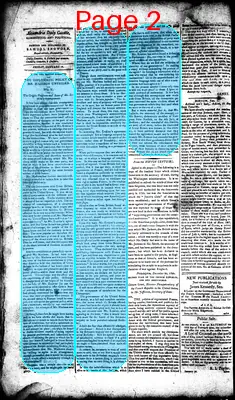
Editorial
January 19, 1810
Alexandria Daily Gazette, Commercial & Political
Alexandria, Virginia
What is this article about?
This editorial critiques James Madison's insincere handling of David Erskine's 1809 trade arrangement with Britain, portraying it as a partisan ploy to widen U.S.-British tensions, please Democrats and France, and avoid a popular peace, while highlighting offensive language in the agreement.
Clipping
OCR Quality
95%
Excellent
Full Text
FROM THE BOSTON GAZETTE
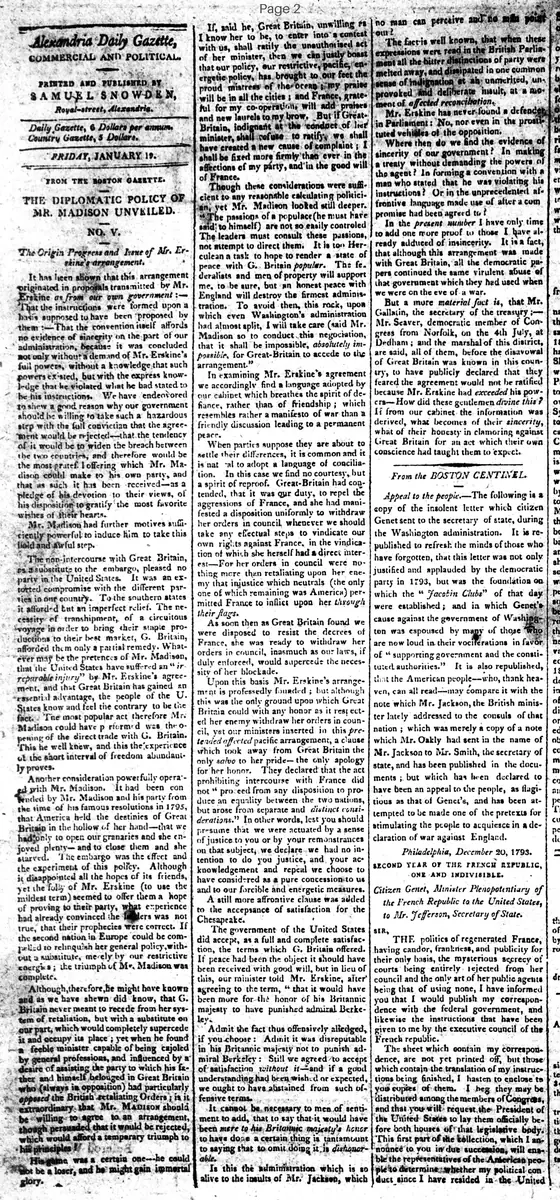
THE DIPLOMATIC POLICY OF MR. MADISON UNVEILED.
NO. V.
The Origin Progress and Issue of Mr. Erskine's arrangement.
It has been shown that this arrangement originated in proposals transmitted by Mr. Erskine as from our own government:-
That the instructions were formed upon a basis supposed to have been proposed by them:-
That the convention itself affords no evidence of sincerity on the part of our administration, because it was concluded not only without a demand of Mr. Erskine's full powers, without a knowledge that such powers existed, but with the express knowledge that he violated what he had stated to be his instructions. We have endeavored to show a good reason why our government should be willing to take such a hazardous step with the full conviction that the agreement would be rejected--that the tendency of it would be to widen the breach between the two countries, and therefore would be the most grateful offering which Mr. Madison could make to his own party, and that as such it has been received-as a pledge of his devotion to their views, of his disposition to gratify the most favorite wishes of their hearts.
Mr. Madison had further motives sufficiently powerful to induce him to take this bold and awful step.
The non-intercourse with Great Britain, as a substitute to the embargo, pleased no party in the United States. It was an extorted compromise with the different parties in our country. To the southern states it afforded but an imperfect relief. The necessity of transhipment, of a circuitous voyage in order to bring their staple productions to their best market, G. Britain, afforded them only a partial remedy. Whatever may be the pretences of Mr. Madison, that the United States have suffered an "irreparable injury" by Mr. Erskine's agreement, and that Great Britain has gained an essential advantage, the people of the U. States know and feel the contrary to be the fact. The most popular act therefore Mr. Madison could have performed was the opening of the direct trade with G. Britain. This he well knew, and this the experience of the short interval of freedom abundantly proves.
Another consideration powerfully operated with Mr. Madison. It had been contended by Mr. Madison and his party from the time of his famous resolutions in 1795, that America held the destinies of Great Britain in the hollow of her hand-that we had only to open our granaries and she enjoyed plenty-and to close them and she starved. The embargo was the effect and the experiment of this policy. Although it disappointed all the hopes of its friends, yet the folly of Mr. Erskine (to use the mildest term) seemed to offer them a hope of proving to their party, what experience had already convinced the leaders was not true, that their prophecies were correct. If the second nation in Europe could be compelled to relinquish her general policy, without a substitute, merely by our restrictive coercion; the triumph of Mr. Madison was complete.
Although, therefore, he might have known and as we have shown did know, that G. Britain never meant to recede from her system of retaliation, but with a substitute on our part, which would completely supersede it and occupy its place; yet when he found a feeble minister capable of being cajoled by general professions, and influenced by a desire of assisting the party to which his father and himself belonged in Great Britain who (always in opposition) had particularly opposed the British retaliating Orders; is it extraordinary that Mr. Madison should be willing to agree to an arrangement, though persuaded that it would be rejected, which would afford a temporary triumph to his principles
His game was a certain one-he could not be a loser, and he might gain immortal glory.
If, said he, Great Britain, unwilling as I know her to be, to enter into a contest with us, shall ratify the unauthorised act of her minister, then we can justly boast that our policy, our restrictive pacific energetic policy, has brought to our feet the proud mistress of the ocean--my praise will be in all the cities; and France, grateful for my co-operation, will add praises and new laurels to my brow. But if Great-Britain, indignant at the conduct of her minister, shall refuse to ratify we shall have created a new cause of complaint; I shall be fixed more firmly than ever in the affections of my party, and in the good will of France.
Though these considerations were sufficient to any reasonable calculating politician, yet Mr. Madison looked still deeper.
The passions of a populace (he must have said) to himself are not so easily controlled. The leaders must consult these passions, not attempt to direct them: It is too Herculean a task to hope to render a state of peace with G. Britain popular. The federalists and men of property will support me, to be sure, but an honest peace with England will destroy the firmest administration. To avoid then, this rock, upon which even Washington's administration had almost split, I will take care (said Mr. Madison) so to conduct this negociation, that it shall be impossible, absolutely impossible, for Great-Britain to accede to the arrangement.
In examining Mr. Erskine's agreement we accordingly find a language adopted by our cabinet which breathes the spirit of defiance, rather than of friendship: which resembles rather a manifesto of war than a friendly discussion leading to a permanent peace.
When parties suppose they are about to settle their differences, it is common and it is natural to adopt a language of conciliation. In this case we find no courtesy, but a spirit of reproof. Great-Britain had contended, that it was our duty, to repel the aggressions of France, and she had manifested a disposition uniformly to withdraw her orders in council, whenever we should take any effectual steps to vindicate our own rights against France, in the vindication of which she herself had a direct interest-For her orders in council were nothing more than retaliating upon her enemy that injustice which neutrals (the only one of which remaining was America) permitted France to inflict upon her through their flags.
As soon then as Great Britain found we were disposed to resist the decrees of France, she was ready to withdraw her orders in council, inasmuch as our laws, if duly enforced, would supersede the necessity of her blockade.
Upon this basis Mr. Erskine's arrangement is professedly founded; but although this was the only ground upon which Great Britain could with any honor as it respected her enemy withdraw her orders in council, yet our ministers inserted in this pretended affected pacific arrangement, a clause which took away from Great Britain the only salvo to her pride-the only apology for her honor. They declared that the act prohibiting intercourse with France did not "proceed from any disposition to produce an equality between the two nations, but arose from separate and distinct considerations." In other words, lest you should presume that we were actuated by a sense of justice to you or by your remonstrances on that subject; we declare-we had no intention to do you justice, and, your acknowledgement and repeal we choose to have considered as a pure concession to us and to our forcible and energetic measures.
A still more affirmative clause was added to the acceptance of satisfaction for the Chesapeake.
The government of the United States did accept, as a full and complete satisfaction, the terms which G. Britain offered. If peace had been the object it should have been received with good will, but in lieu of this, our minister told Mr. Erskine, after agreeing to the term, "that it would have been more for the honor of his Britannic majesty to have punished admiral Berkeley."
Admit the fact thus offensively alleged, if you choose: Admit it was disreputable in his Britannic majesty not to punish admiral Berkeley: Still we agreed to accept of satisfaction without it and if a good understanding had been wished or expected, we ought to have abstained from such offensive terms.
It cannot be necessary to men of sentiment to add, that to say that it would have been more to his Britannic majesty's honor to have done a certain thing is tantamount to saying that to omit doing it is dishonorable.
Is this the administration which is so alive to the insults of Mr. Jackson, which no man can perceive and no man poise our
The fact is well known, that when these expressions were read in the British Parliament all the bitter distinctions of party were melted away, and dissipated in one common sense of indignation at an unmerited, unprovoked and deliberate insult, at a moment of affected reconciliation.
Mr. Erskine has never found a defender in Parliament: No, nor even in the prostituted vehicles of the opposition.
Where then do we find the evidence of sincerity of our government? In making a treaty without demanding the powers of the agent? In forming a convention with a man who stated that he was violating his instructions? Or in the unprecedented affirmative language made use of after a compromise had been agreed to?
In the present number I have only time to add one more proof to those I have already adduced of insincerity. It is a fact, that although this arrangement was made with Great Britain, all the democratic papers continued the same virulent abuse of that government which they had used when we were on the eve of a war.
But a more material fact is, that Mr. Gallatin, the secretary of the treasury:-- Mr. Seaver, democratic member of Congress from Norfolk, on the 4th July, at Dedham; and the marshal of this district, are said, all of them, before the disavowal of Great Britain was known in this country, to have publicly declared that they feared the agreement would not be ratified because Mr. Erskine had exceeded his powers-How did these gentlemen divine this?
If from our cabinet, the information was derived, what becomes of their sincerity, what of their honesty in clamoring against Great Britain for an act which their own conscience had taught them to expect.
THE DIPLOMATIC POLICY OF MR. MADISON UNVEILED.
NO. V.
The Origin Progress and Issue of Mr. Erskine's arrangement.
It has been shown that this arrangement originated in proposals transmitted by Mr. Erskine as from our own government:-
That the instructions were formed upon a basis supposed to have been proposed by them:-
That the convention itself affords no evidence of sincerity on the part of our administration, because it was concluded not only without a demand of Mr. Erskine's full powers, without a knowledge that such powers existed, but with the express knowledge that he violated what he had stated to be his instructions. We have endeavored to show a good reason why our government should be willing to take such a hazardous step with the full conviction that the agreement would be rejected--that the tendency of it would be to widen the breach between the two countries, and therefore would be the most grateful offering which Mr. Madison could make to his own party, and that as such it has been received-as a pledge of his devotion to their views, of his disposition to gratify the most favorite wishes of their hearts.
Mr. Madison had further motives sufficiently powerful to induce him to take this bold and awful step.
The non-intercourse with Great Britain, as a substitute to the embargo, pleased no party in the United States. It was an extorted compromise with the different parties in our country. To the southern states it afforded but an imperfect relief. The necessity of transhipment, of a circuitous voyage in order to bring their staple productions to their best market, G. Britain, afforded them only a partial remedy. Whatever may be the pretences of Mr. Madison, that the United States have suffered an "irreparable injury" by Mr. Erskine's agreement, and that Great Britain has gained an essential advantage, the people of the U. States know and feel the contrary to be the fact. The most popular act therefore Mr. Madison could have performed was the opening of the direct trade with G. Britain. This he well knew, and this the experience of the short interval of freedom abundantly proves.
Another consideration powerfully operated with Mr. Madison. It had been contended by Mr. Madison and his party from the time of his famous resolutions in 1795, that America held the destinies of Great Britain in the hollow of her hand-that we had only to open our granaries and she enjoyed plenty-and to close them and she starved. The embargo was the effect and the experiment of this policy. Although it disappointed all the hopes of its friends, yet the folly of Mr. Erskine (to use the mildest term) seemed to offer them a hope of proving to their party, what experience had already convinced the leaders was not true, that their prophecies were correct. If the second nation in Europe could be compelled to relinquish her general policy, without a substitute, merely by our restrictive coercion; the triumph of Mr. Madison was complete.
Although, therefore, he might have known and as we have shown did know, that G. Britain never meant to recede from her system of retaliation, but with a substitute on our part, which would completely supersede it and occupy its place; yet when he found a feeble minister capable of being cajoled by general professions, and influenced by a desire of assisting the party to which his father and himself belonged in Great Britain who (always in opposition) had particularly opposed the British retaliating Orders; is it extraordinary that Mr. Madison should be willing to agree to an arrangement, though persuaded that it would be rejected, which would afford a temporary triumph to his principles
His game was a certain one-he could not be a loser, and he might gain immortal glory.
If, said he, Great Britain, unwilling as I know her to be, to enter into a contest with us, shall ratify the unauthorised act of her minister, then we can justly boast that our policy, our restrictive pacific energetic policy, has brought to our feet the proud mistress of the ocean--my praise will be in all the cities; and France, grateful for my co-operation, will add praises and new laurels to my brow. But if Great-Britain, indignant at the conduct of her minister, shall refuse to ratify we shall have created a new cause of complaint; I shall be fixed more firmly than ever in the affections of my party, and in the good will of France.
Though these considerations were sufficient to any reasonable calculating politician, yet Mr. Madison looked still deeper.
The passions of a populace (he must have said) to himself are not so easily controlled. The leaders must consult these passions, not attempt to direct them: It is too Herculean a task to hope to render a state of peace with G. Britain popular. The federalists and men of property will support me, to be sure, but an honest peace with England will destroy the firmest administration. To avoid then, this rock, upon which even Washington's administration had almost split, I will take care (said Mr. Madison) so to conduct this negociation, that it shall be impossible, absolutely impossible, for Great-Britain to accede to the arrangement.
In examining Mr. Erskine's agreement we accordingly find a language adopted by our cabinet which breathes the spirit of defiance, rather than of friendship: which resembles rather a manifesto of war than a friendly discussion leading to a permanent peace.
When parties suppose they are about to settle their differences, it is common and it is natural to adopt a language of conciliation. In this case we find no courtesy, but a spirit of reproof. Great-Britain had contended, that it was our duty, to repel the aggressions of France, and she had manifested a disposition uniformly to withdraw her orders in council, whenever we should take any effectual steps to vindicate our own rights against France, in the vindication of which she herself had a direct interest-For her orders in council were nothing more than retaliating upon her enemy that injustice which neutrals (the only one of which remaining was America) permitted France to inflict upon her through their flags.
As soon then as Great Britain found we were disposed to resist the decrees of France, she was ready to withdraw her orders in council, inasmuch as our laws, if duly enforced, would supersede the necessity of her blockade.
Upon this basis Mr. Erskine's arrangement is professedly founded; but although this was the only ground upon which Great Britain could with any honor as it respected her enemy withdraw her orders in council, yet our ministers inserted in this pretended affected pacific arrangement, a clause which took away from Great Britain the only salvo to her pride-the only apology for her honor. They declared that the act prohibiting intercourse with France did not "proceed from any disposition to produce an equality between the two nations, but arose from separate and distinct considerations." In other words, lest you should presume that we were actuated by a sense of justice to you or by your remonstrances on that subject; we declare-we had no intention to do you justice, and, your acknowledgement and repeal we choose to have considered as a pure concession to us and to our forcible and energetic measures.
A still more affirmative clause was added to the acceptance of satisfaction for the Chesapeake.
The government of the United States did accept, as a full and complete satisfaction, the terms which G. Britain offered. If peace had been the object it should have been received with good will, but in lieu of this, our minister told Mr. Erskine, after agreeing to the term, "that it would have been more for the honor of his Britannic majesty to have punished admiral Berkeley."
Admit the fact thus offensively alleged, if you choose: Admit it was disreputable in his Britannic majesty not to punish admiral Berkeley: Still we agreed to accept of satisfaction without it and if a good understanding had been wished or expected, we ought to have abstained from such offensive terms.
It cannot be necessary to men of sentiment to add, that to say that it would have been more to his Britannic majesty's honor to have done a certain thing is tantamount to saying that to omit doing it is dishonorable.
Is this the administration which is so alive to the insults of Mr. Jackson, which no man can perceive and no man poise our
The fact is well known, that when these expressions were read in the British Parliament all the bitter distinctions of party were melted away, and dissipated in one common sense of indignation at an unmerited, unprovoked and deliberate insult, at a moment of affected reconciliation.
Mr. Erskine has never found a defender in Parliament: No, nor even in the prostituted vehicles of the opposition.
Where then do we find the evidence of sincerity of our government? In making a treaty without demanding the powers of the agent? In forming a convention with a man who stated that he was violating his instructions? Or in the unprecedented affirmative language made use of after a compromise had been agreed to?
In the present number I have only time to add one more proof to those I have already adduced of insincerity. It is a fact, that although this arrangement was made with Great Britain, all the democratic papers continued the same virulent abuse of that government which they had used when we were on the eve of a war.
But a more material fact is, that Mr. Gallatin, the secretary of the treasury:-- Mr. Seaver, democratic member of Congress from Norfolk, on the 4th July, at Dedham; and the marshal of this district, are said, all of them, before the disavowal of Great Britain was known in this country, to have publicly declared that they feared the agreement would not be ratified because Mr. Erskine had exceeded his powers-How did these gentlemen divine this?
If from our cabinet, the information was derived, what becomes of their sincerity, what of their honesty in clamoring against Great Britain for an act which their own conscience had taught them to expect.
What sub-type of article is it?
Foreign Affairs
Partisan Politics
Economic Policy
What keywords are associated?
Erskine Arrangement
Madison Diplomacy
Us Britain Relations
Non Intercourse Act
Orders In Council
Chesapeake Affair
Partisan Motives
Trade Policy
What entities or persons were involved?
Mr. Madison
Mr. Erskine
Great Britain
France
Mr. Gallatin
Mr. Seaver
Admiral Berkeley
Mr. Jackson
Editorial Details
Primary Topic
Critique Of Madison's Insincere Handling Of Erskine's Arrangement
Stance / Tone
Strongly Critical Of Madison's Diplomacy
Key Figures
Mr. Madison
Mr. Erskine
Great Britain
France
Mr. Gallatin
Mr. Seaver
Admiral Berkeley
Mr. Jackson
Key Arguments
Arrangement Originated From U.S. Proposals Via Erskine
Madison Knew Erskine Violated Instructions But Proceeded
Non Intercourse Act Unpopular; Direct Trade With Britain Desired
Madison's Policy Aimed To Prove U.S. Control Over Britain
Arrangement Designed To Fail, Creating Complaints Against Britain
Offensive Language In Agreement Insulted British Honor
U.S. Officials Anticipated Rejection Before Britain's Disavowal
Democratic Papers Continued Abusing Britain Post Arrangement