Thank you for visiting SNEWPapers!
Sign up free
The Virginia Gazette
Richmond, Williamsburg, Richmond County, Virginia
What is this article about?
In February 1766, Wilmington residents resist the Stamp Act after sloops are seized for lacking stamped clearances. Legal opinion by Robert Jones prompts public assembly, formation of an anti-Stamp Act association, march to Brunswick, oaths from officials against stamped papers, and release of vessels.
Clipping
OCR Quality
Full Text
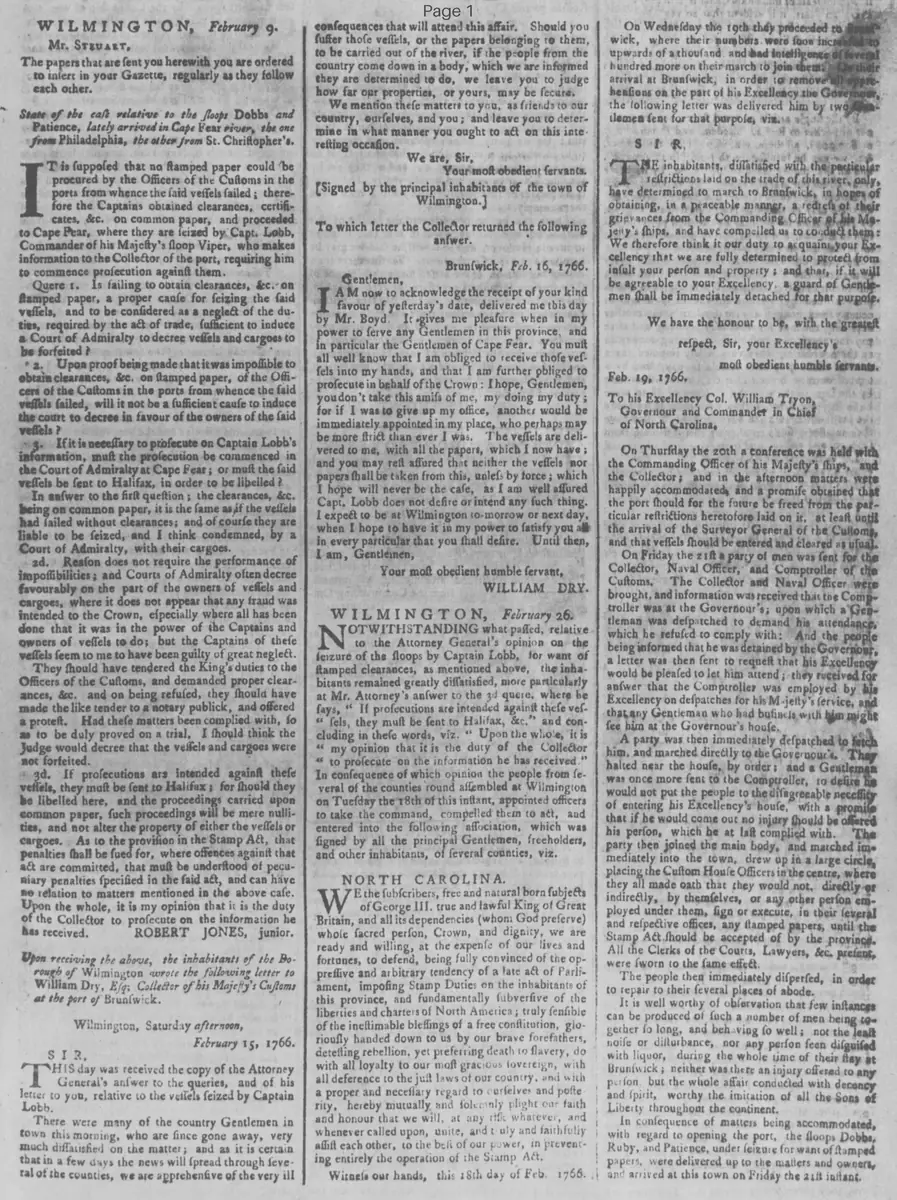
To Mr. Stewart,
The papers that are sent you herewith you are ordered to insert in your Gazette, regularly as they follow each other.
State of the case relative to the sloops Dobbs and Patience, lately arrived in Cape Fear river. the one from Philadelphia, the other from St. Christopher's.
It is supposed that no stamped paper could be procured by the Officers of the Customs in the ports from whence the said vessels sailed; therefore the Captains obtained clearances, certificates, &c. on common paper, and proceeded to Cape Fear, where they are seized by Capt. Lobb, Commander of his Majesty's sloop Viper, who makes information to the Collector of the port, requiring him to commence prosecution against them.
Query 1. Is failing to obtain clearances, &c. on stamped paper, a proper cause for seizing the said vessels, and to be considered as a neglect of the duties, required by the act of trade, sufficient to induce a Court of Admiralty to decree vessels and cargoes to be forfeited?
2. Upon proof being made that it was impossible to obtain clearances, &c. on stamped paper, of the Officers of the Customs in the ports from whence the said vessels sailed, will it not be a sufficient cause to induce the court to decree in favour of the owners of the said vessels?
3. If it is necessary to prosecute on Captain Lobb's information, must the prosecution be commenced in the Court of Admiralty at Cape Fear; or must the said vessels be sent to Halifax, in order to be libelled?
In answer to the first question; the clearances, &c. being on common paper, it is the same as if the vessels had sailed without clearances; and of course they are liable to be seized, and I think condemned, by a Court of Admiralty, with their cargoes.
2d. Reason does not require the performance of impossibilities; and Courts of Admiralty often decree favourably on the part of the owners of vessels and cargoes, where it does not appear that any fraud was intended to the Crown, especially where all has been done that it was in the power of the Captains and owners of vessels to do; but the Captains of these vessels seem to me to have been guilty of great neglect.
They should have tendered the King's duties to the Officers of the Customs, and demanded proper clearances, &c. and on being refused, they should have made the like tender to a notary publick, and offered a protest. Had these matters been complied with, so as to be duly proved on a trial, I should think the Judge would decree that the vessels and cargoes were not forfeited.
3d. If prosecutions are intended against these vessels, they must be sent to Halifax; for should they be libelled here, and the proceedings carried upon common paper, such proceedings will be mere nullities, and not alter the property of either the vessels or cargoes. As to the provision in the Stamp Act, that penalties shall be sued for, where offences against that Act are committed, that must be understood of pecuniary penalties specified in the said act, and can have no relation to matters mentioned in the above case.
Upon the whole, it is my opinion that it is the duty of the Collector to prosecute on the information he has received.
ROBERT JONES, junior.
Upon receiving the above, the inhabitants of the Borough of Wilmington wrote the following letter to William Dry, Esq; Collector of his Majesty's Customs at the port of Brunswick.
Wilmington, Saturday afternoon, February 15, 1766.
SIR,
This day was received the copy of the Attorney General's answer to the queries, and of his letter to you, relative to the vessels seized by Captain Lobb.
There were many of the country Gentlemen in town this morning, who are since gone away, very much dissatisfied on the matter; and as it is certain that a few days the news will spread through several of the counties, we are apprehensive of the very ill consequences that will attend this affair. Should you suffer those vessels, or the papers belonging to them, to be carried out of the river, if the people from the country come down in a body, which we are informed they are determined to do, we leave you to judge how far our properties, or yours, may be secure.
We mention these matters to you, as friends to our country, ourselves, and you; and leave you to determine in what manner you ought to act on this interesting occasion.
We are, Sir,
Your most obedient servants.
[Signed by the principal inhabitants of the town of Wilmington.]
To which letter the Collector returned the following answer.
Brunswick, Feb. 16, 1766.
Gentlemen,
I am now to acknowledge the receipt of your kind favour of yesterday's date, delivered me this day by Mr. Boyd. It gives me pleasure when in my power to serve any Gentlemen in this province, and in particular the Gentlemen of Cape Fear. You must all well know that I am obliged to receive those vessels into my hands, and that I am further obliged to prosecute in behalf of the Crown : I hope, Gentlemen, you don't take this amiss of me, my doing my duty; for if I was to give up my office, another would be immediately appointed in my place, who perhaps may be more strict than ever I was. The vessels are delivered to me, with all the papers, which I now have; and you may rest assured that neither the vessels nor papers shall be taken from this, unless by force; which I hope will never be the case, as I am well assured Capt. Lobb does not desire or intend any such thing.
I expect to be at Wilmington to-morrow or next day, when I hope to have it in my power to satisfy you all in every particular that you shall desire. Until then, I am, Gentlemen,
Your most obedient humble servant,
WILLIAM DRY.
WILMINGTON, February 26.
NOTWITHSTANDING what passed, relative to the Attorney General's opinion on the seizure of the sloops by Captain Lobb, for want of stamped clearances, as mentioned above, the inhabitants remained greatly dissatisfied, more particularly at Mr. Attorney's answer to the 3d query, where he says, "If prosecutions are intended against these vessels, they must be sent to Halifax, &c." and concluding in these words, viz. "Upon the whole, it is my opinion that it is the duty of the Collector to prosecute on the information he has received."
In consequence of which opinion the people from several of the counties round assembled at Wilmington on Tuesday the 18th of this instant, appointed officers to take the command, compelled them to act, and entered into the following association, which was signed by all the principal Gentlemen, freeholders, and other inhabitants, of several counties, viz.
NORTH CAROLINA.
We the subscribers, free and natural born subjects of George III. true and lawful King of Great Britain, and all its dependencies (whom God preserve) whose sacred person, Crown, and dignity, we are ready and willing, at the expense of our lives and fortunes, to defend, being fully convinced of the oppressive and arbitrary tendency of a late act of Parliament, imposing Stamp Duties on the inhabitants of this province, and fundamentally subversive of the liberties and charters of North America; truly sensible of the inestimable blessings of a free constitution, gloriously handed down to us by our brave forefathers, detesting rebellion, yet preferring death to slavery, do with all loyalty to our most gracious sovereign, with all deference to the just laws of our country, and with a proper and necessary regard to ourselves and posterity, hereby mutually and solemnly plight our faith and honour that we will, at any risk whatever, and whenever called upon, unite, and truly and faithfully assist each other, to the utmost of our power, in preventing entirely the operation of the Stamp Act.
Witness our hands, this 18th day of Feb. 1766.
On Wednesday the 19th they proceeded to Brunswick, where their numbers were soon increased to upwards of a thousand and had intelligence of seven hundred more on their march to join them. On their arrival at Brunswick, in order to remove all apprehensions on the part of his Excellency the Governor the following letter was delivered him by two gentlemen sent for that purpose, viz.
SIR,
The inhabitants, dissatisfied with the particular restrictions laid on the trade of this river, only, have determined to march to Brunswick, in hopes of obtaining, in a peaceable manner, a redress of their grievances from the Commanding Officer of his Majesty's ships, and have compelled us to conduct them: We therefore think it our duty to acquaint your Excellency that we are fully determined to protect from insult your person and property; and that, if it will be agreeable to your Excellency, a guard of Gentlemen shall be immediately detached for that purpose.
We have the honour to be, with the greatest respect, Sir, your Excellency's most obedient humble servants.
Feb. 19, 1766.
To his Excellency Col. William Tryon, Governor and Commander in Chief of North Carolina.
On Thursday the 20th a conference was held with the Commanding Officer of his Majesty's Ships, and the Collector; and in the afternoon matters were happily accommodated and a promise obtained that the port should for the future be freed from the particular restrictions heretofore laid on it, at least until the arrival of the Surveyor General of the Customs, and that vessels should be entered and cleared as usual.
On Friday the 21st a party of men was sent for the Collector, Naval Officer, and Comptroller of the Customs. The Collector and Naval Officer were brought, and information was received that the Comptroller was at the Governor's; upon which a Gentleman was dispatched to demand his attendance, which he refused to comply with: And the people being informed that he was detained by the Governor, a letter was then sent to request that his Excellency would be pleased to let him attend; they received for answer that the Comptroller was employed by his Excellency on dispatches for his Majesty's service, and that any Gentleman who had business with him might see him at the Governor's house.
A party was then immediately dispatched to fetch him, and marched directly to the Governor's. They halted near the house, by order; and a Gentleman was once more sent to the Comptroller, to desire he would not put the people to the disagreeable necessity of entering his Excellency's house, with a promise that if he would come out no injury should be offered his person, which he at last complied with. The party then joined the main body, and marched immediately into the town, drew up in a large circle, placing the Custom House Officers in the centre, where they all made oath that they would not, directly or indirectly, by themselves, or any other person employed under them, sign or execute, in their several and respective offices, any stamped papers, until the Stamp Act should be accepted of by the province.
All the Clerks of the Courts, Lawyers, &c. present, were sworn to the same effect. The people then immediately dispersed, in order to repair to their several places of abode.
It is well worthy of observation that few instances can be produced of such a number of men being together so long, and behaving so well; not the least noise or disturbance, nor any person seen disguised with liquor, during the whole time of their stay at Brunswick; neither was there an injury offered to any person but the whole affair conducted with decency and spirit, worthy the imitation of all the Sons of Liberty throughout the continent.
In consequence of matters being accommodated, with regard to opening the port, the sloops Dobbs, Ruby, and Patience, under seizure for want of stamped papers, were delivered up to the masters and owners, and arrived at this town on Friday the 21st instant.
What sub-type of article is it?
What themes does it cover?
What keywords are associated?
What entities or persons were involved?
Where did it happen?
Story Details
Key Persons
Location
Wilmington And Brunswick, Cape Fear River, North Carolina
Event Date
February 1766
Story Details
Sloops seized for lacking stamped clearances prompt Attorney General Robert Jones's opinion favoring prosecution, leading to public dissatisfaction, assembly in Wilmington, formation of anti-Stamp Act association on Feb 18, march to Brunswick, conference with officials on Feb 20, oaths from customs officers and others against stamped papers on Feb 21, and release of vessels.