Thank you for visiting SNEWPapers!
Sign up free
Literary
June 17, 1837
The Columbia Democrat
Bloomsburg, Columbia County, Pennsylvania
What is this article about?
In 1832 New York, Charles Barton, chief mate of the ship Fame, impulsively marries Ellen Moran, a wealthy young woman escaping her abusive guardian uncle's control over her inheritance. The uncle, confronted, commits suicide. The couple settles happily in North Carolina.
Clipping
OCR Quality
98%
Excellent
Full Text
THE REPERTORY.
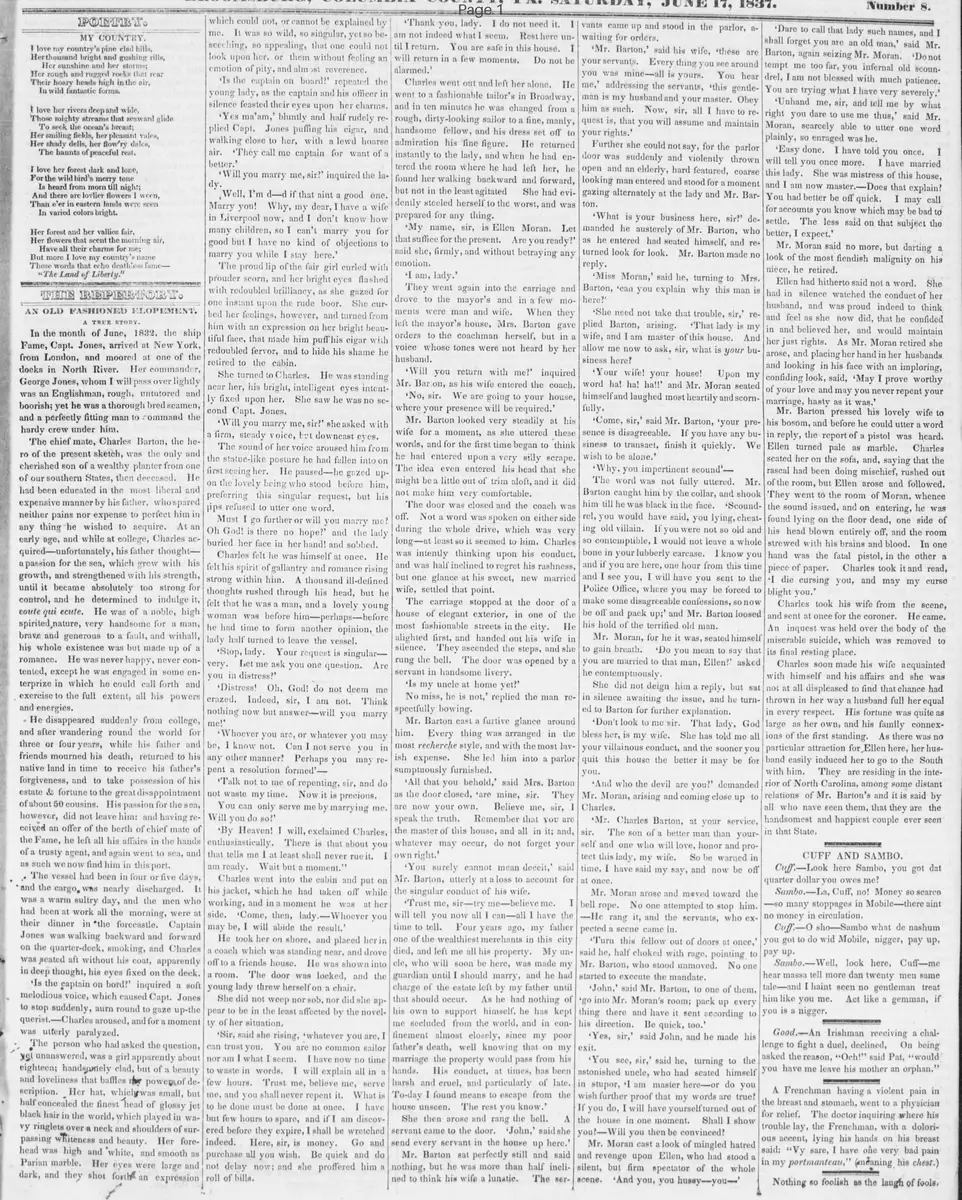
AN OLD FASHIONED ELOPEMENT.
A TRUE STORY.
In the month of June, 1832, the ship Fame, Capt. Jones, arrived at New York from London, and moored at one of the docks in North River. Her commander, George Jones, whom I will pass over lightly, was an Englishman, rough, untutored and boorish: yet he was a thorough bred seaman, and a perfectly fitting man to command the hardy crew under him.
The chief mate, Charles Barton, the hero of the present sketch, was the only and cherished son of a wealthy planter from one of our southern States, then deceased. He had been educated in the most liberal and expensive manner by his father, who spared neither pains nor expense to perfect him in any thing he wished to acquire. At an early age, and while at college, Charles acquired—unfortunately, his father thought—a passion for the sea, which grew with his growth, and strengthened with his strength, until it became absolutely too strong for control, and he determined to indulge it, coute que coute. He was of a noble, high spirited nature, very handsome for a man, brave and generous to a fault, and withal, his whole existence was but made up of a romance. He was never happy, never contented, except he was engaged in some enterprize in which he could call forth and exercise to the full extent, all his powers and energies.
He disappeared suddenly from college, and after wandering round the world for three or four years, while his father and friends mourned his death, returned to his native land in time to receive his father's forgiveness, and to take possession of his estate & fortune to the great disappointment of about 50 cousins. His passion for the sea, however, did not leave him: and having received an offer of the berth of chief mate of the Fame, he left all his affairs in the hands of a trusty agent, and again went to sea, and as such we now find him in this port.
The vessel had been in four or five days, and the cargo was nearly discharged. It was a warm sultry day, and the men who had been at work all the morning, were at their dinner in the forecastle. Captain Jones was walking backward and forward on the quarter-deck, smoking, and Charles was seated aft without his coat, apparently in deep thought, his eyes fixed on the deck.
'Is the captain on board?' inquired a soft melodious voice, which caused Capt. Jones to stop suddenly, turn round to gaze up the querist.—Charles aroused, and for a moment was utterly paralyzed.
The person who had asked the question, yet unanswered, was a girl apparently about eighteen; handsomely clad, but of a beauty and loveliness that baffles my powers of description. Her hat, which was small, but half concealed the finest head of glossy jet black hair in the world, which played in wavy ringlets over a neck and shoulders of surpassing whiteness and beauty. Her forehead was high and white, and smooth as Parian marble. Her eyes were large and dark, and they shot forth an expression which could not, or cannot be explained by me. It was so wild, so singular, yet so beseeching, so appealing, that one could not look upon her, or them without feeling an emotion of pity, and almost reverence.
'Is the captain on board?' repeated the young lady, as the captain and his officer in silence feasted their eyes upon her charms.
'Yes ma'am,' bluntly and half rudely replied Capt. Jones puffing his cigar, and walking close to her, with a lewd hoarse air. 'They call me captain for want of a better.'
'Will you marry me, sir?' inquired the lady.
Well, I'm dd if that aint a good one. Marry you! Why, my dear, I have a wife in Liverpool now, and I don't know how many children, so I can't marry you for good but I have no kind of objections to marry you while I stay here.'
The proud lip of the fair girl curled with prouder scorn, and her bright eyes flashed with redoubled brilliancy, as she gazed for one instant upon the rude boor. She curbed her feelings, however, and turned from him with an expression on her bright beautiful face, that made him puff his cigar with redoubled fervor, and to hide his shame he retired to the cabin.
She turned to Charles. He was standing near her, his bright, intelligent eyes intently fixed upon her. She saw he was no second Capt. Jones.
'Will you marry me, sir?' she asked with a firm, steady voice, but downcast eyes.
The sound of her voice aroused him from the statue-like posture he had fallen into on first seeing her. He paused—he gazed upon the lovely being who stood before him, preferring this singular request, but his lips refused to utter one word.
'Must I go further or will you marry me? Oh God! is there no hope?' and the lady buried her face in her hand! and sobbed.
Charles felt he was himself at once. He felt his spirit of gallantry and romance rising strong within him. A thousand ill-defined thoughts rushed through his head, but he felt that he was a man, and a lovely young woman was before him—perhaps—before he had time to form another opinion, the lady half turned to leave the vessel.
'Stop, lady. Your request is singular—very. Let me ask you one question. Are you in distress?'
'Distress! Oh, God! do not deem me crazed. Indeed, sir, I am not. Think nothing now but answer—will you marry me!'
'Whoever you are, or whatever you may be, I know not. Can I not serve you in any other manner? Perhaps you may repent a resolution formed'—
'Talk not to me of repenting, sir, and do not waste my time. Now it is precious. You can only serve me by marrying me. Will you do so?'
'By Heaven! I will, exclaimed Charles, enthusiastically. There is that about you that tells me I at least shall never rue it. I am ready. Wait but a moment.'
Charles went into the cabin and put on his jacket, which he had taken off while working, and in a moment he was at her side. 'Come, then, lady.—Whoever you may be, I will abide the result.'
He took her on shore, and placed her in a coach which was standing near, and drove off to a friend's house.
He was shown into a room. The door was locked, and the young lady threw herself on a chair. She did not weep nor sob, nor did she appear to be in the least affected by the novelty of her situation.
'Sir, said she rising, 'whatever you are, I can trust you. You are no common sailor nor am I what I seem. I have now no time to waste in words. I will explain all in a few hours. Trust me, believe me, serve me, and you shall never repent it. What is to be done must be done at once. I have but few hours to spare, and if I am discovered before they expire, I shall be wretched indeed. Here, sir, is money. Go and purchase all you wish. Be quick and do not delay now'; and she proffered him a roll of bills.
'Thank you, lady. I do not need it. I am not indeed what I seem. Rest here until I return. You are safe in this house. I will return in a few moments. Do not be alarmed.'
Charles went out and left her alone. He went to a fashionable tailor's in Broadway, and in ten minutes he was changed from a rough, dirty-looking sailor to a fine, manly, handsome fellow, and his dress set off to admiration his fine figure. He returned instantly to the lady, and when he had entered the room where he had left her, he found her walking backward and forward, but not in the least agitated. She had evidently steeled herself to the worst, and was prepared for any thing.
'My name, sir, is Ellen Moran. Let that suffice for the present. Are you ready?' said she, firmly, and without betraying any emotion.
'I am, lady.'
They went again into the carriage and drove to the mayor's and in a few moments were man and wife. When they left the mayor's house, Mrs. Barton gave orders to the coachman herself, but in a voice whose tones were not heard by her husband.
'Will you return with me?' inquired Mr. Barton, as his wife entered the coach.
'No, sir. We are going to your house, where your presence will be required.'
Mr. Barton looked very steadily at his wife for a moment, as she uttered these words, and for the first time began to think he had entered upon a very silly scrape. The idea even entered his head that she might be a little out of trim aloft, and it did not make him very comfortable.
The door was closed and the coach was off. Not a word was spoken on either side during the whole drive, which was very long—at least so it seemed to him. Charles was intently thinking upon his conduct, and was half inclined to regret his rashness, but one glance at his sweet, new married wife, settled that point.
The carriage stopped at the door of a house of elegant exterior, in one of the most fashionable streets in the city. He alighted first, and handed out his wife in silence. They ascended the steps, and she rung the bell. The door was opened by a servant in handsome livery.
'Is my uncle at home yet?'
'No miss, he is not,' replied the man respectfully bowing.
Mr. Barton cast a furtive glance around him. Every thing was arranged in the most recherche style, and with the most lavish expense. She led him into a parlor sumptuously furnished.
'All that you behold,' said Mrs. Barton as the door closed, 'are mine, sir. They are now your own. Believe me, sir, I speak the truth. Remember that you are the master of this house, and all in it; and, whatever may occur, do not forget your own right.'
'You surely cannot mean deceit,' said Mr. Barton, utterly at a loss to account for the singular conduct of his wife.
'Trust me, sir—try me—believe me. I will tell you now all I can—all I have the time to tell. Four years ago, my father one of the wealthiest merchants in this city died, and left me all his property. My uncle, who will soon be here, was made my guardian until I should marry, and he had charge of the estate left by my father until that should occur. As he had nothing of his own to support himself, he has kept me secluded from the world, and in confinement almost closely, since my poor father's death, well knowing that on my marriage the property would pass from his hands. His conduct, at times, has been harsh and cruel, and particularly of late. To-day I found means to escape from the house unseen. The rest you know.'
She then arose and rang the bell. A servant came to the door. 'John,' said she 'send every servant in the house up here.'
Mr. Barton sat perfectly still and said nothing, but he was more than half inclined to think his wife a lunatic. The servants came up and stood in the parlor, awaiting for orders.
'Mr. Barton.' said his wife, 'these are your servants. Every thing you see around you was mine—all is yours. You hear me,' addressing the servants, 'this gentleman is my husband and your master. Obey him as such. Now, sir, all I have to request is, that you will assume and maintain your rights.'
Further she could not say, for the parlor door was suddenly and violently thrown open and an elderly, hard featured, coarse looking man entered and stood for a moment gazing alternately at the lady and Mr. Barton.
'What is your business here, sir?' demanded he austerely of Mr. Barton, who as he entered had seated himself, and returned look for look. Mr. Barton made no reply.
'Miss Moran,' said he, turning to Mrs. Barton, 'can you explain why this man is here?'
'She need not take that trouble, sir,' replied Barton, arising. 'That lady is my wife, and I am master of this house. And allow me now to ask, sir, what is your business here?'
'Your wife! your house! Upon my word ha! ha! ha!!' and Mr. Moran seated himself and laughed most heartily and scornfully.
'Come, sir,' said Mr. Barton, 'your presence is disagreeable. If you have any business to transact, finish it quickly. We wish to be alone.'
'Why, you impertinent scound'——
The word was not fully uttered. Mr. Barton caught him by the collar, and shook him till he was black in the face. 'Scoundrel, you would have said, you lying, cheating old villain. If you were not so old and so contemptible, I would not leave a whole bone in your lubberly carcase. I know you and if you are here, one hour from this time and I see you, I will have you sent to the Police Office, where you may be forced to make some disagreeable confessions, so now be off and pack up'; and Mr. Barton loosed his hold of the terrified old man.
Mr. Moran, for he it was, seated himself to gain breath. 'Do you mean to say that you are married to that man, Ellen?' asked he contemptuously.
She did not deign him a reply, but sat in silence awaiting the issue, and he turned to Barton for further explanation.
'Don't look to me sir. That lady, God bless her, is my wife. She has told me all your villainous conduct, and the sooner you quit this house the better it may be for you.'
'And who the devil are you?' demanded Mr. Moran, arising and coming close up to Charles.
'Mr. Charles Barton, at your service, sir. The son of a better man than yourself and one who will love, honor and protect this lady, my wife. So be warned in time, I have said my say, and now be off at once.'
Mr. Moran arose and moved toward the bell rope. No one attempted to stop him.—He rang it, and the servants, who expected a scene came in.
'Turn this fellow out of doors at once,' said he, half choked with rage, pointing to Mr. Barton, who stood unmoved. No one started to execute the mandate.
'John,' said Mr. Barton, to one of them, 'go into Mr. Moran's room; pack up every thing there and have it sent according to his direction. Be quick, too.'
'Yes, sir,' said John, and he made his exit.
'You see, sir,' said he, turning to the astonished uncle, who had seated himself in stupor, 'I am master here—or do you wish further proof that my words are true? If you do, I will have yourself turned out of the house in one moment. Shall I show you?—Will you then be convinced?'
Mr. Moran cast a look of mingled hatred and revenge upon Ellen, who had stood a silent, but firm spectator of the whole scene. 'And you, you hussy—you—'
'Dare to call that lady such names, and I shall forget you are an old man,' said Mr. Barton, again seizing Mr. Moran. 'Do not tempt me too far, you infernal old scoundrel, I am not blessed with much patience. You are trying what I have very severely.'
'Unhand me, sir, and tell me by what right you dare to use me thus,' said Mr. Moran, scarcely able to utter one word plainly, so enraged was he.
'Easy done. I have told you once. I will tell you once more. I have married this lady. She was mistress of this house, and I am now master.—Does that explain? You had better be off quick. I may call for accounts you know which may be bad to settle. The less said on that subject the better, I expect.'
Mr. Moran said no more, but darting a look of the most fiendish malignity on his niece, he retired.
Ellen had hitherto said not a word. She had in silence watched the conduct of her husband, and was proud indeed to think and feel as she now did, that he confided in and believed her, and would maintain her just rights. As Mr. Moran retired she arose, and placing her hand in her husband's and looking in his face with an imploring, confiding look, said, 'May I prove worthy of your love and may you never repent your marriage, hasty as it was.'
Mr. Barton pressed his lovely wife to his bosom, and before he could utter a word in reply, the report of a pistol was heard.
Ellen turned pale as marble. Charles seated her on the sofa, and, saying that the rascal had been doing mischief, rushed out of the room, but Ellen arose and followed.
They went to the room of Moran, whence the sound issued, and on entering, he was found lying on the floor dead, one side of his head blown entirely off, and the room strewed with his brains and blood. In one hand was the fatal pistol, in the other a piece of paper. Charles took it and read.
'I die cursing you, and may my curse blight you.'
Charles took his wife from the scene, and sent at once for the coroner. He came. An inquest was held over the body of the miserable suicide, which was removed to its final resting place.
Charles soon made his wife acquainted with himself and his affairs and she was not at all displeased to find that chance had thrown in her way a husband full her equal in every respect. His fortune was quite as large as her own, and his family connexions of the first standing. As there was no particular attraction for Ellen here, her husband easily induced her to go to the South with him. They are residing in the interior of North Carolina, among some distant relations of Mr. Barton's and it is said by all who have seen them, that they are the handsomest and happiest couple ever seen in that State.
AN OLD FASHIONED ELOPEMENT.
A TRUE STORY.
In the month of June, 1832, the ship Fame, Capt. Jones, arrived at New York from London, and moored at one of the docks in North River. Her commander, George Jones, whom I will pass over lightly, was an Englishman, rough, untutored and boorish: yet he was a thorough bred seaman, and a perfectly fitting man to command the hardy crew under him.
The chief mate, Charles Barton, the hero of the present sketch, was the only and cherished son of a wealthy planter from one of our southern States, then deceased. He had been educated in the most liberal and expensive manner by his father, who spared neither pains nor expense to perfect him in any thing he wished to acquire. At an early age, and while at college, Charles acquired—unfortunately, his father thought—a passion for the sea, which grew with his growth, and strengthened with his strength, until it became absolutely too strong for control, and he determined to indulge it, coute que coute. He was of a noble, high spirited nature, very handsome for a man, brave and generous to a fault, and withal, his whole existence was but made up of a romance. He was never happy, never contented, except he was engaged in some enterprize in which he could call forth and exercise to the full extent, all his powers and energies.
He disappeared suddenly from college, and after wandering round the world for three or four years, while his father and friends mourned his death, returned to his native land in time to receive his father's forgiveness, and to take possession of his estate & fortune to the great disappointment of about 50 cousins. His passion for the sea, however, did not leave him: and having received an offer of the berth of chief mate of the Fame, he left all his affairs in the hands of a trusty agent, and again went to sea, and as such we now find him in this port.
The vessel had been in four or five days, and the cargo was nearly discharged. It was a warm sultry day, and the men who had been at work all the morning, were at their dinner in the forecastle. Captain Jones was walking backward and forward on the quarter-deck, smoking, and Charles was seated aft without his coat, apparently in deep thought, his eyes fixed on the deck.
'Is the captain on board?' inquired a soft melodious voice, which caused Capt. Jones to stop suddenly, turn round to gaze up the querist.—Charles aroused, and for a moment was utterly paralyzed.
The person who had asked the question, yet unanswered, was a girl apparently about eighteen; handsomely clad, but of a beauty and loveliness that baffles my powers of description. Her hat, which was small, but half concealed the finest head of glossy jet black hair in the world, which played in wavy ringlets over a neck and shoulders of surpassing whiteness and beauty. Her forehead was high and white, and smooth as Parian marble. Her eyes were large and dark, and they shot forth an expression which could not, or cannot be explained by me. It was so wild, so singular, yet so beseeching, so appealing, that one could not look upon her, or them without feeling an emotion of pity, and almost reverence.
'Is the captain on board?' repeated the young lady, as the captain and his officer in silence feasted their eyes upon her charms.
'Yes ma'am,' bluntly and half rudely replied Capt. Jones puffing his cigar, and walking close to her, with a lewd hoarse air. 'They call me captain for want of a better.'
'Will you marry me, sir?' inquired the lady.
Well, I'm dd if that aint a good one. Marry you! Why, my dear, I have a wife in Liverpool now, and I don't know how many children, so I can't marry you for good but I have no kind of objections to marry you while I stay here.'
The proud lip of the fair girl curled with prouder scorn, and her bright eyes flashed with redoubled brilliancy, as she gazed for one instant upon the rude boor. She curbed her feelings, however, and turned from him with an expression on her bright beautiful face, that made him puff his cigar with redoubled fervor, and to hide his shame he retired to the cabin.
She turned to Charles. He was standing near her, his bright, intelligent eyes intently fixed upon her. She saw he was no second Capt. Jones.
'Will you marry me, sir?' she asked with a firm, steady voice, but downcast eyes.
The sound of her voice aroused him from the statue-like posture he had fallen into on first seeing her. He paused—he gazed upon the lovely being who stood before him, preferring this singular request, but his lips refused to utter one word.
'Must I go further or will you marry me? Oh God! is there no hope?' and the lady buried her face in her hand! and sobbed.
Charles felt he was himself at once. He felt his spirit of gallantry and romance rising strong within him. A thousand ill-defined thoughts rushed through his head, but he felt that he was a man, and a lovely young woman was before him—perhaps—before he had time to form another opinion, the lady half turned to leave the vessel.
'Stop, lady. Your request is singular—very. Let me ask you one question. Are you in distress?'
'Distress! Oh, God! do not deem me crazed. Indeed, sir, I am not. Think nothing now but answer—will you marry me!'
'Whoever you are, or whatever you may be, I know not. Can I not serve you in any other manner? Perhaps you may repent a resolution formed'—
'Talk not to me of repenting, sir, and do not waste my time. Now it is precious. You can only serve me by marrying me. Will you do so?'
'By Heaven! I will, exclaimed Charles, enthusiastically. There is that about you that tells me I at least shall never rue it. I am ready. Wait but a moment.'
Charles went into the cabin and put on his jacket, which he had taken off while working, and in a moment he was at her side. 'Come, then, lady.—Whoever you may be, I will abide the result.'
He took her on shore, and placed her in a coach which was standing near, and drove off to a friend's house.
He was shown into a room. The door was locked, and the young lady threw herself on a chair. She did not weep nor sob, nor did she appear to be in the least affected by the novelty of her situation.
'Sir, said she rising, 'whatever you are, I can trust you. You are no common sailor nor am I what I seem. I have now no time to waste in words. I will explain all in a few hours. Trust me, believe me, serve me, and you shall never repent it. What is to be done must be done at once. I have but few hours to spare, and if I am discovered before they expire, I shall be wretched indeed. Here, sir, is money. Go and purchase all you wish. Be quick and do not delay now'; and she proffered him a roll of bills.
'Thank you, lady. I do not need it. I am not indeed what I seem. Rest here until I return. You are safe in this house. I will return in a few moments. Do not be alarmed.'
Charles went out and left her alone. He went to a fashionable tailor's in Broadway, and in ten minutes he was changed from a rough, dirty-looking sailor to a fine, manly, handsome fellow, and his dress set off to admiration his fine figure. He returned instantly to the lady, and when he had entered the room where he had left her, he found her walking backward and forward, but not in the least agitated. She had evidently steeled herself to the worst, and was prepared for any thing.
'My name, sir, is Ellen Moran. Let that suffice for the present. Are you ready?' said she, firmly, and without betraying any emotion.
'I am, lady.'
They went again into the carriage and drove to the mayor's and in a few moments were man and wife. When they left the mayor's house, Mrs. Barton gave orders to the coachman herself, but in a voice whose tones were not heard by her husband.
'Will you return with me?' inquired Mr. Barton, as his wife entered the coach.
'No, sir. We are going to your house, where your presence will be required.'
Mr. Barton looked very steadily at his wife for a moment, as she uttered these words, and for the first time began to think he had entered upon a very silly scrape. The idea even entered his head that she might be a little out of trim aloft, and it did not make him very comfortable.
The door was closed and the coach was off. Not a word was spoken on either side during the whole drive, which was very long—at least so it seemed to him. Charles was intently thinking upon his conduct, and was half inclined to regret his rashness, but one glance at his sweet, new married wife, settled that point.
The carriage stopped at the door of a house of elegant exterior, in one of the most fashionable streets in the city. He alighted first, and handed out his wife in silence. They ascended the steps, and she rung the bell. The door was opened by a servant in handsome livery.
'Is my uncle at home yet?'
'No miss, he is not,' replied the man respectfully bowing.
Mr. Barton cast a furtive glance around him. Every thing was arranged in the most recherche style, and with the most lavish expense. She led him into a parlor sumptuously furnished.
'All that you behold,' said Mrs. Barton as the door closed, 'are mine, sir. They are now your own. Believe me, sir, I speak the truth. Remember that you are the master of this house, and all in it; and, whatever may occur, do not forget your own right.'
'You surely cannot mean deceit,' said Mr. Barton, utterly at a loss to account for the singular conduct of his wife.
'Trust me, sir—try me—believe me. I will tell you now all I can—all I have the time to tell. Four years ago, my father one of the wealthiest merchants in this city died, and left me all his property. My uncle, who will soon be here, was made my guardian until I should marry, and he had charge of the estate left by my father until that should occur. As he had nothing of his own to support himself, he has kept me secluded from the world, and in confinement almost closely, since my poor father's death, well knowing that on my marriage the property would pass from his hands. His conduct, at times, has been harsh and cruel, and particularly of late. To-day I found means to escape from the house unseen. The rest you know.'
She then arose and rang the bell. A servant came to the door. 'John,' said she 'send every servant in the house up here.'
Mr. Barton sat perfectly still and said nothing, but he was more than half inclined to think his wife a lunatic. The servants came up and stood in the parlor, awaiting for orders.
'Mr. Barton.' said his wife, 'these are your servants. Every thing you see around you was mine—all is yours. You hear me,' addressing the servants, 'this gentleman is my husband and your master. Obey him as such. Now, sir, all I have to request is, that you will assume and maintain your rights.'
Further she could not say, for the parlor door was suddenly and violently thrown open and an elderly, hard featured, coarse looking man entered and stood for a moment gazing alternately at the lady and Mr. Barton.
'What is your business here, sir?' demanded he austerely of Mr. Barton, who as he entered had seated himself, and returned look for look. Mr. Barton made no reply.
'Miss Moran,' said he, turning to Mrs. Barton, 'can you explain why this man is here?'
'She need not take that trouble, sir,' replied Barton, arising. 'That lady is my wife, and I am master of this house. And allow me now to ask, sir, what is your business here?'
'Your wife! your house! Upon my word ha! ha! ha!!' and Mr. Moran seated himself and laughed most heartily and scornfully.
'Come, sir,' said Mr. Barton, 'your presence is disagreeable. If you have any business to transact, finish it quickly. We wish to be alone.'
'Why, you impertinent scound'——
The word was not fully uttered. Mr. Barton caught him by the collar, and shook him till he was black in the face. 'Scoundrel, you would have said, you lying, cheating old villain. If you were not so old and so contemptible, I would not leave a whole bone in your lubberly carcase. I know you and if you are here, one hour from this time and I see you, I will have you sent to the Police Office, where you may be forced to make some disagreeable confessions, so now be off and pack up'; and Mr. Barton loosed his hold of the terrified old man.
Mr. Moran, for he it was, seated himself to gain breath. 'Do you mean to say that you are married to that man, Ellen?' asked he contemptuously.
She did not deign him a reply, but sat in silence awaiting the issue, and he turned to Barton for further explanation.
'Don't look to me sir. That lady, God bless her, is my wife. She has told me all your villainous conduct, and the sooner you quit this house the better it may be for you.'
'And who the devil are you?' demanded Mr. Moran, arising and coming close up to Charles.
'Mr. Charles Barton, at your service, sir. The son of a better man than yourself and one who will love, honor and protect this lady, my wife. So be warned in time, I have said my say, and now be off at once.'
Mr. Moran arose and moved toward the bell rope. No one attempted to stop him.—He rang it, and the servants, who expected a scene came in.
'Turn this fellow out of doors at once,' said he, half choked with rage, pointing to Mr. Barton, who stood unmoved. No one started to execute the mandate.
'John,' said Mr. Barton, to one of them, 'go into Mr. Moran's room; pack up every thing there and have it sent according to his direction. Be quick, too.'
'Yes, sir,' said John, and he made his exit.
'You see, sir,' said he, turning to the astonished uncle, who had seated himself in stupor, 'I am master here—or do you wish further proof that my words are true? If you do, I will have yourself turned out of the house in one moment. Shall I show you?—Will you then be convinced?'
Mr. Moran cast a look of mingled hatred and revenge upon Ellen, who had stood a silent, but firm spectator of the whole scene. 'And you, you hussy—you—'
'Dare to call that lady such names, and I shall forget you are an old man,' said Mr. Barton, again seizing Mr. Moran. 'Do not tempt me too far, you infernal old scoundrel, I am not blessed with much patience. You are trying what I have very severely.'
'Unhand me, sir, and tell me by what right you dare to use me thus,' said Mr. Moran, scarcely able to utter one word plainly, so enraged was he.
'Easy done. I have told you once. I will tell you once more. I have married this lady. She was mistress of this house, and I am now master.—Does that explain? You had better be off quick. I may call for accounts you know which may be bad to settle. The less said on that subject the better, I expect.'
Mr. Moran said no more, but darting a look of the most fiendish malignity on his niece, he retired.
Ellen had hitherto said not a word. She had in silence watched the conduct of her husband, and was proud indeed to think and feel as she now did, that he confided in and believed her, and would maintain her just rights. As Mr. Moran retired she arose, and placing her hand in her husband's and looking in his face with an imploring, confiding look, said, 'May I prove worthy of your love and may you never repent your marriage, hasty as it was.'
Mr. Barton pressed his lovely wife to his bosom, and before he could utter a word in reply, the report of a pistol was heard.
Ellen turned pale as marble. Charles seated her on the sofa, and, saying that the rascal had been doing mischief, rushed out of the room, but Ellen arose and followed.
They went to the room of Moran, whence the sound issued, and on entering, he was found lying on the floor dead, one side of his head blown entirely off, and the room strewed with his brains and blood. In one hand was the fatal pistol, in the other a piece of paper. Charles took it and read.
'I die cursing you, and may my curse blight you.'
Charles took his wife from the scene, and sent at once for the coroner. He came. An inquest was held over the body of the miserable suicide, which was removed to its final resting place.
Charles soon made his wife acquainted with himself and his affairs and she was not at all displeased to find that chance had thrown in her way a husband full her equal in every respect. His fortune was quite as large as her own, and his family connexions of the first standing. As there was no particular attraction for Ellen here, her husband easily induced her to go to the South with him. They are residing in the interior of North Carolina, among some distant relations of Mr. Barton's and it is said by all who have seen them, that they are the handsomest and happiest couple ever seen in that State.
What sub-type of article is it?
Prose Fiction
What themes does it cover?
Love Romance
Social Manners
What keywords are associated?
Elopement
Marriage
Inheritance
Guardian
Suicide
Shipmate
New York
1832
Literary Details
Title
An Old Fashioned Elopement.
Subject
A True Story.
Key Lines
'Will You Marry Me, Sir?' Inquired The Lady.
'By Heaven! I Will, Exclaimed Charles, Enthusiastically. There Is That About You That Tells Me I At Least Shall Never Rue It. I Am Ready. Wait But A Moment.'
'All That You Behold,' Said Mrs. Barton As The Door Closed, 'Are Mine, Sir. They Are Now Your Own.'
'I Die Cursing You, And May My Curse Blight You.'