Thank you for visiting SNEWPapers!
Sign up free
Story
November 13, 1860
The Western Democrat
Charlotte, Mecklenburg County, North Carolina
What is this article about?
Dr. Tucker of the Medical Journal dismisses bran and rye bread as ineffective remedies for dyspepsia, citing their irritant effects on weakened stomachs, and endorses cold, stale wheat bread as superior.
Clipping
OCR Quality
95%
Excellent
Full Text
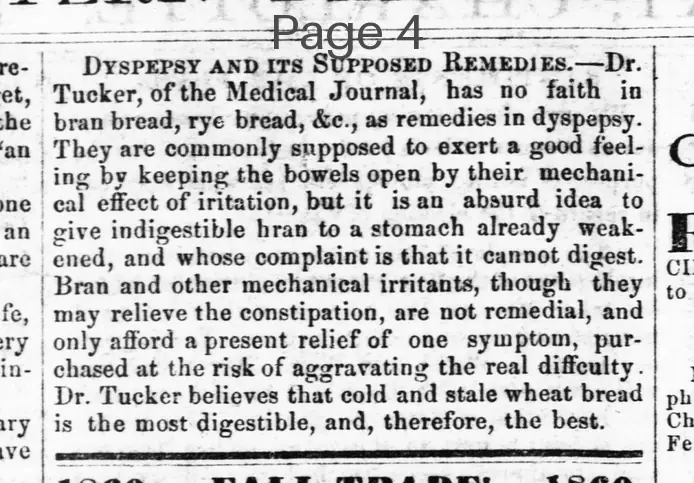
Dyspepsia And Its Supposed Remedies.—Dr. Tucker, of the Medical Journal, has no faith in bran bread, rye bread, &c., as remedies in dyspepsia. They are commonly supposed to exert a good feeling by keeping the bowels open by their mechanical effect of irritation, but it is an absurd idea to give indigestible bran to a stomach already weakened, and whose complaint is that it cannot digest. Bran and other mechanical irritants, though they may relieve the constipation, are not remedial, and only afford a present relief of one symptom, purchased at the risk of aggravating the real difficulty
Dr. Tucker believes that cold and stale wheat bread is the most digestible, and, therefore, the best.
Dr. Tucker believes that cold and stale wheat bread is the most digestible, and, therefore, the best.
What sub-type of article is it?
Medical Curiosity
What themes does it cover?
Recovery
Moral Virtue
What keywords are associated?
Dyspepsia Remedies
Bran Bread Critique
Wheat Bread Recommendation
What entities or persons were involved?
Dr. Tucker
Story Details
Key Persons
Dr. Tucker
Story Details
Dr. Tucker argues against using bran bread and rye bread for dyspepsia, as they irritate a weakened stomach without addressing the core issue, and recommends cold, stale wheat bread as the most digestible option.