Thank you for visiting SNEWPapers!
Sign up free
Virginia Argus
Richmond, Virginia
What is this article about?
The British Prince Regent revokes the Orders in Council amid the War of 1812, seen by Americans as a vindication of U.S. embargo policies. The proclamation includes conditions allowing reinstatement, and licenses protect British goods from capture. Commentary criticizes Federalists for undermining U.S. efforts.
Clipping
OCR Quality
Full Text
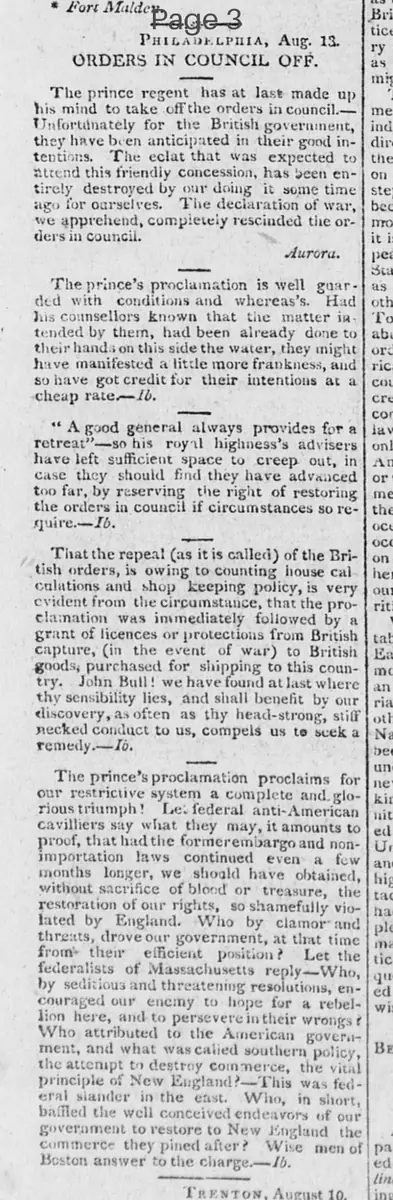
ORDERS IN COUNCIL
The prince regent has at last made up his mind to take off the orders in Council. Unfortunately for the British government, they have been anticipated in their good intentions. The eclat that was expected to attend this friendly concession, has been entirely destroyed by our doing it some time ago for ourselves. The declaration of war, we apprehend, completely rescinded the orders in council.
Aurora.
The prince's proclamation is well guarded with conditions and whereas's. Had his counsellors known that the matter intended by them, had been already done to their hands on this side the water, they might have manifested a little more frankness, and so have got credit for their intentions at a cheap rate.—Ib.
"A good general always provides for a retreat"—so his royal highness's advisers have left sufficient space to creep out, in case they should find they have advanced too far, by reserving the right of restoring the orders in council if circumstances so require.—Ib.
That the repeal (as it is called) of the British orders, is owing to counting house calculations and shop keeping policy, is very evident from the circumstance, that the proclamation was immediately followed by a grant of licences or protections from British capture, (in the event of war) to British goods; purchased for shipping to this country. John Bull! we have found at last where thy sensibility lies, and shall benefit by our discovery, as often as thy head-strong, stiff necked conduct to us, compels us to seek a remedy.—Ib.
The prince's proclamation proclaims for our restrictive system a complete and glorious triumph! Let federal anti-American cavillers say what they may, it amounts to proof, that had the former embargo and non-importation laws continued even a few months longer, we should have obtained, without sacrifice of blood or treasure, the restoration of our rights, so shamefully violated by England. Who by clamor and threats, drove our government, at that time from their efficient position? Let the federalists of Massachusetts reply—Who, by seditious and threatening resolutions, encouraged our enemy to hope for a rebellion here, and to persevere in their wrongs? Who attributed to the American government, and what was called southern policy, the attempt to destroy commerce, the vital principle of New England?—This was federal slander in the east. Who, in short, baffled the well conceived endeavors of our government to restore to New England the commerce they pined after? Wise men of Boston answer to the charge. Ib.
What sub-type of article is it?
What keywords are associated?
What entities or persons were involved?
Where did it happen?
Foreign News Details
Primary Location
Britain
Key Persons
Outcome
repeal of orders in council with conditions allowing reinstatement; grant of licenses protecting british goods from capture in event of war; viewed as triumph of u.s. restrictive trade policies without bloodshed.
Event Details
The Prince Regent issues a proclamation revoking the Orders in Council, but it is conditional and allows for restoration if needed. The U.S. declaration of war is seen as having already nullified them. The move is attributed to British economic interests, followed by protections for goods shipped to America. American commentary hails it as proof of the success of prior U.S. embargoes and non-importation laws, criticizing Federalists for opposing these measures and aiding Britain.