Thank you for visiting SNEWPapers!
Sign up free
Literary
March 31, 1790
Gazette Of The United States
New York, New York County, New York
What is this article about?
Dr. George Logan's essay details the natural history, varieties, and chemical composition of gypsum (plaster of Paris), linking it to calcareous earth from shells. He advocates its use as manure for crops and grass, especially on light soils, comparing it to marl. Read to the Agricultural Society of Pennsylvania, October 3, 1789.
Clipping
OCR Quality
95%
Excellent
Full Text
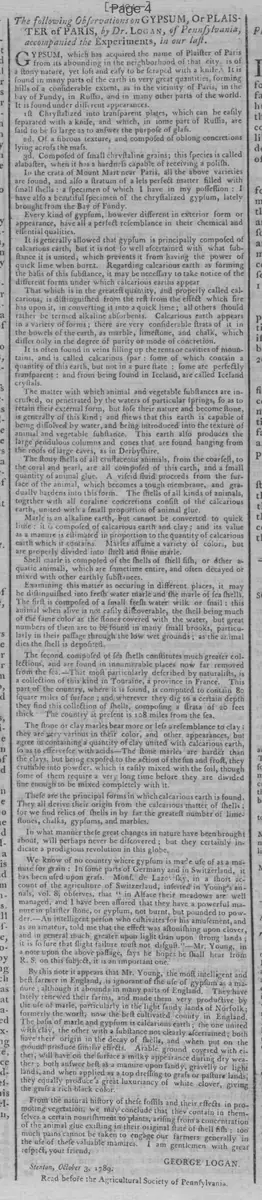
The following Observations on GYPSUM, Or PLASTER of PARIS. by Dr. Logan, of Pennsylvania, accompanied the Experiments, in our last.
GYPSUM, which has acquired the name of Plaster of Paris from its abounding in the neighborhood of that city, is of a stony nature, yet soft and easy to be scraped with a knife. It is found in many parts of the earth in very great quantities, forming hills of a considerable extent, as in the vicinity of Paris, in the bay of Fundy, in Russia, and in many other parts of the world.
It is found under different appearances.
1st. Crystallized into transparent plates, which can be easily separated with a knife, and which, in some part of Russia, are said to be so large as to answer the purpose of glass.
2d. Of a fibrous texture, and composed of oblong concretions lying across the mass.
3d. Composed of small crystalline grains; this species is called alabaster, when it has a hardness capable of receiving a polish.
In the strata of Mount Mart near Paris, all the above varieties are found, and also a stratum of a less perfect matter filled with small shells: a specimen of which I have in my possession: I have also a beautiful specimen of the crystallized gypsum, lately brought from the Bay of Fundy.
Every kind of gypsum, however different in exterior form or appearance, have all a perfect resemblance in their chemical and essential qualities.
It is generally allowed that gypsum is principally composed of calcareous earth, but it is not so well ascertained with what substance it is united, which prevents it from having the power of quick lime when burnt. Regarding calcareous earth as forming the basis of this substance, it may be necessary to take notice of the different forms under which calcareous earths appear.
That which is in the greatest quantity, and properly called calcareous, is distinguished from the rest from the effect which fire has upon it, in converting it into a quick lime; all others should rather be termed alkaline absorbents. Calcareous earth appears in a variety of forms; there are very considerable strata of it in the bowels of the earth, as marble, limestone, and chalk, which differ only in the degree of purity or mode of concretion.
It is often found in veins filling up the rents or cavities of mountains, and is called calcareous spar: some of which contain a quantity of this earth, but not in a pure state: some are perfectly transparent: and from being found in Iceland, are called Iceland crystals.
The matter with which animal and vegetable substances are incrusted, or penetrated by the waters of particular springs, so as to retain their external form, but lose their nature and become stone, is generally of this kind; and shows that this earth is capable of being dissolved by water, and being introduced into the texture of animal and vegetable substance. This earth also produces the large pendulous columns and cones that are found hanging from the roofs of large caves, as in Derbyshire.
The stony shells of all crustaceous animals, from the coarsest, to the coral and pearl, are all composed of this earth, and a small quantity of animal glue. A viscid fluid proceeds from the surface of the animal, which becomes a tough membrane, and gradually hardens into this form. The shells of all kinds of animals, together with all coralline concretions consist of the calcareous earth, united with a small proportion of animal glue.
Marle is an alkaline earth, but cannot be converted to quick lime: it is composed of calcareous earth and clay: and its value as a manure is estimated in proportion to the quantity of calcareous earth which it contains. Marles assume a variety of colors, but are properly divided into shell and stone marle.
Shell marle is composed of the shells of shell fish, or other aquatic animals, which are sometimes entire, and often decayed or mixed with other earthly substances.
Examining this matter as occurring in different places, it may be distinguished into fresh water marle and the marle of sea shells.
The first is composed of a small fresh water wilk or snail: this animal when alive is not easily discoverable, the shell being much of the same color as the stones covered with the water, but great numbers of them are to be found in many small brooks, particularly in their passage through the low wet grounds; as the animal dies the shell is deposited.
The second composed of sea shells constitutes much greater collections, and are found in innumerable places now far removed from the sea. That most particularly described by naturalists, is a collection of this kind in Touraine, a province in France. This part of the country, where it is found, is computed to contain 80 square miles of surface; and wherever they dig to a certain depth they find this collection of shells, composing a strata of 20 feet thick. The country at present is 108 miles from the sea.
The stone or clay marles bear more or less a resemblance to clay; they are very various in their color, and other appearances, but agree in containing a quantity of clay united with calcareous earth, so as to effervesce with acids. The stone marles are harder than the clays, but being exposed to the action of the sun and frost, they crumble into powder, which is easily mixed with the soil, though some of them require a very long time before they are divided fine enough to be mixed completely with it.
These are the principal forms in which calcareous earth is found. They all derive their origin from the calcareous matter of shells; for we find relics of shells in by far the greatest number of limestones, chalks, gypsums, and marbles.
In what manner these great changes in nature have been brought about, will perhaps never be discovered; but they certainly indicate a prodigious revolution in this globe.
We know of no country where gypsum is made use of as a manure for grain: In some parts of Germany and in Switzerland, it has been used upon grass. Mons. de Lazowsky, in a short account of the agriculture of Switzerland, inserted in Young's annals, vol. 8, observes, that "in Alsace their meadows are well managed, and I have been assured that they have a powerful manure in plaster stone, or gypsum, not burnt, but pounded to powder.—An intelligent person who cultivates for his amusement, and as an amateur, told me that the effect was astonishing upon clover, and in general much greater upon light than upon strong lands; it is so sure that light soils must not disgust."—Mr. Young, in a note upon the above passage, says he hopes he shall hear from R. S. on this subject, it is an important one.
By this note it appears that Mr. Young, the most intelligent and best farmer in England, is ignorant of the use of gypsum as a manure; although it abounds in many parts of England. They have lately renewed their farms, and made them very productive by the use of marle, particularly in the light sandy lands of Norfolk; formerly the worst, now the best cultivated county in England.
The basis of marle and gypsum is calcareous earth; the one united with clay, the other with a substance not clearly ascertained; both have their origin in the decay of shells, and when put on the ground produce similar effects. Arable ground covered with either, will have on the surface a milky appearance during dry weather; both answer best as a manure upon sandy, gravelly or light lands, and when applied as a top dressing to grass or pasture lands, they equally produce a great luxuriancy of white clover, giving the grass a rich black color.
From the natural history of these soils and their effects in promoting vegetation, we may conclude that they contain in themselves a certain nourishment to plants, arising from a concentration of the animal glue existing in their original state of shell fish; too much pains cannot be taken to engage our farmers generally in the use of these valuable manures. I am gentlemen with great respect, your friend,
GEORGE LOGAN.
Stenton, October 3, 1789.
Read before the Agricultural Society of Pennsylvania
GYPSUM, which has acquired the name of Plaster of Paris from its abounding in the neighborhood of that city, is of a stony nature, yet soft and easy to be scraped with a knife. It is found in many parts of the earth in very great quantities, forming hills of a considerable extent, as in the vicinity of Paris, in the bay of Fundy, in Russia, and in many other parts of the world.
It is found under different appearances.
1st. Crystallized into transparent plates, which can be easily separated with a knife, and which, in some part of Russia, are said to be so large as to answer the purpose of glass.
2d. Of a fibrous texture, and composed of oblong concretions lying across the mass.
3d. Composed of small crystalline grains; this species is called alabaster, when it has a hardness capable of receiving a polish.
In the strata of Mount Mart near Paris, all the above varieties are found, and also a stratum of a less perfect matter filled with small shells: a specimen of which I have in my possession: I have also a beautiful specimen of the crystallized gypsum, lately brought from the Bay of Fundy.
Every kind of gypsum, however different in exterior form or appearance, have all a perfect resemblance in their chemical and essential qualities.
It is generally allowed that gypsum is principally composed of calcareous earth, but it is not so well ascertained with what substance it is united, which prevents it from having the power of quick lime when burnt. Regarding calcareous earth as forming the basis of this substance, it may be necessary to take notice of the different forms under which calcareous earths appear.
That which is in the greatest quantity, and properly called calcareous, is distinguished from the rest from the effect which fire has upon it, in converting it into a quick lime; all others should rather be termed alkaline absorbents. Calcareous earth appears in a variety of forms; there are very considerable strata of it in the bowels of the earth, as marble, limestone, and chalk, which differ only in the degree of purity or mode of concretion.
It is often found in veins filling up the rents or cavities of mountains, and is called calcareous spar: some of which contain a quantity of this earth, but not in a pure state: some are perfectly transparent: and from being found in Iceland, are called Iceland crystals.
The matter with which animal and vegetable substances are incrusted, or penetrated by the waters of particular springs, so as to retain their external form, but lose their nature and become stone, is generally of this kind; and shows that this earth is capable of being dissolved by water, and being introduced into the texture of animal and vegetable substance. This earth also produces the large pendulous columns and cones that are found hanging from the roofs of large caves, as in Derbyshire.
The stony shells of all crustaceous animals, from the coarsest, to the coral and pearl, are all composed of this earth, and a small quantity of animal glue. A viscid fluid proceeds from the surface of the animal, which becomes a tough membrane, and gradually hardens into this form. The shells of all kinds of animals, together with all coralline concretions consist of the calcareous earth, united with a small proportion of animal glue.
Marle is an alkaline earth, but cannot be converted to quick lime: it is composed of calcareous earth and clay: and its value as a manure is estimated in proportion to the quantity of calcareous earth which it contains. Marles assume a variety of colors, but are properly divided into shell and stone marle.
Shell marle is composed of the shells of shell fish, or other aquatic animals, which are sometimes entire, and often decayed or mixed with other earthly substances.
Examining this matter as occurring in different places, it may be distinguished into fresh water marle and the marle of sea shells.
The first is composed of a small fresh water wilk or snail: this animal when alive is not easily discoverable, the shell being much of the same color as the stones covered with the water, but great numbers of them are to be found in many small brooks, particularly in their passage through the low wet grounds; as the animal dies the shell is deposited.
The second composed of sea shells constitutes much greater collections, and are found in innumerable places now far removed from the sea. That most particularly described by naturalists, is a collection of this kind in Touraine, a province in France. This part of the country, where it is found, is computed to contain 80 square miles of surface; and wherever they dig to a certain depth they find this collection of shells, composing a strata of 20 feet thick. The country at present is 108 miles from the sea.
The stone or clay marles bear more or less a resemblance to clay; they are very various in their color, and other appearances, but agree in containing a quantity of clay united with calcareous earth, so as to effervesce with acids. The stone marles are harder than the clays, but being exposed to the action of the sun and frost, they crumble into powder, which is easily mixed with the soil, though some of them require a very long time before they are divided fine enough to be mixed completely with it.
These are the principal forms in which calcareous earth is found. They all derive their origin from the calcareous matter of shells; for we find relics of shells in by far the greatest number of limestones, chalks, gypsums, and marbles.
In what manner these great changes in nature have been brought about, will perhaps never be discovered; but they certainly indicate a prodigious revolution in this globe.
We know of no country where gypsum is made use of as a manure for grain: In some parts of Germany and in Switzerland, it has been used upon grass. Mons. de Lazowsky, in a short account of the agriculture of Switzerland, inserted in Young's annals, vol. 8, observes, that "in Alsace their meadows are well managed, and I have been assured that they have a powerful manure in plaster stone, or gypsum, not burnt, but pounded to powder.—An intelligent person who cultivates for his amusement, and as an amateur, told me that the effect was astonishing upon clover, and in general much greater upon light than upon strong lands; it is so sure that light soils must not disgust."—Mr. Young, in a note upon the above passage, says he hopes he shall hear from R. S. on this subject, it is an important one.
By this note it appears that Mr. Young, the most intelligent and best farmer in England, is ignorant of the use of gypsum as a manure; although it abounds in many parts of England. They have lately renewed their farms, and made them very productive by the use of marle, particularly in the light sandy lands of Norfolk; formerly the worst, now the best cultivated county in England.
The basis of marle and gypsum is calcareous earth; the one united with clay, the other with a substance not clearly ascertained; both have their origin in the decay of shells, and when put on the ground produce similar effects. Arable ground covered with either, will have on the surface a milky appearance during dry weather; both answer best as a manure upon sandy, gravelly or light lands, and when applied as a top dressing to grass or pasture lands, they equally produce a great luxuriancy of white clover, giving the grass a rich black color.
From the natural history of these soils and their effects in promoting vegetation, we may conclude that they contain in themselves a certain nourishment to plants, arising from a concentration of the animal glue existing in their original state of shell fish; too much pains cannot be taken to engage our farmers generally in the use of these valuable manures. I am gentlemen with great respect, your friend,
GEORGE LOGAN.
Stenton, October 3, 1789.
Read before the Agricultural Society of Pennsylvania
What sub-type of article is it?
Essay
What themes does it cover?
Agriculture Rural
Nature
What keywords are associated?
Gypsum
Plaster Of Paris
Calcareous Earth
Manure
Agriculture
Marl
Shells
Natural History
What entities or persons were involved?
Dr. Logan, Of Pennsylvania (George Logan)
Literary Details
Title
Observations On Gypsum, Or Plaster Of Paris
Author
Dr. Logan, Of Pennsylvania (George Logan)
Subject
On Gypsum As Manure And Its Natural History
Form / Style
Prose Essay On Natural History And Agriculture
Key Lines
Gypsum, Which Has Acquired The Name Of Plaster Of Paris From Its Abounding In The Neighborhood Of That City, Is Of A Stony Nature, Yet Soft And Easy To Be Scraped With A Knife.
Every Kind Of Gypsum, However Different In Exterior Form Or Appearance, Have All A Perfect Resemblance In Their Chemical And Essential Qualities.
From The Natural History Of These Soils And Their Effects In Promoting Vegetation, We May Conclude That They Contain In Themselves A Certain Nourishment To Plants, Arising From A Concentration Of The Animal Glue Existing In Their Original State Of Shell Fish; Too Much Pains Cannot Be Taken To Engage Our Farmers Generally In The Use Of These Valuable Manures.