Thank you for visiting SNEWPapers!
Sign up free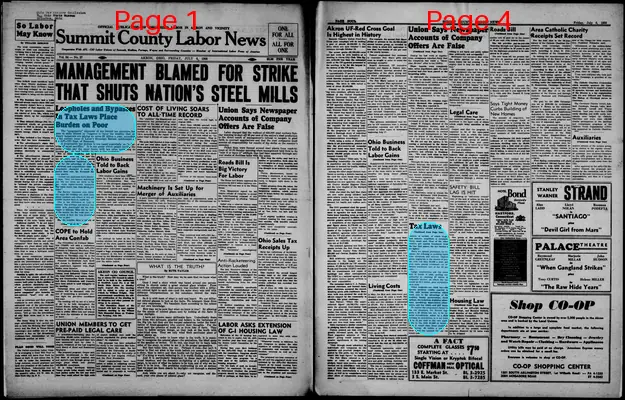
Summit County Labor News
Akron, Summit County, Ohio
What is this article about?
Article critiques U.S. federal tax system's loopholes favoring the wealthy, burdening low-income taxpayers with an extra $9 billion annually, per AFL-CIO's Labor's Economic Review. Discusses income types, special provisions, and suggests tax cuts and loophole closures.
Merged-components note: Merged continuation of tax loopholes story from page 1 to page 4.
Clippings
1 of 2
OCR Quality
Full Text
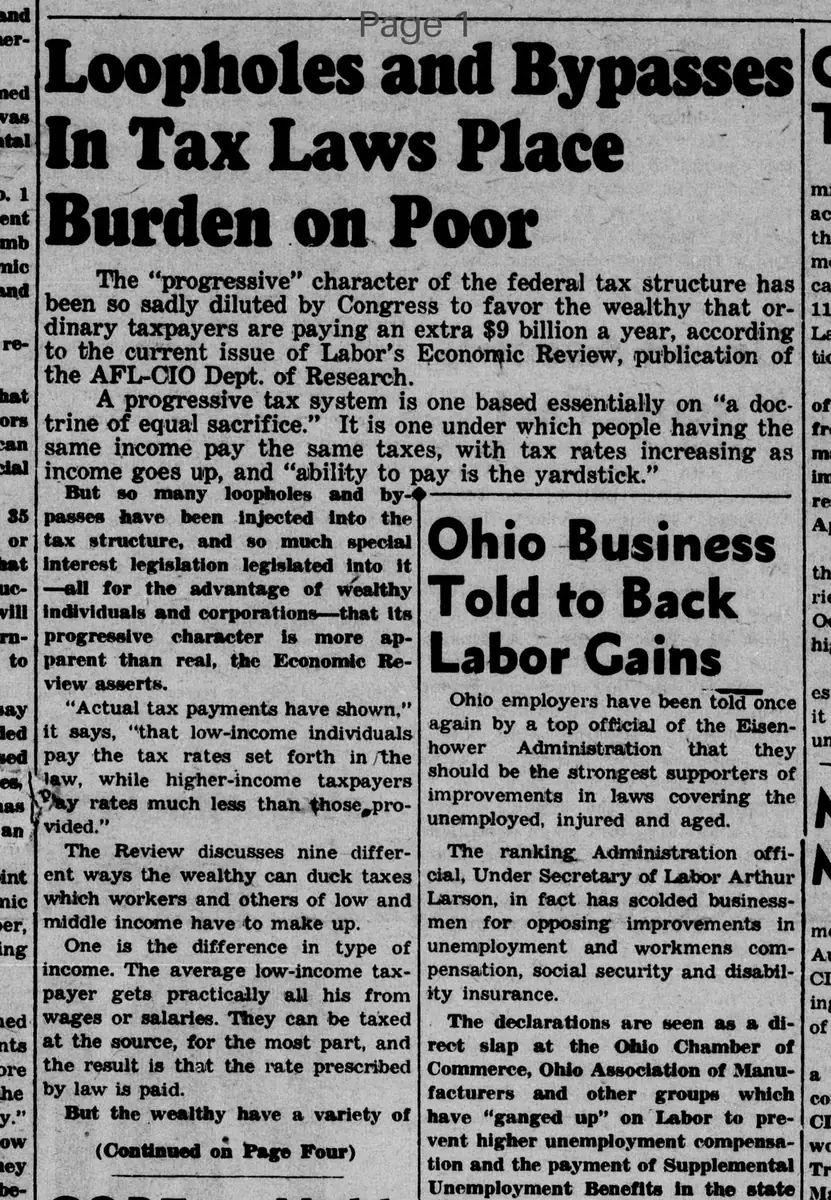
The "progressive" character of the federal tax structure has been so sadly diluted by Congress to favor the wealthy that ordinary taxpayers are paying an extra $9 billion a year, according to the current issue of Labor's Economic Review, publication of the AFL-CIO Dept. of Research.
A progressive tax system is one based essentially on "a doctrine of equal sacrifice." It is one under which people having the same income pay the same taxes, with tax rates increasing as income goes up, and "ability to pay is the yardstick."
Bypasses have been injected into the tax structure, and so much special interest legislation legislated into it -all for the advantage of wealthy individuals and corporations-that its progressive character is more apparent than real, the Economic Review asserts.
"Actual tax payments have shown," it says, "that low-income individuals pay the tax rates set forth in the law, while higher-income taxpayers pay rates much less than those provided."
The Review discusses nine different ways the wealthy can duck taxes which workers and others of low and middle income have to make up.
One is the difference in type of income. The average low-income taxpayer gets practically all his from wages or salaries. They can be taxed at the source, for the most part, and the result is that the rate prescribed by law is paid.
But the wealthy have a variety of
(Continued on Page Four)
Tax Laws
(Continued from Page One)
sources of income, of which wages and salaries constitute a comparatively small part. Most of the other sources get special treatment from the law that makes the tax burden a lot lighter.
There are special provisions, for instance, for reducing or avoiding taxes from dividends and interest. Capital gains, negligible in the income of people with less than $5,000 a year, get even more special treatment--an effective maximum rate of but 25 per cent.
Large corporations get the same sort of break, it adds, quoting one authority as claiming $7 billion of corporate income, on which the tax would be $3.5 billion, goes unreported each year.
Other loopholes are cited, too--the special dividend credits enacted in 1954, split income provisions which work only to the advantage of the wealthy, family partnerships, stock options, the notorious depletion allowance, speeded-up depreciation allowances, and low estate and gift taxes.
To restore the progressive factor to the tax structure, the Review suggests a $3 billion tax cut, to be enacted immediately, either by a $100 increase in exemptions or a cut from 20 to 15 per cent in the rate applicable to the first $1,000 of income.
Then it would close these loopholes. The saving: $9 billion a year, or three times the amount the tax cut would cost.
What sub-type of article is it?
What themes does it cover?
What keywords are associated?
Where did it happen?
Story Details
Location
United States
Story Details
The AFL-CIO's Labor's Economic Review argues that federal tax loopholes favor the wealthy, causing low-income taxpayers to pay an extra $9 billion yearly. It details nine evasion methods like special treatments for dividends, capital gains, and corporate unreported income, and proposes a $3 billion tax cut plus loophole closures to restore progressivity.