Thank you for visiting SNEWPapers!
Sign up free
Story
April 15, 1961
Atlanta Daily World
Atlanta, Fulton County, Georgia
What is this article about?
A Sunday School lesson from April 16, 1961, explores the theme of righteous suffering using the Book of Job, discussing how trials reveal dependence on God, challenge superficial faith, and foster spiritual growth through acceptance and praise.
Clipping
OCR Quality
98%
Excellent
Full Text
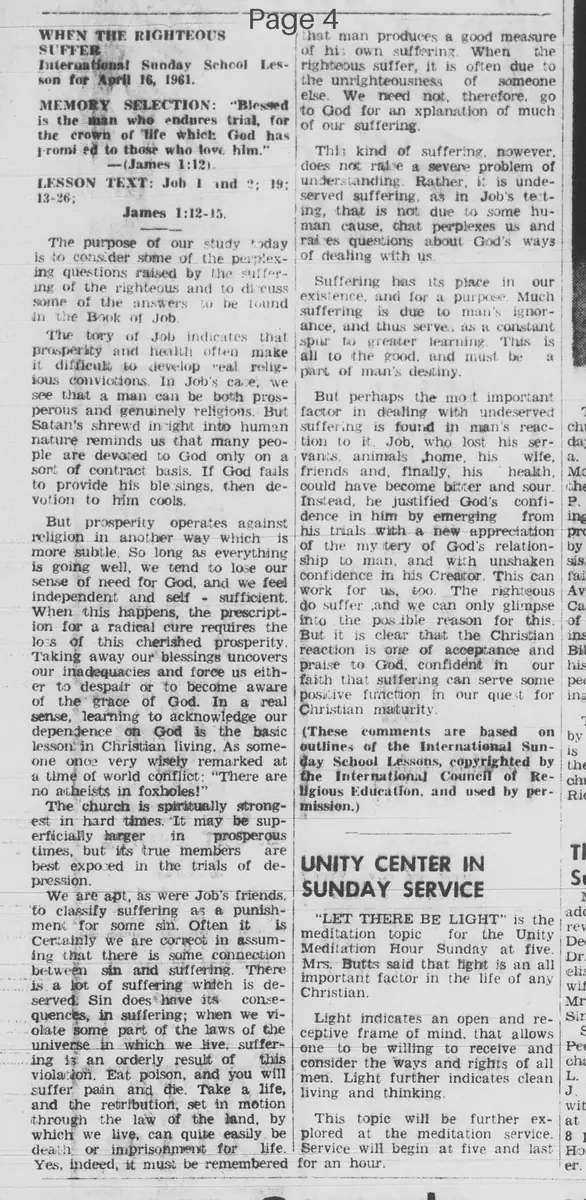
WHEN THE RIGHTEOUS SUFFER
International Sunday School Lesson for April 16, 1961.
MEMORY SELECTION: "Blessed is the man who endures trial, for the crown of life which God has promised to those who love him." —(James 1:12)
LESSON TEXT: Job 1 and 3; 19:13-26; James 1:12-15.
The purpose of our study today is to consider some of the perplexing questions raised by the suffering of the righteous and to discuss some of the answers to be found in the Book of Job.
The story of Job indicates that prosperity and health often make it difficult to develop real religious convictions. In Job's case, we see that a man can be both prosperous and genuinely religious. But Satan's shrewd insight into human nature reminds us that many people are devoted to God only on a sort of contract basis. If God fails to provide his blessings, then devotion to him cools.
But prosperity operates against religion in another way which is more subtle. So long as everything is going well, we tend to lose our sense of need for God, and we feel independent and self-sufficient. When this happens, the prescription for a radical cure requires the loss of this cherished prosperity. Taking away our blessings uncovers our inadequacies and forces us either to despair or to become aware of the grace of God. In a real sense, learning to acknowledge our dependence on God is the basic lesson in Christian living. As someone once very wisely remarked at a time of world conflict: "There are no atheists in foxholes!"
The church is spiritually strongest in hard times. It may be superficially larger in prosperous times, but its true members are best exposed in the trials of depression.
We are apt, as were Job's friends, to classify suffering as a punishment for some sin. Often it is. Certainly we are correct in assuming that there is some connection between sin and suffering. There is a lot of suffering which is deserved. Sin does have its consequences. In suffering; when we violate some part of the laws of the universe in which we live, suffering is an orderly result of this violation. Eat poison, and you will suffer pain and die. Take a life, and the retribution, set in motion through the law of the land, by which we live, can quite easily be death or imprisonment for life.
Yes, indeed, it must be remembered that man produces a good measure of his own suffering. When the righteous suffer, it is often due to the unrighteousness of someone else. We need not, therefore, go to God for an explanation of much of our suffering.
This kind of suffering, however, does not raise a severe problem of understanding. Rather, it is undeserved suffering, as in Job's testing, that is not due to some human cause, that perplexes us and raises questions about God's ways of dealing with us.
Suffering has its place in our existence, and for a purpose. Much suffering is due to man's ignorance, and thus serves, as a constant spur to greater learning. This is all to the good, and must be a part of man's destiny.
But perhaps the most important factor in dealing with undeserved suffering is found in man's reaction to it. Job, who lost his servants, animals, home, his wife, friends and, finally, his health, could have become bitter and sour. Instead, he justified God's confidence in him by emerging from his trials with a new appreciation of the mystery of God's relationship to man, and with unshaken confidence in his Creator. This can work for us, too. The righteous do suffer and we can only glimpse into the possible reason for this. But it is clear that the Christian reaction is one of acceptance and praise to God, confident in our faith that suffering can serve some positive function in our quest for Christian maturity.
(These comments are based on outlines of the International Sunday School Lessons, copyrighted by the International Council of Religious Education, and used by permission.)
International Sunday School Lesson for April 16, 1961.
MEMORY SELECTION: "Blessed is the man who endures trial, for the crown of life which God has promised to those who love him." —(James 1:12)
LESSON TEXT: Job 1 and 3; 19:13-26; James 1:12-15.
The purpose of our study today is to consider some of the perplexing questions raised by the suffering of the righteous and to discuss some of the answers to be found in the Book of Job.
The story of Job indicates that prosperity and health often make it difficult to develop real religious convictions. In Job's case, we see that a man can be both prosperous and genuinely religious. But Satan's shrewd insight into human nature reminds us that many people are devoted to God only on a sort of contract basis. If God fails to provide his blessings, then devotion to him cools.
But prosperity operates against religion in another way which is more subtle. So long as everything is going well, we tend to lose our sense of need for God, and we feel independent and self-sufficient. When this happens, the prescription for a radical cure requires the loss of this cherished prosperity. Taking away our blessings uncovers our inadequacies and forces us either to despair or to become aware of the grace of God. In a real sense, learning to acknowledge our dependence on God is the basic lesson in Christian living. As someone once very wisely remarked at a time of world conflict: "There are no atheists in foxholes!"
The church is spiritually strongest in hard times. It may be superficially larger in prosperous times, but its true members are best exposed in the trials of depression.
We are apt, as were Job's friends, to classify suffering as a punishment for some sin. Often it is. Certainly we are correct in assuming that there is some connection between sin and suffering. There is a lot of suffering which is deserved. Sin does have its consequences. In suffering; when we violate some part of the laws of the universe in which we live, suffering is an orderly result of this violation. Eat poison, and you will suffer pain and die. Take a life, and the retribution, set in motion through the law of the land, by which we live, can quite easily be death or imprisonment for life.
Yes, indeed, it must be remembered that man produces a good measure of his own suffering. When the righteous suffer, it is often due to the unrighteousness of someone else. We need not, therefore, go to God for an explanation of much of our suffering.
This kind of suffering, however, does not raise a severe problem of understanding. Rather, it is undeserved suffering, as in Job's testing, that is not due to some human cause, that perplexes us and raises questions about God's ways of dealing with us.
Suffering has its place in our existence, and for a purpose. Much suffering is due to man's ignorance, and thus serves, as a constant spur to greater learning. This is all to the good, and must be a part of man's destiny.
But perhaps the most important factor in dealing with undeserved suffering is found in man's reaction to it. Job, who lost his servants, animals, home, his wife, friends and, finally, his health, could have become bitter and sour. Instead, he justified God's confidence in him by emerging from his trials with a new appreciation of the mystery of God's relationship to man, and with unshaken confidence in his Creator. This can work for us, too. The righteous do suffer and we can only glimpse into the possible reason for this. But it is clear that the Christian reaction is one of acceptance and praise to God, confident in our faith that suffering can serve some positive function in our quest for Christian maturity.
(These comments are based on outlines of the International Sunday School Lessons, copyrighted by the International Council of Religious Education, and used by permission.)
What sub-type of article is it?
Biography
Historical Event
Tragedy
What themes does it cover?
Moral Virtue
Providence Divine
Misfortune
What keywords are associated?
Righteous Suffering
Book Of Job
Faith Trials
Divine Providence
Spiritual Growth
Undeserved Affliction
Christian Maturity
What entities or persons were involved?
Job
Satan
God
Story Details
Key Persons
Job
Satan
God
Story Details
Job, a prosperous and righteous man, endures severe trials including loss of possessions, family, and health, testing his faith; he emerges with deeper appreciation of God's mystery and unshaken confidence, illustrating that undeserved suffering can foster Christian maturity through acceptance.